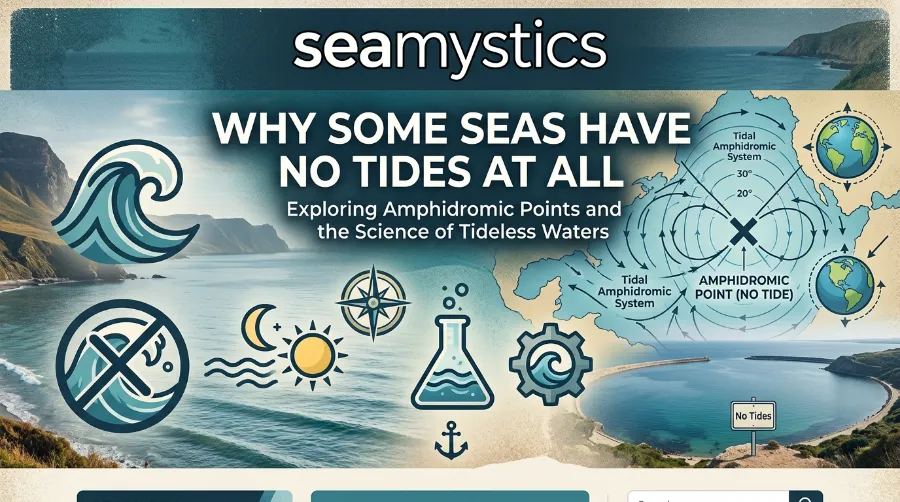

Stand on a beach in Split, Croatia, at sunrise, then come back at sunset. The water will look almost exactly the same. Now do the same thing on the coast of Nova Scotia, and you could watch the sea retreat by 16 metres. Both places sit on the same planet, pulled by the same moon. So why do some seas without tides stay eerily calm while others swing wildly twice a day?
How Icebergs Form and Why Most of Them Stay Hidden
The short answer is geography, not gravity. Tides are not a simple on-off switch controlled by the moon. They are a wave phenomenon, and waves need room, depth, and an open connection to the ocean to build up any real height. Take those things away, and you get a tideless sea.
Key Takeaways
| Question | Quick Answer |
|---|---|
| Why do some seas have no tides? | Small, enclosed basins cannot generate or receive large tidal waves; the wave has nowhere to build |
| What is an amphidromic point? | A location where the tidal range is close to zero because tidal waves rotate around it and cancel out |
| Which seas are nearly tideless? | Mediterranean, Baltic, Black, and Caspian Seas all have tidal ranges under 30 cm |
| Is the Mediterranean truly tideless? | No, it has small but measurable tides, typically 10 to 40 cm, making it a tideless sea explained by geography rather than a true zero-tide zone |
| What actually moves sea level there instead? | Wind, air pressure, and seiches, which can shift water levels far more than the tide itself |
TL;DR: Seas like the Mediterranean, Baltic, Black, and Caspian have almost no visible tides because they are small, largely enclosed basins cut off from the open ocean’s tidal energy. Instead of the moon, everyday water-level changes there come mostly from wind and air pressure, which is exactly why sailors call them low tide range seas.
What a Tide Actually Is, In Plain Terms
Before getting into why some seas stay calm, it helps to strip tides down to basics. A tide is a very long wave, generated mainly by the gravitational pull of the moon and, to a lesser extent, the sun. As the Earth rotates underneath these pulls, water bulges toward and away from the moon, and that bulge sweeps around the globe roughly every 12 hours and 25 minutes.
That sweep only becomes a dramatic rise and fall when it has thousands of kilometres of open ocean to travel through. The Atlantic, for instance, is wide and deep enough for the tidal wave to build real momentum, which is part of why the Bay of Fundy in Canada records tidal ranges up to 17 metres. According to the National Geographic Society’s ocean education resources, the world’s seas vary enormously in how connected they are to that open-ocean system, and that connection is the single biggest factor in how strong local tides feel.
Why the Dead Sea Isn’t Technically an Ocean The Dead Sea Science Behind the Myth
Why Some Seas Calm Down: The Geography Behind It
There are four main reasons certain seas barely register a tide.
- Small basin size. A tidal wave needs distance to amplify. Enclosed seas simply do not span enough water for the wave to grow.
- Narrow, shallow connections to the ocean. A strait acts like a bottleneck, letting only a trickle of tidal energy pass through in the time available.
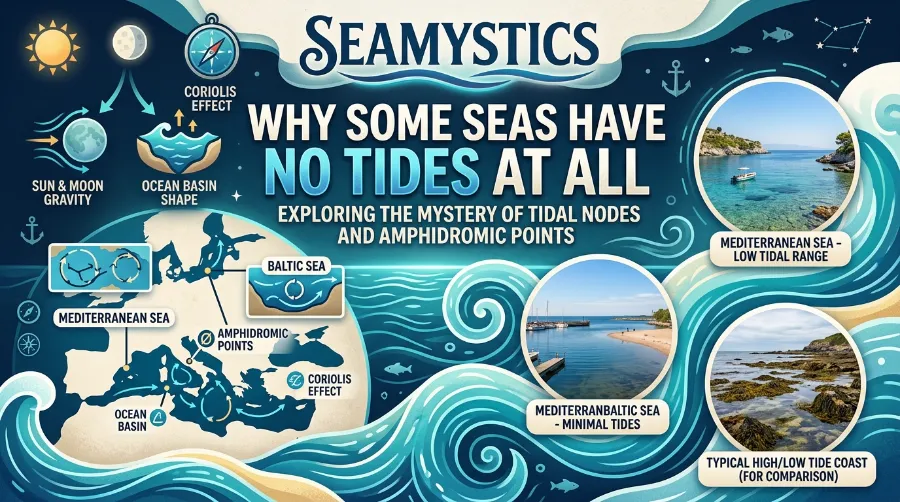
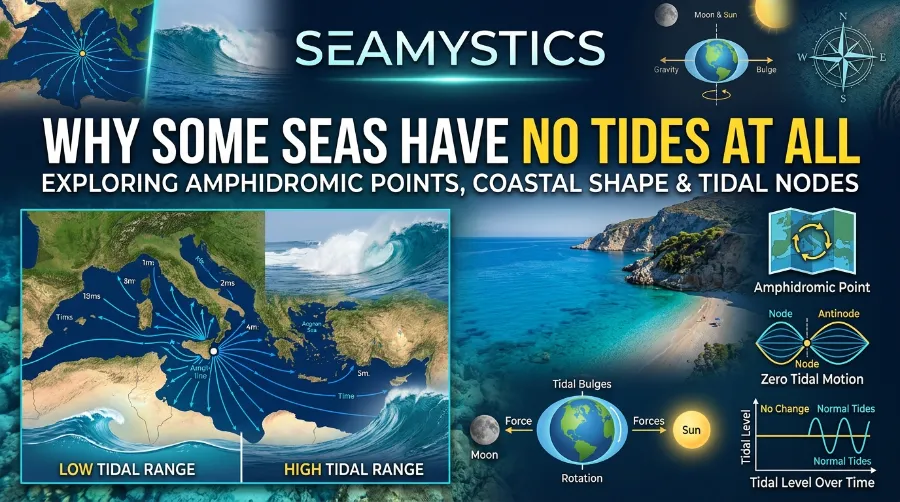
- Amphidromic points. These are natural “eyes” in a tidal system where the tide rotates around a fixed spot and the rise and fall cancels out to nearly zero. Oceanographers have mapped roughly 140 of them worldwide.
- Basin shape and depth. Irregular coastlines and shallow shelves scatter and dampen a tidal wave rather than letting it travel cleanly.
The Mediterranean is the textbook case. It connects to the Atlantic only through the narrow Strait of Gibraltar, and its own amphidromic points, several of which sit within the basin itself, further flatten what little tidal energy does get in. That is why coastal engineers and marine researchers describe it as a near-tideless sea explained almost entirely by plumbing rather than physics failing to apply.
Sea Spray Science How Ocean Droplets Shape Coastal Weather
Mediterranean Tide Facts You Can Actually Use
If you have ever sailed, moored a boat, or planned a coastal trip in southern Europe, these numbers matter more than they sound.
| Sea | Typical Tidal Range | Main Cause |
|---|---|---|
| Mediterranean Sea | 10 to 40 cm | Narrow Strait of Gibraltar, small basin, internal amphidromic points |
| Baltic Sea | 10 to 15 cm, up to 30 cm locally | Shallow, narrow Danish straits limiting North Sea inflow |
| Black Sea | Under 10 to 20 cm | Restricted exchange through the Turkish Straits |
| Caspian Sea | 5 to 21 cm | Fully landlocked, generates only its own weak, self-contained tides |
| Bay of Fundy, Canada, for comparison | Up to 17 m | Wide, funnel-shaped bay resonating with the tidal period |
Boating guides for the region back this up directly, noting that across most of the Mediterranean the difference between high and low tide sits around 10 to 40 centimetres, largely because the sea’s only real link to the Atlantic is that narrow gap at Gibraltar. Venice and parts of North Africa see slightly stronger tides due to local coastal shape, but even those remain modest next to Atlantic standards.
The Water Cycle and the Ocean How They’re Actually Connected
It is worth being precise here: none of these seas are perfectly tideless. A 2016 study published in Frontiers in Marine Science by Medvedev, Rabinovich, and Kulikov used over a century of tide gauge data and found maximum tidal heights over a 100 year period of about 23 cm in the Baltic, 18 cm in the Black Sea, and 21 cm in the southern Caspian. Real, measurable, but functionally invisible to anyone standing on the shore.
How Salinity Affects Marine Life Survival
The Caspian Sea: A Sea That Makes Its Own, Tiny Tides
The Caspian is the world’s largest fully enclosed body of water, with zero connection to any ocean. That means it cannot receive tidal energy from anywhere else. Instead, researchers using the Princeton Ocean Model found the Caspian generates weak, independent tides directly from the moon and sun’s pull on its own water mass, peaking at around 21 cm in the southeastern Turkmen Bay area and dropping to near zero across much of the shallow northern basin.
How Underwater Earthquakes Cause Tsunamis The Real Tsunami Formation Science
That distinction matters for anyone searching for low tide range seas for boating or research purposes. A landlocked sea like the Caspian behaves completely differently from a semi-enclosed one like the Mediterranean, even though both end up looking calm from the surface.
What Actually Moves the Water Instead
Here is the part most articles skip. In a nearly tideless sea, the moon is not the main driver of daily sea-level change, weather is.
- Wind pushing water toward or away from a coastline, known as wind setup, can raise or lower levels by well over a metre during a storm.
- Air pressure changes cause the sea surface to rise under low pressure systems and fall under high pressure, sometimes called the inverse barometer effect.
- Seiches, a kind of standing wave that sloshes back and forth in an enclosed basin like water in a bathtub, can temporarily raise harbour levels by 20 to 30 cm or more after a storm passes.
Coastal guides for Baltic sailors note this directly: on the Baltic, it is not the moon but the wind that decides the water level, with onshore gales able to shift the surface by more than a metre, dwarfing the actual tidal signal underneath.
A Real Example: The Tasman Sea’s Hidden Giant
Interestingly, near-tideless surface conditions do not mean the ocean underneath is quiet. Scientists have found some of the largest tidal waves on the planet hiding well below the surface, not on the shore. In 2015, a research team led by Amy Waterhouse of Scripps Institution of Oceanography and Samuel Kelly of the University of Minnesota Duluth spent nearly a month aboard the research vessel Falkor, studying what is described as the largest, most focused internal tide on the planet, one that moves across the Tasman Sea every single day.
These internal tides form deep underwater, are invisible from a boat deck, and can tower hundreds of metres tall as they roll silently between temperature layers, entirely different from the surface tides most people picture. It is a useful reminder that “no tide” at the surface does not always mean “no tidal activity” at all.
What Determines Ocean Water Temperature by Region
Frequently Asked Questions
Is the Mediterranean Sea completely tideless?
No. It has small but real tides, generally between 10 and 40 centimetres, which is why it is often loosely called a tideless sea even though the effect is simply too subtle to notice without instruments.
Why does the Caribbean sometimes get described as having no tides?
Parts of the Caribbean do see very modest tidal ranges due to their semi-enclosed geography and position relative to major ocean currents, though the effect and its causes differ from the fully landlocked Caspian or the narrow-strait Mediterranean.
Do sailors need tide tables in the Mediterranean?
Generally not for casual coastal cruising, since the tide is rarely large enough to affect mooring or navigation, though storm surges and seiches are still worth watching.
Are there any places within a tideless sea that still get noticeable tides?
Yes. Venice, parts of the Adriatic, and pockets of North Africa see slightly higher ranges than the rest of the Mediterranean due to local coastal shape and resonance.
What is the calmest sea in the world by tidal range?
The Caspian Sea’s northern basin records some of the lowest tidal ranges anywhere, often just a few centimetres, because it is shallow, landlocked, and generates only weak, self-contained tides.
What Causes Ocean Currents to Reverse Seasonally
Conclusion
Seas without tides are not a break in the laws of physics, they are a lesson in how much geography shapes what gravity can actually do. A narrow strait, a shallow shelf, or a well-placed amphidromic point can flatten the moon’s pull into something you would need a tide gauge to detect. Understanding this is more than trivia for anyone planning a Mediterranean sailing trip, studying coastal ecosystems, or just curious why the sea outside their window never seems to move much. If you want to go deeper into how ocean water actually circulates on a planetary scale, our ocean water cycle guide is the natural next stop, and you can always browse more marine science breakdowns over on Sea Mystics.
References
- Medvedev, I. P., Rabinovich, A. B., and Kulikov, E. A. (2016). Tides in Three Enclosed Basins: The Baltic, Black, and Caspian Seas. Frontiers in Marine Science.
- Schmidt Ocean Institute. Tracking the Tasman Sea’s Hidden Tide, T-Beam Expedition, 2015.
- National Geographic Education. World’s Seas resource collection.
- AVISO+ / CLS-Legos. Tides Around the World.
- Open University OpenLearn. Engineering: Environmental Fluids, Tides and Tidal Currents.