
Stand on the shore at Ein Bokek and the water looks like any other sea. It stretches to the horizon, it laps at your ankles, and it carries the same salty sting in your eyes. Yet nothing about the Dead Sea behaves like an ocean, and understanding why is where real Dead Sea science begins. This single fact, that a body of water can look like a sea and act nothing like one, is the hook that pulls travelers, students, and curious readers into one of the strangest corners of marine geography.
What Determines Ocean Water Temperature by Region
I have spent two decades studying how bodies of water are classified, and the Dead Sea remains one of the most misunderstood examples I teach. People assume “sea” in the name means it belongs to the same family as the Atlantic or the Mediterranean. It does not. Consequently, this article walks through the actual science, compares it with real ocean behavior, and shows how ocean temperature by latitude shapes water everywhere else on Earth except here.
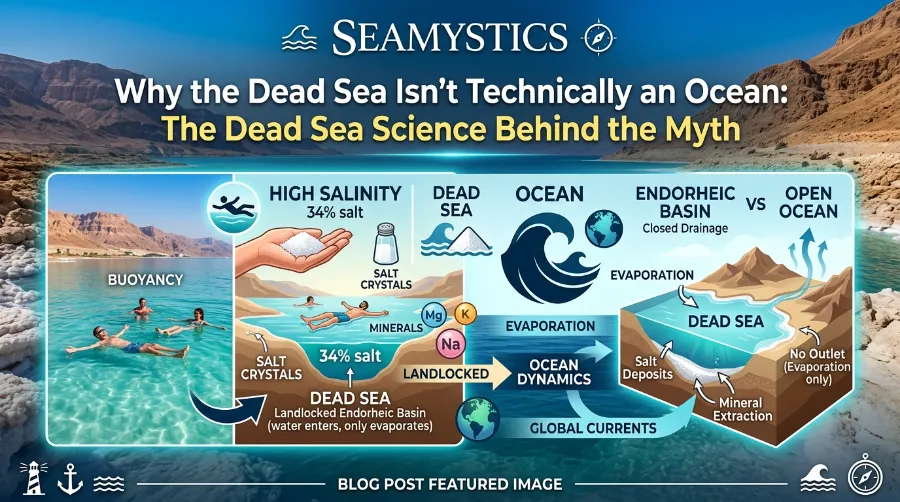
TL;DR: The Dead Sea isn’t an ocean because it has no outlet to the sea, it sits in a closed inland basin, and its water chemistry is dominated by magnesium chloride rather than the sodium chloride found in ocean water. Its salinity of roughly 34 percent, about ten times saltier than average seawater, also breaks the normal rules that govern sea surface temperature and marine life. Geographically and hydrologically, it functions as a terminal salt lake, not a sea.
Key Takeaways
| Fact | Dead Sea | Typical Ocean |
|---|---|---|
| Classification | Terminal (endorheic) salt lake | Connected ocean basin |
| Average salinity | About 34 percent | About 3.5 percent |
| Outlet to global ocean | None | Yes |
| Dominant salt | Magnesium chloride | Sodium chloride |
| Elevation | About 430 meters below sea level | At sea level |
| Marine fish and coral | Absent | Present |
| Surface temperature range | Roughly 19°C to 33°C seasonally | -2°C to 30°C, varies by latitude |
What Actually Makes a Body of Water an “Ocean”
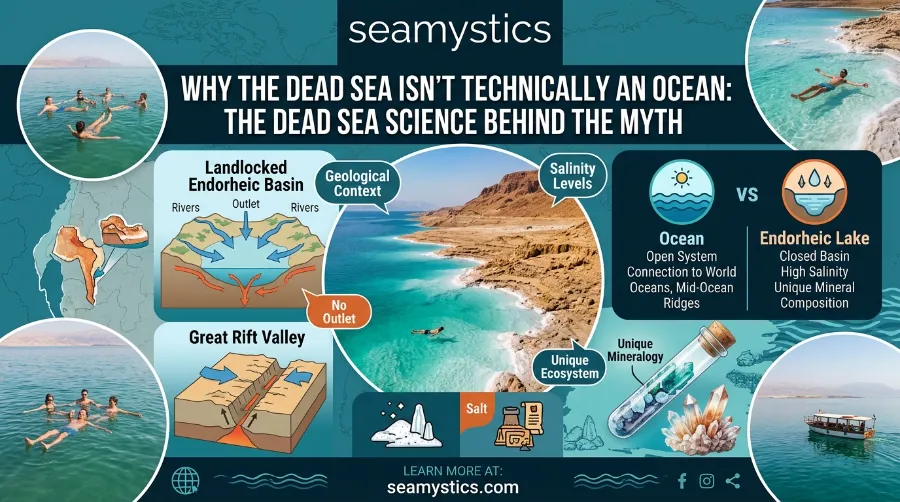
Geographers and oceanographers use a fairly simple test. A true ocean, or a sea that belongs to it, is connected to the global ocean system and exchanges water with it over time. The Dead Sea fails that test completely. It sits in the Jordan Rift Valley, fed almost entirely by the Jordan River, with no river or channel carrying its water back out. Everything that flows in stays in, and only evaporation removes it, which is exactly why the minerals keep concentrating year after year.
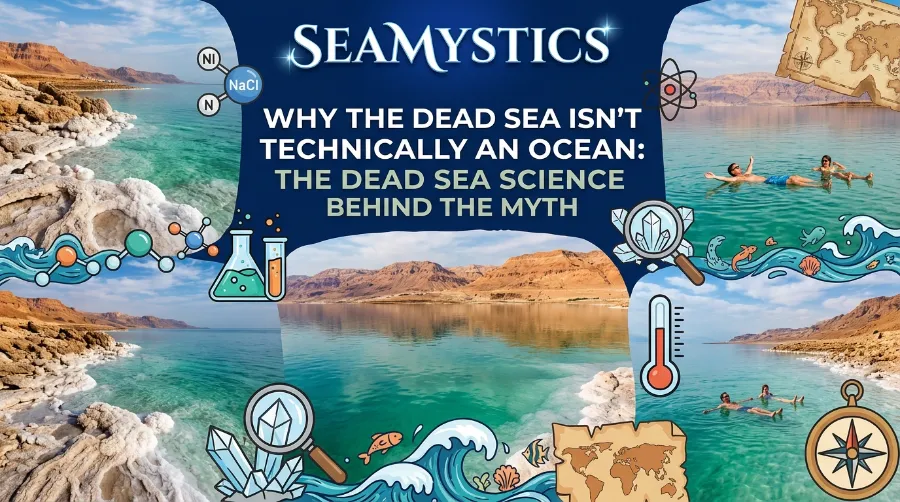
Why the Dead Sea Isn’t Technically an Ocean The Dead Sea Science Behind the Myth
This is why hydrologists classify it as an endorheic, or terminal, lake rather than a sea in the scientific sense. NASA’s Earth observation imagery of the basin shows the shrinking shoreline clearly, a visible record of a closed system losing more water than it receives. The name “sea” survived from ancient trade and biblical texts, long before anyone had a formal classification system, and it simply stuck.
The Salt Chemistry Nobody Expects
Ordinary seawater is dominated by sodium chloride, plain table salt, at around 3.5 percent concentration. The Dead Sea runs closer to 34 percent, and the mineral mix is unusual too. Research summarized by Birthright Israel’s science team notes that magnesium chloride, not sodium chloride, makes up the majority of dissolved salts here, alongside high concentrations of calcium and potassium. That chemistry is precisely why so few organisms can tolerate it, and why the water feels oily rather than simply salty on the skin.
A short list makes the contrast easier to hold onto:
- Ocean water: roughly 3.5 percent salinity, sodium chloride dominant, supports fish, coral, and complex food webs.
- Dead Sea water: roughly 34 percent salinity, magnesium chloride dominant, supports only microbes and extremophile algae.
- Great Salt Lake, Utah: a comparable terminal lake, salinity that varies from about 5 percent to over 27 percent depending on water levels.
- Caspian Sea: the world’s largest inland body of water, technically a lake despite its name, much closer to true seawater chemistry than the Dead Sea.
Ocean Temperature by Latitude: Why the Dead Sea Doesn’t Follow the Rules
If you want to understand why the Dead Sea reads as an anomaly, it helps to know how a real ocean actually behaves first. Sea surface temperature facts generally come down to one variable more than any other: latitude. NOAA Ocean Exploration explains that surface waters near the equator receive direct sunlight year-round and can reach about 30°C, while polar water sits close to -2°C because seawater’s salt content lowers its freezing point below that of fresh water.
That pattern holds with remarkable consistency across the world’s connected oceans:
- Equatorial belt (0 to 10 degrees latitude): surface temperatures average around 27°C to 29°C, with very little seasonal swing.
- Mid-latitudes (30 to 50 degrees): surface temperatures swing more dramatically, often 8°C or more between summer and winter.
- Polar regions (above 60 degrees): temperatures hover near freezing year-round, rarely climbing more than 2°C in either direction.
This is the warmest coldest ocean contrast in a nutshell. The warmest surface water on the planet tends to sit a few degrees north of the equator, in parts of the western Pacific, where readings above 30°C are common, according to sea surface temperature mapping from NASA’s MODIS satellite instrument. The coldest surface water sits in the Arctic and around Antarctica, where ice cover keeps temperatures pinned near the freezing point of saltwater for most of the year.
Ocean Temperature Factors That Don’t Apply to the Dead Sea
A connected ocean is shaped by currents, wind-driven upwelling, seasonal mixing, and depth. None of
those forces operate the same way in a closed basin like the Dead Sea. There is no Gulf Stream equivalent moving heat through it, no upwelling bringing cold water to the surface, and no connection to a deep, cold global reservoir. Instead, its temperature is driven almost entirely by local desert climate, which is why Dead Sea surface water can swing from around 19°C in winter to over 33°C in peak summer, a wider seasonal range than most open ocean water at a similar latitude.
Sea Spray Science How Ocean Droplets Shape Coastal Weather
Desert heat above the basin, which regularly tops 40°C in summer, warms the shallow, dense brine quickly because there is so little water volume exchange to buffer it. In an open ocean, deep cold water constantly tempers the surface layer. In the Dead Sea, that deep reservoir simply does not exist in the same way, so the whole system reacts faster to air temperature than a true sea would.
Real Numbers: How Fast the Dead Sea Is Actually Changing
Numbers make this story concrete rather than abstract. The shoreline has dropped by roughly one meter per year for decades, a rate largely driven by upstream diversion of the Jordan River for agriculture and drinking water, according to field research described by geological researchers at Ben-Gurion University who used diver-based survey systems to measure underwater freshwater springs feeding the basin. Between 1930 and today, the surface elevation has fallen from around 390 meters below sea level to roughly 430 meters below sea level, making the shoreline the lowest point of dry land on the planet and pushing it lower every year.
How Salinity Affects Marine Life Survival
That shrinking has a side effect most visitors never expect. As groundwater beneath the retreating shoreline dissolves old salt deposits, the ground above collapses into sinkholes, and thousands have opened along the western shore since the 1980s. It is a striking, physical demonstration of what happens when a closed hydrological system loses its water balance, something that essentially cannot happen the same way in an open ocean basin.
Frequently Asked Questions
Is the Dead Sea actually dead, with zero life in it? No. While fish, coral, and typical marine life cannot survive its salinity, halophilic archaea and the green alga Dunaliella thrive there, along with dozens of catalogued fungal species in the sediment and shoreline.
Why does the Dead Sea make you float so easily? Density, not magic. Dead Sea brine measures around 1.24 grams per milliliter, well above the human body’s average density of roughly 1.01 grams per milliliter, so the body displaces far less water to reach equilibrium and sits much higher on the surface than it would in ordinary seawater.
Is the Dead Sea connected to the Mediterranean or Red Sea? Not currently. Proposed canal projects linking it to the Red Sea have been discussed for decades to slow its decline, but as of today no such connection exists, and the basin remains fully landlocked.
How does Dead Sea water temperature compare with the nearest real sea? The Mediterranean, a genuine sea connected to the global ocean, averages closer to 18°C to 22°C depending on season. The Dead Sea runs warmer and swings more widely because it lacks the ocean’s deep-water buffering effect.
Why This Distinction Matters Beyond Trivia
Getting the classification right isn’t pedantic, it actually changes how scientists study the basin. Because the Dead Sea behaves as a closed hydrological system rather than an open marine one, researchers monitoring its water balance use lake hydrology models, not oceanographic circulation models. That distinction also shapes conservation policy, since fixing a shrinking lake requires managing river inflow and groundwater extraction, an entirely different toolkit than managing an ocean threatened by currents, warming, or acidification.
For readers who want to go further into how the wider ocean system actually moves water and heat around the planet, our guide to the ocean water cycle is the natural next stop, since it explains the circulation the Dead Sea is cut off from entirely. If tidal behavior is what fascinates you, the piece on seas without tides covers another category of water body that breaks the “typical sea” mold, for different reasons than the Dead Sea does.
Readers curious about how temperature differences drive larger ocean processes may also enjoy our coverage of seasonal current reversal, which shows how the connected ocean redistributes heat in ways a closed lake never can. And if extreme water chemistry is the part that grabbed you, our explainer on iceberg formation science looks at the opposite end of the spectrum, where cold and fresh water, not heat and salt, define the extremes.
References
- NASA Earth Observatory, Dead Sea photojournal imagery, science.nasa.gov
- Birthright Israel, “What’s the Science Behind the Dead Sea,” blog.birthrightisrael.com
- NOAA Ocean Exploration, “How does the temperature of ocean water vary?” oceanexplorer.noaa.gov
- NASA Earth Observatory, Sea Surface Temperature global maps, earthobservatory.nasa.gov
- NBC News / OurAmazingPlanet, Ben-Gurion University diver research on Dead Sea springs
- DeadSea.com, “Dead Sea vs Ocean: Differences in Salt, Density and Life”
Conclusion
The Dead Sea earns its name from history, not hydrology. It looks like a sea, it floats you like nothing else on Earth, and it carries thousands of years of story in its shrinking shoreline, but by every scientific measure that matters, salinity, chemistry, connection to the global ocean, and even how its temperature responds to the seasons, it behaves as a landlocked lake. That gap between the name and the science is exactly what makes it worth understanding properly, whether you are planning a visit, studying marine geography, or just settled a dinner-table argument once and for all.