
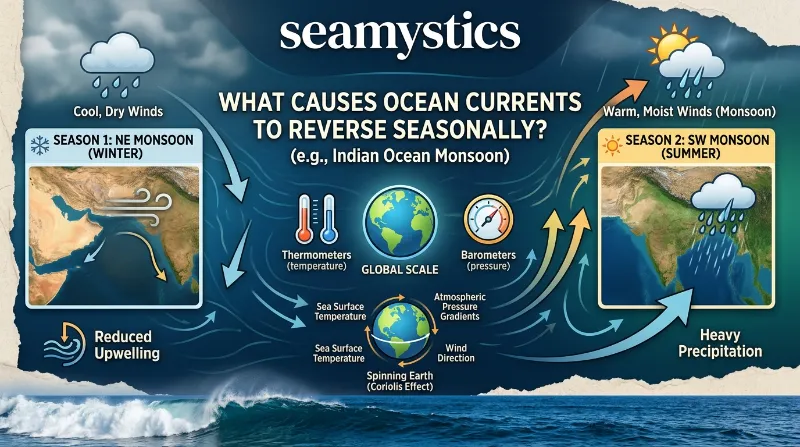

Stand on a beach in Mumbai in July and the water pulls one way. Stand there again in December and it pulls the other. This is not a trick of the tide. It is a seasonal current reversal, one of the ocean’s strangest and most predictable habits, and once you understand why it happens, you start noticing its fingerprints everywhere, from where fish gather to where cargo ships plot their routes.
Key Takeaways
| Question | Short Answer |
|---|---|
| What is a seasonal current reversal? | A current that flips direction on a yearly cycle, usually tied to shifting wind patterns |
| Main cause | Monsoon winds reversing between summer and winter, combined with the Coriolis effect |
| Best known example | The Somali Current, off East Africa, which flips direction twice a year |
| Where it happens most | The Indian Ocean and Arabian Sea, though smaller reversals occur elsewhere |
| Why it matters | Affects fisheries, shipping routes, coral health, and regional weather |
TL;DR: Seasonal current reversal happens when large scale wind systems, mainly monsoon winds, switch direction with the seasons and drag surface water along with them. Add in the Coriolis effect and shifting pressure zones, and currents that flow one way for six months flow the opposite way for the next six. The Indian Ocean’s Somali Current is the textbook case, but the pattern shows up, in smaller forms, in several other coastal regions too.
What Is a Seasonal Ocean Current, Anyway?
Most people picture ocean currents as permanent rivers within the sea, and many are. The Gulf Stream, for instance, flows northeast pretty much all year. But seasonal ocean currents behave differently. They respond to changes that happen predictably every year, mainly wind and temperature, so their speed, and sometimes their entire direction, shifts with the calendar.
What Causes Ocean Currents to Reverse Seasonally
This is different from tidal currents, which change direction twice a day because of the moon and sun. A seasonal reversal takes months to build and months to unwind, driven by much larger atmospheric forces.
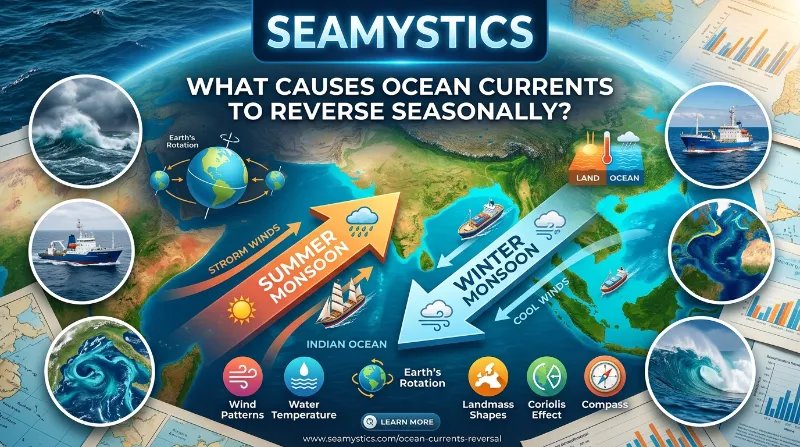
The Monsoon Current Reversal: Nature’s Biggest U-Turn
If there is one system that explains monsoon current reversal better than any textbook diagram, it is the Arabian Sea and the water just off the Horn of Africa.
How Salinity Affects Marine Life Survival
The Somali Current
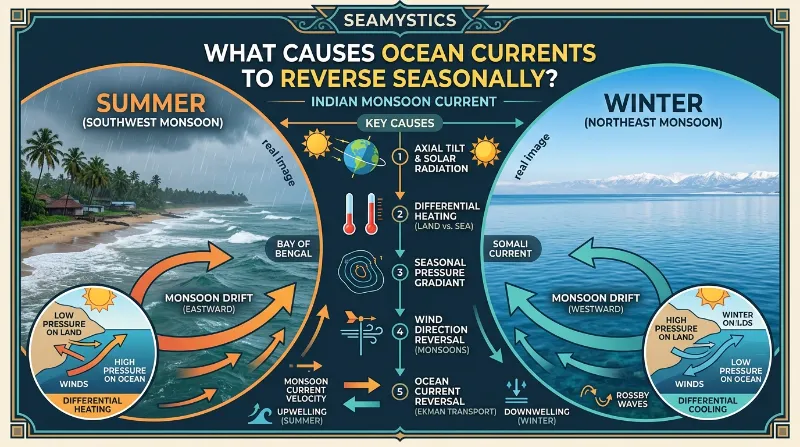
Between roughly June and September, the southwest monsoon blows hard across the Arabian Sea. That wind drags surface water northeast along the Somali coast, and the current can move faster than most rivers on land, among the fastest ocean currents recorded anywhere. Then, once the northeast monsoon takes over from around November to February, the wind reverses, and so does the current, now flowing southwest.
Researchers at institutions like the National Institute of Oceanography in India have tracked this flip for decades, and it remains one of the clearest real-world demonstrations of how wind, not just temperature, steers ocean water.
How Underwater Earthquakes Cause Tsunamis The Real Tsunami Formation Science
The Indian Monsoon Current
A similar story plays out further east and south, across the Bay of Bengal and the wider Indian Ocean. During the summer monsoon, surface currents generally push eastward; during the winter monsoon, they swing westward. Fishing communities along India’s coastline have built their seasonal calendars around this shift for generations, long before satellites confirmed what their nets already told them.
What Really Drives Current Direction Change
So what is actually happening under the surface when a current direction change occurs on this scale? Three forces work together.
Shifting Wind Belts
Wind is the primary engine. As the sun’s heating shifts between hemispheres through the year, entire wind belts migrate, and over the Indian Ocean this migration is dramatic enough to flip which direction the trade winds blow. Since surface currents are largely wind-driven, when the wind flips, the water eventually follows.
The Coriolis Effect
Because the Earth rotates, moving water gets deflected, to the right in the Northern Hemisphere and to the left in the Southern Hemisphere. This effect does not cause the reversal by itself, but it shapes exactly how the current curves and where it piles up water, which then influences coastal sea levels and upwelling patterns.
Why the Dead Sea Isn’t Technically an Ocean The Dead Sea Science Behind the Myth
Pressure and Temperature Gradients
Warmer water expands and sits slightly higher than colder water nearby, which creates pressure differences that push currents along. As seasonal heating shifts, so does this pressure gradient, reinforcing the wind-driven changes rather than working against them.
Seasonal Ocean Currents Around the World
| Region | Current | Reversal Pattern |
|---|---|---|
| Arabian Sea / Somalia | Somali Current | Northeast in summer monsoon, southwest in winter monsoon |
| Bay of Bengal | Indian Monsoon Current | Eastward flow in summer, westward in winter |
| South China Sea | South China Sea Current | Southwestward in winter, weaker and variable in summer |
| Northern Indian Ocean | Coastal currents off Sri Lanka | Follow monsoon wind shifts closely |
Why This Matters: Fisheries, Shipping, and Climate
A seasonal current reversal is not just an oceanography curiosity. It reshapes entire coastal economies.
- Fish populations, especially sardines and mackerel along India’s west coast, cluster around upwelling zones that only appear when the current runs in a particular direction, so fishing fleets time their season around it.
- Shipping routes across the Arabian Sea have historically been planned around the monsoon current, going back to Arab and Indian traders centuries before modern navigation existed.
- Coral reefs and mangroves depend on the nutrient mixing these currents bring, and disruptions to the usual pattern, sometimes linked to broader shifts in the Indian Ocean, can stress reef systems already dealing with warming water.
You can see real-time examples of how forecasters track these shifting patterns through resources like the NOAA Ocean Prediction Center’s current forecasts, which model surface current behavior daily.
A Marine Biologist’s Field Notes
Spend enough time on research vessels in monsoon-affected waters and you learn to respect how fast these reversals actually happen. Crews adjust net depths, sampling schedules, and even travel plans around the wind, because a current that was pushing you northeast in August can be pushing the opposite way by November. It is one of those things that reads as a tidy diagram in a paper but feels a lot more chaotic from the deck of a boat.
What Determines Ocean Water Temperature by Region
Peer-reviewed research backs up what fieldwork suggests. A study published in the Journal of Geophysical Research: Oceans examined how wind stress variability drives current behavior in the Indian Ocean in detail, and it remains a useful reference for anyone wanting the harder numbers behind the pattern, available through AGU’s journal archive. More recent work published in Scientific Reports has also examined how warming trends may be nudging the timing and strength of these seasonal shifts, a topic worth watching closely over the next decade, detailed in this Nature-published study.
Sea Spray Science How Ocean Droplets Shape Coastal Weather
If you want the bigger picture of how currents fit into ocean movement generally, our guide on the ocean water cycle walks through how evaporation, precipitation, and circulation connect. And if reversing currents feel strange, wait until you read about the seas without tides, which break an entirely different rule of ocean behavior.
How Seasonal Reversal Differs From Other Ocean Changes
It helps to separate seasonal reversal from other current-related phenomena people often mix it up with.
- Tidal currents change direction roughly every six hours, driven by the moon and sun, not the seasons.
- El Nino and La Nina shift currents across years, not months, and are driven by Pacific Ocean temperature anomalies rather than monsoon winds.
- Seasonal current reversal sits in between, cycling once or twice per year, tied closely to predictable wind belt migration.
Understanding which category a current change falls into matters for anyone working in fisheries, shipping, or climate research, since the causes and the forecasting methods differ for each.
Frequently Asked Questions
What causes ocean currents to reverse seasonally? Mainly the reversal of large-scale wind systems, particularly monsoon winds, combined with the Coriolis effect and seasonal temperature gradients that reinforce the wind-driven push.
Where does this happen most dramatically? The Arabian Sea and the Somali coast show the clearest, best-studied example, though similar smaller-scale patterns appear across the Indian Ocean and parts of the South China Sea.
Does climate change affect seasonal current reversal? Emerging research suggests warming ocean temperatures may be altering the timing and intensity of these reversals, though long-term monitoring is still ongoing.
Is seasonal current reversal the same as a tidal current? No. Tidal currents shift every few hours due to the moon and sun. Seasonal reversal happens once or twice a year due to shifting wind patterns.
Conclusion
Seasonal current reversal is a reminder that the ocean runs on rhythms just as reliable as the seasons on land, even if most of us never see them. Wind belts shift, the Coriolis effect bends the resulting flow, and temperature gradients add momentum, and together they turn currents like the Somali Current into one of nature’s most punctual U-turns. Whether you are a fisherman reading the water, a shipping planner charting a route, or just someone curious about what is happening beneath the waves, understanding these patterns turns the ocean from a flat blue backdrop into a living, breathing, seasonal machine. For more on how ocean systems connect to one another, our piece on iceberg formation science shows a very different but equally fascinating side of how temperature and current shape the sea.
References
- NOAA Ocean Prediction Center, Current Forecasts, https://ocean.weather.gov/Current_fcasts.php
- Journal of Geophysical Research: Oceans, AGU Publications, https://agupubs.onlinelibrary.wiley.com/doi/abs/10.1029/2018JC013975
- Scientific Reports, Nature Publishing, https://www.nature.com/articles/s41598-023-40979-9
- Sea Mystics, Ocean Water Cycle Guide, https://seamystics.com/ocean-water-cycle/
- Sea Mystics, Seas Without Tides, https://seamystics.com/seas-without-tides/
- Sea Mystics, Iceberg Formation Science, https://seamystics.com/iceberg-formation-science/