
Stand on any beach when the wind picks up. You will feel it on your lips before you see it: that faint, salty sting in the air. That sensation is not just weather. It is sea spray science in action, and it is one of the most underrated forces shaping the climate along every coastline in the United States and Europe. A simple salty mist hides a chain of physics, chemistry, and biology. Scientists are still working to fully map that chain, and it influences everything from the clouds over Cornwall to the fog banks off San Francisco.
How Salinity Affects Marine Life Survival
This article breaks down what actually happens when a wave breaks. It explains why sea spray formation depends so heavily on water temperature, and how all of it feeds back into the coastal weather people experience every single day. Along the way, we will look at real studies, real numbers, and real coastlines, not vague generalities.
TL;DR
Sea spray forms when breaking waves trap air bubbles. Those bubbles later burst at the surface and fling tiny droplets of salt, organic matter, and microbes into the air. Scientists call these droplets sea spray aerosol. They seed clouds, influence rainfall, and even affect how much heat coastal regions retain. Recent research shows shoreline wave breaking can triple the number of these particles compared to the open ocean. That means local surf conditions shape coastal weather more than scientists once assumed.
Key Takeaways
| Topic | What the Research Shows |
|---|---|
| Formation | Breaking waves and bursting bubbles mainly produce sea spray, a process called whitecap production |
| Ocean coverage | Oceans cover roughly 71 percent of Earth’s surface, giving sea spray an enormous reach |
| Temperature link | Sea spray aerosol production efficiency dips to its lowest point around 6 to 10 degrees Celsius, then rises again in colder and warmer water |
| Shoreline effect | Shoreline wave breaking can increase coastal sea spray aerosol and cloud condensation nuclei by more than three times compared to open ocean levels |
| Daily rhythm | Sea spray aerosol concentrations rise after sunrise and fall after sunset, a pattern confirmed across more than 42,000 kilometers of ocean |
| Carbon transfer | Sea spray moves an estimated 23 to 56 teragrams of dissolved organic carbon into the atmosphere every year |
What Sea Spray Actually Is, and Why It Is Not Just Salt
Most people assume sea spray is simply saltwater kicked up by wind. In reality, it is far more layered than that. Wind blowing across the ocean surface transfers energy into the water and generates waves. Once those waves grow steep enough, they break and trap pockets of air underwater.
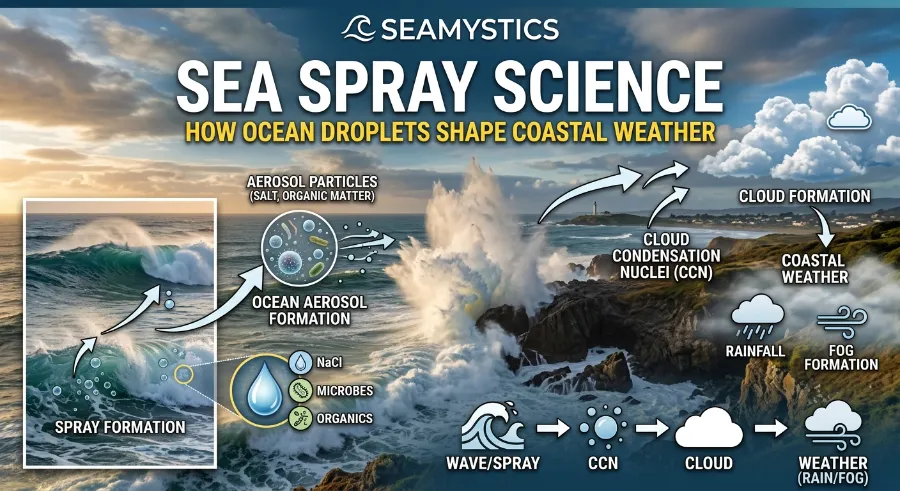
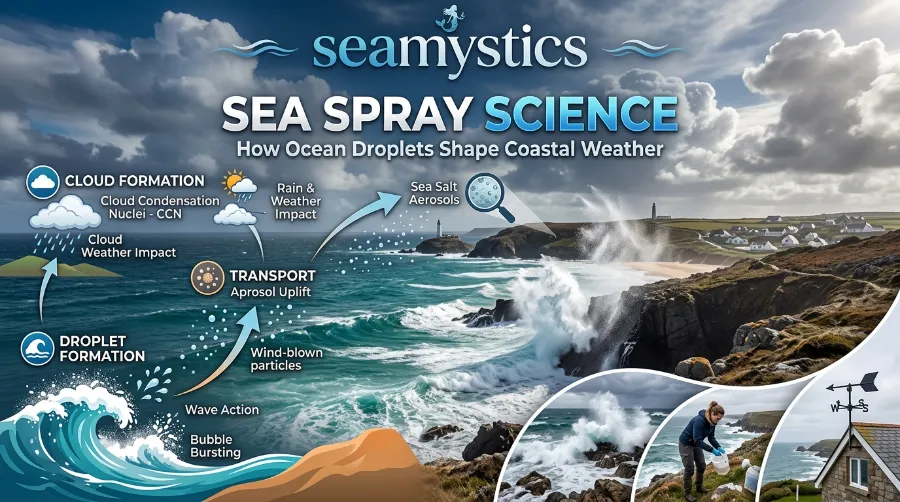
Those trapped air pockets rise back to the surface as bubbles. When a bubble bursts, it launches two kinds of droplets into the air: fine “film drops” from the thin bubble skin, and slightly larger “jet drops” that shoot upward from the bubble’s collapsing cavity. Atmospheric chemist Kimberly Prather led a team at Scripps Institution of Oceanography that showed these two droplet types carry genuinely different chemical signatures depending on how they formed. This was the first clear evidence that the physical mechanism behind sea spray formation directly shapes its chemistry. This is not a side detail. It means every whitecap you see is quietly manufacturing a mix of sea salt, fatty acids, proteins, sugars, bacteria, and even viruses, all pulled from the sea surface microlayer, the ocean’s topmost skin.
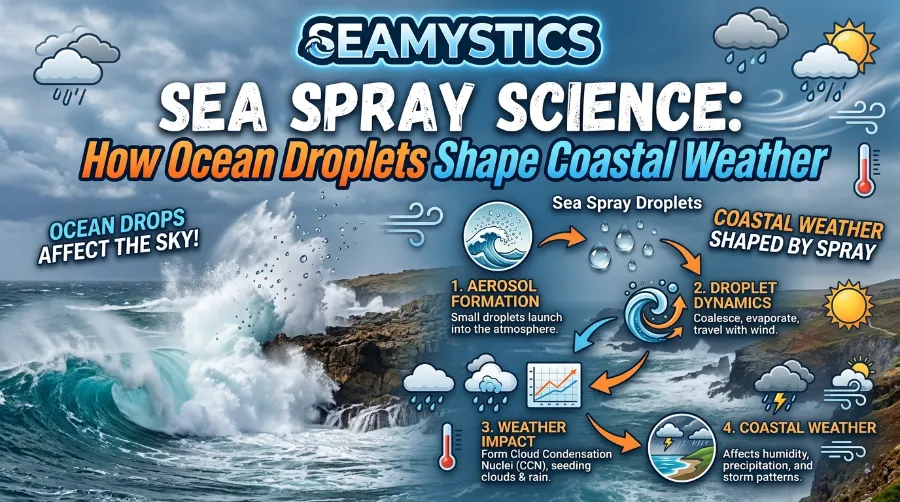
That cocktail of material is what scientists call sea spray aerosol, and it does not just sit on the water. Wind lofts it into the lower atmosphere, sometimes carrying it well into the upper troposphere, where it plays a direct role in cloud formation and regional weather.
The Two-Step Journey From Wave to Weather
- Bubble entrainment. Breaking waves and whitecaps trap air underwater, creating a dense field of rising bubbles.
- Bubble bursting and droplet release. As bubbles reach the surface and pop, they release fine aerosol particles carrying salts, organics, and microbes into the marine boundary layer. Wind and turbulence then carry these particles further inland or upward into developing clouds.
If you want the fuller picture of how this fits into the planet’s larger water cycle, our guide on the ocean water cycle walks through how evaporation, precipitation, and aerosol transport all connect.
Sea Spray Aerosol and the Chemistry of a Breaking Wave
Sea spray aerosol is not a fixed recipe. Its composition shifts constantly depending on what is happening biologically at the sea surface. During a phytoplankton bloom, for instance, researchers have measured dissolved organic carbon enrichment in sea spray aerosol increasing by 10 to 30 times compared to normal conditions. The bloom leaves behind a film of organic material, and every bursting bubble sweeps some of it up.
This matters for coastal weather because organic-rich aerosol behaves differently in the atmosphere than plain sea salt. It changes how easily water vapor condenses around each particle, which in turn changes how clouds form and how much sunlight gets scattered or absorbed. A 2025 review published in Elementa: Science of the Anthropocene found that surface-active compounds concentrated in the sea surface microlayer play a major role in determining how many sea spray particles form in the first place. Researchers still do not fully understand which biological or chemical triggers control that process, though.
For readers curious about a related surface phenomenon, our piece on sea foam science explains why some of that same organic-rich water turns into visible foam along the shoreline rather than lifting into the air.
Why Sea Spray Behaves Like a Tiny Chemistry Lab
- Salts dominate the larger, heavier particles that fall out of the air quickly, usually within a few hundred meters of the coast.
- Organic compounds and microbes concentrate more heavily in the smallest particles, which can travel much farther and stay airborne much longer.
- Exposure to ozone and ultraviolet light gradually ages sea salt particles chemically, and this reduces how easily they absorb moisture, according to research published in Scientific Reports. That, in turn, affects their ability to seed clouds days after formation.
How Ocean Temperature Drives Sea Spray Formation
This is where sea spray science gets genuinely surprising. You might expect warmer water to simply produce more spray, but laboratory research tells a more complicated story. A study published in Environmental Science and Technology used a plunging jet apparatus to isolate the effect of seawater temperature on sea spray formation. It found that production efficiency does not rise or fall in a straight line. Instead, it dips to a low point somewhere between 6 and 10 degrees Celsius before climbing again in both colder and warmer water.
A separate 2024 study in npj Climate and Atmospheric Science, part of Nature’s family of journals, added more detail. The researchers found that sea spray particles trend smaller as sea surface temperature drops, shifting into what scientists call the Aitken size mode. Smaller, more numerous particles are especially effective at forming cloud condensation nuclei in cold water. Because of this, the study predicted that a one-degree drop toward 0 degrees Celsius could meaningfully increase the contribution of cold-water sea spray to cloud seeding, compared to the same process in 30-degree tropical water.
Table: Sea Surface Temperature and Sea Spray Behavior
| Water Temperature Range | What Happens to Sea Spray Aerosol |
|---|---|
| Near 0°C (polar and sub-polar waters) | Smaller particles, higher contribution to cloud condensation nuclei in the Aitken size range |
| 6°C to 10°C | Lowest measured production efficiency in controlled lab tests |
| Mid-range temperate water (roughly 10°C to 20°C) | Efficiency gradually increases again as temperature moves away from the mid-range dip |
| Near 30°C (tropical and subtropical waters) | Higher production efficiency, larger particle sizes, different organic enrichment ratios |
This has direct relevance for anyone studying regional climate patterns. Cold-water coastlines in places like the North Atlantic or the Pacific Northwest do not simply produce “less” sea spray in winter. They produce a different kind of sea spray, one with its own distinct effect on local cloud cover. If you want to go deeper on how temperature varies by ocean region, we cover that in our companion piece on ocean temperature regions.
Coastal Weather and the Ocean Weather Influence Nobody Talks About
Sea spray does not stay near the water. It becomes part of the marine boundary layer, the lowest section of atmosphere directly influenced by the ocean surface. From there it shapes coastal weather in several concrete ways.
First, sea spray aerosol acts as cloud condensation nuclei: water vapor needs these particles to condense around before a cloud can even form. Without enough aerosol, coastal air would produce far fewer clouds and far less rain. Second, some sea spray particles work as effective ice-nucleating particles, which can influence precipitation timing in cooler, higher-latitude coastal zones. Third, the density and chemical makeup of the aerosol layer changes how much solar radiation scatters back into space versus how much the surface absorbs, and that has a small but measurable effect on local temperature.
A 2025 Discovery That Changed the Shoreline Picture
For decades, most sea spray research focused on the open ocean, where scientists treated local wind speed as the main driver of aerosol production. A 2025 study led by researchers at Washington University in St. Louis analyzed wave data from twelve coastal atmospheric observatories stretching from the North Atlantic to Australia. It found that shoreline wave breaking behaves very differently: swell energy, meaning waves that traveled in from distant storms, drives it, not local wind.
Postdoctoral researcher Shengqian Zhou led the team, and Washington University’s newsroom reported the findings in August 2025. The team found that this shoreline process can push coastal sea spray aerosol concentrations and cloud condensation nuclei counts up by more than three times compared to open-ocean levels. That is a substantial gap. It means climate models that only account for local wind speed near the coast likely underestimate how much aerosol coastal communities actually face.
This kind of finding is exactly why our seasonal current reversal guide matters for anyone trying to understand coastal climate as a whole system rather than a single variable. Currents, swell, temperature, and spray are all connected.
The Daily Rhythm Scientists Did Not Expect
Sea spray also follows a clock. A study tracked aerosol concentrations across more than 42,000 kilometers of the Atlantic Ocean, Caribbean Sea, and Pacific Ocean. It found a consistent 24-hour rhythm: concentrations climb after sunrise, stay elevated through the day, and drop back down after sunset. Researchers could not tie this pattern to wind speed, atmospheric pressure, or pollution levels, though. The clearest correlation they found was between daily mean sea surface temperature and the size of the daytime aerosol increase. That reinforces just how tightly sea spray formation and ocean temperature link together.
Real-World Examples: Sea Spray Science in Practice
Numbers on a page are one thing, coastlines are another. Here is how this plays out in specific, documented cases.
- In November 2025, researchers publishing in Environmental Science and Technology documented diurnal emissions of sea spray aerosol during active algal blooms. They showed that biological activity can shift both the timing and volume of aerosol release well beyond what physical wave action alone would predict.
- A 2025 laboratory study used the Scripps Ocean-Atmosphere Research Simulator, a wave-making facility built to recreate open-ocean conditions indoors. It measured how wind-driven sea spray from actual seawater samples produces ice-nucleating particles, and that data now feeds directly into forecasting models used along the California coast.
- A 2024 study published in Estuarine, Coastal and Shelf Science found that coastal dune ecosystems in Spain receive meaningful nitrogen input directly from seawater spray. This illustrates that sea spray formation is not just a climate story. It is also a quiet nutrient pipeline for shoreline plant life.
These are not isolated curiosities. They point to a consistent theme: sea spray formation, ocean temperature, and coastal ecosystems form one interconnected system, not three separate topics.
Why This Matters Beyond the Science Pages
For coastal communities across the UK, the US Eastern Seaboard, and the Mediterranean, understanding sea spray science has real, practical value. It affects:
- Local air quality, since sea spray can carry biological toxins, algae byproducts, and pollutants absorbed from seawater into the air people breathe near the shore.
- Weather forecasting accuracy, because models that ignore shoreline-specific aerosol production tend to under-predict coastal cloud cover and precipitation.
- Climate modeling at a global scale, since sea spray aerosol remains one of the largest natural contributors to Earth’s radiative budget. Even so, the Intergovernmental Panel on Climate Change data cited by the Natural Resources Defense Council shows its net warming or cooling effect still carries wide uncertainty.
If severe weather patterns interest you, it is also worth reading how extreme wave energy plays into other ocean hazards in our piece on tsunami formation science, which explains a different but related category of wave-driven ocean event.
The Research Gaps Nobody Has Closed Yet
Despite decades of study, sea spray science still has open questions. Scientists are not yet certain exactly which biogeochemical or photochemical triggers control ultrafine particle production at the sea surface. Researchers also still debate how much of the marine aerosol layer near coastlines comes from primary sea spray versus secondary aerosol, meaning gases that later convert into particles through atmospheric chemistry rather than direct sea spray. A 2020 mesocosm study published in ACS Central Science found that during a phytoplankton bloom, these secondary marine aerosols, made of sulfate, ammonium, and organic compounds, actually played a more dominant role in cloud formation than primary sea spray itself. That surprised many researchers in the field.
This is a useful reminder: sea spray science is still an active, evolving discipline, not a settled textbook chapter. New instruments, longer field campaigns, and better lab simulators like SOARS continue to reshape what scientists thought they understood even five years ago.
Sea Spray Compared to Other Ocean-Driven Weather Forces
Sea spray rarely acts alone. It sits alongside a handful of other ocean processes that also push and pull on coastal weather, and understanding the differences helps put sea spray formation into proper context.
Tidal forces drive predictable rhythms in coastal water movement, yet not every sea behaves the same way. Our explainer on seas without tides covers why certain enclosed seas barely rise or fall at all, which changes how consistently wave-driven spray forms along their shores. Polar coastlines, at the opposite temperature extreme from tropical whitecaps, deal with an entirely different set of aerosol-generating dynamics. We explore that further in our guide to iceberg formation science, where melting ice and cold sea spray interact in ways researchers are still untangling.
Then there are the outliers. Highly saline, landlocked bodies of water behave nothing like the open ocean, and that includes how they interact with air and evaporation. Our piece on the Dead Sea science is a useful reminder that salinity alone can completely change the physics of a water surface, even where true sea spray aerosol, in the oceanic sense, does not form the same way.
The common thread across all of these examples is simple: a single variable never governs coastal weather ocean dynamics. Temperature, salinity, tidal range, wind, and biology all interact, and sea spray formation happens to be one of the more overlooked pieces of that puzzle.
How Researchers Actually Measure Sea Spray in the Field
It is worth pausing on methodology, because sea spray science depends heavily on how researchers collect the data. Field teams generally use one of three approaches, and each comes with tradeoffs worth knowing about.
- Shipboard sampling. Instruments mounted on research vessels pull in ambient air and count aerosol particles in real time as the ship crosses different water temperatures and wave conditions.
- Coastal observatory towers. Fixed stations positioned near the shoreline continuously log wind, wave height, and particle counts. This is how the twelve-station swell study mentioned earlier became possible.
- Controlled wave tanks, such as the Scripps Ocean-Atmosphere Research Simulator. Scientists recreate breaking waves indoors using real or artificial seawater so they can isolate one variable, like temperature or biology, without the noise of open-ocean conditions.
Each method answers a slightly different question. Shipboard data captures real-world complexity but makes it hard to isolate a single cause. Wave tanks strip away that complexity but cannot fully replicate the scale or randomness of actual ocean weather. Increasingly, researchers combine both approaches, and that combination has allowed the field to move from broad guesses toward the more specific, quantified relationships described earlier in this article, such as the 6 to 10 degree Celsius efficiency dip or the threefold shoreline increase in aerosol counts.
What This Means for the Next Decade of Coastal Climate Research
Sea spray science is shifting from a niche subfield into something climate modelers can no longer treat as a rounding error. Coastal populations keep growing across the United States, the United Kingdom, and mainland Europe. Because of that, even small improvements in how accurately models capture sea spray aerosol, ocean weather influence, and shoreline-specific wave breaking translate into meaningfully better forecasts for storm intensity, fog formation, and rainfall timing near the coast.
Several research groups, including teams at Scripps, Washington University in St. Louis, and multiple European atmospheric institutes, are now pushing to fold shoreline-specific swell data directly into regional weather models rather than relying on open-ocean assumptions. That single shift, treating the coast as its own distinct aerosol environment rather than a smaller version of the open sea, may end up being one of the more consequential changes in coastal weather forecasting over the next several years.
Frequently Asked Questions
What is sea spray made of? Sea spray is a mix of sea salt, organic compounds such as proteins and fatty acids, and biological material including bacteria and viruses. Bursting bubbles pull all of it from the sea surface microlayer.
Does sea spray actually affect the weather? Yes. Sea spray aerosol acts as cloud condensation nuclei, so it directly influences how and where clouds form. That, in turn, affects local rainfall and coastal temperature patterns.
Why does ocean temperature change how much sea spray forms? Laboratory studies show sea spray production efficiency is nonlinear with temperature. It dips to its lowest point around 6 to 10 degrees Celsius before rising again in both colder and warmer water, partly because seawater viscosity and surface tension change with temperature.
Is sea spray the same everywhere along a coastline? No. Research from 2025 shows shoreline wave breaking, driven by swell rather than local wind, can triple sea spray aerosol and cloud condensation nuclei levels compared to open-ocean conditions.
Can sea spray affect air quality on land? Yes, particularly in coastal areas with high wave activity or nearby harmful algal blooms, since sea spray can carry biological toxins and pollutants from the water directly into the air.
Conclusion
Sea spray science sits at a genuinely rare intersection of physics, chemistry, biology, and everyday weather. Every whitecap along every coastline from Maine to Cornwall is quietly manufacturing the particles that seed clouds, shape rainfall, and influence how much heat a coastal region holds onto. Researchers keep digging deeper, whether through wave tanks in California, swell data gathered from twelve observatories worldwide, or diurnal tracking across three oceans. And the deeper they dig, the clearer it becomes that sea spray formation is not a minor coastal detail. It is a genuine driver of ocean weather influence, one that connects the smallest bursting bubble to the largest climate models scientists build today. Understanding it a little better means understanding coastal weather itself a little better, and that is worth paying attention to the next time salty air hits your face on a windy shoreline.
References
- Natural Resources Defense Council, “The Science of Sea Spray”
- University of Connecticut Marine Sciences, “Investigating the Role of Sea Spray in Gas Exchange”
- Georgia Tech College of Sciences, “Sea Spray, Water Worlds, and the Search for Life”
- Zhou, S. et al., “Shoreline Wave Breaking Strongly Enhances the Coastal Sea Spray Aerosol Population,” reported via Washington University in St. Louis, 2025
- Hu, J. et al., “Underestimated Role of Sea Surface Temperature in Sea Spray Aerosol Formation and Climate Effects,” npj Climate and Atmospheric Science, Nature, 2024
- American Chemical Society, Environmental Science and Technology, “Sea Spray Aerosol Formation: Laboratory Results on the Role of Air Entrainment, Water Temperature, and Phytoplankton Biomass”
- Scientific Reports, Nature, “The Impact of Atmospheric Oxidation on Hygroscopicity and Cloud Droplet Activation of Inorganic Sea Spray Aerosol”