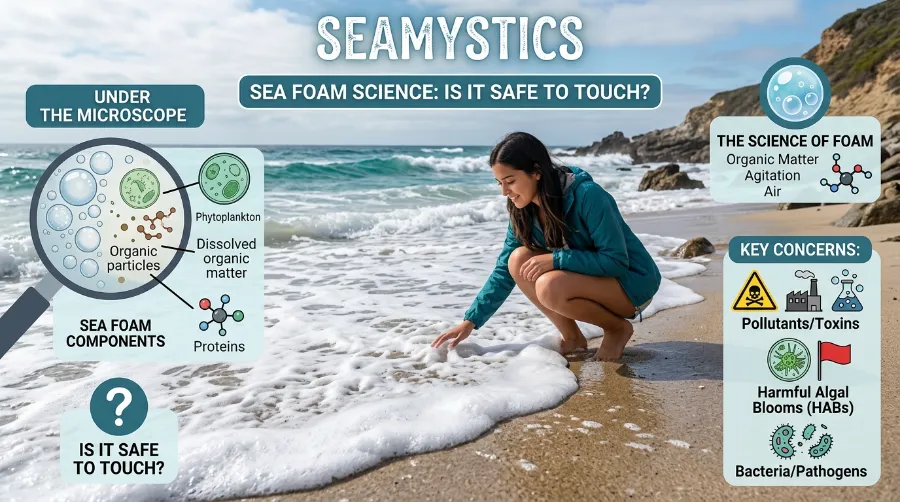

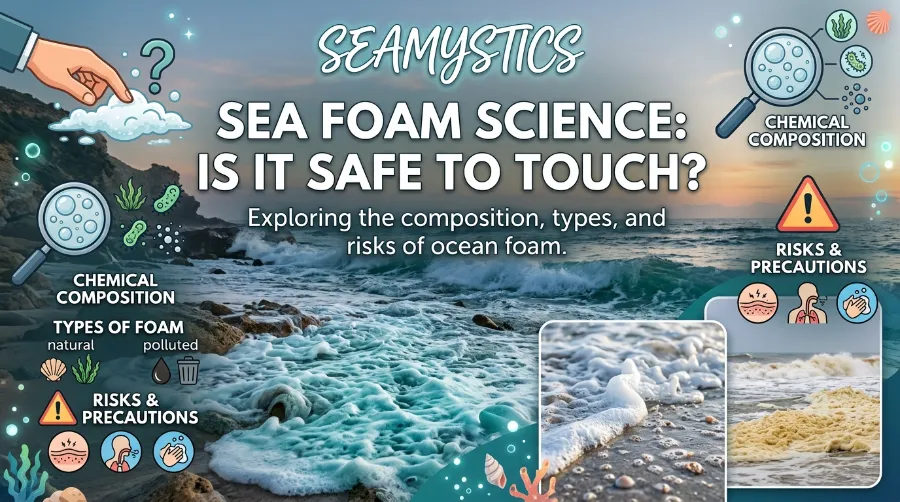
You are walking along the shoreline, coffee in hand. A thick white mass rolls in with the tide and piles up at your feet like a spilled bubble bath. It looks a little like shaving cream, a little like dish soap gone wrong. It raises the same question every time: is this stuff actually safe to touch? Sea foam science gives a clear answer most of the time, but not always. The difference comes down to color, smell, and what has been happening in the water nearby. This guide walks through what sea foam actually is, why it forms, when it turns from harmless to hazardous, and how to read the warning signs like a marine biologist would.
TL;DR: Wind and waves whip up dissolved organic matter in seawater, mostly proteins and fats from algae and decaying sea life, and that mixture acts like natural soap. Most white sea foam stays harmless and even signals a productive ocean. Thick brown or discolored foam near an algal bloom can carry irritants, so avoid it. When in doubt, skip the touch, keep pets away, and rinse off if you make contact.
Key Takeaways
| Question | Quick Answer |
|---|---|
| What is sea foam made of? | Proteins, fats, dead algae, salts, and sometimes pollutants, all acting as natural surfactants |
| What causes sea foam? | Wind and wave agitation trapping air inside dissolved organic matter |
| Is white sea foam safe? | Usually yes, in small amounts, for a quick touch |
| Is brown sea foam safe? | Often no, especially near a red tide or algal bloom, avoid it |
| Can it hurt pets or kids? | Yes, if it contains algal toxins, it can cause vomiting, eye irritation, or breathing trouble |
| How thick can it get? | Storm surf has produced foam piles taller than a house in extreme cases |
What Is Sea Foam, Really?
People also call sea foam ocean foam, beach foam, or spume. Wind and breaking waves whip seawater into a froth, and that froth is sea foam. Seawater with a high load of dissolved organic matter foams the most. That matter includes proteins, lignins, and lipids, and much of it comes from algal blooms breaking down offshore. In plain terms, the ocean carries more than salt and water. It carries a soup of leftover biological material, and that material turns ordinary waves into foam.
Marine scientists reach for one comparison more than any other: your morning latte. Proteins and fats in warm milk act as surfactants. They trap air bubbles and build foam when you shake the milk. Seawater holds its own natural surfactants, pulled from proteins and fats in decaying marine life. Wind and waves mix that seawater, air gets trapped inside the surfactant molecules, and the familiar froth builds up.
What Causes Ocean Currents to Reverse Seasonally
The Chemistry Behind the Bubbles
At the molecular level, surfactants look a bit like tadpoles. One end loves water, the other end avoids it. The molecules arrange themselves around tiny air pockets and form protective spheres called micelles. These micelles stabilize the bubbles so they do not pop right away, the same way soap forms micelles around dirt and oil on your hands.
How Underwater Earthquakes Cause Tsunamis The Real Tsunami Formation Science
Saltwater carries one more trick that a freshwater lake or river lacks. Engineers studying bubble physics traced this trick to dissolved electrolytes, the mobile ions that salts create when they dissolve in water. These electrolytes set up subtle forces during a bubble collision. The forces slow down how quickly two bubbles can merge and pop, and that slowdown explains why seawater produces such long lasting foam compared to pure water. This single mechanism explains why whitecaps and shoreline foam show up so reliably on ocean beaches and rarely on inland lakes.
Want a deeper look at how water moves through the planet’s systems before it ever reaches the surf zone? Our guide on the ocean water cycle breaks that process down step by step.
Why the Dead Sea Isn’t Technically an Ocean The Dead Sea Science Behind the Myth
What Causes Sea Foam to Form?
Sea foam explained simply: it needs two ingredients working together, organic material and physical agitation. Remove either one and the foam disappears. Here is the short version of what causes sea foam along most coastlines.
- Algal blooms and phytoplankton die-offs. Algae grow rapidly, then decompose, and that decay releases proteins, lipids, and carbohydrates into the surrounding water. This decaying matter drives one of the most common single sources of thick foam.
- Kelp and seaweed breakdown. Coastal vegetation sheds mucilage and organic compounds as it decays, and that runoff adds to the surfactant pool near shore.
- Wind and breaking waves. Strong winds create waves. When those waves ripple and break, they inject bubbles of air into the water, and that injection triggers visible froth.
- Storm intensity. Bigger storms churn more air into the surf zone, and that extra churn builds thicker, longer lasting foam.
- Human runoff, occasionally. Fertilizer and detergent residue wash out from land and add extra surfactants, though this source contributes less than natural biological material along most beaches.
Sea foam is not purely an earthly mixture either. In 2024, researchers at the Smithsonian Astrophysical Observatory collected sea foam from two beaches in Rhode Island. They identified hemoglycin in the samples, a polymer of glycine and iron that scientists have previously found in meteorites. The team suggests that some of the roughly 5,200 metric tons of cosmic dust that falls to Earth every year may contribute trace material to ocean foam’s unusual stability. It is a strange footnote, and it reminds us that sea foam science remains an active research area, not a settled textbook chapter.
Sea Foam Safety Facts: When Is It Safe to Touch?
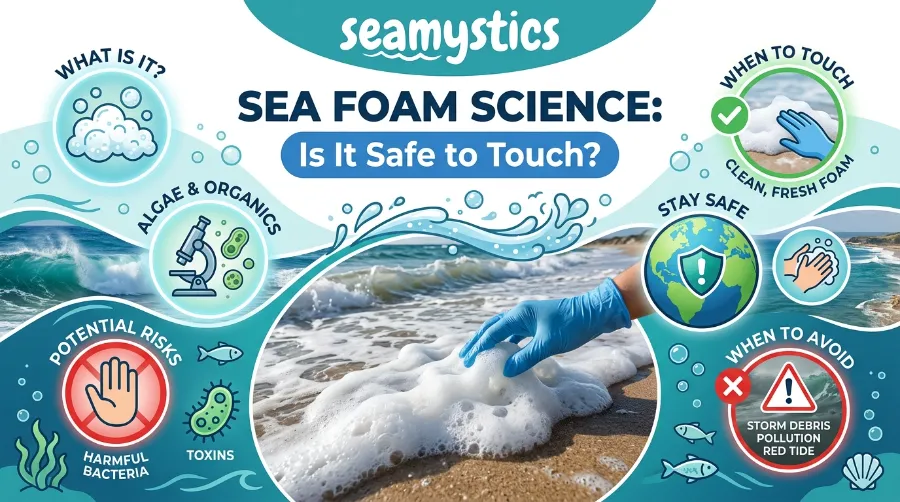
This is the question most beachgoers actually want answered, and the honest response depends on what triggered the foam in the first place. Most sea foam stays harmless to humans and often signals a productive ocean ecosystem. But when large harmful algal blooms decay near shore, the resulting foam can carry real risks to human health and the environment.
Follow this quick check before you or your kids wade through a foam pile.
- Check the color. White or off white foam carries generally low risk. Brown, reddish, or greenish foam signals that an algal bloom may be involved.
- Check for a smell. A sharp, fishy, or chemical odor warns you that something beyond normal organic matter is present.
- Look for local advisories. Coastal health departments post warnings during red tide season, so run a quick search before letting pets near thick foam.
- Avoid inhaling near thick foam. Popping bubbles can aerosolize toxins, so keep your face away from dense patches, especially if you have asthma or another respiratory condition.
- Rinse off after contact. If you or your dog touch foam that turns out to be from a bloom, rinse with fresh water to reduce skin and coat irritation.
Why Brown Sea Foam at the Beach Is the One to Watch
Brown sea foam beach conditions usually trace back to one thing: a harmful algal bloom, often called a red tide. Along Gulf Coast beaches, blooms of Karenia brevis send algal toxins airborne when foam bubbles pop. That aerosol can irritate the eyes of beachgoers and poses a real health risk for people with asthma or other respiratory conditions.
What Determines Ocean Water Temperature by Region
The color itself comes from pigment inside the algae. Phytoplankton blooms cause most reddish brown sea foam, and this coloring counts as a natural phenomenon. Still, these tiny organisms release toxins that harm people, pets, and birds. The algal toxins have irritated eyes and ears in documented cases and have even triggered respiratory symptoms.
Sea Spray Science How Ocean Droplets Shape Coastal Weather
Wildlife pays a price too, and the record on this runs well documented. Scientists studied seabird die-offs off California in 2007 and in the Pacific Northwest in 2009. They traced the deaths to a soap-like foam from a decaying Akashiwo sanguinea algae bloom. That foam stripped the natural waterproofing off the birds’ feathers, made flight harder, and ultimately caused fatal hypothermia in many affected birds. This single case study offers one of the clearest examples in sea foam science of how a natural process can turn genuinely dangerous once a harmful bloom enters the picture.
Real Storms, Real Numbers: Sea Foam at Its Most Extreme
Sea foam does not always stay a thin lace along the tideline. Under the right storm conditions, it can pile up to genuinely dangerous heights.
- In 2007, a powerful storm off the coast of Australia produced a layer of foam taller than a house. The foam stretched across miles of ocean and resembled mounds of dirty whipped cream.
- In the winter of 2020, a king tide in Washington state brought waves nearly 25 feet high. The waves created a churning “blender effect” and built sea foam as high as a person’s chest along the shoreline.
-
That same year, tragedy struck in Europe. In May 2020, five experienced surfers lost their lives in the Netherlands. Thick, disorienting sea foam made it hard for them to escape rough seas.
These events matter because they show sea foam is not just a curiosity for the tide pool crowd. It can become a genuine visibility and safety hazard, and it can hide rocks, debris, rip currents, and even wildlife. Reports from Australian beaches have even described venomous sea snakes sheltering underneath dense foam banks, drawn to the bubbles the same way they might seek any sheltered patch of water.
How Salinity Affects Marine Life Survival
Storm driven ocean behavior interest you? Our piece on seasonal current reversal covers a related pattern in how coastal waters shift throughout the year.
How Much of the Ocean Is Actually Covered in Foam?
It is easy to assume foam is a rare event, but satellite data tells a different story. Researchers estimate that whitecaps and foam cover roughly 1 to 6 percent of the ocean’s surface at any given time. Most foam patches last anywhere from a few hours to a few days before they disperse. That range covers a meaningful chunk of the planet’s surface, constantly cycling through this bubbly, short lived state, most of it far offshore where nobody ever sees it.
| Foam Characteristic | Typical Range or Fact |
|---|---|
| Ocean surface covered by foam/whitecaps | About 1 to 6 percent at any given time |
| Foam lifespan | Hours to a few days |
| Composition of seawater | Roughly 96.5 percent water, 2.5 percent salt, about 1 percent other organic and inorganic material |
| Tallest documented storm foam | Taller than a house, Australia, 2007 |
| Notable fatal foam event | Netherlands, May 2020, five surfers |
Seawater itself runs about 96.5 percent water and 2.5 percent salt. That leaves roughly 1 percent made up of proteins, fats, dead algae, detergents, other pollutants, and assorted organic and inorganic particles. That leftover 1 percent turns into foam once the water gets agitated.
Sea Foam and the Wider Ocean Ecosystem
Foam is not just a beach nuisance, it also serves as a habitat. Recent microbiology research found that sea foams host distinctive bacterial communities. These communities differ from both the surrounding sea surface microlayer and the deeper water underneath, so each foam patch essentially becomes an ephemeral floating hotspot of microbial life. For a few hours or days, each patch runs its own tiny, temporary ecosystem.
That connects to a bigger pattern in ocean science worth understanding on its own. Want to see how frozen and liquid ocean states interact on a larger scale? Check out our explainer on iceberg formation science. Curious how coastal water bodies behave without the usual lunar pull? Our guide to seas without tides makes a useful companion read.
Frequently Asked Questions
Is it safe to touch white sea foam? Generally yes, for a quick touch in small amounts. White sea foam usually comes from ordinary organic matter and wave action rather than a harmful algal bloom. Still, rinse your hands afterward, especially before eating.
What does brown sea foam mean at the beach? Brown or reddish sea foam often links to an algal bloom, sometimes called a red tide. It can carry irritants that affect the eyes, skin, and lungs. Treat brown foam as a signal to keep your distance and check local beach advisories.
Can sea foam make my dog sick? Yes, it can, particularly if the foam formed during a harmful algal bloom. Dogs that lick or roll in contaminated foam have shown symptoms ranging from vomiting to more serious neurological effects. Keep pets away from thick or discolored foam entirely.
Why is there so much sea foam after a storm? Storms combine the two things foam needs most, strong wind and powerful wave action. That combination churns huge volumes of air into water that already contains dissolved organic matter, and that is why the thickest sea foam almost always shows up during or right after rough weather.
Does sea foam mean the ocean is polluted? Not necessarily. Most sea foam forms as a completely natural byproduct of a healthy, biologically active ocean. It only raises a pollution or safety concern when it turns unusually thick, discolored, or foul smelling, or when it ties to a known algal bloom in the area.
Conclusion
Sea foam science comes down to a fairly simple recipe: dissolved organic matter plus wind and wave energy. The safety question, though, depends entirely on what that organic matter happens to be. Most of the time, the white froth rolling onto the sand stays harmless, even encouraging, since it signals a biologically rich ocean. Watch out for brown or reddish color, a strong smell, or a known algal bloom in the area, because that is when sea foam safety facts actually matter for your health and your pet’s health. Next time a thick bank of foam rolls in, take a second look before you dive in, and let the color do the talking.
References
- National Oceanic and Atmospheric Administration, “What is sea foam?” oceanservice.noaa.gov
- National Oceanic and Atmospheric Administration, “How does sea foam form?” noaa.gov
- University of Texas Marine Science Institute, “Sea Foam,” utmsi.utexas.edu
- Catalina Island Marine Institute, “Sea Foam, Spume? What is it?!” cimi.org
- Chesapeake Bay Field Station, “Shore Science: Sea Foam Formation,” cbfieldstation.org
- Ocean Conservancy, “What is Sea Foam?” oceanconservancy.org, March 2023
- HowStuffWorks, “What Exactly Is Sea Foam?” science.howstuffworks.com
- Physics Magazine, “Why Seawater Is Foamy,” physics.aps.org, September 2023
- McGeoch, J.E.M. and McGeoch, M.W., “Sea foam contains hemoglycin from cosmic dust,” Royal Society of Chemistry Advances, November 2024