
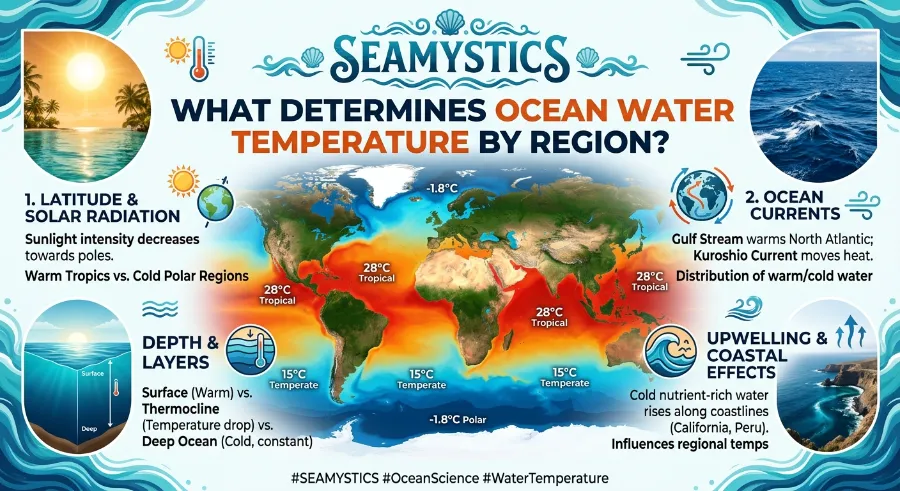

If you have ever jumped into the Atlantic off Maine and then, months later, waded into the Caribbean, you already know that “the ocean” is not one temperature. It is dozens of them, shifting by latitude, depth, current, and season. Understanding ocean temperature regions is not just a curiosity for swimmers and surfers. It shapes hurricane strength, fish migration, coral survival, and even the weather over your city. In this guide, we break down exactly what drives these differences and what the latest research says about where the water is heating up fastest.
Key Takeaways
| Factor | Effect on Ocean Temperature | Example Region |
|---|---|---|
| Latitude | Determines baseline solar heating | Warmest near equator, coldest at poles |
| Ocean currents | Redistribute heat across regions | Gulf Stream warms Northern Europe |
| Depth | Deep water stays near freezing regardless of surface heat | Deep ocean water sits around 0-3°C |
| Season | Surface layers shift with sun angle | Mediterranean summer vs. winter |
| Climate trends | Long-term warming raises baseline temperatures | 2025 ranked third-warmest year on record globally |
TL;DR: Ocean temperature by region comes down to five main forces: how much direct sunlight a region gets (latitude), how currents move warm or cold water around, how deep you go, what season it is, and the ongoing effects of a warming climate. Tropical regions like the western Pacific regularly pass 86°F, while polar water hovers near freezing year-round, and the gap between them is only growing.
Why Ocean Temperature Regions Aren’t All Created Equal
Water covers about 70% of the planet, but it doesn’t heat evenly. A beach in Cancun and a coastline in Norway are getting the same sun in a calendar sense, just at wildly different angles, and that single fact explains most of what follows.
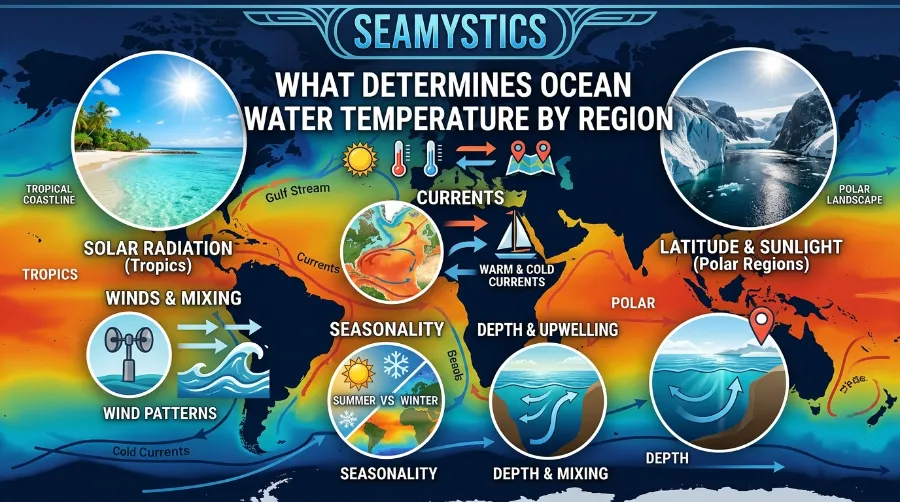
Ocean temperature varies depending on depth, geographical location, and season, and it plays a crucial role in the global climate system, ocean currents, and marine habitats. That’s the short scientific version. The long version is more interesting, and it’s what actually helps you predict conditions in any region you care about, whether you’re planning a dive trip or trying to understand why hurricane season keeps getting worse. Seatemperature
For a deeper look at how this connects to the planet’s broader water systems, our pillar guide on the ocean water cycle walks through the full picture.
Why the Dead Sea Isn’t Technically an Ocean The Dead Sea Science Behind the Myth
1. Latitude: The Biggest Driver of Ocean Temperature by Latitude
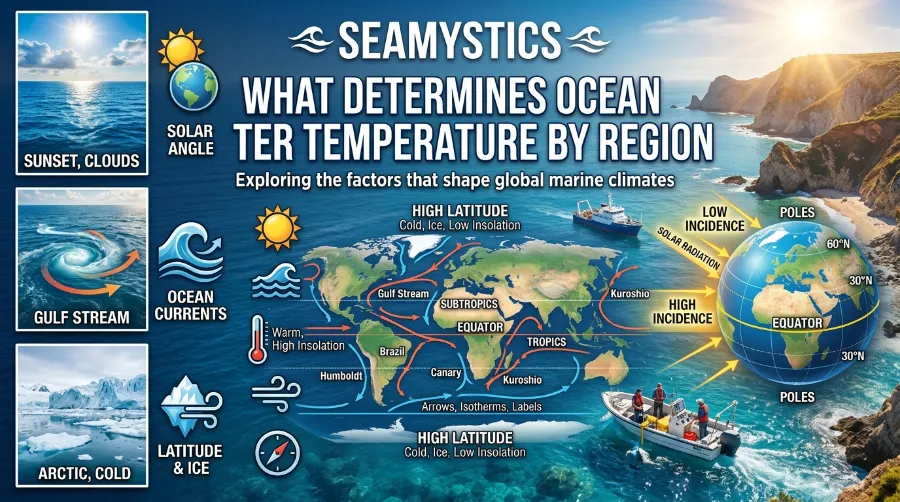
Sunlight hits the equator almost straight on and hits the poles at a steep, glancing angle. That single geometric fact is responsible for most of the temperature difference you’ll find between ocean temperature regions worldwide.
In tropical regions such as the Caribbean, average seawater temperature runs around 79-82°F (26-28°C), while temperate regions such as the Mediterranean average closer to 64-72°F (18-22°C). That’s a 15-degree swing just from moving a few thousand miles north. Wikipedia
- Equatorial belt (0-15° latitude): consistently warm, minimal seasonal swing
- Temperate zones (30-60° latitude): strong seasonal variation, warm summers and cold winters
- Polar zones (60-90° latitude): cold nearly year-round, ice-influenced
Tropical cyclone formation typically requires sea surface temperatures found between latitudes of 8° and 20° from the equator, with an ocean temperature of at least 26.5°C (79.7°F) usually considered the minimum needed to sustain a storm. This is exactly why hurricane forecasters watch tropical Atlantic temperatures so closely every June through November. Sea Temperatures
2. Ocean Currents: Nature’s Heat Delivery System
Latitude sets the baseline, but currents move heat around like a conveyor belt, and this is where things get genuinely fascinating. Warm currents such as the Gulf Stream carry warm water into cooler regions, while cold currents like the Labrador Current push cooler water into otherwise warmer zones. Wikipedia
Sea Spray Science How Ocean Droplets Shape Coastal Weather
This is why London, sitting at a latitude further north than most of Canada, has a relatively mild coastal climate. The Gulf Stream is doing quiet, constant work offshore. Meanwhile, the same current system helps explain seasonal shifts documented in our piece on seasonal current reversal, where entire current directions flip with the monsoon cycle in parts of the Indian Ocean.
A few concrete examples worth knowing:
- The Gulf Stream moves roughly 30 million cubic meters of water per second past Florida, warming the entire North Atlantic corridor
- The Kuroshio Current performs a similar role in the western Pacific
- The Labrador Current cools the northeastern US and Atlantic Canada even in summer
3. Depth: Why the Surface Lies to You
Surface readings only tell part of the story. Deep ocean water is cold and salty, with a fairly uniform temperature around 0-3°C, no matter how warm the surface layer above it gets. This is the layer scientists call the deep ocean, and it barely changes with the seasons or even with long-term warming trends, at least not on human timescales. Seatemperature
How Salinity Affects Marine Life Survival
This matters practically. It’s part of why iceberg formation happens the way it does, with warm surface melt sitting above frigid, dense water below. Divers know this instinctively too: drop 30 meters on a tropical reef and the water can feel noticeably colder, even in the Caribbean.
4. Seasonal Shifts Within Ocean Temperature Regions
In the tropics, with the sun nearly overhead, surface layers can climb above 30°C (86°F), while near the poles, temperatures in equilibrium with sea ice sit around -2°C (28°F). Temperate zones fall in between, and they swing the most dramatically across the calendar year. Seatemperature
Take the Mediterranean as a working example. Water off the coast of Sicily can feel almost bathtub-warm by August, then drop to genuinely cold by February. That seasonal whiplash is part of what drives phenomena like sea foam formation after autumn storms, when temperature contrast and wind energy collide.
Warmest and Coldest Ocean Regions Right Now
If you’re asking which parts of the ocean are hottest and which are coldest today, here’s where the data actually points:
| Region | Typical Temperature Range | Why |
|---|---|---|
| Western Pacific (near equator) | Can exceed 86°F (30°C) | High solar radiation plus warm Kuroshio current |
| Caribbean Sea | 79-82°F (26-28°C) | Tropical latitude, shallow warm shelf waters |
| Mediterranean Sea | 64-72°F (18-22°C), seasonal | Semi-enclosed basin, strong seasonal swing |
| US Pacific Northwest | Often below 55°F (13°C) | Cold California Current, upwelling |
| Arctic Ocean | Near freezing most of the year | Minimal direct sunlight, sea ice cover |
In the United States specifically, sea temperatures vary widely by region, from cool Pacific and Northeast Atlantic waters to consistently warm Gulf of Mexico and South Florida waters, with northern coasts falling well below 50°F in winter while southern Florida and Hawaii often stay above 75°F. You can check live regional readings through the NOAA coastal water temperature guide, and if you’re focused specifically on US coastlines, seatemperature.org’s US data is updated regularly. NOAA Arctic
Sea Surface Temperature Facts: What 2025 Data Actually Shows
This is the part most explainer articles skip, and it’s arguably the most important for understanding where things are heading. NOAA ranked 2025 as the third-warmest year in its global temperature record, which dates back to 1850, with the ten warmest years on record all occurring since 2015. NOAA
Ocean heat specifically kept climbing even as surface air temperatures leveled off slightly. Global upper 2,000 meter ocean heat content increased by roughly 23 zettajoules in 2025 relative to 2024, continuing a long-term acceleration from about 0.14 watts per square meter per decade during 1960-2025 to 0.32 watts per square meter per decade during 2005-2025. In plainer terms, the ocean is absorbing heat faster now than it was even twenty years ago. Scientific American
Regionally, the warming hasn’t been even either. August 2025 Arctic Ocean sea surface temperature was the second warmest on record, behind only August 2007, and the Kara and Chukchi Seas ran up to 9°C warmer than the previous August in some spots. That kind of regional spike is exactly why generic “the ocean is warming” headlines miss the more useful story: some ocean temperature regions are heating far faster than others. NOAA
For a broader look at how this pattern plays out globally, the Ocean Conservancy’s coverage of record-breaking ocean temperatures is a solid starting point, and it connects well to how these shifts influence things like tsunami formation science, where deep ocean temperature layering plays an underappreciated role in wave behavior.
A Regional Case Worth Knowing: The Dead Sea Exception
Not every notable water body follows the standard latitude-and-current model, and it’s worth flagging that so you don’t walk away thinking temperature is the whole story. The Dead Sea sits at a similar latitude to the Mediterranean but behaves completely differently because of extreme salinity and its landlocked, below-sea-level basin. It’s a useful reminder that ocean temperature regions are shaped by a stack of overlapping factors, not any single one in isolation.
Similarly, tideless basins like those covered in our piece on seas without tides show how enclosed geography changes not just water movement but heat retention patterns too.
Frequently Asked Questions
What determines ocean temperature by region?
Latitude sets the baseline through solar angle, currents redistribute that heat, depth changes how much of it reaches deeper water, and season shifts it throughout the year.
What is the warmest ocean region in the world?
The western Pacific near the equator regularly exceeds 86°F (30°C), driven by intense solar exposure and warm currents like the Kuroshio.
What is the coldest ocean region?
The Arctic Ocean stays near freezing for most of the year due to minimal direct sunlight and extensive sea ice cover.
Why is the Gulf Stream important for ocean temperature?
It carries warm tropical water north into the Atlantic, moderating winter temperatures across Northern Europe far more than latitude alone would suggest.
Is ocean warming affecting all regions equally?
No. Some regions, like parts of the Arctic, have warmed considerably faster than the global average in recent years, based on NOAA’s 2025 monitoring data.
Conclusion
Ocean temperature isn’t a single number, and it never has been. It’s the product of latitude, currents, depth, and season all working together, layered on top of a climate system that is measurably warming year over year. Whether you’re planning a dive, tracking hurricane risk, or just curious why two beaches at the same time of year feel completely different, understanding these regional drivers gives you a far more accurate picture than any single “ocean temperature today” number ever could.
References
- NOAA National Centers for Environmental Information, Global Climate Report 2025
- NOAA Arctic Report Card 2025, Sea Surface Temperature
- Institute of Atmospheric Physics / Advances in Atmospheric Sciences, Ocean Heat Content 2025
- Scientific American, “Ocean Temperatures Just Hit a Dire New Record”
- Wikipedia, “Ocean temperature” and “Main development region”