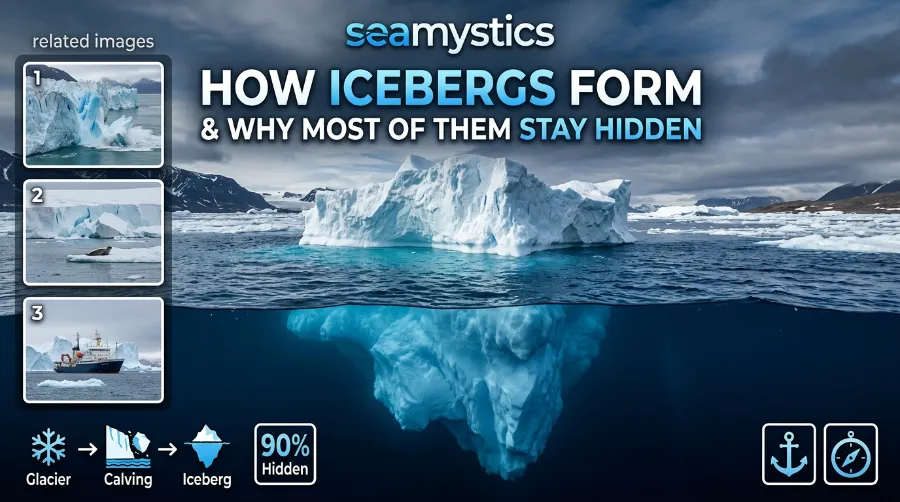

A ship’s radar operator once told me that the scariest icebergs are never the ones you can see. That single line has stuck with me through years of writing about polar oceans, because it captures the entire idea behind iceberg formation science in one breath. What looks like a modest chunk of white ice bobbing near the surface is often the small visible corner of a structure the size of an office building, sitting quietly below the waves.
How Underwater Earthquakes Cause Tsunamis The Real Tsunami Formation Science
This piece walks through how icebergs actually form, from the first snowflake to the final splash of calving, and why most of an iceberg’s bulk hides where no camera or eye can reach.
How Salinity Affects Marine Life Survival
Along the way we will look at real numbers, real disasters, and the physics that keeps these frozen giants afloat.
Key Takeaways
| Fact | Detail |
|---|---|
| Formation process | Snow compresses into glacial ice over centuries, then breaks off (calves) into the ocean |
| Hidden mass | Roughly 88% to 90% of an iceberg’s volume sits underwater |
| Governing law | Archimedes’ Principle, based on the density gap between ice (about 0.92 g/cm3) and seawater |
| Famous example | The iceberg that sank the Titanic on April 15, 1912, showed only a fraction of its true size above water |
| Largest recorded | Iceberg B15A measured roughly 296 km long when it broke from the Ross Ice Shelf in 2001 |
| Travel speed | Glaciers can slide toward the sea at up to 20 meters a day before calving occurs |
TL;DR: Icebergs form when compacted glacial ice breaks away from a glacier or ice shelf in a process called calving, and because ice is only slightly less dense than seawater, roughly 88 to 90 percent of that mass stays submerged. This underwater portion, not the visible tip, is what actually steers an iceberg’s drift and makes it dangerous to ships.
How Icebergs Form: From Snowflake to Open Ocean
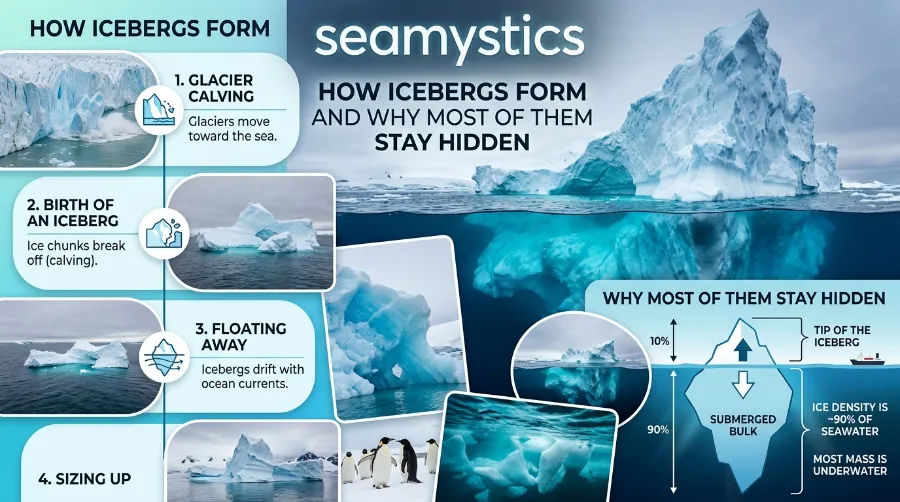
Every iceberg begins life nowhere near the sea. It starts as ordinary snow falling on a glacier or ice sheet in a cold, high-latitude region such as Greenland or Antarctica. Each new snowfall presses down on the layer beneath it, squeezing out air pockets and slowly turning fluffy snow into a denser, granular material called firn.
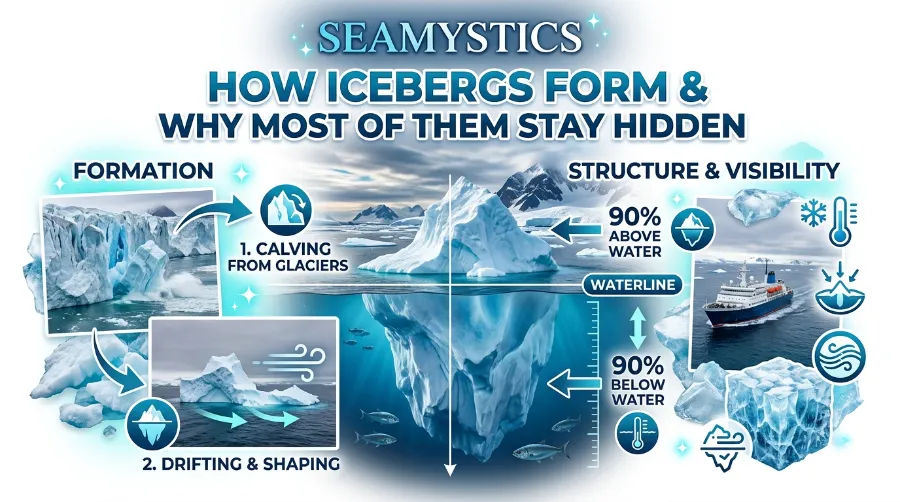
Over hundreds or even thousands of years, continued pressure compacts that firn into solid glacial ice, the same dense blue-tinted ice you often see in photographs from polar expeditions. Once the ice mass is thick and heavy enough, gravity takes over and it begins to creep toward the coastline, a process the team at Edvotek’s science blog describes as one of the slowest and most patient journeys in nature. This ties directly into the broader story of how water moves between land, atmosphere, and sea, something we unpack more fully in our guide to the ocean water cycle.
Why the Dead Sea Isn’t Technically an Ocean The Dead Sea Science Behind the Myth
The Calving Moment
When a glacier finally reaches the coastline, its leading edge, called the terminus, extends out over open water. Eventually the ice cannot support its own weight and a section breaks free. This dramatic split is called calving, and it is the exact moment a glacier officially becomes an iceberg.
A few things happen almost simultaneously during calving:
- Stress fractures spread through the ice as tides and waves flex the glacier’s floating tongue.
- The detached block rolls or settles until it finds a stable floating position.
- Meltwater and internal pressure inside the ice sometimes trigger a secondary crack, splitting one iceberg into two or more.
Some of the most consequential calving events in recent memory happened in Antarctica. The Larsen B Ice Shelf collapse in 2002 released a huge volume of new icebergs in a matter of weeks, and in July 2017 the Larsen C shelf calved the enormous A68 iceberg, which weighed close to one trillion tonnes according to satellite monitoring cited by Eco Magazine’s research desk. Events like these are not rare curiosities either, they are becoming a recurring theme in how scientists track polar ice loss year over year.
Why Most of an Iceberg Stays Hidden Underwater
This is where the physics gets genuinely satisfying. Ice floats because it is less dense than liquid water, a rare property caused by the open hexagonal lattice that water molecules form when they freeze. Glacial ice typically has a density around 0.92 grams per cubic centimeter, while seawater sits closer to 1.02 to 1.03 grams per cubic centimeter because of dissolved salt.
That small density gap, governed by Archimedes’ Principle, is the entire reason for the phrase tip of the iceberg. An object floating in a fluid displaces a volume of that fluid equal to its own weight, and because ice and seawater are so close in density, an iceberg has to push a huge share of itself underwater just to displace enough seawater to stay afloat. Scientists at institutions like the Scott Polar Research Institute, whose iceberg research is referenced in Britannica’s overview of iceberg structure, generally put the submerged share at 88 to 90 percent for freshwater glacial ice.
What Determines Ocean Water Temperature by Region
In practical terms, for every one unit of ice you can see above the waterline, there are roughly eight or nine more units hidden beneath it. That underwater mass, called the keel, is also why icebergs often drift against the wind. Deep ocean currents grip that huge submerged bulk more strongly than surface wind grips the small visible tip, a pattern well documented by researchers who study iceberg tracks near Antarctica through outfits like Natural Habitat Adventures’ Antarctica field team.
A Real-World Warning: The Titanic
No discussion of hidden iceberg mass is complete without the Titanic. On the night of April 15, 1912, lookouts spotted an iceberg with barely any warning because so little of it broke the surface. Survivors and investigators later concluded that the underwater portion of that iceberg, invisible in the dark, gouged the hull along a length far greater than anyone on deck could have judged from what they saw. It remains the clearest historical proof that an iceberg’s danger has almost nothing to do with what is visible.
What Causes Ocean Currents to Reverse Seasonally
Iceberg Size Facts Worth Knowing
Icebergs are sorted into rough categories based on height above water, and the range is wider than most people expect.
- Growlers are small, roughly car-sized fragments that barely peek above the surface.
- Bergy bits are house-sized pieces, still small by iceberg standards but large enough to damage a hull.
- Small and medium icebergs typically rise 5 to 45 meters above the waterline.
- Very large icebergs, sometimes called tabular icebergs, can tower more than 75 meters above the sea and stretch for kilometers.
The record holder is still B15, which broke off Antarctica’s Ross Ice Shelf in 2000 and at one point measured close to 295 kilometers long, roughly the footprint of a small country. Its fragments were still being tracked by satellite more than a decade later.
Sea Spray Science How Ocean Droplets Shape Coastal Weather
Iceberg Underwater Mass: Why the Number Isn’t Fixed
The commonly quoted 90 percent figure is an average, not a fixed law. A few variables shift it in either direction:
- Ice density: older, more compressed glacial ice has fewer trapped air bubbles and sits slightly higher in density, which changes the submerged ratio.
- Water salinity: colder, saltier water is denser, which pushes a bit more of the iceberg above the surface.
- Debris load: icebergs carrying rock and sediment from the glacier bed can ride lower in the water.
- Shape and erosion: as an iceberg melts unevenly, it can roll and expose sections that were previously underwater, sometimes revealing striking blue or green banding
Water Cycle and the Ocean How They’re Actually Connected
Because of these variables, most glaciologists treat 88 to 90 percent as a working range rather than an exact constant, similar to the way tidal researchers describe ranges rather than single figures when explaining regional differences, a theme we cover in our related piece on seas without tides.
Frequently Asked Questions
How long does it take an iceberg to form? The ice itself can take hundreds to thousands of years to compact from snow into solid glacial ice before it ever calves into an iceberg.
Why Some Seas Have No Tides At All
Why is only the tip of an iceberg visible? Because glacial ice is only slightly less dense than seawater, an iceberg must submerge roughly 88 to 90 percent of its volume just to stay afloat, leaving a small visible tip above the surface.
Do all icebergs come from Antarctica? No. Antarctica and the ice shelves of the Southern Ocean produce many of the largest tabular icebergs, but Greenland’s tidewater glaciers are the main source of the icebergs found drifting through the North Atlantic shipping lanes.
Can an iceberg flip over? Yes. As an iceberg melts unevenly or breaks apart, its center of gravity shifts and it can roll or capsize suddenly, which is one reason ships and researchers keep a wide safety margin around them.
Conclusion
Icebergs are one of the clearest reminders that appearances in nature are rarely the full story. Behind every visible ice tower sits centuries of compacted snow, a slow glacial journey to the coast, a dramatic calving event, and a submerged mass many times larger than what any eye can see. Understanding that hidden bulk is not just a fun fact, it shapes how ships navigate polar waters, how scientists track melting ice sheets, and how coastal ecosystems respond to the freshwater these giants eventually release. The next time you see a photo of an iceberg, remember that the real story is happening below the waterline, out of sight and far larger than the picture suggests. For more on how water moves through the planet’s polar systems, visit Sea Mystics.
References
- Britannica, “Iceberg: Definition, Structure, Types, Melt, Examples & Facts” – https://www.britannica.com/science/iceberg
- Edvotek Blog, “The Science Beneath the Surface of Icebergs” – https://blog.edvotek.com/2022/04/19/the-science-beneath-the-surface-of-icebergs/
- Eco Magazine, “Arctic Iceberg Surge Is Reshaping Deep-Sea Biodiversity” – https://ecomagazine.com/news/research/arctic-iceberg-surge-is-reshaping-deep-sea-biodiversity/
- Natural Habitat Adventures, “Antarctica Iceberg” – https://www.nathab.com/blog/antarctica-iceberg
- AntarcticGlaciers.org, “Icebergs” – https://www.antarcticglaciers.org/glacier-processes/glacier-types/icebergs/
- U.S. Coast Guard Navigation Center, “Iceberg Formation” – https://www.navcen.uscg.gov/sites/default/files/pdf/iip/Iceberg_Formation.pdf