
Off the coast of southeastern Australia, at a depth of about 2,000 meters, a trawl net once pulled up a small flapjack octopus with wing-like fins. It sat unidentified in a museum collection for years. Scientists finally described it in 2024 and gave it a name that would make any mythology fan smile. They called it Opisthoteuthis kerberos, after Kerberos, the three-headed hound that guards the underworld in Greek myth.
New Octopus Species Named After Mythical Creatures The Naming Trend Explained
This choice is not unusual. Research institutions across the United States, the United Kingdom and Europe now use octopus species naming as a small but telling window into how scientists think. The pattern behind these names reveals how researchers hope the public will pay attention.
New Nudibranch Species The Sea Slugs Still Surprising Scientists
This is not just a quirky footnote for trivia night. The naming trend connects directly to how research vessel discoveries get funded. It shapes how expedition new species stories spread online, and it helps turn deep sea research trip data into real public interest in ocean conservation. A shy, eight-armed animal from a canyon floor can end up named after a Greek god or a Norse sea monster, and that choice tells us something real about ocean exploration in 2026.
Key Takeaways
| Point | What it means |
|---|---|
| Naming is regulated | The International Code of Zoological Nomenclature governs every new species name, so myth-inspired names still meet strict scientific rules |
| It is not new | Sailors have linked octopuses to monsters like the Kraken and the Hydra since at least the 1700s |
| It aids public engagement | Evocative names help ocean expedition findings reach mainstream media, which helps fund further research |
| Discoveries are accelerating | Researchers described roughly 1,100 new ocean species between April 2025 and March 2026 alone |
| Naming rights often go to discoverers | Research teams usually choose the name, within scientific guidelines, not a central naming committee |
TL;DR: Marine biologists increasingly name new octopus species after mythical sea monsters like the Kraken, Cerberus and the Hydra. The octopus body plan explains why: multiple flexible arms, sharp camouflage and sudden appearances from the dark have inspired sailors’ legends for centuries. The trend also makes dense taxonomic papers more shareable, and that helps smaller expeditions win public attention and continued funding.
Why Octopuses Keep Getting Compared to Monsters
The link between octopuses and mythical monsters predates modern taxonomy itself. Sailors in Norway often found the rotting remains of giant squid and octopus washed up on beaches. Many assumed they were looking at messages from another world. Researchers at the Natural History Museum in London note that this belief helped grow the kraken myth, with people sometimes reading the washed-up specimens as messages from God or the Devil. The Danish historian Erik Pontoppidan formally documented the Kraken legend in his 1755 book Natural History of Norway.
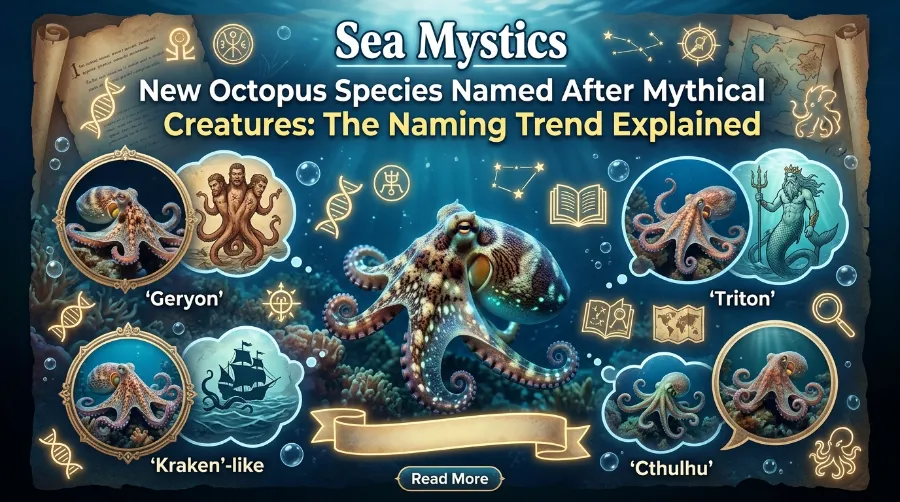
The Hydra story follows a similar path. Ancient depictions of the nine-headed beast that Hercules battled bear a striking resemblance to a many-armed cephalopod. Scholars studying old texts and artwork argue the octopus itself helped inspire the Hydra, one of mythology’s most famous monsters. A marble relief in the Vatican shows Hercules fighting the Hydra, and to modern eyes it reads almost exactly like an octopus attack.
Deep-Sea Expedition Discoveries What Research Ships Found This Year
Modern marine biologists know this cultural backstory well, and it comes up in casual conversation as much as in journal papers. When Seattle’s NHL team named itself the Kraken, journalists asked researchers at the University of Washington to weigh in. Their answer doubled as a compact case for the myth-to-animal connection.
- Octopus arms move somewhat independently, and each one processes sensory information almost like a small brain of its own
- Some species can overpower prey far larger than themselves
- Octopuses live mostly solitary lives, yet their arms show coordinated, almost team-like behavior when they solve a problem together
That last point is worth sitting with. An animal built for coordinated ambush was always going to end up compared to something legendary.
New Ray Species Identified Off Unexpected Coastlines
The Modern Naming Trend, With Real Examples
Octopus species naming is not random poetry. Every name has to pass through the International Code of Zoological Nomenclature, and researchers typically justify the choice in the published description. Taxonomists still find plenty of room to have fun within those rules, and in the past few years they have used that room generously.
A few concrete cases from actual expedition new species reports:
- Opisthoteuthis kerberos (2024) – Researchers named this flapjack octopus for Kerberos, guardian of the underworld. The former CSIRO research vessel Southern Surveyor collected it off eastern Bass Strait, Australia, from roughly 2,000 meters down.
- Opisthoteuthis carnarvonensis (2025) – A close relative of the Kerberos octopus. A CSIRO team collected it aboard the RV Investigator at Carnarvon Canyon Marine Park and formally described it the following year.
- Microeledone galapagensis – A newly documented blue octopus found near Darwin Island in the northern Galápagos. National Geographic reported that invertebrate zoologist Janet Voight called the find likely just the tip of the iceberg for new deep-sea animals still waiting to be found.
- The “Dorado octopus” – Researchers discovered this species near hydrothermal vents at the Dorado Outcrop off Costa Rica. Scientific American reported that it closely resembles the pearl octopus, Muusoctopus robustus, which a separate research team had earlier found brooding eggs near hydrothermal vents off central California.
That last discovery shows how these ocean expedition findings actually happen. The Schmidt Ocean Institute’s research vessel Falkor (too) found at least four new deep-sea octopus species inside a 100-square-mile patch of seafloor off Costa Rica, during a single deep sea research trip. The team also found a previously unknown deep-sea skate nursery nearby. Researchers brought specimens back to the Zoology Museum at the University of Costa Rica, where Fiorella Vásquez and Janet Voight of Chicago’s Field Museum carefully measured arms and counted suckers to confirm each species was genuinely distinct. Voight explained that the two closely related octopus species share smallish eyes, a robust body and short arms, so the fine details truly separate them.
New Bioluminescent Species Found How Scientists Confirm Glowing Animals
Why the Kraken and Cerberus Naming Choice Actually Helps Science
Some readers might dismiss myth-themed octopus species naming as marketing, and most researchers would not fully deny that. But a more practical reason drives the trend too.
Museum Specimens Reclassified Old Samples That Turned Out to Be New Species
Deep sea research trips cost real money. A single expedition on a vessel like Falkor (too) or Investigator can run into the millions of dollars once you count fuel, crew, submersibles and lab time. Funding for that kind of work often depends on visibility. A paper titled “A new species of Opisthoteuthis” rarely draws much media attention, but one about an octopus named after the guardian of the underworld usually does.
Undersea Volcano Discoveries New Species Found Near Hydrothermal Vents
A name that references the Kraken, the Hydra or Cerberus does three things at once:
- It signals something about the animal’s appearance or behavior that a general reader can immediately picture
- It creates a natural hook for journalists, teachers and science communicators, and that hook multiplies the discovery’s reach well beyond the original journal
- It quietly reinforces the idea that today’s ocean still produces animals strange enough to earn a legendary name
None of this weakens the science. Taxonomic names still require morphological evidence, museum specimens and, increasingly, genetic sequencing. The mythology is packaging, not substance.
New Anglerfish Species Discovered in the Pacific Abyss
How Fast New Species Are Actually Being Found
Ocean discovery is moving at a genuinely remarkable pace right now, and that pace puts the octopus naming trend into context. Between April 2025 and March 2026 alone, researchers described more than 1,100 new species living in the ocean’s depths. The list ranges from a worm that lives inside glass sponges near an underwater mountain off Japan to a species nicknamed the “ghost shark.” Octopuses show up consistently in that wave. Deep-sea trawls and remotely operated vehicles now cover more seafloor than ever before, and DNA sequencing lets scientists split apart species that researchers used to lump together as one.
| New species category | Approximate discovery window | Example |
|---|---|---|
| Deep-sea octopuses | 2024 to 2026 | Opisthoteuthis kerberos, Opisthoteuthis carnarvonensis, Dorado octopus |
| Blue-hued octopus species | 2025 to 2026 | Microeledone galapagensis, Galápagos |
| Giant fossil octopus relatives | Prehistoric, described 2026 | 19-metre extinct octopus relative, fossils from British Columbia and Japan |
| Total new ocean species | April 2025 to March 2026 | Over 1,100 |
That fossil entry deserves its own mention. A 2026 study based on fossils from British Columbia and Japan suggested an ancient octopus relative grew to around 19 meters long, roughly the size of a sei whale. It is a real reminder that the Kraken legend was never entirely divorced from biology.
Newly Described Sea Spider Species and Why They’re Larger Than Expected
Where This Fits Into Broader Ocean Expedition Findings
Our guide on the first photos and expert tips for identifying new species walks through the full confirmation process, from initial ROV footage to lab confirmation, if you want more detail. It pairs well with our deep dive on how scientists discover new octopus species using modern submersible technology. Our pillar guide to newly documented abyssal species offers the wider picture of what is turning up in the deep ocean right now.
The U.S. Fish and Wildlife Service maintains a public taxonomic tree reference worth bookmarking, for readers who want official taxonomic records. iNaturalist also keeps an actively updated observation record for Octopus americanus, a good example of how citizen science data feeds into formal taxonomy. If you want a general overview of octopus body types, try Octopus Worlds’ overview of octopus types.
Frequently Asked Questions
Why do scientists name new octopus species after mythical creatures? The resemblance genuinely helps, both scientifically and in communication. Multiple arms, sudden appearances from dark water and unusual size have linked octopuses to sea monster myths for centuries. A name like Kerberos or Kraken gives the public an instant mental image while still meeting formal naming rules.
Who actually gets to choose a new species’ name? Usually the research team that first describes the species in a peer-reviewed paper chooses the name, within the rules set by the International Code of Zoological Nomenclature. No single global committee approves mythology-themed names case by case.
Are more octopus species being discovered than in the past? Yes. Better deep-sea imaging, more research vessel discoveries reaching previously unexplored depths, and genetic sequencing that separates look-alike species all drive a noticeable rise in newly confirmed species.
Is the Kraken based on a real animal? Most historians and marine biologists believe real sightings and washed-up remains of giant squid, and possibly large octopus, sparked the Kraken legend, particularly along the Norwegian coast in the 1700s.
Does a mythology-based name affect how seriously a species is taken scientifically? No. The name stays separate from the taxonomic description, which still requires physical specimens, detailed morphological comparison and, in most modern cases, genetic evidence before scientists accept it.
Conclusion
Naming a newly discovered octopus after Kerberos, the Kraken or the Hydra is not just a scientist having fun on the side of dry taxonomy, though it is partly that too. It reflects a genuine, centuries-old relationship between this animal and human imagination. Ocean expedition findings are arriving faster than at almost any point in scientific history, and a well-chosen mythological name often gets a quiet, important discovery in front of the public at all. The next time a headline mentions an octopus named after a legendary sea monster, remember what sits behind that name: a research vessel, a careful count of arms and suckers, and a team working to make sure the ocean’s real strangeness gets noticed before it is lost.
References
- Natural History Museum, “Sea monsters and their inspiration: Serpents, mermaids, the kraken and more” – nhm.ac.uk
- Scientific American, “Four New Octopus Species Discovered in the Deep Sea”
- National Geographic, “The color of this new and unusual blue octopus is what helps it survive”
- Schmidt Ocean Institute, “Scientists Discover Four New Species of Deep-Sea Octopus”
- Wikipedia, “Opisthoteuthis kerberos” and “Opisthoteuthis carnarvonensis” (citing original CSIRO taxonomic descriptions)
- University of Washington News, “Meet the real-life kraken: the octopus”
- U.S. Fish and Wildlife Service, Taxonomic Tree Reference
- iNaturalist, Octopus americanus observation records
- Octopus Worlds, “Types of Octopuses”