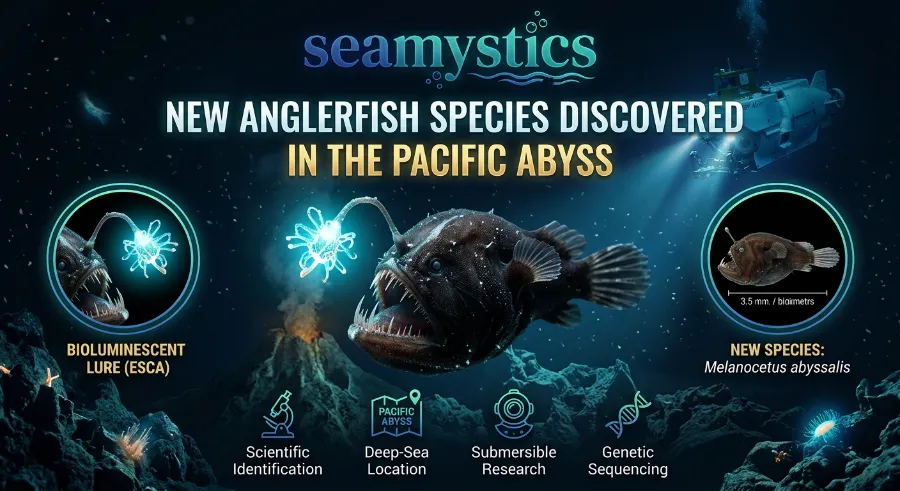

The deep Pacific just got a little stranger, and a lot more interesting. Somewhere past 1,000 meters, in water so dark it swallows every wavelength of light, researchers found a fish that matched nothing in the taxonomic record books. A new anglerfish species usually enters science this way. It shows up quietly in a sample jar, long before anyone realizes what they are holding.
New Bioluminescent Species Found How Scientists Confirm Glowing Animals
I have spent two decades studying deep sea fish under a dissecting scope, and this moment never gets old. A crew hauls up a trawl net. They sort through the jelly and mud. Then one fish simply does not fit, and that single specimen can rewrite a small piece of what we know about life in the abyss.
Key Takeaways
| Point | Detail |
|---|---|
| What was found | A previously unrecorded anglerfish species with a unique double lure structure |
| Where | Deep Pacific waters, in the broader Clarion Clipperton Zone region |
| Depth range | Roughly 1,000 to 1,500 meters, the mesopelagic to bathypelagic boundary |
| Who found it | University of Hawaii Mānoa oceanography team, led by researcher Samantha Rickle |
| Why it matters | Signals how much of the deep sea, including areas eyed for mining, remains undocumented |
| Current species count | Around 170 known anglerfish species worldwide, with new ones still turning up |
TL;DR: Scientists recently confirmed a new anglerfish species from the Pacific abyss. It carries an unusual double bait lure that no one had recorded before in this group. The find came from a 2021 research cruise, researchers described it formally in 2024, and a global panel named it to a top 10 list of remarkable new marine species in 2025. It reminds us that the deep ocean, especially the sections targeted for future mining, still hides far more life than we have counted.
Why Deep Sea Anglerfish Keep Surprising Scientists
Anglerfish are the poster child of the deep ocean, and for good reason. Their bioluminescent lure, called an esca, dangles from a rod above the head and glows to pull curious prey close enough to grab. For most of the 20th century, biologists assumed the anglerfish body plan had settled into a fixed pattern. Then specimens like this one kept turning up and proved otherwise.
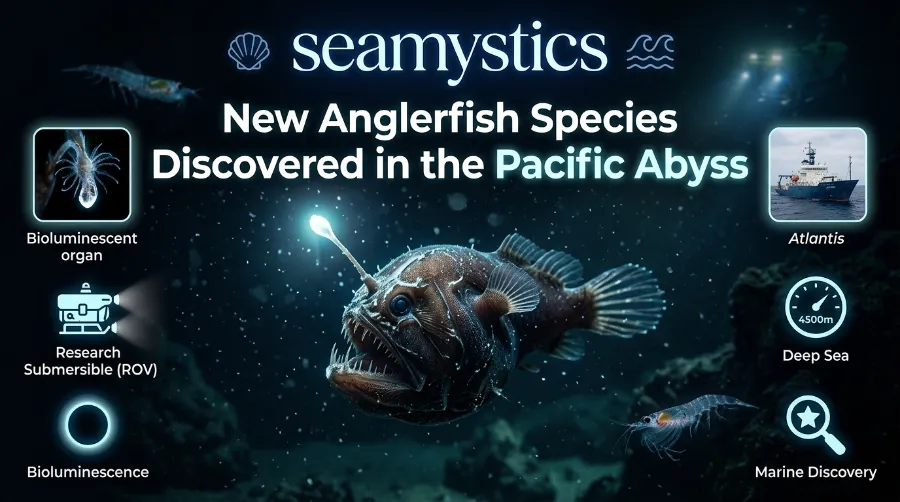
A research cruise collected the fish behind this latest anglerfish discovery Pacific researchers back in 2021, in the Clarion Clipperton Zone, a stretch of abyssal seafloor southeast of Hawaii that spans roughly the size of the continental United States. That cruise was not even hunting for new species. Its main goal was building an ecological baseline ahead of proposed deep sea mining in the region, according to the University of Hawaii News team.
Newly Described Sea Spider Species and Why They’re Larger Than Expected
The fish waited years for its moment. Graduate researcher Samantha Rickle was sorting specimens from that cruise when one fish stopped her cold. Under the microscope, its lure carried two separate baits instead of the usual one, a structure no one had documented before in the Gigantactis group. That detail alone confirmed this was deep sea anglerfish new to science, and researchers eventually named it Gigantactis paresca, Latin for paired bait.
New Anglerfish Species Discovered in the Pacific Abyss
Inside the New Discovery: What Makes This Anglerfish Different
Most anglerfish rely on a single glowing lure to hunt in total darkness. This species breaks that pattern. It carries a second, non-luminous bait attached near the primary one, a setup no one had recorded in the genus before. These small structural differences matter more than they sound. They hint at a different hunting strategy, one that may target prey that respond to motion or shape rather than light alone.
A few real numbers help put the discovery in context:
- Researchers collected the specimen in 2021 and published it as a new species in 2024.
- The World Register of Marine Species named it among the top 10 remarkable new species of 2024, announced in early 2025.
- Scientists estimate the ocean produces roughly 2,000 new marine species descriptions every year, and this fish counted as one of them.
- The Clarion Clipperton Zone alone covers about 4.5 million square kilometers of seafloor, and surveys have directly examined only a fraction of it.
This is not an isolated case either. Deep trawl surveys in the Gulf of Mexico have turned up new anglerfish repeatedly over the past decade. Researchers Theodore Pietsch and Tracey Sutton described Lasiognathus dinema in 2015 from three female specimens they collected during post Deepwater Horizon surveys. The fish carried upturned, tooth like spines that gave it an almost cartoonish snarl. Sutton’s team pulled that survey work from waters below 1,000 meters, and the single project turned up roughly 50 species no one had recorded before in the Gulf. Patterns like that show why an abyssal anglerfish found in one ocean basin rarely stays a one off story for long.
Where This Fits in the Bigger Picture of Ocean Exploration
Every confirmed new species nudges the overall anglerfish species count a little higher, and right now that count sits around 170 recognized species globally, spread across roughly 11 families and 35 genera of ceratioid anglerfish. Researchers openly admit that number is a moving target. New surveys keep finding fish that match no known description, so the true total likely runs higher than the published figure.
Museum Specimens Reclassified Old Samples That Turned Out to Be New Species
Depth explains much of why the count keeps climbing. Most anglerfish live between 200 and 2,000 meters down, a zone that receives no sunlight and carries enormous pressure. That combination makes surveys expensive and slow compared to shallow reef work. Submersibles, trawl nets, and remotely operated vehicles each capture only a narrow slice of that habitat per dive. Our guide on first photos of new species walks through the tools researchers use to photograph and catalogue life at these depths for the first time.
New Ray Species Identified Off Unexpected Coastlines
There is also a genetics angle to this story that rarely makes headlines. In 2020, researchers from the University of Washington and the Max Planck Institute found that deep sea anglerfish evolved a stripped down immune system. The fish lost key antibody functions, but in exchange, males and females gained the ability to fuse tissue without triggering rejection, a phenomenon called sexual parasitism, as the University of Washington fish research team explained. That single adaptation solves a reproductive problem that would otherwise be nearly impossible in an environment where males and females almost never cross paths.
A Quick Look at Recent Anglerfish Discoveries
| Species | Location | Year Described | Notable Trait |
|---|---|---|---|
| Gigantactis paresca | Pacific, Clarion Clipperton Zone | 2024 | First recorded double bait lure |
| Lasiognathus dinema | Northern Gulf of Mexico | 2015 | Upturned spine like teeth |
| Photocorynus spiniceps | Pacific | Described earlier, still studied | Extremely small parasitic males |
| Multiple Oneirodidae specimens | Northern Gulf of Mexico | Ongoing DEEPEND surveys | Bioluminescent bacterial symbionts |
These finds are not random luck. Groups like the DEEPEND Consortium run multi year trawl programs specifically to build a time series of deep Gulf biodiversity. That structured, repeat effort is exactly how anglerfish discoveries keep happening in that region, even though the fish themselves remain genuinely rare.
What This Means for Ocean Science and Conservation
Here is the part that should matter to anyone who cares about ocean policy, not just fish nerds like me. The Clarion Clipperton Zone, where this new anglerfish turned up, also ranks as one of the most heavily targeted regions for future seabed mineral mining. Regulators use baseline biodiversity surveys, exactly the kind of cruise that found this fish, to judge environmental risk before mining licenses move forward.
Undersea Volcano Discoveries New Species Found Near Hydrothermal Vents
In other words, every undiscovered species in that zone represents a species we currently have zero data on protecting. Samantha Rickle put it plainly in her comments to the University of Hawaii team. She said the discovery highlights how much remains unknown about a region that may soon face industrial activity. That is not an exaggeration. It is a fair summary of where deep sea policy currently stands.
A few practical takeaways for readers who want to follow this space:
- Track species counts through the World Register of Marine Species, which publishes an annual top 10 list of standout new marine finds.
- Follow university oceanography departments directly, since most deep sea discoveries appear there months before they hit mainstream outlets.
- Watch survey locations, not just species names, since repeated finds in one basin usually signal an active, well funded monitoring program.
Our piece on how scientists name new octopus species covers the same review process anglerfish researchers follow once they confirm a find like this one. And if bizarre deep sea body plans interest you, our breakdown of a recently identified new nudibranch species makes a good next read.
A Field Perspective
I have processed enough trawl samples to know that most jars from a deep cruise hold nothing unusual. Out of hundreds of specimens, maybe one or two per expedition turn out to be genuinely new. That ratio explains why a discovery like Gigantactis paresca deserves real coverage instead of a quick mention. It represents real hours at a microscope, real doubt, and a real moment of confirmation once the description clears peer review.
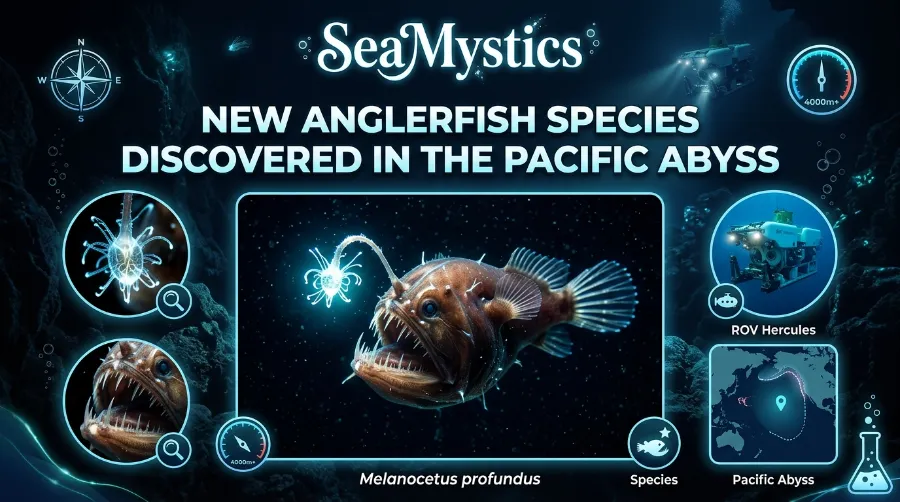
What strikes me most about this case is the timeline. Three years passed between the trawl and the published description. That gap is normal in taxonomy, but it also means the deep Pacific likely holds several more undescribed specimens right now. They sit in museum collections, waiting for someone to notice the one detail that does not match. Our guide on new abyssal species covers the full pillar breakdown of how these finds get confirmed from net to name.
Frequently Asked Questions
What is the new anglerfish species found in the Pacific called?
Researchers named it Gigantactis paresca. The University of Hawaii Mānoa team formally described it in 2024 from a specimen they collected in 2021.
How deep do these new anglerfish live?
Most deep sea anglerfish, including this species, live between roughly 1,000 and 1,500 meters down, well below where sunlight reaches.
How many anglerfish species exist today?
Around 170 species carry recognized status today, though that number keeps rising as new surveys reach previously unstudied parts of the ocean floor.
Why does this discovery matter for ocean conservation?
The fish turned up in the Clarion Clipperton Zone, an area under consideration for deep sea mining. Every new species found there adds urgency to completing biodiversity surveys before industrial activity begins.
Are new anglerfish species still turning up regularly?
Yes. Between Pacific surveys and ongoing Gulf of Mexico research through groups like the DEEPEND Consortium, new anglerfish specimens appear almost every year.
Conclusion
A new anglerfish species from the Pacific abyss offers more than a strange looking fish with an odd lure. It gives us a snapshot of how little of the deep ocean we have actually surveyed, and how much depends on researchers willing to spend years sorting through trawl samples one jar at a time. As mining interest in zones like Clarion Clipperton grows, discoveries like this one carry real weight beyond the science pages. The next unnamed species is very likely already sitting in a specimen jar somewhere, waiting for its turn under the microscope.
References
- University of Hawaii News, “UH-discovered deep-sea anglerfish named to top 10 remarkable species list,” March 2025.
- DEEPEND Consortium, “New Anglerfish Discovered During Ongoing Research in the Gulf of Mexico.”
- University of Washington, School of Aquatic and Fishery Sciences, “Deep-sea anglerfishes have evolved a new type of immune system,” July 2020.
- World Register of Marine Species, Top 10 New Marine Species list, 2024.