
Every time a research submarine drops below 2,000 meters near an undersea volcano, there’s a decent chance the crew will meet an animal that science has never named. That is not an exaggeration. It is the normal outcome of hydrothermal vent expeditions over the last decade, and it is exactly why hydrothermal vent species keep reshaping what marine biologists thought they knew about life on this planet.
TL;DR: Hydrothermal vent species are still being discovered at a fast pace, often several new species per expedition, because these undersea volcano ecosystems run on chemosynthesis instead of sunlight. Recent finds span the Gulf of California, the Galápagos, Antarctica, and the Indian Ocean, and each one reshapes how scientists think life might survive in extreme environments, including on other worlds.
Key Takeaways
| Discovery | Location | Year | New Species Found | Notable Detail |
|---|---|---|---|---|
| Pescadero Basin vents | Gulf of California | 2018 | 6+ candidate species | Named after Indigenous Yuman languages |
| Galápagos mapping survey | Galápagos Marine Reserve | 2021 | 15+ unknown species | Used high-resolution seafloor mapping |
| Longqi vent field | Southwest Indian Ocean | 2011 | 6 new species | Site of planned deep-sea mining |
| East Scotia Ridge | Southern Ocean, Antarctica | 2011 | New yeti crab, sea stars | First hydrothermal vent fauna found in Antarctic waters |
| South Sandwich Islands | Southern Atlantic | 2024 | Multiple corals, sponges, snails | Vents found at 700 meters, chimneys 4 meters tall |
| Onnuri Vent Field | Indian Ocean (Central Indian Ridge) | 2025 | New copepod genus | Tiny meiofauna often overlooked in vent surveys |
What Makes Hydrothermal Vent Life So Different
Sunlight never reaches these depths, so ordinary food chains do not work down there. Instead, undersea volcano life runs on chemosynthesis, a process where bacteria convert chemicals like hydrogen sulfide, pouring out of the seafloor, into energy. Everything else in the vent ecosystem discovery story builds on that one trick.
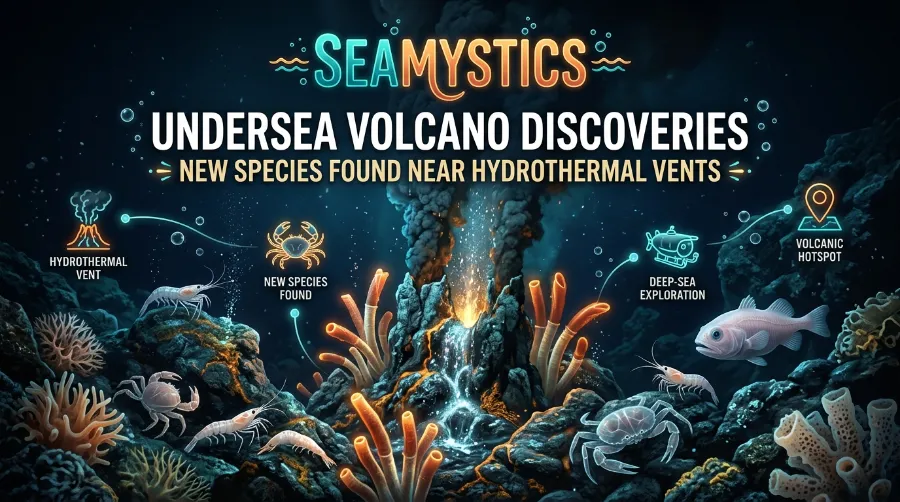
Giant tubeworms, ghostly white crabs, and eyeless shrimp all depend on these bacteria, either by hosting them internally or by grazing on bacterial mats. It is a strange, closed-loop economy that has nothing to do with the sun, which is part of why hydrothermal vent life keeps surprising researchers who expect deep water to be mostly empty.
For a broader look at how these ecosystems function day to day, WHOI’s ocean learning hub on hydrothermal vent life is one of the clearer public resources on the topic, and Oceana’s overview of deep hydrothermal vents covers the conservation angle well.
Recent New Vent Species Discoveries, With Real Dates
Gulf of California, 2018
A joint Mexican and U.S. team aboard Schmidt Ocean Institute’s research vessel Falkor spent 33 days off the coast of La Paz and came home with six or more candidate new vent species, including polychaete worms, arrow worms, crustaceans, and roundworms. They also found ten known species living somewhere new to science, in the Pescadero Basin.
Museum Specimens Reclassified Old Samples That Turned Out to Be New Species
One of the largest new vent mounds they mapped was named Maija awi, after a water serpent from Kumiai creation stories, since the terrain resembled a dragon. Another nearby vent field, ‘Melsuu, was named for the Kiliwa word for blue, after the number of iridescent blue worms found clustered there. Naming choices like these are a small but telling detail: teams increasingly draw on the languages of Indigenous communities connected to the region instead of defaulting to Latin or expedition-leader surnames.
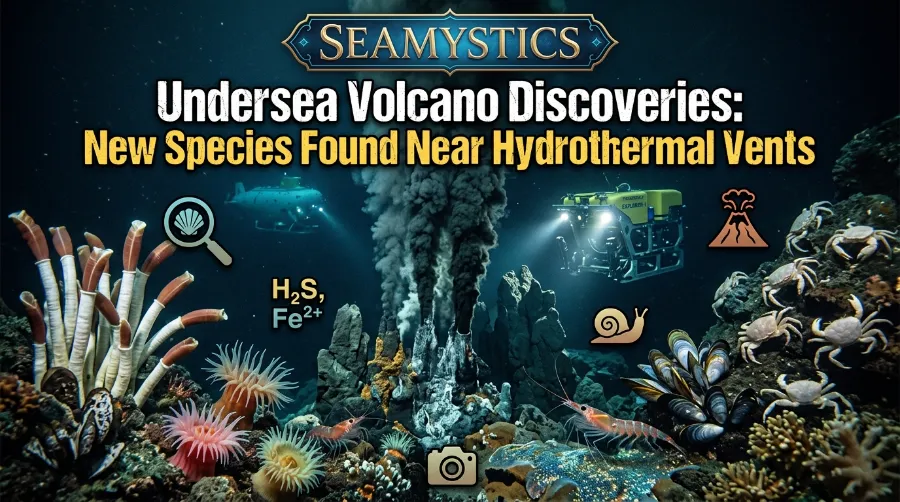
Undersea Volcano Discoveries New Species Found Near Hydrothermal Vents
If you want to see how one of these discoveries gets formally described and named, our octopus species naming guide walks through that process step by step.
Galápagos Marine Reserve, 2021
Using high-resolution seafloor mapping technology, a research team located new hydrothermal vents around the Galápagos and documented at least 15 unknown species living among them. The mapping approach matters here almost as much as the biology, since better maps mean researchers can target dives more precisely instead of searching blind.
New Ray Species Identified Off Unexpected Coastlines
Southwest Indian Ocean, 2011
Researchers from the University of Southampton, the Natural History Museum in London, and Newcastle University found six new animal species at a vent field called Longqi, or “dragon’s breath,” roughly 1,200 miles southeast of Madagascar and 9,200 feet down. Alongside the new arrivals, they also confirmed known species already recorded thousands of miles away, including a scaleworm from Antarctic vents and a ragworm from Pacific vents. That kind of overlap tells scientists something important about how vent larvae travel between distant, isolated ecosystems.
Longqi is also notable for a less happy reason. It sits in an area already earmarked for future seafloor mining, which puts a hard deadline on documenting these hydrothermal vent species before mining activity potentially disturbs them.
East Scotia Ridge, Antarctica, 2011
This expedition described the first hydrothermal vent community ever found in Antarctic waters, dominated by a new species of yeti crab, stalked barnacles, limpets, snails, sea anemones, and a seven-armed predatory starfish. Interestingly, animals that are common at Pacific, Atlantic, and Indian Ocean vents, like giant Riftia tubeworms and vent mussels, were completely absent here. That absence is a discovery in its own right, since it suggests Southern Ocean vent ecosystems evolved along a separate path.
South Sandwich Islands, 2024
A 35-day expedition to one of the most remote island chains on Earth turned up new hydrothermal vents at 700 meters depth, with the tallest chimney measuring four meters. Researchers documented coral gardens alongside the vents, along with new species of sponges, snails, urchins, and sea stars, all clustered around chemosynthesis-driven habitats.
Our team covered a related dive in more depth in this deep-sea expedition recap, including how remote polar logistics change what a survey team can bring down with them.
Onnuri Vent Field, Indian Ocean, 2025
A more recent, smaller-scale but scientifically important find: researchers described a brand-new genus of hydrothermal copepod, Parabathyesola calida, from the Onnuri Vent Field on the Central Indian Ridge. Copepods are tiny meiofauna, easy to overlook next to giant tubeworms, but they make up a large share of vent biodiversity that rarely gets media attention.
Why New Vent Species Keep Turning Up
A few practical reasons explain why the discovery rate has stayed high instead of slowing down:
- Mapping technology has improved enough that researchers can locate promising vent fields before ever sending a submersible down, which used to require expensive, slow, blind searching.
- Remotely operated vehicles can now collect samples at depths and temperatures that would be dangerous or impossible for crewed submersibles.
- Many vent fields sit along mid-ocean ridges that stretch for thousands of kilometers, and only a small fraction of that terrain has ever been surveyed closely.
- International collaborations, pairing local research institutes with larger vessels like Falkor, have made expeditions to remote regions more frequent.
For a closer look at the technology driving this, our piece on new sea spider discoveries covers how ROV sampling arms handle delicate specimens without destroying them on the way up.
What This Means Beyond Biology
Vent ecosystems matter for reasons that go past cataloguing new animals. NASA and other space agencies study chemosynthesis-based life as a working model for how life might survive on ocean worlds like Europa or Enceladus, where sunlight never reaches the water either. National Geographic’s education resource on deep-sea hydrothermal vents covers this astrobiology connection in accessible detail if you want to go further down that path.
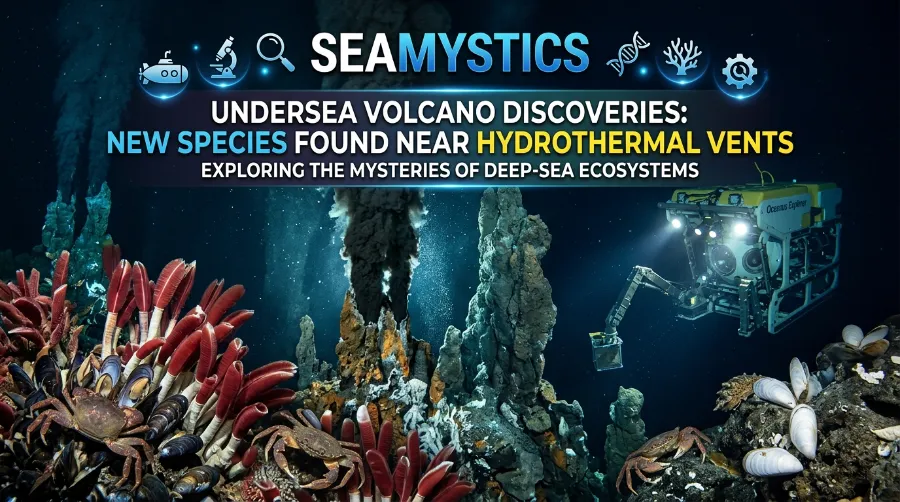
There is also a conservation clock running. Several known vent fields, including Longqi, sit inside zones already licensed or under consideration for polymetallic nodule and sulfide mining. Every hydrothermal vent species documented before mining begins becomes part of the baseline record used to judge environmental impact later. Skip the documentation step, and regulators lose the ability to measure what was lost.
Related discoveries worth a look if this topic interests you:
- New nudibranch species, some of which live near shallower hydrothermal seeps
- New anglerfish species, found well outside vent zones but in similarly extreme deep water
- New bioluminescent species, for animals that generate their own light instead of relying on chemosynthesis
- Our full pillar guide to new abyssal species for the broader deep-sea discovery picture
Frequently Asked Questions
What is a hydrothermal vent species?
It is any organism adapted to live at or near an undersea hydrothermal vent, typically relying directly or indirectly on chemosynthetic bacteria for energy rather than sunlight.
How many hydrothermal vent species have been discovered so far?
The number keeps climbing every year. Individual expeditions regularly report six to fifteen new species candidates, and formal taxonomic description can take years after initial collection.
Why do scientists find so many new species near undersea volcanoes?
Vent fields are isolated, extreme, and largely unmapped. Each newly surveyed ridge segment tends to host its own distinct community, since larvae often cannot travel far between vents.
Are hydrothermal vent ecosystems under threat?
Yes, in specific locations. Some known vent fields overlap with areas licensed for deep-sea mineral mining, which has pushed researchers to document biodiversity there before extraction activity begins.
Conclusion
Hydrothermal vent species are not a closed chapter in marine biology, they are one of its most active frontiers. From the Gulf of California to Antarctica’s East Scotia Ridge to the recently described Onnuri copepod, each expedition adds names to a list that started with the first vent discovery back in 1977 and still has no visible end. As mapping technology improves and more remote ridges get surveyed, the undersea volcano life we know about today is likely a small fraction of what is actually down there.
References
- Schmidt Ocean Institute, “Scientists Discover New Hydrothermal Vents and Possible New Species in the Gulf of California”
- Darwin Foundation, “Scientists Find New Hydrothermal Vents and 15 Unknown Species,” Galápagos Marine Reserve
- Gizmodo, “Bizarre New Deep Sea Creatures Found in Unexplored Hydrothermal Vents,” Longqi vent field
- PMC / Southern Ocean hydrothermal vent fauna study, East Scotia Ridge
- Schmidt Ocean Institute, “New Coral Gardens and Hydrothermal Vents Found in the Icy Depths of the South Sandwich Islands”
- ZooKeys, “Discovery of a New Hydrothermal Copepod from the Indian Ocean,” Onnuri Vent Field, 2025
- WHOI Ocean Learning Hub, Hydrothermal Vent Life
- Oceana, Deep Hydrothermal Vent
- National Geographic Education, Deep-Sea Hydrothermal Vents