
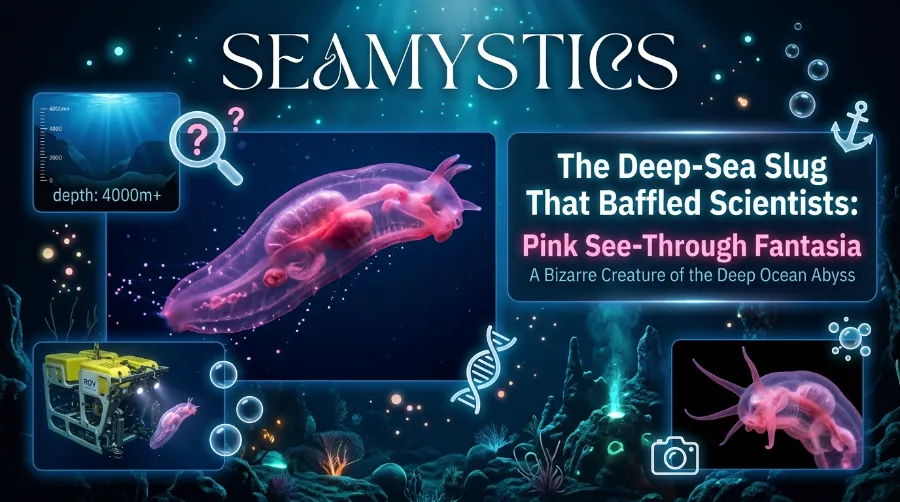
Picture a camera drifting two and a half kilometers below the surface of the Celebes Sea. Suddenly, something glows a soft, bruised pink in the dark. Its skin is so thin that you can watch its gut work in real time. Researchers on that 2007 expedition gave it a nickname: the pink see through fantasia. Almost two decades later, scientists are still learning new things about it.
Coffinfish Facts: The Deep-Sea Fish Nobody Expects
First, a quick correction. This is not actually a slug, even though the nickname has stuck. Instead, it is a swimming sea cucumber, and it is a distant cousin of starfish and urchins. Because of this, it counts as one of the strangest animals ever filmed on the ocean floor. So if you have ever wondered how a transparent sea slug survives at crushing depths, or why a glass sea creature would evolve to glow, this guide breaks down what scientists know today.
Barreleye Fish Facts: The Fish With a Transparent Head
TL;DR: The pink see through fantasia (Enypniastes eximia) is a translucent, swimming deep sea sea cucumber. It lives between roughly 500 and 5,700 meters down. Its see-through skin exposes its digestive tract, and it swims using winglike fins instead of crawling. It also uses bioluminescence to startle predators rather than to hunt. Even so, scientists still don’t fully understand its lifespan or reproduction.
Key Takeaways
| Fact | Detail |
|---|---|
| Scientific name | Enypniastes eximia |
| Common nicknames | Pink see through fantasia, headless chicken monster, Spanish dancer |
| Depth range | 461 to roughly 5,700 meters |
| Body length | 11 to 25 centimeters |
| Diet | Detritus (organic debris on the seafloor) |
| Defense mechanism | Bioluminescent “paint” that marks predators for other predators |
| First documented | 2007, Celebes Sea expedition |
| Conservation status | Not formally assessed (data deficient) |
What Exactly Is the Pink See-Through Fantasia?
The pink see through fantasia belongs to the genus Enypniastes. In fact, it is the only known member of that genus. This places it in the same broad family as sea cucumbers, so it sits closer to starfish and urchins than to any slug. Researchers at the Woods Hole Oceanographic Institution have documented the species across several deep-sea expeditions. Their footage still gives us the clearest picture of how it actually moves.
What truly sets it apart, though, is its lifestyle. Most sea cucumbers crawl slowly along the seafloor. This one swims instead. It has evolved webbed, fin-like structures at both ends of its body, and it uses them to lift completely off the mud. From there, it can glide up to a thousand meters higher in the water column. Scientists believe this behavior helps it reach fresh feeding grounds while also dodging bottom-dwelling predators.
Giant Isopod Facts: The Deep-Sea Relative of the Pill Bug
Interestingly, its color changes as it ages, and this detail trips up a lot of casual descriptions online. Young animals appear a vivid, almost neon pink. As they mature, however, they shift toward a deeper reddish brown. So two photos labeled “pink see through fantasia” can look like completely different animals, yet both are correct.
Why Is This Deep Sea Sea Cucumber Transparent?
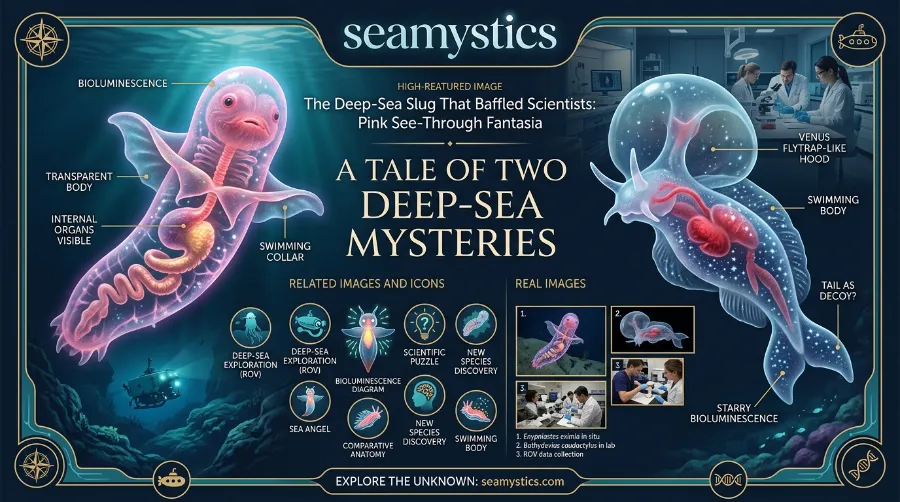
The see-through body remains the most talked-about feature, and for good reason. Its skin is thin enough that you can watch its intestines process sediment live, almost like a moving anatomy diagram. Its mouth, gut, and anus are all visible from the outside. Understandably, this detail either fascinates people or makes them a little queasy.
Zombie Worm Facts: The Creature That Eats Whale Bones
Transparency at depth is not just decorative. In the deep sea, where almost no sunlight reaches, being see-through works like a form of camouflage. A solid, pigmented body would still cast a visible silhouette against faint bioluminescent glow from other organisms. A transparent one does not.
However, there is a real cost to this strategy. A body this delicate stays extremely fragile. Because of this, ROV pilots have to move carefully, since contact with equipment or a sudden shift in pressure can damage the animal’s skin.
Sea Pig Facts: The Deep-Sea Cucumber That Looks Like a Toy
How Does This Glass Sea Creature Defend Itself?
Since it has no shell, no spines, and barely any structural rigidity, the pink see through fantasia relies almost entirely on bioluminescence for defense. Its skin holds granular cells that glow on demand, and the effect works less like a flashlight and more like a warning flare.
When a predator attacks, the creature can shed a sticky, luminous “paint” onto it. This glow does not harm the predator directly. Instead, it makes that predator visible to other, larger predators nearby. Essentially, the attacker becomes an easy target for something bigger.
A few other survival traits stand out:
- It can rise off the seafloor almost instantly when disturbed, thanks to its fin-like webbing.
- It appears to shed waste while fleeing, likely to reduce weight and swim faster.
- Its glow may also help with navigation, not just defense, in total darkness.
Where Does the Pink See-Through Fantasia Live?
This species holds one of the widest depth ranges recorded for any swimming sea cucumber. So far, it has been documented from roughly 461 meters down to nearly 5,700 meters. It spans temperate and tropical waters across the Atlantic, Pacific, and Indian Oceans. During the original 2007 discovery, researchers found it around 2,500 meters deep in the Celebes Sea, off Indonesia, near the Sulu Archipelago and Sulawesi.
Fangtooth Fish Facts: The Small Fish With the Biggest Teeth
It generally prefers soft, sediment-covered seafloor known as the abyssal plain. There, organic material, often called marine snow, settles after drifting down from the surface for weeks or months. Since that constant rain of debris is its food supply, this habitat suits it well.
Here is a quick comparison against two other deep-sea oddities readers often search for alongside it:
| Species | Typical depth | Notable trait |
|---|---|---|
| Pink see through fantasia | 461 to 5,700 m | Transparent, swimming sea cucumber |
| Frilled shark | 120 to 1,570 m | Living fossil with snake-like body |
| Dumbo octopus | 3,000 to 4,000 m | Ear-like fins, deepest-living octopus known |
If frilled sharks and dumbo octopuses already fascinate you, check out our frilled shark facts guide and dumbo octopus facts guide. Both cover animals that share this same extreme, lightless world.
What Does It Eat, and How Does It Feed?
Like other sea cucumbers, the pink see through fantasia is a detritivore. It uses its oral tentacles to sweep sediment off the seafloor, then extracts whatever organic matter hides inside. In short, it eats mud for the nutrients mixed into it. Because its body is transparent, researchers can literally watch this digestion happen without dissecting a single specimen. As a result, it has become an accidental teaching tool for deep-sea biology students.
What Scientists Still Don’t Know
Despite all the attention this creature gets online, the actual scientific record stays thin. No one has confirmed how long it lives. Similarly, nobody has directly observed its reproduction in the wild. Population size remains largely unknown, and the species has not been formally assessed for conservation status, mainly because so few specimens have ever been studied up close.
This gap matters more than it might seem at first. Deep-sea ecosystems like this one face growing pressure from seabed mining exploration and deep trawling. Yet a species we cannot fully assess is also a species we cannot properly protect, and that puts marine science in an uncomfortable position heading into 2025, as interest in deep-sea mineral extraction keeps accelerating.
Why the Pink See-Through Fantasia Keeps Going Viral
Every couple of years, footage of this animal resurfaces online and racks up millions of views. Usually, the clips come from ROV missions run by NOAA’s Okeanos Explorer program. This happened after the original 2007 discovery, and it has repeated many times since, as expedition footage gets re-shared. Part of the appeal is simple: the animal looks unreal, almost like a special effect, so people often assume each clip shows something brand new.
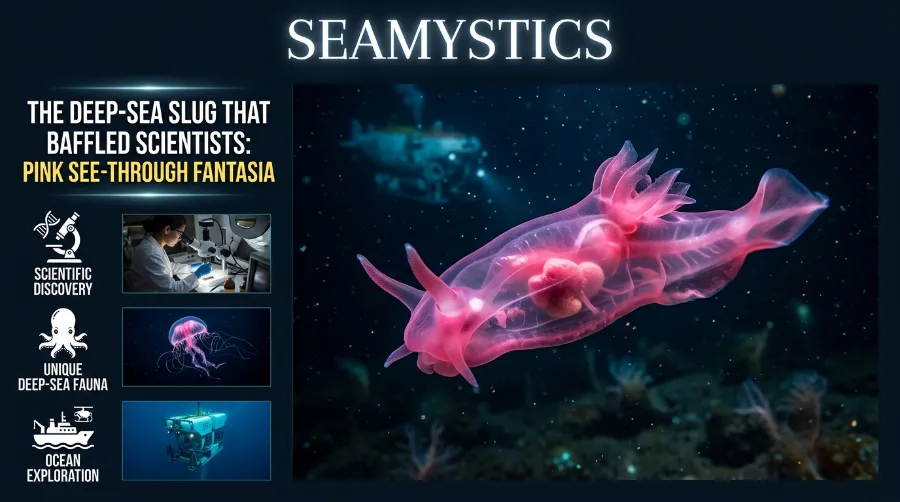
In reality, though, it is neither new nor especially rare within its depth range. It is simply hard to see. Almost nobody encounters this creature outside a research submersible or a deep-sea documentary, which is exactly why every fresh video feels like a new discovery.
For a closer, well-documented look at the animal, EarthlyMission has put together a detailed photo breakdown of the species. Meanwhile, Woods Hole Oceanographic Institution has published footage and background from its own deep-sea missions. If you prefer listening over reading, the University of Texas Marine Science Institute also covers the species in an episode of its Science and the Sea radio program.
If this kind of animal grabs your attention, our full bizarre sea creatures guide rounds up dozens of similarly strange deep-ocean species. It makes a good next stop after this one.
Frequently Asked Questions
Is the pink see through fantasia a slug or a sea cucumber?
It is a sea cucumber, not a slug. The nickname stuck because of its slug-like swimming motion, but scientifically, it belongs to the same group as starfish and urchins.
Can you keep a pink see-through fantasia in an aquarium?
No. It only survives at extreme depth and pressure, so it has never been kept in captivity long-term.
Is it dangerous to humans?
Not at all. It has no venom and no bite, and it cannot reach a human diver, since it lives thousands of meters below typical dive limits.
Why is it also called the headless chicken monster?
Its shape and movement, especially in low-resolution ROV footage, resemble a plucked, headless chicken drifting through water. ROV pilots coined the nickname, and it eventually spread online.
How rare is this creature?
It is not considered rare within its habitat. However, its extreme depth range makes sightings uncommon and hard to document.
Conclusion
The pink see through fantasia reminds us that some of the most alien-looking life on Earth does not require a telescope to find, just a submersible and a lot of patience. It is a transparent sea slug that is not actually a slug. It is also a glass sea creature that defends itself by lighting up its enemies, and a deep sea sea cucumber that scientists still cannot fully explain after nearly two decades of study. That mix of familiar biology and lingering mystery probably explains why this animal keeps resurfacing in headlines every time a new expedition camera catches it drifting through the dark.
References
- Woods Hole Oceanographic Institution, “In the Pink” multimedia collection, https://www.whoi.edu/ocean-learning-hub/multimedia/in-the-pink-2/
- EarthlyMission, “Pink See-Through Fantasia: Dweller of the Deep Sea Whose Organs Are Visible,” https://earthlymission.com/pink-see-through-fantasia-dweller-deep-sea-organs-visible/
- University of Texas Marine Science Institute, “Science and the Sea: Fantasia,” https://utmsi.utexas.edu/science-and-the-sea/radio-program/fantasia/
- Animalia.bio, “Enypniastes,” https://animalia.bio/enypniastes
- iNaturalist, “Headless Chicken Monster (Enypniastes eximia),” https://www.inaturalist.org/taxa/901109-Enypniastes-eximia