
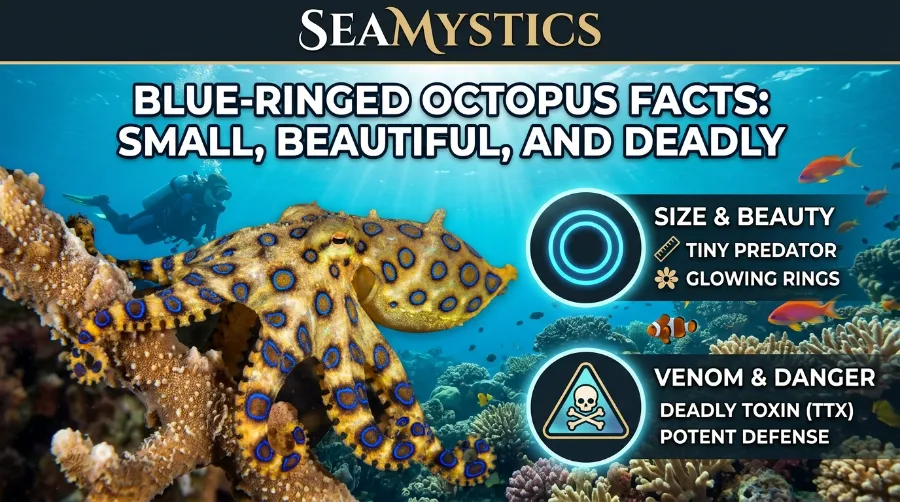

Picture a creature no bigger than a golf ball, sitting quietly in a tide pool. It looks about as threatening as a seashell. Then it flashes electric blue rings across its skin, and suddenly you understand why the blue-ringed octopus has earned a reputation few animals in the ocean can match. This small mollusk carries a venom strong enough to kill dozens of grown adults, yet it would rather hide than fight.
At Sea Mystics, we spend our days studying creatures like this one. We wanted to pull together everything worth knowing in one place. Below, you will find real case studies, field notes, current medical data, and practical safety advice, all explained in plain language.
Key Takeaways
| Fact | Detail |
|---|---|
| Size | Roughly 5 to 20 cm (2 to 8 inches), about the length of a pencil |
| Venom | Tetrodotoxin, roughly 1,200 times more toxic than cyanide |
| Lethal potential | Enough venom in one bite to kill up to 26 adult humans |
| Antivenom | None currently exists; treatment is supportive care |
| Habitat | Tide pools and coral reefs across the Pacific and Indian Oceans |
| Number of species | At least 10 recognized species in the genus Hapalochlaena |
| Lifespan | Around 2 years in the wild |
TL;DR: The blue-ringed octopus is a small, shy cephalopod that lives in tide pools from Australia to Japan. Its bite injects tetrodotoxin, a neurotoxin with no antivenom that can paralyze a person within minutes. Most bites happen when someone picks the animal up or corners it, so prevention and fast medical care matter most.
What Is a Blue-Ringed Octopus?
The name covers a small group of octopuses in the genus Hapalochlaena. Researchers currently recognize around ten species, though only two or three show up in most field guides. The two most commonly discussed are the greater blue-ringed octopus (Hapalochlaena lunulata) and the lesser, or Southern, blue-ringed octopus (Hapalochlaena maculosa). Oddly enough, the “lesser” species is usually the larger of the two, since its rings are simply smaller.
Fire Coral Facts: Why It Burns and How to Treat It
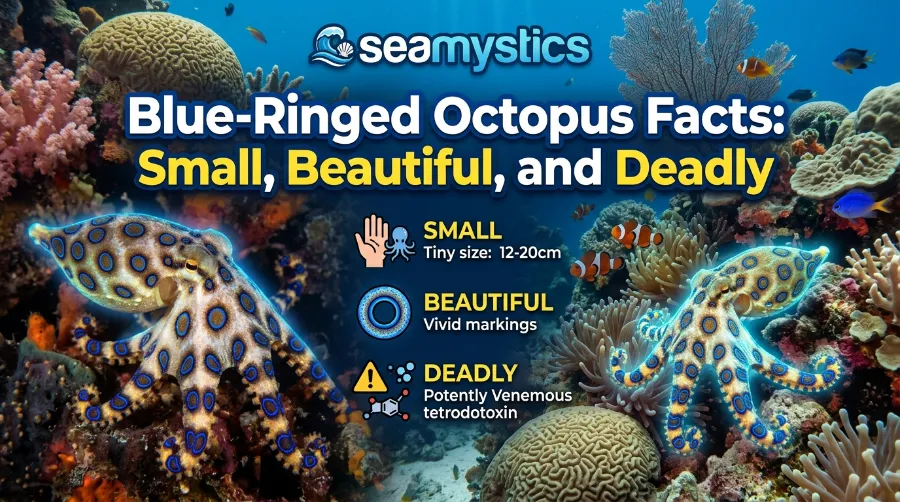
When resting, this octopus looks unremarkable. Its skin turns a dull yellow-brown or beige, and it blends into sand, rubble, and rock so well that most swimmers walk right past one. However, the moment it feels threatened, its skin flashes bright, pulsing blue-and-black rings within a fraction of a second. That flash is not decoration. It is a warning, and it means the animal wants to be left alone.
Weever Fish Facts: The Hidden Danger Buried in Sand
Blue-Ringed Octopus Habitat: Where This Tiny Predator Lives
The blue-ringed octopus habitat stretches across the shallow coastal waters of the Indo-Pacific. You can find it from Australia and Papua New Guinea up through Indonesia, the Philippines, and Japan. It also turns up around Sri Lanka and parts of Southeast Asia. Divers who visit muck-diving hotspots such as the Lembeh Strait in Indonesia often list this octopus as a top target for underwater photography.
These animals favor shallow tide pools, coral rubble, seagrass beds, and rocky crevices. They tuck themselves out of sight during the day because they are mostly nocturnal. They spend daylight hours resting inside empty shells, discarded bottles, or narrow rock gaps. This habit sometimes puts them in direct contact with people, since a hand reaching into a “harmless” rock crevice can accidentally provoke one.
A few habitat highlights worth remembering:
- They prefer water depths of less than 20 meters, which puts them within reach of snorkelers, not just scuba divers.
- Sandy or muddy substrates near reefs give them ideal camouflage and easy access to crabs and small fish.
- Marine debris, including bottles, cans, and abandoned fishing gear, often becomes makeshift shelter. This connects directly to a bigger problem explored in our guide on the fishing bycatch problem.
- They rarely wander into open water, so most encounters happen at the shoreline.
Blue-Ringed Octopus Venom: Why It’s Called the Deadliest Small Octopus
Here is where the story turns serious. Blue-ringed octopus venom relies on tetrodotoxin (TTX), the same neurotoxin found in pufferfish. Bacteria living inside the octopus’s salivary glands genuinely produce this toxin, not the octopus itself. A fact-check published by Snopes in June 2024 confirmed the numbers with the Aquarium of the Pacific. A single bite can deliver enough toxin to kill roughly 26 adult humans, and the toxin measures about 1,200 times more potent than cyanide.
Cone Snail Facts: The Shell That Can Kill in Minutes
How the Venom Works
What makes this animal earn the label of deadliest small octopus is not aggression. It is efficiency. TTX blocks sodium channels in nerve cells, and this stops muscles from receiving signals from the brain. The paralysis can progress and reach the diaphragm, which can stop breathing entirely within 10 to 20 minutes of a bite, according to the Aquarium of the Pacific’s species profile. No antivenom exists for TTX, so doctors treat every bite as a medical emergency.
A quick comparison helps put this venom in perspective:
| Toxin Source | Approximate Toxicity vs. Cyanide | Antivenom Available? |
|---|---|---|
| Blue-ringed octopus (tetrodotoxin) | ~1,200x more toxic | No |
| Box jellyfish (cnidarian venom) | Varies by species, extremely fast-acting | Yes, in some regions |
| Inland taipan snake | Highly potent, different mechanism | Yes |
| Pufferfish (also tetrodotoxin) | ~1,200x more toxic | No |
If you want to see how this compares to another dangerous ocean animal, our team broke down a similar threat profile in box jellyfish facts.
Blue Ring Octopus Bite: Symptoms, First Aid, and Real Cases
A blue ring octopus bite often feels painless at first, and that is exactly what makes it so dangerous. Victims frequently do not realize anything serious has happened. Numbness spreads across the face, lips, and tongue, and muscle weakness follows. Symptoms can then escalate toward full-body paralysis, while the person often stays fully conscious the entire time.
Recognizing the Symptoms
Common symptoms include:
- A small, sometimes painless puncture mark at the bite site
- Numbness or tingling around the mouth and face
- Nausea and vomiting
- Blurred vision and difficulty speaking
- Progressive muscle weakness leading to respiratory distress
Real Bite Cases
A peer-reviewed case report in Clinical Toxicology offers one clear illustration. A blue-ringed octopus bit a 4-year-old boy in Queensland, Australia, while he played at a beach. Within ten minutes, he had vomited three times, lost the ability to stand, and reported blurred vision. Doctors intubated him and placed him on a ventilator, and his spontaneous muscle activity returned about 15 hours later. He ultimately made a full recovery with no long-term effects.
Box Jellyfish Facts: The Most Dangerous Jellyfish in the Ocean
In another case, Newsweek reported in 2022 that a blue-ringed octopus bit a woman on a popular Australian beach. Paramedics rushed her to Royal North Shore Hospital, where staff monitored her and gave her supportive oxygen therapy. She recovered because paramedics identified the bite quickly, and treatment began before her breathing was severely compromised.
First Aid Steps
If you or someone nearby is bitten, take these steps immediately:
- Call emergency services right away; do not wait to see if symptoms appear.
- Keep the person as still as possible to slow venom spread through the body.
- Apply a firm pressure immobilization bandage over the bite and splint the limb if possible.
- Monitor breathing closely, and be ready to perform rescue breathing or CPR if breathing stops.
- Never cut the wound, attempt to suck out venom, or apply a tourniquet, since these can make things worse.
Recovery is genuinely possible with fast action. Most survivors who receive ventilation support within the first hour recover completely within 24 to 48 hours, since the body eventually metabolizes and clears the toxin on its own.
Stingray Sting Facts: What Actually Happens During a Sting
How to Avoid an Encounter While Diving or Beachcombing
From twenty years of fieldwork around Indo-Pacific reefs, one lesson comes up again and again. Almost every bite happens because someone touched or cornered the octopus, not because it attacked first. This animal would much rather flash its rings and retreat than engage a creature many times its size.
A few practical habits go a long way:
- Never put your bare hands into rock crevices, shells, or holes you cannot see into, especially in Australia, Indonesia, and the Philippines.
- If you spot the warning rings, back away slowly instead of reaching for your camera first.
- Teach children not to pick up “pretty” shells or small octopuses on tide pool walks, since juveniles can look harmless.
- Wear reef shoes or fins when wading through shallow, rocky areas, since bites to the feet are common among waders.
- If you photograph one, use a zoom lens and keep at least an arm’s length of distance.
Sea Wasp Facts: Australia’s Most Feared Ocean Animal
Conservation and Why This Species Matters
Conservation groups do not currently list blue-ringed octopuses as endangered. However, pollution, coastal development, and unsustainable fishing practices increasingly threaten their coastal, reef-edge habitat. They rely heavily on healthy tide pools and reef rubble, so habitat loss in these zones hits them harder than it hits open-ocean species.
Textile Cone Snail vs Geography Cone: Comparing the Deadliest Shells
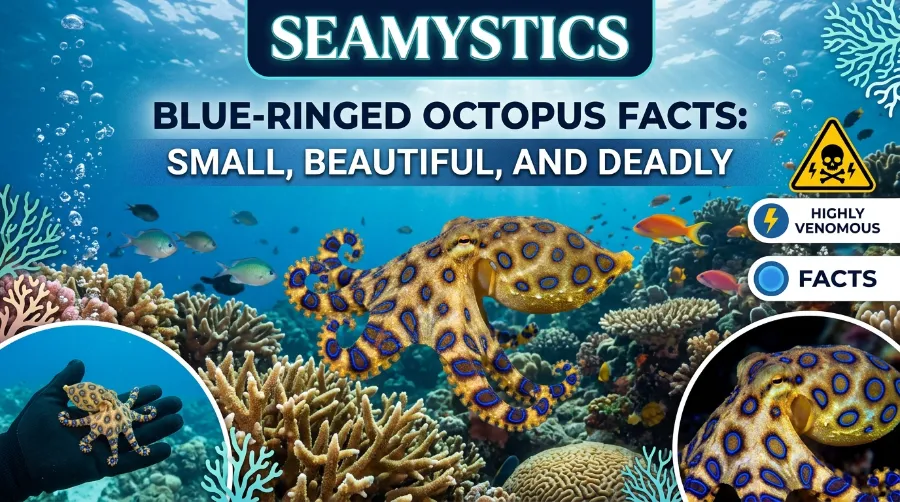
Their diet of small crustaceans and mollusks also links them into a wider food web that supports the seafood many of us eat. If you want the bigger picture on how everyday seafood choices affect reef ecosystems like these, our sustainable seafood guide breaks it down without the jargon.
Portuguese Man O’ War Facts: Not a Jellyfish at All
Blue-Ringed Octopus vs. Other Notorious Marine Animals
| Animal | Size | Venom Type | Typical Bite/Sting Outcome |
|---|---|---|---|
| Blue-ringed octopus | 5 to 20 cm | Tetrodotoxin | Paralysis, potentially fatal without care |
| Box jellyfish | Bell up to 30 cm | Cardiotoxic venom | Extreme pain, can be fatal within minutes |
| Cone snail | 2 to 15 cm | Conotoxins | Paralysis, respiratory failure possible |
| Stonefish | Up to 40 cm | Neurotoxic spine venom | Severe pain, tissue damage |
This table shows something worth remembering. The blue-ringed octopus is small enough to fit in your palm, yet its venom belongs in the same conversation as animals many times its size. Experienced dive guides treat this creature with real respect despite its shy nature.
Frequently Asked Questions
Is the blue-ringed octopus the most venomous octopus in the world? Yes. Marine biologists consider it the most dangerous octopus to humans, since researchers have confirmed its venom can kill people.
How many blue-ringed octopus bites are fatal each year? Confirmed fatalities stay rare. Most bites occur near hospitals in Australia and Southeast Asia, so treatment reaches victims quickly, and many bites also deliver only defensive doses rather than full venom loads.
Can you touch a blue-ringed octopus safely? No. Even brief handling can provoke a bite. Because the bite itself often feels painless, you may not realize the octopus envenomated you until symptoms begin.
What does a blue-ringed octopus bite feel like? Most victims describe a small, almost unnoticeable pinch rather than sharp pain. That is part of why people miss the bite until numbness sets in.
Where is the blue-ringed octopus most commonly found? Divers and researchers most frequently report it around Australia, Indonesia, the Philippines, and Japan. It typically lives in shallow tide pools and coral rubble zones.
Quick Quiz: How Much Do You Know About the Blue-Ringed Octopus?
1. What toxin does the blue-ringed octopus use to defend itself? A) Cyanide B) Tetrodotoxin C) Botulinum toxin D) Melittin Answer: B, Tetrodotoxin
2. Roughly how many adult humans could one bite’s worth of venom kill? A) 2 B) 10 C) 26 D) 100 Answer: C, 26
3. Which region is NOT a typical home for the blue-ringed octopus? A) Australia B) Indonesia C) The Caribbean D) The Philippines Answer: C, The Caribbean
4. What is the first recommended step if someone is bitten? A) Suck out the venom B) Apply a tourniquet C) Call emergency services immediately D) Wait to see if symptoms appear Answer: C, Call emergency services immediately
5. Is there an antivenom for blue-ringed octopus venom? A) Yes, widely available B) No, treatment is supportive care only C) Only in Australia D) Only for children Answer: B, No, treatment is supportive care only
Conclusion
The blue-ringed octopus pairs beauty with real danger, and that is exactly why it fascinates so many of us. It is small and shy, and it would rather vanish into a crevice than confront anyone. Yet it carries enough venom to remind us that respect for wildlife is not optional near tide pools and reefs. With some awareness, sensible habits, and quick action after any bite, this remarkable little cephalopod can be admired safely from a short distance. For more marine safety guides and ocean field notes, explore the rest of our library at Sea Mystics.
References
- Aquarium of the Pacific. “Greater Blue-Ringed Octopus.” https://www.aquariumofpacific.org/onlinelearningcenter/species/greater_blue_ringed_octopus1
- Ocean Conservancy. “Blue-Ringed Octopus: Small but Deadly.” https://oceanconservancy.org/blog/2017/03/13/blue-ringed-octopus/
- Solitude World. “Blue-Ringed Octopus.” https://solitude.world/blue-ringed-octopus/
- Snopes. “Blue-Ringed Octopus Has Enough Venom to Kill 26 Adult Humans Within Minutes?” June 9, 2024. https://www.snopes.com/fact-check/blue-ringed-octopus-venom/
- Newsweek. “Venomous Blue-Ringed Octopus Bites Woman on Popular Beach.” https://www.newsweek.com/venomous-blue-ringed-octopus-bite-australia-1788162
- Clinical Toxicology. “Blue-ringed octopus (Hapalochlaena sp.) envenomation of a 4-year-old boy: A case report.” https://www.tandfonline.com/doi/full/10.1080/15563650701601790