
Picture a tide pool at low water in the Philippines. The sand looks calm, the shells look pretty, and one of them is loaded like a tiny harpoon gun. That is the honest picture behind any real cone snail comparison, and it is why so many beachcombers get hurt for the simple crime of picking up something beautiful.
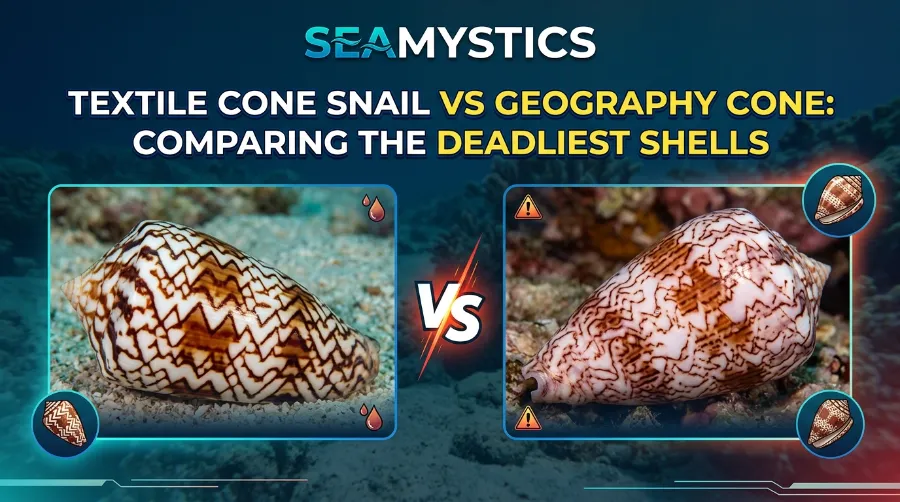
This guide breaks down two of the most talked about species in that world: the textile cone and the geography cone. Both carry venom strong enough to kill a grown adult, yet they hunt differently, sting differently, and carry different odds of survival. If you dive, snorkel, collect shells, or just want cone snail types facts that are actually accurate, this is written for you.
TL;DR
- The geography cone (Conus geographus) is generally considered the deadliest of all cone snail species, with human fatality rates reported as high as 65 to 70 percent in documented envenomations.
- The textile cone (Conus textile) is also dangerous and has caused confirmed deaths, but it stings less often and tends to be somewhat less lethal per incident.
- Neither snail has an antivenom on the market, so treatment focuses on immobilization, monitoring breathing, and getting to a hospital fast.
Key Takeaway Table
| Feature | Textile Cone (Conus textile) | Geography Cone (Conus geographus) |
|---|---|---|
| Common nickname | Cloth-of-gold cone | Cigarette snail |
| Typical shell size | 9 to 10 cm, up to 15 cm | Up to 12 cm |
| Diet | Worms, mollusks, small fish, occasionally cannibalistic | Fish specialist, ambush hunter |
| Venom delivery | Harpoon-like radular tooth | Harpoon-like radular tooth, faster fish-paralyzing toxin |
| Reported human fatality rate | Roughly 15 to 20 percent of severe cases | Up to 65 to 70 percent of severe cases |
| Range | Indo-Pacific, Red Sea, East Africa to Hawaii | Indo-Pacific reefs, sandy rubble zones |
| Antivenom available | No | No |
What Makes a Cone Snail Dangerous in the First Place
Every one of the roughly 800 known cone snail species uses the same basic weapon, a modified tooth called a radula that acts like a disposable hypodermic needle. When a snail senses prey, or a curious hand, it fires this harpoon and injects a cocktail of neurotoxins called conotoxins. Because the venom targets nerve channels directly, the effect on a fish, or a person, can start in seconds.
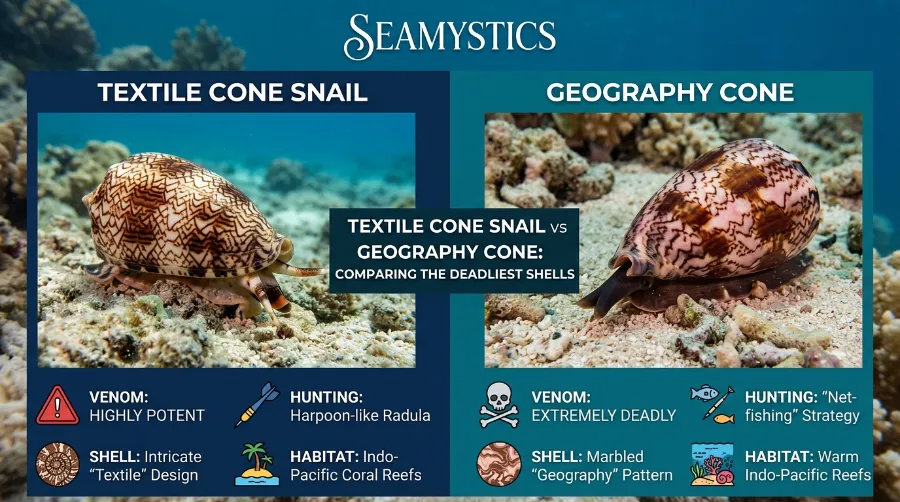
That single hunting trick is also why cone snail venom danger shows up on almost every “deadliest animals” list, sitting alongside creatures most people would never expect from a slow moving shell. If you have ever read our deep dive into cone snail venom chemistry, you already know the toxin itself is being studied for pain medicine, which is a strange twist for something this dangerous.
Geography Cone: The One With the Scary Nickname
The geography cone earned the grim nickname “cigarette snail” from a persistent bit of diver folklore, the idea being a victim has only enough time to smoke a cigarette before the venom takes hold. That is an exaggeration, but not by much in the worst cases. Guinness World Records lists the geography cone as the most dangerous of all cone snails, crediting it with roughly three dozen deaths over the last 300 years, with the earliest documented case dating back to 1705.
Fire Coral Facts: Why It Burns and How to Treat It
One frequently cited case comes from Hayman Island on Australia’s Great Barrier Reef in 1935, where a young man died after handling a live geography cone. Because this species specializes in hunting fast-moving fish, its venom evolved to act almost instantly, which is unfortunately just as effective on a human hand.
Key traits of the geography cone:
- Lives on sand and rubble near coral reefs, often partly buried during the day
- Feeds almost exclusively on fish, using an unusually fast acting toxin
- Reported fatality rates in severe envenomation cases have run as high as 65 to 70 percent
- Death, when it occurs, is typically from respiratory or cardiac failure within hours
Textile Cone: Beautiful, Common, and Still Risky
The textile cone gets its name from the striking, fabric-like pattern on its shell, which is exactly why so many tourists and collectors reach for it. It is one of the more commonly encountered species in shallow reef flats and sandy areas across the Indo-Pacific, and it has been directly linked to human fatalities since at least the 1940s, when researcher E.A.R. Hermitte reviewed historical cone sting cases and counted two deaths attributed to Conus textile among the earliest documented incidents.
Textile cones are technically molluscivores and generalists, meaning they eat other snails, worms, and small fish, and are even known to turn cannibalistic when food is scarce. Their venom is potent, but it was built to subdue slower moving prey rather than instantly drop a darting fish, which may explain why textile cone danger, while very real, tends to produce a somewhat lower fatality rate than its geography cone cousin.
Key traits of the textile cone:
- Common in sand and rubble zones, often hiding under rocks or coral slabs by day
- Broader diet than the geography cone, including other mollusks
- Documented human deaths since the mid-1900s, though less frequent than geography cone incidents
- Shell is popular with collectors, which increases the odds of accidental handling
Textile Cone vs Geography Cone: Side by Side on Symptoms
| Stage | Textile Cone Sting | Geography Cone Sting |
|---|---|---|
| Immediate | Sharp prick, localized pain, sometimes minimal | Sharp prick, may include a numbing sensation |
| Within minutes | Swelling, tingling, numbness spreading from the site | Rapid numbness, muscle weakness starting quickly |
| Within an hour | Possible dizziness, blurred vision | Complete limb paralysis reported in historic cases |
| Severe cases | Muscle weakness, respiratory difficulty | Respiratory failure, cardiac involvement, coma |
| Medical outcome | Full recovery common with prompt care | Death reported in a significant share of untreated severe cases |
There is no antivenin for either species. Emergency response for both centers on pressure immobilization of the affected limb, monitoring for breathing trouble, and rapid transport to a hospital where artificial respiration can be provided if paralysis spreads to the diaphragm.
Real World Incidents Worth Knowing
- In 1935, a young man on Hayman Island, Queensland, died after being stung by a geography cone he had picked up, one of the earliest well-documented Australian fatalities.
- Historical review work covering sting reports from 1848 through 1943 recorded five confirmed human deaths, three attributed to the geography cone and two to the textile cone.
- A widely cited 2004 review in the scientific literature put the global death toll from cone snail stings at roughly 30 people, a figure researchers still reference today.
These are not ancient risks either. Divers and shell collectors across Hawaii, the Philippines, Australia, and parts of the Caribbean continue to report stings every year, usually from handling a live shell that looked harmless.
Geography Cone Snail Facts Divers Should Actually Remember
- It hunts fish, not people, and stings are almost always defensive rather than aggressive
- The shell can grow to roughly 12 cm and often looks partially buried in sand
- It is found throughout Indo-Pacific reef systems, frequently in shallow water where tourists wade
- Gloves and even a thin wetsuit have not always stopped the harpoon from penetrating skin
Why People Keep Getting Stung
Curiosity is the biggest risk factor by far. Shells wash up looking empty, or a live snail simply looks too attractive to leave behind, and that split second decision is where almost every documented sting begins. This pattern repeats across marine envenomation cases generally, not just with cone snails, which is part of why we also cover risks like the blue ringed octopus and the box jellyfish in similar detail elsewhere on this site.
A few practical habits genuinely reduce risk:
- Never pick up a cone shell with bare hands, even if it looks empty or dead
- Avoid pockets and dive bags for storing unidentified shells while diving
- Treat any shell with a smooth, glossy, cone shaped pattern as potentially alive and dangerous
- If stung, immobilize the limb, stay calm, and seek medical help immediately rather than waiting to see if symptoms fade
Because cone snails are just one entry in a much larger list of reef hazards, it is worth comparing them against other risks you might meet on the same trip, from a stingray hidden in the sand to a weever fish buried at the waterline, or drifting hazards like the Portuguese man o’ war and the sea wasp.
Why Cone Snail Venom Matters Beyond the Danger
Conotoxins, the compounds inside cone snail venom, are being researched as the basis for powerful, non-addictive pain medications, because they target nerve pathways with remarkable precision. Researchers studying this venom have compared its neuromuscular effect to a combination of cobra venom and pufferfish toxin, which sounds terrifying until you realize that same precision is exactly what makes it medically valuable. According to a detailed breakdown from the Bailey-Matthews National Shell Museum, the mechanics of the harpoon strike itself are almost engineering-grade in their efficiency.
If cone snails intersect with your interest in ocean conservation more broadly, our sustainable seafood guide covers how reef predators like these fit into the wider health of coastal ecosystems, and how bycatch pressure documented in our piece on the fishing bycatch problem affects the same reef habitats where cone snails live.
Which One Is Actually More Dangerous
If the question is which single species poses the higher individual risk, the geography cone wins that unfortunate title, largely because its venom evolved to instantly stop a fast fish, and that same speed translates poorly for a human nervous system. The Maui Ocean Center’s marine life profile on cone snails backs this up, noting the geography cone’s reputation as the most medically significant species in the genus.
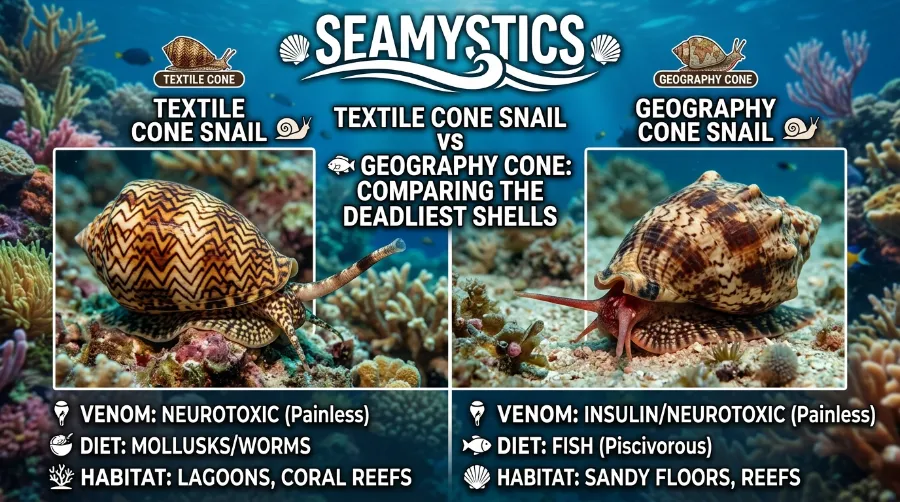
That said, the textile cone should never be dismissed as the safer option. It is more commonly encountered by tourists and shell collectors specifically because of its attractive pattern, and a 2018 feature from The Ethogram highlights how often stings happen simply because people cannot resist picking one up for a photo.
Frequently Asked Questions
Is a cone snail sting always fatal?
No. Most stings, especially from smaller or less venomous species, cause pain and numbness that resolves without lasting harm. Severe outcomes are more common with fish-hunting species like the geography cone.
How long does it take to feel symptoms after a cone snail sting?
Symptoms can appear within minutes, though some cases show a delayed onset of several hours. Any numbness or tingling should be treated as a medical emergency regardless of timing.
Is there an antivenom for cone snail stings?
Not currently. Treatment relies on supportive care, pressure immobilization, and, in severe cases, mechanical ventilation until the venom’s effects wear off.
Where are textile and geography cones most commonly found?
Both species live throughout the Indo-Pacific region, including reefs around Australia, the Philippines, Hawaii, and East Africa, typically in shallow sandy or rubble zones near coral.
Can gloves protect you from a cone snail sting?
Not reliably. The harpoon-like radular tooth has been documented penetrating thin gloves and wetsuit material, so the safest approach is never handling a live cone snail at all.
A Short Quiz: Test Your Cone Snail Knowledge
1. Which cone snail species is generally considered the most lethal to humans?
A) Textile cone
B) Geography cone
C) Striated cone
2. What is the geography cone’s grim nickname among divers?
A) The reef reaper
B) The cigarette snail
C) The sand ghost
3. Roughly how many cone snail species exist worldwide?
A) About 80
B) About 300
C) About 800
Answers: 1. B — the geography cone has the highest documented fatality rate. 2. B — reflects venom speed, not exact medical fact. 3. C — roughly 800 recognized species.
Conclusion
A cone snail comparison like this one boils down to a simple lesson that applies to almost every dangerous ocean creature: appearance has nothing to do with risk. The geography cone earns its reputation through raw lethality, while the textile cone earns its own place on this list through sheer frequency of contact with curious hands. Both deserve respect, not a place in your beach bag.
References
- Guinness World Records, “Most Venomous Gastropods”
- Wikipedia, “Conus textile”
- Queensland Museum Network, “Geography Cone”
- WikEM, “Cone Shell Envenomation”
- Bailey-Matthews National Shell Museum, cone snail ballistics research
- Maui Ocean Center, marine life profile on cone snails
- The Ethogram, creature feature on cone snails