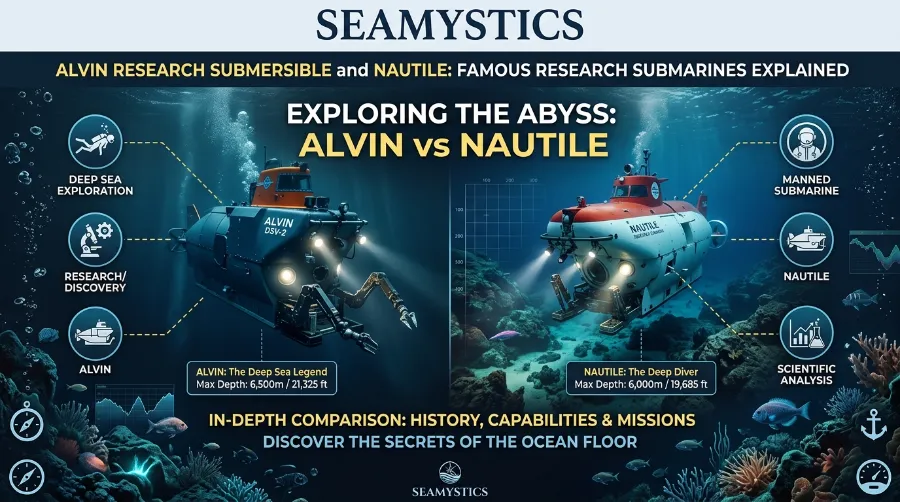

Two small titanium spheres carried people into the dark and changed ocean science. The Alvin research submersible entered service on June 5, 1964 and still dives today, while France’s yellow Nautile made its first crewed dive to 6,000 meters on April 3, 1985. Between them, these subs found strange life at hot vents, visited the Titanic, and helped hunt a lost hydrogen bomb. This guide explains how each one works, what they found, and why they still matter in 2026. whoiifremer
TL;DR: Alvin is an American three-person sub that now reaches 6,500 meters and made the first human visit to the Titanic in 1986. Nautile is a French sub that reaches 6,000 meters and spent 1987 to 1998 working on the wreck. Both still matter because people in the water can see, touch, and decide things that a camera on a cable cannot.
Key Takeaways
| Topic | Quick fact |
|---|---|
| Alvin start date | Commissioned June 5, 1964 |
| Alvin depth today | 6,500 meters, about 99% of the global seafloor |
| Alvin in 2026 | Navy recertification came on June 24, 2026 |
| Nautile first deep dive | April 3, 1985, at 6,000 meters |
| Nautile Titanic work | Five campaigns and 116 dives from 1987 to 1998 |
| Biggest Alvin discovery | Life around hydrothermal vents, 1977 |
| Best use today | Work that needs human eyes and hands in deep water |
I have read many dive reports over the years, and one pattern keeps showing up. People remember the machines, but the real story is the question each dive answered. So this guide follows the dates, the numbers, and the questions, not just the hardware.
If you want the wider picture first, our ocean exploration technology guide covers the tools that sit around subs like these. For now, let’s start with the older and more famous of the two.
What Makes the Alvin Research Submersible So Special?
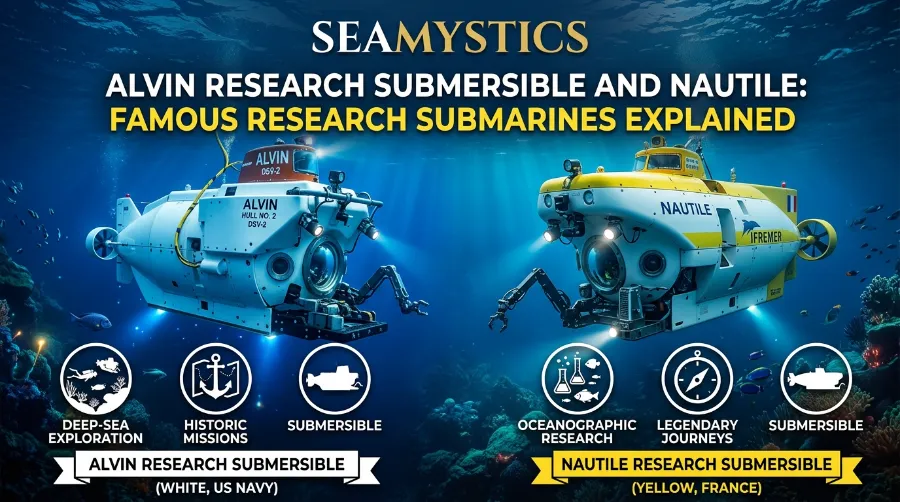
Alvin is a human occupied vehicle, or HOV. A pilot and two scientists sit inside a titanium sphere, while seven reversible thrusters and two robotic arms do the work outside. The US Navy owns the sub, and Woods Hole Oceanographic Institution (WHOI) runs it as part of the National Deep Submergence Facility. whoiecomagazine
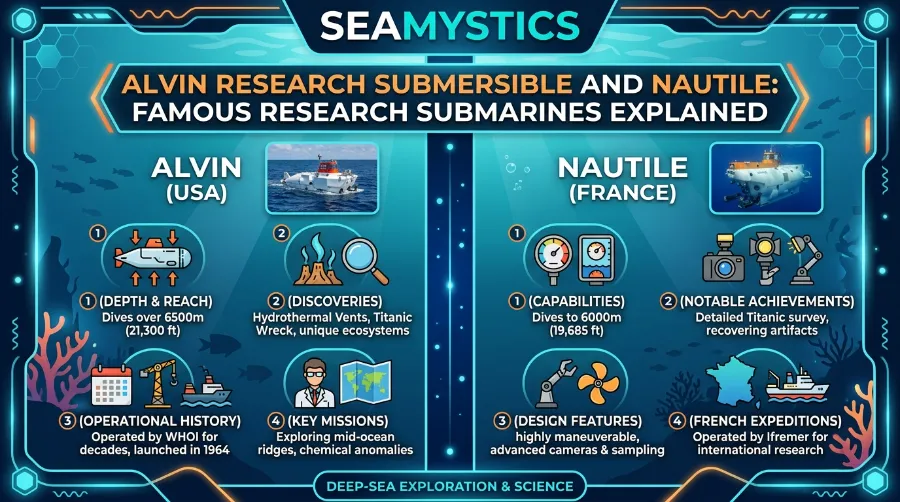
The numbers explain why scientists line up for a seat. Alvin has carried more than 3,000 researchers on more than 5,000 dives. Also, it makes about 100 dives in an average year, so it stays busy. whoiwhoi
The Five Deeps Expedition: Diving to the Bottom of Every Ocean
Why does a person still matter when robots exist? A scientist at a viewport can spot a tiny detail, change the plan on the spot, and pick the exact sample. The NDSF describes this as direct observation by two scientists on dives that last up to twelve hours. That kind of hands-on judgment is hard to copy with a camera on a cable. whoi
Here is what you get inside Alvin:
- Crew: one pilot and two observers
- Depth: 6,500 meters after the 2022 upgrade
- Dive time: roughly ten to twelve hours
- Pressure at full depth: about 681 atmospheres, which is why the hull must be nearly a perfect sphere jamstec
- Tools: two robotic arms and a basket that the team rearranges before each dive
Alvin Submersible History: The Key Dates
Alvin’s story runs longer than most careers. Here are the dates that matter most.
- 1964: The Navy commissions Alvin, and WHOI takes charge of it.
- 1966: Alvin helps find a lost hydrogen bomb off Spain.
- 1968: The sub sinks during a launch and sits on the bottom until 1969.
- 1977: Alvin dives on a Galapagos vent site and finds crowded communities of animals.
- 1986: Alvin takes people back to the Titanic for the first time.
- 2011 to 2022: A long upgrade takes Alvin from 4,500 meters to 6,500 meters.
- 2026: The Navy recertifies Alvin after a routine overhaul.
The upgrade changed Alvin’s reach a lot. Before it, the sub could reach about 63 percent of the ocean floor. The 2011 phase replaced 70% of the sub’s systems, and the 2020 to 2022 work finished the job. On July 21, 2022, Alvin reached 6,453 meters, its deepest dive ever. the future alvin +2
The 1966 Bomb Hunt and the 1968 Sinking
On March 17, 1966, a US Air Force plane crash over Palomares, Spain, dropped a hydrogen bomb into the sea. Alvin found it on a steep slope near 2,500 feet, but the sub had trouble lifting it, and the bomb slid deeper. A Navy CURV-I raised it on April 7. The Alvin crew logged 34 dives and more than 220 hours, and the team used that experience to improve the sub’s navigation. Wikipedia
Then came a scary day in October 1968. Cradle cables snapped during a launch, and Alvin sank about 5,000 feet. The crew got out safely. The sub stayed down almost a year, and here is my favorite detail: the lunches on board were still edible when crews recovered it. Cold, deep water works like a fridge. CNNieeeoes
My take is that this accident shaped Alvin’s culture. Modern pilots treat launch checks like a ritual, and the boring routine is a big reason the sub has lasted so long.
NOAA Ocean Exploration: What the Agency Actually Discovers Each Year
How Alvin Found Life Around Hydrothermal Vents
In 1977, scientists wanted to test a simple idea. New seafloor forms where plates pull apart, so hot water should escape there. A towed camera sled visited the Galapagos site first, and Alvin dove the next day and found rich biological activity. ieeeoes
Before that dive, scientists thought little or no life existed in such places. Instead, they found giant tube worms and dense animal communities living on chemical energy, not sunlight. That result made researchers rethink where life can survive, and it even changed how we talk about the origin of life on Earth. whoi
Alvin in 2026: The Latest Update
The newest news is about safety and trust. After an overhaul that happens roughly every five years, a three-person team made a seven-hour certification dive on June 20. The Navy’s submarine programs office then gave formal approval on June 24, 2026. ecomagazineecomagazine
During sea trials, Alvin also dove to 6,374 meters. Teams also tested a companion robot called Deep Venture to make future expeditions more efficient. You can read the full announcement in this ECO Magazine report or check the sub’s specs on the WHOI Alvin page. ecomagazine
The Alvin Titanic Dive of 1986: What Really Happened
Many people think Alvin found the Titanic. It did not. French and American teams working together found the wreck on September 1, 1985, using a towed camera. Alvin came later. ifremer
In July 1986, a WHOI team returned with Alvin and a new small robot called Jason Jr. Robert Ballard led the trip and rode inside Alvin. It was the first time humans had seen the ship in almost 75 years. The wreck lay near 12,500 feet, or about 3,800 meters. whoidivemagazine
Here is the part most articles skip. WHOI says the main purpose of the dives was to test the Jason Jr. prototype. Alvin sat on the seafloor as a steady launch pad, and Jason Jr. sent its video back to scientists inside the sub. That trick meant the team did not need a very long fiber cable that did not exist yet. As a result, the tests let the Argo and Jason projects move ahead in parallel and bring Jason online years early. whoiwhoi
Jason Jr. also brought back the images that shaped public memory. Its cameras showed the captain’s quarters, a promenade, and a grand staircase. Sources differ on the dive count: some say 11 dives and WHOI’s own history page says twelve, probably because of how test dives get counted. In 2023, WHOI released 80 minutes of never-seen video, which you can learn about on the WHOI 1986 expedition page. accuweatherwhoi
Here is my view. The Titanic looks like a treasure hunt in the movies, but in 1986 it worked as a test lab. That is the pattern in deep sea research subs again and again: a famous target pays for a technology leap.
Ocean Exploration Trust: Inside Modern Deep-Sea Research Missions
Nautile: France’s Yellow Deep Sea Workhorse
Nautile is Alvin’s French cousin, and it has a different personality. Ifremer and its operating partner Genavir run the sub, which entered service in 1984. It is about 8 meters long, carries three people, and has two robotic arms. ifremerWikipedia
Its first pilots gave it a warm review. Guy Sciarrone and Georges Arnoux called it stable and easy to pilot. Since then, Nautile has done 2,122 dives, and Ifremer marked its 40th anniversary in 2025. You can read their story on the Ifremer Nautile page. ifremerifremer
Nautile and the Titanic, 1987 to 1998
Ifremer helped find the Titanic, yet it missed the first visit. In 1986, the French institute had to cancel its inspection plan because of money problems. So France came back in 1987 with a different plan and a different job. exail
That job was recovery. In July 1987, a private expedition with Ifremer’s technical support made 32 dives and brought up about 1,800 artifacts. Over the next years, Nautile made five campaigns and 116 dives to the wreck. NOAA notes that salvage work through 2004 ultimately recovered nearly 5,000 artifacts, and you can see that timeline on the NOAA Titanic history page. Maritime Heritage Program – Titanic – NOAA +2
Nautile also carried a small helper robot. ROBIN was only 60 by 50 by 50 centimeters and weighed 130 kilograms, and it rode in a front niche on the sub. Veteran pilot Paul-Henri Nargeolet flew Titanic dives in 1987, 1993, 1994, and 1996. WikipediaWikipedia
Not everyone agrees on artifact recovery. Some experts want the wreck left alone as a grave site, while others say recovery saves items from decay. I think both sides have a point, and the debate is why modern expeditions publish more images and take fewer objects.
More Nautile Missions
Titanic was only one job. Nautile also worked on many other tasks:
- It inspected the wreck of the oil tanker Prestige and searched for the black boxes of Air France Flight 447 Wikipedia
- It discovered by chance the wreck of La Lune, a French warship that sank near Toulon in 1664 Wikipedia
- It helped train Indian aquanauts before India built its own deep sub Wikipedia
Now, let’s put the two Titanic programs side by side, because the numbers tell a clear story.Alvin’s 11 dives were a short first look, while Nautile’s 116 dives were long, steady recovery work. I ran the numbers to see how much of each sub’s career this covers. The Titanic made up about 5.5 percent of Nautile’s 2,122 dives, but only about 0.2 percent of Alvin’s 5,000 plus dives. So the wreck defined Nautile’s mid-career, yet it was a small chapter in Alvin’s long life.
Alvin vs Nautile: Side by Side
| Feature | Alvin | Nautile |
|---|---|---|
| Owner and operator | US Navy owns it, WHOI operates it | Ifremer, with Genavir |
| Start | Commissioned 1964 | Commissioned 1984, first 6,000 m dive 1985 |
| Depth today | 6,500 meters | 6,000 meters |
| Crew | 3 | 3 |
| Robot arms | 2 | 2 |
| Dive count | 5,000 plus | 2,122 |
| Average pace (my math) | About 80 dives a year since 1964 | About 53 dives a year since 1985 |
| Titanic role | 1986 first look, 11 dives | 1987 to 1998 recovery, 116 dives |
| Signature work | Hot vents, H-bomb search | Wreck work, Prestige, Air France 447 |
So which sub is better? I think that is the wrong question. Alvin leads on depth, dive count, and pure science output, with nearly 2,000 scientific papers tied to its work. Nautile leads on wreck work and France’s public research mission. Each sub fits the job its home country gave it.
Famous Research Submarines Around the World
Alvin and Nautile do not work alone. Several other famous research submarines share the deep, and each one adds a different piece of the story.
| Sub | Country | Depth | Why it matters |
|---|---|---|---|
| Shinkai 6500 | Japan | 6,500 m | JAMSTEC’s flagship, passed 1,500 dives by 2017 |
| Mir 1 and Mir 2 | Russia | 6,000 m | Twin subs built in Finland, in service from 1987 |
| Jiaolong | China | Over 7,000 m | In service since 2010 |
| Fendouzhe | China | Over 10,000 m | Reached Challenger Deep multiple times |
Japan’s Shinkai 6500 is the closest match to modern Alvin. Its team descends at about 45 meters a minute, so a trip to full depth takes around two and a half hours. China now leads the world in yearly deep sea dives, according to the Smithsonian Ocean Portal.
Why do so many subs stop near 6,000 to 6,500 meters? Because that range covers roughly 97 to 99 percent of the seafloor at a much lower cost than a full-ocean-depth sub. In my view, that sweet spot explains why Alvin’s upgrade was such a smart move.
Jiaolong and Fendouzhe are shown at their minimum proven depths, since both have gone deeper than the bars show.
Deep Sea Research Subs: How a Dive Really Works
A dive looks simple from the outside: go down, look around, come up. In practice, teams plan every step. The Shinkai 6500 schedule gives a good picture of a typical day.
- Launch: The team lowers the sub from the ship in the morning after final checks.
- Descent: The sub sinks at about 45 meters a minute, so a full-depth trip takes around two and a half hours.
- Work on the bottom: Pilots and scientists take photos, samples, and measurements in tight time windows.
- Ascent and recovery: Specially trained swimmers help launch and recover Alvin, and a ship like R/V Atlantis, which has six labs, handles the rest.
Before any of this, the team needs a map. Satellites give the broad shape of the seafloor, and ship sonar adds detail at the dive site. If you want to see how that first step works, read our satellite ocean mapping guide.
Currents also matter for the surface team. Winds move surface currents, while cold, salty, dense water creates slow currents deep down, as the Ocean Wise climate explainer describes. A clear summary of surface and deep flows also appears on Royal Ocean’s currents guide, and this short piece on how ocean currents shape the weather we live in shows why it all reaches people on land. For a dive team, a strong surface current can make launch and recovery harder, so they watch the sea state closely.
Deep Sea Cables: The Hidden Infrastructure Beneath the Ocean
Are Crewed Subs Still Worth It in the Age of Robots?
This is the question I hear most from readers. Robots keep getting better, and the Titanic story itself began with a robot, Jason Jr. Yet Alvin still dives about 100 times a year, and the Navy just recertified it, so someone believes the sub is worth keeping.
Here is how I sort the choice:
- Send a person when the target is complex, the plan may change, or the sampling needs careful judgment
- Send a robot when the job is long, dull, or dangerous, like broad mapping or repeated surveys
- Send both when you can: the Alvin and Deep Venture pairing is a good sign of where the field is going
Our guide to autonomous underwater vehicles explains how the robot side works. My honest opinion is that the future is a team, not a contest.
Safety, Certification, and the Titan Lesson
Alvin’s safety record comes from a strict process. The Navy requires a certification dive between 6,200 and 6,500 meters after a major overhaul. In November 2021, test dives even stopped for a while after crews found damage to attachment points on the buoyancy foam. That pause looks slow, but it is the system working.
The 2023 loss of the OceanGate Titan, in which five people died, made the same point in the hardest way. Paul-Henri Nargeolet, who had piloted Nautile dives to the Titanic, was among those lost. Titan skipped independent third-party certification, and certified programs like Alvin and Nautile show why that step matters. Good deep sea work is boring on purpose.
FAQ
How deep can Alvin dive?
Alvin can dive to 6,500 meters, or about 21,325 feet. That reaches about 99 percent of the global seafloor. Its deepest dive so far, on July 21, 2022, went to 6,453 meters.
Did Alvin discover the Titanic?
No. Robert Ballard and Ifremer found the Titanic on September 1, 1985, using a towed camera. Alvin took people to the wreck in July 1986.
How many people fit inside Nautile?
Nautile carries three people: a pilot and two observers. It is about 8 meters long and has two robotic arms.
Is Nautile still in use?
Yes. Ifremer celebrated 40 years of the sub in 2025 and calls it a major player in deep ocean exploration.
What is the difference between a submersible and a submarine?
A submarine can travel far and stay out for long periods. A submersible is smaller, depends on a support ship, and focuses on short science dives.
Conclusion
The Alvin research submersible and Nautile prove that the best science often starts with a person looking through a small window. Alvin found life at hot vents, tested the tools that shaped modern robots, and just earned its 2026 recertification. Nautile did long, careful work on the Titanic and on wrecks across the Atlantic. Both subs keep pushing us to ask better questions, so explore more in our ocean exploration technology guide and see where the next dive leads.
Quick Quiz: Test What You Learned
- Who operates Alvin?
A) Ifremer
B) Woods Hole Oceanographic Institution
C) JAMSTEC - In what year did the Alvin Titanic dive happen?
A) 1985
B) 1986
C) 1987 - What is Nautile’s depth rating?
A) 4,500 meters
B) 6,000 meters
C) 11,000 meters - True or false: Alvin discovered the Titanic wreck in 1985.
- True or false: Nautile made 116 dives to the Titanic between 1987 and 1998.
Answers: 1) B. 2) B. 3) B. 4) False, a towed camera found the wreck and Alvin visited in 1986. 5) True.
References
- Woods Hole Oceanographic Institution, HOV Alvin overview and 2022 dive news release
- National Deep Submergence Facility, HOV Alvin and Alvin Refit pages
- ECO Magazine, WHOI’s Alvin Cleared for Deep-Ocean Science After Overhaul (2026)
- WHOI, 1986 Return to the RMS Titanic and 2023 video release
- Ifremer, Nautile 1985 to 2025: 40 years in the depths
- NOAA Maritime Heritage Program, Titanic past expeditions
- Engineering and Technology History Wiki, Alvin Deep-Sea Research Submersible milestone
- IEEE Oceanic Engineering Society, Alvin Milestone Report
- JAMSTEC, Shinkai 6500 specifications
- Smithsonian Ocean Portal, Deep-Sea Submersibles
- Ocean Wise, Global Weather and Climate