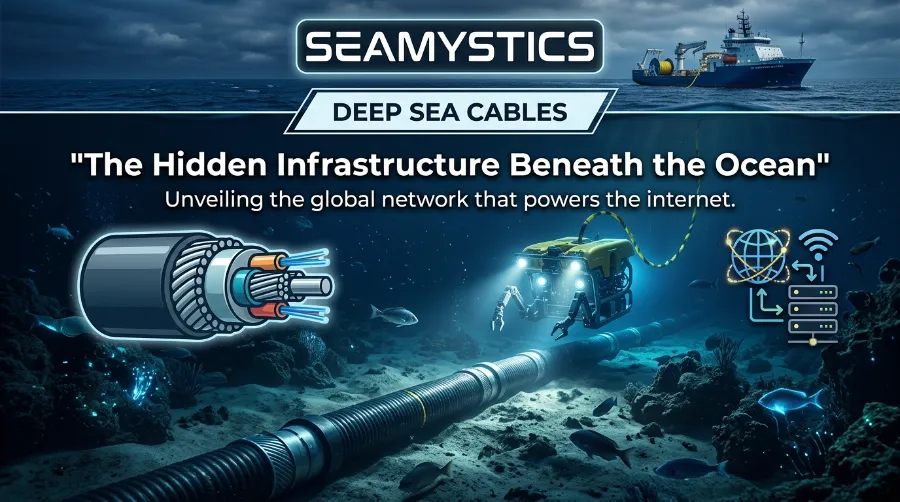

You sent a message, watched a video, or paid a bill today. Almost none of it traveled through the sky. Deep sea cables, roughly as thick as a garden hose, carried it across the ocean floor in a blink. As a marine biologist, I love this fact because the same dark water that shelters whale falls and vent life also holds the internet.
TL;DR: Deep sea cables are fiber-optic lines that carry about 99% of intercontinental internet traffic. Fishing gear and ship anchors cause most of the 150 to 200 faults each year, while sharks and spies play a much smaller part. Even so, new tension in the Gulf, the Baltic, and the Arctic has pushed the United States and Europe to guard the cables more closely.
Key Takeaways
| Metric | Latest figure | What it means |
|---|---|---|
| Cable systems mapped, 2026 | 694 systems and 1,893 landing stations | The network keeps growing every year |
| Share of intercontinental data | Over 99% | Cables, not satellites, carry almost everything |
| Total cable length | About 1.7 million km in 2025 | Long enough to reach the Moon more than four times |
| Width of a deep-ocean cable | 17 to 22 mm | About the size of a garden hose |
| Faults per year | 150 to 200 | Roughly three a week |
| Faults from fishing and anchors | 70 to 80%, and 86% in 2025 repair data | People cause most of the damage |
| Shark-caused faults, 2007 to 2014 | Zero | The shark story is mostly a myth |
| EU cable security package, Feb 2026 | €347 million | Europe now funds protection at scale |
What Are Deep Sea Cables and Why Do They Matter?
Deep sea cables are fiber-optic lines that lie on the ocean floor and link continents. Each cable holds glass fibers about as thin as a hair, and each fiber carries data as flashes of light. The ITU says these lines carry over 99% of international data traffic. guardian
Think about what that covers. Streaming, online banking, cloud backups, and video calls all cross oceans this way. Satellites help in remote places, but they cannot match the capacity of glass on the seabed. Engineers at Pioneer Consulting write about this often, including whether satellite constellations could ever replace cables.
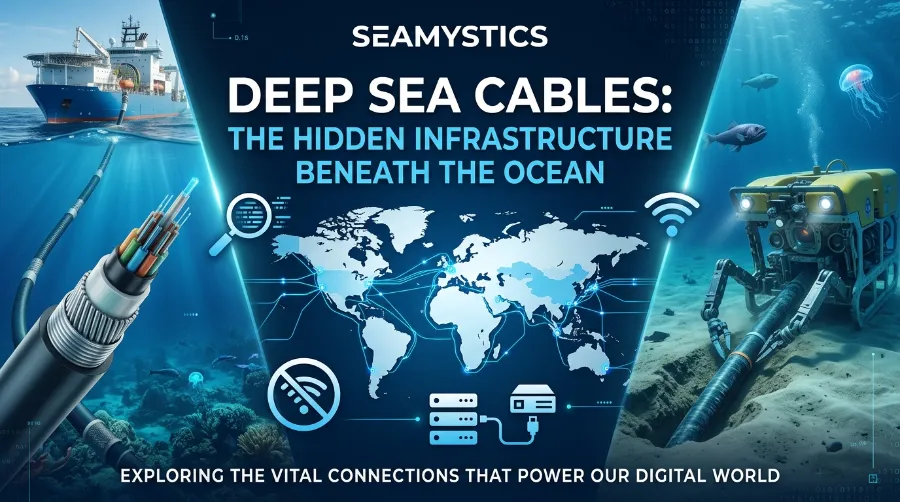
The network also keeps growing. TeleGeography’s 2026 Submarine Cable Map shows 694 cable systems and 1,893 landing stations, counting both working and planned systems. telegeography
From Telegraph Wires to Fiber Light
The story began long before the web. The Mid-Atlantic Regional Council on the Ocean notes that the first telegraph cable crossed the Atlantic in 1858 and moved only six to eight words a minute. Today, in contrast, the 2Africa system offers 180 terabits per second across 16 fiber pairs. midatlanticoceandatacenterdynamics
The Five Deeps Expedition: Diving to the Bottom of Every Ocean
Our data desk tracked TeleGeography’s yearly map editions to see the pace. The count rose from 447 systems in 2020 to 694 in 2026, a gain of about 55%. Each edition counts working and planned systems, so read the chart as a trend line, not an exact tally of live cables. telegeographytelegeographyThe jump from 2025 to 2026 is the biggest in this stretch: 97 more systems in one year. A July 2026 analysis of the same data counts 603 systems in service and 91 planned or under construction. Builders keep returning to the seabed because demand for capacity keeps rising. mappr
How Undersea Internet Cables Work
An undersea internet cable is a simple idea wrapped in serious engineering. Light goes in at one shore and comes out at the other. Everything in between exists to protect that light and boost it.
What Sits Inside the Cable
At the center, hair-thin glass fibers carry the signal. Around them, engineers add a copper layer for power, steel wires for strength, and a tough plastic sheath. Deep-ocean cables measure only 17 to 22 mm across, while armored types near shore can reach 50 mm. iscpc
The thin design works because most of the ocean is deep and quiet. Water deeper than 2,000 m covers about 84% of the ocean. Few things touch a cable down there. Pressure is the main test, since it reaches about 800 atmospheres at 8,000 m. iscpcsciencedirect
Repeaters, Power, and Light
Light fades as it travels. So repeaters sit at intervals approaching 100 km along the route, and many systems space them 50 to 100 km apart. Modern repeaters use fiber doped with erbium, a rare earth element. Lasers energize that fiber, and it amplifies the light. Power reaches each repeater through the copper layer, fed from land at both ends. iscpc
NOAA Ocean Exploration: What the Agency Actually Discovers Each Year
Capacity comes from a trick called wavelength multiplexing, which puts many colors of light on one fiber. Ciena’s Brian Lavallée explains that this lets operators upgrade shore equipment and lift capacity, and the Southern Cross cable now handles more than 80 times its original design. In other words, the cable stays put while the electronics on land get smarter. datacenterdynamics
How Cable Ships Lay the Line
Every route starts with a survey. Teams map the seabed to avoid cliffs, trenches, and busy fishing grounds. Route planners lean on satellite ocean mapping for the big picture and on autonomous underwater vehicles for close inspection.
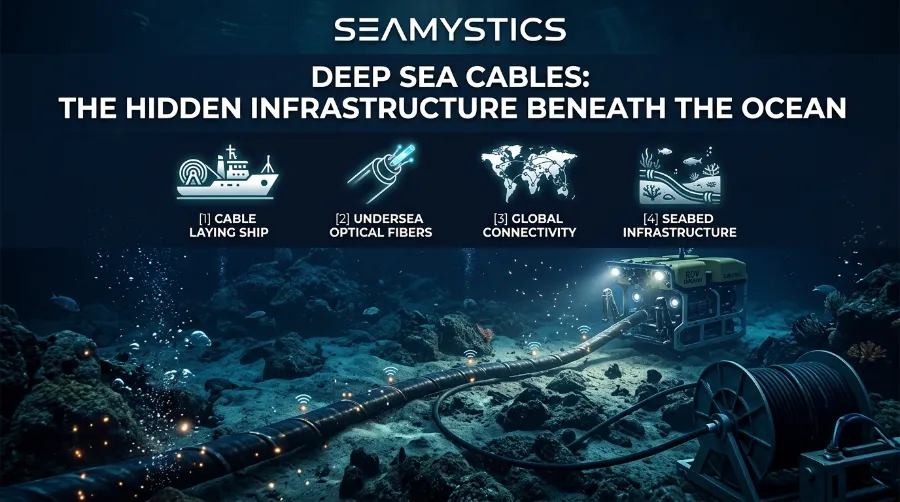
Next, a specialized ship carries thousands of kilometers of cable and pays it out slowly. Near shore, cables sit roughly one to two meters below the seabed for protection. In deep water, the cable simply rests on the floor. DCConnect Global gives a short, plain overview of the ships and plows involved. It also explains why routes that avoid the South China Sea cost more: they run through shallower water and need stronger armor. midatlanticocean
Subsea Cable Facts That Surprise Most People
These subsea cable facts come from the industry’s own data, and a few of them changed how I picture the seafloor.
- They are thin. Deep-ocean types without armor run about 17 to 20 mm wide, close to a garden hose. sargassoseacommission
- They vary wildly in length. The Ireland to UK link called CeltixConnect covers 131 km, while the Asia America Gateway stretches 20,000 km. telegeography
- The total is huge. Global cable length grew from 1 million km in 2014 to about 1.7 million km in 2025. iscpc
- Most cable just lies there. In deep water, cables rest directly on the ocean floor. telegeography
- Few ships can fix them. A 2026 statistics roundup, citing SubTel Forum, counts only 62 specialized cable-laying vessels in service worldwide. voxbooster
- The next giant is coming. Meta’s Project Waterworth will span over 50,000 km with 24 fiber pairs and reach depths of up to 7,000 m. convergedigest
- Sharks rarely cause faults. Fish bites, a group that includes sharks, caused zero faults between 2007 and 2014. telegeography
- Cables can double as instruments. SMART cables carry thermistors, pressure gauges, and accelerometers at repeaters to record temperature, pressure, and seafloor motion. Wikipedia
Ocean Exploration Trust: Inside Modern Deep-Sea Research Missions
Inside the Ocean Cable Network: Who Owns It and Where It Runs
The ocean cable network used to belong mostly to phone companies. Now tech giants build and own many routes, often with telecom partners. Meta led the 2Africa consortium, and it announced completion of the core system on November 17, 2025. Google owns Equiano privately. ecofinagency
| System | Route | Length | Notable detail |
|---|---|---|---|
| 2Africa | Loop around Africa, plus Europe and the Middle East | 45,000 km | 16 fiber pairs and 180 Tbps, linking 33 countries |
| Equiano | Portugal to South Africa | 15,000 km | Design capacity of 144 Tbit/s, in use since 2022 |
| Project Waterworth | US, India, Brazil, South Africa | 50,000+ km | Planned, with 24 fiber pairs |
| Asia America Gateway | Asia to the US | 20,000 km | One of the longest in service |
| CeltixConnect | Ireland to UK | 131 km | A short hop for comparison |
Money drives this shift. TeleGeography figures reported in a 2026 roundup say hyperscalers account for 84% of transatlantic bandwidth demand. Consequently, cloud and AI needs now shape where new cables go. voxbooster
Why One Cable Is Never Enough
Smart operators plan for failure. Companies spread their capacity across several cables, so the network keeps running when one breaks. Landing sites matter too. Microsoft’s Marea cable lands in Virginia Beach, far from New York and New Jersey, to avoid a repeat of a Sandy-sized storm. telegeographyacm
Cable makers plan the same way at the hardware level. DeRegt Cables, a Dutch maker of marine cables for ROVs and other subsea work, publishes engineering notes on how subsea cables survive depth, stress, and time. Those notes show how much testing goes into a product that nobody expects to see again.
What Breaks Internet Cables on the Ocean Floor?
Here is the surprise for most readers: deep sea cables rarely break in the deep sea. Damage is most common in water shallower than 300 m, where shipping and fishing are busy. The abyss is the safe part of the route. iscpc
The ICPC counts 150 to 200 outages a year, or about three a week. Cable length grew by 70% between 2014 and 2025, yet the number of faults stayed steady. Better charts and awareness programs likely helped. Repair data shared at SubOptic 2025 counted about 199 faults a year, with fishing and anchoring behind 86%. Fishing trawlers, not sabotage, behind most undersea cable damage: UN +2
| Cause of fault | Share, 2025 repair data | Typical trigger |
|---|---|---|
| Suspected fishing or anchoring, unspecified | 44% | Ship activity in shallow water, no direct proof |
| Fishing | 28% | Trawl gear dragged across the seabed |
| Anchoring | 14% | Anchors dropped or dragged over a cable |
| Geological events | 7% | Earthquakes and underwater landslides |
| Abrasion | 4% | Rubbing against rough seabed |
| Plant failure | 3% | Equipment or component faults |
Source: SubOptic 2025 data, published by Submarine Networks, June 2025.Put simply, boats cause most of the trouble, not the deep ocean.
Anchors and Fishing Gear
Bottom trawling drags heavy gear across the seabed. Anchors do the same when a crew drops one in the wrong spot or when a storm drags it. The ICPC estimates that dragged anchors cause about 30% of incidents, or roughly 60 faults a year. Its research on dragged anchors shows that these events are often preventable.
Charting helps, too. The ICPC says accurate nautical charts and awareness programs cut risk because fishing crews can see where cables run. My read of the data is simple: the cheapest protection is a conversation with captains.
Earthquakes and Underwater Landslides
Geological events caused about 7% of faults in the 2025 data. The ITU adds storms and strong seafloor currents to the list of natural hazards. These events are rarer, but they can hit several cables at once. As a result, planners avoid steep slopes and canyon mouths when they can.
Sharks, Whales, and Other Wildlife
Movies love the shark story, yet the numbers disagree. According to TeleGeography’s FAQ, ICPC data show fish bites caused no faults from 2007 to 2014. Shark bites did happen in the past: a review counts at least 39 fish and shark bite events between 1907 and 2006.
Whales tell a similar story. A 1956 paper documented 14 whale entanglements in older cables, and every whale identified was a sperm whale. A later study of two large fault databases found no whale entanglement in modern telecom cables. As a biologist, I take one lesson from this: today, people hurt cables far more often than animals do.
Accident or Sabotage?
Headlines often lean toward sabotage. However, the ITU says over 80% of faults trace back to fishing and anchoring, and the ICPC puts accidents at 70 to 80%. Real concerns still exist. The EU’s own action plan says the pattern seen in the Baltic suggests deliberate hostile acts. Both statements can be true at once: most cuts are accidents, and a small share needs careful investigation.
Case Studies: Five Cuts and What They Taught Engineers
Real events show how faults play out. These five cases include two from this month.
Sicily, 2008: One Anchor, Six Cables
A ship dragged its anchor for about 300 km off Sicily and damaged six cables. The lesson: cables near busy ports need space between them, because one accident can hit several routes.
Red Sea, September 2025: Two Main Routes Down
On September 6, 2025, damage to the SEA-ME-WE-4 and IMEWE systems near Jeddah forced Microsoft to reroute Azure traffic. It also slowed internet service in Pakistan, India, and parts of the Gulf. Experts told the AP that a commercial ship likely cut the cables and that 10 nations felt the effects. The lesson: many cables share one narrow corridor, so a single event there can cut several routes.
Baltic Sea, 2024 and 2025: Watching Works
After incidents involving the Yi Peng 3, the Eagle S, and the Vezhen, NATO launched Baltic Sentry in January 2025. An Atlantic Council brief reported no suspicious incidents in the Baltic since January 2025, and an official quoted there credited deterrence. The lesson: patrols and fast attribution can change behavior.
The Gulf, 2026: A Cable Ship Stuck in Port
Bloomberg reported that the Persian Gulf conflict put the final stages of 2Africa Pearls on hold. The cable-laying ship Ile de Batz sat docked in Saudi Arabia, unable to finish the landings. The lesson: war can delay a build as easily as a fault can break a cable.
Indonesia to Singapore, September 2026: A Break in Progress
On September 4, 2026, the Australia Singapore Cable broke on its Indonesia to Singapore segment. The operator, Vocus, added an extra network path on September 11. On September 18, it said the fault sat in Indonesian waters, about 615 km from the Singapore landing station. The lesson: repairs take weeks, so backup capacity is the real product.
Across these cases, ships and shallow water show up again and again. That pattern matches the fault data.
Deep Sea Cables and Marine Life: What a Biologist Notices
Cables are a thin line, but they are not invisible to the ecosystem. Kentik’s engineering blog notes that an installed cable becomes new hard surface for animals within months. Cable protection zones can also turn into unplanned wildlife refuges, because fishing stops there.
Electromagnetic fields raise fair questions. Some sharks, rays, fish, and turtles can sense such fields. Still, one academic chapter on cables and marine life found no conclusive evidence of harm. I would call that “unproven,” not “proven safe,” and I would keep watching the research.
Alvin Research Submersible and Nautile: Famous Research Submarines Explained
When the Cable Starts Listening
The same fibers can also listen. In Svalbard, researchers used a fiber-optic cable to detect blue and fin whales at distances of at least 95 km, as they report in Scientific Reports. A 2026 PNAS study went a step further. It showed that the method can track silent whales by the pressure waves their bodies make.
This is the part that excites me most. A network built for data could become a huge listening array. However, standard repeaters block the reflected signal, so most work today covers only the stretch between shore and the first repeater.
Scientists rarely see a deep cable in person. Robots and crewed submersibles like the Alvin research submersible give the few direct looks. For the wider picture, see our guide to ocean exploration technology.
How Cable Repairs Work, Step by Step
A repair sounds simple on paper. In practice, it takes skill, good weather, and a lot of patience.
- Detect the break. Test signals from shore show where the light stops, often within a few hundred meters.
- Send a repair ship. Crews load spare cable, repeaters, and joint kits.
- Snag the cable. The ship drags a grapnel along the seabed until it hooks the line.
- Lift both ends. Crews bring the damaged section to the deck.
- Splice in new cable. Technicians join the fibers and test them on board.
- Lower the line. The ship returns the cable to the floor or buries it in shallow water.
Repairs can take a few days to several weeks. Depth, weather, and permits all change the timeline. That is why the Indonesia case above stretched over multiple weeks.
Security and Policy: What Changed in the US and Europe
Europe moved first on paper. The European Commission adopted its Action Plan on Cable Security in February 2025 and built it on four priorities: prevention, detection, response and repair, and deterrence. You can read the full text on EUR-Lex.
In February 2026, the Commission added a Cable Security Toolbox and €347 million for strategic projects. That money includes €20 million for repair capacity, and it names 13 areas of European interest for public funding up to 2040. Regional cable hubs will fuse data and use AI-based threat analysis, with the Nordic Baltic region as the test bed.
The United States focused on permits. On February 11, 2026, the House passed a bill that removes a duplicate permit for cables crossing National Marine Sanctuaries. The sponsor said no new cables had gone through sanctuaries in more than 20 years.
Then this month brought two developing stories. According to a September 10 Reuters report, US, UK, and Norwegian forces disrupted a covert Russian operation near Svalbard in spring 2026, as FDD summarizes. Separately, the Wall Street Journal reported on August 16 that Iran was weighing attacks on Gulf cables, and Asia Times says the Gulf’s shallow water makes that threat credible. Treat both as reports from officials and press, not final findings.
My analysis: shallow water is the common thread. Whether the cause is an accident or an attack, cables near shore are the easy target, so protection there gives the biggest return.
What This Means for You
You cannot lay a cable, but you can act on what the data shows.
- If you run a business, ask your provider whether your traffic uses more than one cable route and more than one landing site.
- If you live in a country with few cables, expect slowdowns during a fault. TeleGeography says countries need several cables to stay reliable.
- If you fish or sail, check the chart before you drop an anchor or gear. Charting cuts damage.
- If you study marine science, watch fiber-based whale monitoring. It is growing fast.
- If you follow the news, check ICPC or TeleGeography before you trust the first sabotage headline.
Frequently Asked Questions
What are deep sea cables?
They are fiber-optic cables on the ocean floor that carry internet, phone, and cloud traffic between continents. Most are about the width of a garden hose.
How many undersea cables exist?
TeleGeography’s 2026 map shows 694 systems and 1,893 landing stations. A July 2026 analysis counts 603 in service and 91 planned.
How deep do deep sea cables go?
Most Atlantic and Pacific routes stay above 6,000 m, though some designs reach 7,000 m. At 8,000 m the pressure hits about 800 atmospheres.
Do sharks bite undersea cables?
Rarely. ICPC data show zero fish-bite faults between 2007 and 2014.
What happens when a cable breaks?
Traffic moves to other cables. A repair ship then finds the break, lifts the cable, splices it, and tests it. That usually takes days to weeks.
Can satellites replace deep sea cables?
Not at today’s scale. Cables carry over 99% of intercontinental traffic, and satellites carry a small remainder.
Quick Quiz: Test What You Learned
- About what share of intercontinental data do subsea cables carry?
A) 10% B) 50% C) Over 99% D) 25% - What causes most cable faults?
A) Sharks B) Fishing and anchoring C) Solar storms D) Whales - How wide is a typical deep-ocean cable?
A) 17 to 22 mm B) About 1 meter C) 5 cm of solid steel D) The width of a fire hose - True or false: Cables are buried under the seabed across the whole ocean.
- True or false: ICPC data recorded zero fish-bite faults from 2007 to 2014.
Answers: 1) C. 2) B. 3) A. 4) False, because in deep water the cable simply rests on the floor. 5) True.
Conclusion
Deep sea cables carry almost everything we do online, yet they stay out of sight. They are thin, they rest on the seabed, and most of their trouble starts near shore, where boats and anchors work. The 2026 picture adds pressure from the Gulf, the Baltic, and the Arctic, but the basics still protect best: clear charts, alert crews, backup routes, and fast repair ships.
The story also matters to those of us who study the ocean. Cables may shape habitats, and they may soon help us hear whales. To keep exploring the technology under the waves, browse more guides at Sea Mystics.
References
- International Cable Protection Committee, Media Enquiries and FAQ (2025 to 2026); Damage to Submarine Cables from Dragged Anchors; Charting Submarine Cables Is Critical for Maritime Safety
- TeleGeography, 2026 Submarine Cable Map (January 2026); Submarine Cable FAQs
- Submarine Networks, Statistics on Subsea Cable Fault and Repair (June 2025, SubOptic 2025 data)
- The Guardian Nigeria, report on ITU statement on cable damage (February 4, 2026)
- European Commission and High Representative, EU Action Plan on Cable Security (February 2025); Cable Security Toolbox announcement (February 2026)
- Atlantic Council, How the Baltic Sea Nations Have Tackled Suspicious Cable Cuts
- Tom’s Hardware, Red Sea cable cut takes Azure routes down (September 2025); Associated Press via Broadband Breakfast (September 9, 2025)
- TechSpot, Meta’s undersea cable project delayed in Persian Gulf (2026); RCR Wireless, Meta completes core of 2Africa (November 2025); Meta Engineering, Project Waterworth (February 2025)
- Scientific Reports, Sensing whales, storms, ships and earthquakes using an Arctic fibre optic cable; PNAS (2026), Detecting silent whales using seabed fiber-optic cables
- Wood and Carter, Whale Entanglements With Submarine Telecommunication Cables (IEEE Journal of Oceanic Engineering, 2008); Whales entangled in deep sea cables (1956)
- Carter and Burnett, chapter in the Routledge Handbook of Ocean Resources and Management
- Asia Times (September 16, 2026); FDD (September 16, 2026); US House Committee on Natural Resources press release (February 11, 2026)
- Mid-Atlantic Regional Council on the Ocean; Kentik; DCConnect Global; DeRegt Cables; Pioneer Consulting; Communications of the ACM