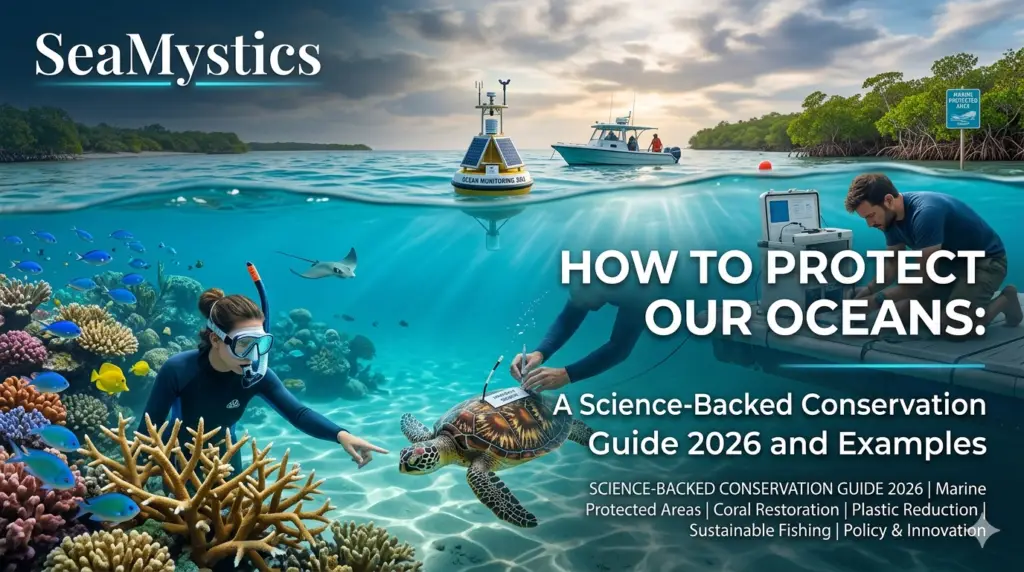

Salt air. Crashing waves. A horizon that never ends. Most of us love the ocean, yet very few of us know it is fighting for its life right now. So, how to protect oceans before it’s too late? That question sits at the heart of every marine biology lab, every coastal town hall, and every dinner table conversation about climate change today.
you read our blog climate change ocean impact
I’m Dr. Rabica, and I have spent years studying coral reefs and coastal ecosystems. In that time, one truth has become clear: ocean health is not a far-off issue. It is tied to the air we breathe, the food we eat, and the economy that supports millions of jobs. Because of this, learning how to protect oceans is no longer optional. It is essential.
you can read our blog overfishing effects ocean life
This guide breaks down the science, the numbers, and the real steps that work. Furthermore, it shows what governments, businesses, and everyday people are doing right now, in 2026, to turn the tide.
you can read our blog endangered marine species list
Key Takeaways at a Glance
| Focus Area | Current Status (2026) | Why It Matters |
|---|---|---|
| Marine Protected Areas | 10.01% of the ocean is officially protected as of April 2026 IUCN | Goal is 30% by 2030; progress is behind schedule |
| Plastic Pollution | About 11 million tonnes of plastic enters the ocean every year Surfers Against Sewage | Harms marine life and enters the human food chain |
| Effective Protection | Only 2.7% of the ocean is effectively protected with active management Campaign For Nature | Paper protection without enforcement does little good |
| Funding Gap | Just $1.2 billion flows to ocean protection yearly, versus the $15.8 billion needed Campaign For Nature | Lack of money slows real-world conservation work |
| High Seas Treaty | The UN High Seas Treaty came into force in January 2026 IUCN | First-ever legal tool to protect international waters |
Why Ocean Protection Matters More Than Ever
The ocean is not just scenery. It regulates climate, feeds billions, and produces the air we breathe. Without it, life on land would look very different.
Consider this: oceans absorb roughly a third of the carbon dioxide humans release. They also generate over half of the planet’s oxygen through tiny marine plants called phytoplankton. Therefore, when ocean health declines, the effects ripple far beyond the coastline.
you can read our blogocean acidification explained simply
The Scale of the Threat Today
Pollution, overfishing, and habitat loss are pushing marine ecosystems toward a tipping point. As a result, scientists now describe several oceans as approaching crisis-level stress.
- Between 1 and 2 million tonnes of mismanaged plastic enter the ocean annually, according to long-term tracking data. Our World in Data
- At least 15 trillion plastic particles, weighing roughly 93,000 tonnes, now float on the ocean’s surface alone. OECD
- Under current trends, ocean plastic could reach 76 million tonnes by 2040, nearly doubling today’s accumulated total. OECD
These numbers are not abstract. For instance, in May 2025, the Pacific nation of Samoa created nine new marine protected areas, covering nearly a third of its national waters, specifically because local fish stocks and reef health were declining fast.
How to Protect Oceans Through Global Policy
Government action sits at the foundation of ocean protection. Consequently, tracking real policy wins helps separate genuine progress from empty promises.
Marine Protected Areas: Progress and Gaps
Marine Protected Areas, often called MPAs, restrict harmful activity in chosen ocean zones. However, not every MPA actually stops damage.
As of 2025, about 9.6% of the world’s oceans were covered by marine protected areas, up from 8.4% in 2024. Then, in April 2026, the world crossed the 10% mark, with 10.01% of the ocean now within protected and conserved areas. Still, that leaves a long road ahead, since an area roughly the size of the Indian Ocean must still be protected by 2030 to hit the global 30% target. Mongabay + 2
Here is the catch, though. Quality matters as much as quantity.
- Only about 3.3% of the ocean is fully or highly protected, meaning extraction activities like fishing or mining are completely banned. Mongabay
- Roughly 3.2% of designated MPAs are considered “paper parks,” areas protected on paper while still allowing destructive practices such as bottom trawling. Mongabay
- Just 2.7% of the ocean is assessed as effectively protected, with real management and enforcement in place. Campaign For Nature
For an audience in the United States and Europe, this distinction matters a great deal. Many coastal regions advertise “protected” status, yet enforcement budgets often fall short. For deeper background on regional protection rules, you can check our /related-guide on coastal regulations.
you read our blog deep sea mining risks
The High Seas Treaty: A New Legal Tool
For decades, international waters had almost no legal protection. That changed recently.
The UN High Seas Treaty entered into force in January 2026, becoming the first international agreement focused specifically on biodiversity in waters beyond national borders. This matters enormously because an estimated 95% of Earth’s habitable space by volume sits in the high seas, yet only 1.66% of that zone carries any protection. IUCNIUCN
According to the International Union for Conservation of Nature, governments, Indigenous communities, and conservation groups must now work together to translate this treaty into enforceable action on the water, not just on paper.
How to Protect Oceans From Plastic Pollution
Plastic remains the most visible ocean threat, and it touches nearly every coastline on Earth, from busy beaches to remote Arctic ice.
Where the Plastic Comes From
Most ocean plastic does not come from beachgoers dropping a bottle. Instead, it travels long distances before reaching the sea.
- More than 1,000 rivers account for roughly 80% of global riverine plastic emissions into the ocean. Our World in Data
- Roughly 9.5 million tonnes of ocean plastic comes from land, while about 1.75 million tonnes comes directly from fishing and shipping. Surfers Against Sewage
- Only about 9% of all plastic ever produced has actually been recycled. Surfers Against Sewage
In short, the problem starts far inland, long before plastic ever touches saltwater. That is why river cleanup and waste management upgrades matter just as much as beach cleanups.
Practical Steps That Reduce Plastic Waste
Individual habits add up, especially across millions of households in the US and Europe.
- Swap single-use plastic bottles and bags for reusable versions.
- Choose products with minimal or plastic-free packaging when shopping.
- Support local recycling programs and ask local officials about waste infrastructure gaps.
- Join or organize a river or beach cleanup, since rivers feed most ocean plastic.
- Avoid products containing microbeads, which slip past most filtration systems.
The nonprofit Ocean Cleanup project, based in the Netherlands, focuses on intercepting plastic in rivers before it ever reaches open water. This approach, paired with local policy, offers a more practical fix than only chasing plastic after it has already entered the sea. For more on reducing household waste, see our /related-guide on sustainable living swaps.
How to Protect Oceans Through Smarter Fishing and Food Choices
Overfishing depletes fish populations faster than they can recover, which throws entire food webs out of balance.
Choosing Sustainable Seafood
Consumers hold real power here, since seafood demand drives much of global fishing pressure.
- Look for certification labels such as the Marine Stewardship Council mark when shopping.
- Ask restaurants where their seafood comes from and how it was caught.
- Favor smaller, fast-reproducing fish species over slow-growing predators like bluefin tuna.
Meanwhile, organizations are pushing for stronger fishing rules at sea. In Latin America, nearly 27% of marine areas carry MPA status, yet only 2.5% receive effective protection, according to Conservation International’s recent analysis. This gap shows why labels alone do not guarantee a fish stock’s recovery; enforcement does. Conservation International
Supporting Ocean-Friendly Policy at Home
Voters and consumers in the US and Europe can push for change beyond their grocery cart.
- Contact local representatives about fishing quota enforcement.
- Support businesses that publish supply chain transparency reports.
- Donate to groups working on high seas enforcement and monitoring.
Real-World Wins Worth Knowing
Good news exists, and it deserves attention alongside the warnings.
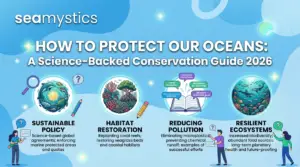
In June 2025, French Polynesia announced protection across its entire 4.8 million square kilometer ocean territory, with over 1 million square kilometers receiving the strictest possible status. Around the same time, Pakistan declared a new marine protected area around Miani Hor Lagoon in September 2025, safeguarding habitat for endangered Indian Ocean humpback dolphins. Additionally, four marine sites, including Costa Rica’s Cahuita National Park and Hawai’i’s Kaho’olawe Island Reserve, received Blue Park Awards in 2025 for meeting rigorous, science-based conservation standards.
These examples prove that meaningful protection is achievable when funding, science, and political will line up together.
The Funding Gap Holding Conservation Back
Money remains the biggest barrier between ambition and real-world results.
Currently, just $1.2 billion flows annually toward ocean protection, far short of the $15.8 billion needed each year to meet the 30% target by 2030. Interestingly, that shortfall represents only about 0.5% of annual global defense spending worldwide, which puts the scale of the gap into perspective. Campaign For NatureCampaign For Nature
According to a report from the Bloomberg Ocean Fund and Campaign for Nature, closing this gap could unlock close to $85 billion per year by 2050 through avoided coastal damage, carbon storage, and restored fisheries. In other words, ocean protection is not just an environmental cost; it is also a sound economic investment.
Frequently Asked Questions
What is the single biggest threat to ocean health right now?
Most marine scientists point to a combination of plastic pollution, overfishing, and warming waters, rather than one single cause.
Can individuals really make a difference in ocean protection?
Yes. Household choices around plastic use, seafood sourcing, and voting on environmental policy collectively shape demand and political pressure.
What percentage of the ocean is currently protected?
As of April 2026, just over 10% of the global ocean carries some form of protected status, though far less is fully enforced.
Why does “protected” not always mean “safe”?
Many protected zones permit damaging activities like bottom trawling, so the label alone does not guarantee strong enforcement or ecological recovery.
Will the 30% by 2030 ocean goal be met?
At the current pace, most experts agree the world is unlikely to hit 30% by 2030 without a dramatic increase in funding and enforcement.
Conclusion
Protecting our oceans is not a single fix; it is a combination of stronger policy, smarter consumer habits, and sustained funding working together. The data clearly shows progress, yet it also shows how far the world still has to go before reaching the 30% protection goal. Every action, from choosing sustainable seafood to supporting river cleanup projects, adds up across millions of people. Ultimately, the ocean’s recovery depends on choices made today, by governments, businesses, and individuals alike, in the US, Europe, and everywhere else connected to this shared blue planet. For more on related sustainability steps, visit our /related-guide on climate-friendly habits.
References
- IUCN & UNEP-WCMC, “World reaches milestone for nature: 10% of ocean now officially protected,” April 2026.
- Campaign For Nature, “Ocean Gap Report 2025,” 2025.
- Mongabay, “Marine protected areas expanded in 2025, but still far from 30% goal,” 2026.
- Surfers Against Sewage, “Plastic pollution: facts & figures,” 2025.
- Our World in Data, “Plastic Pollution,” 2023.
- Conservation International, “Report issues ‘sobering reality check’ for world’s oceans,” 2024.
- OECD, “Stemming plastic pollution to protect the ocean,” 2025.