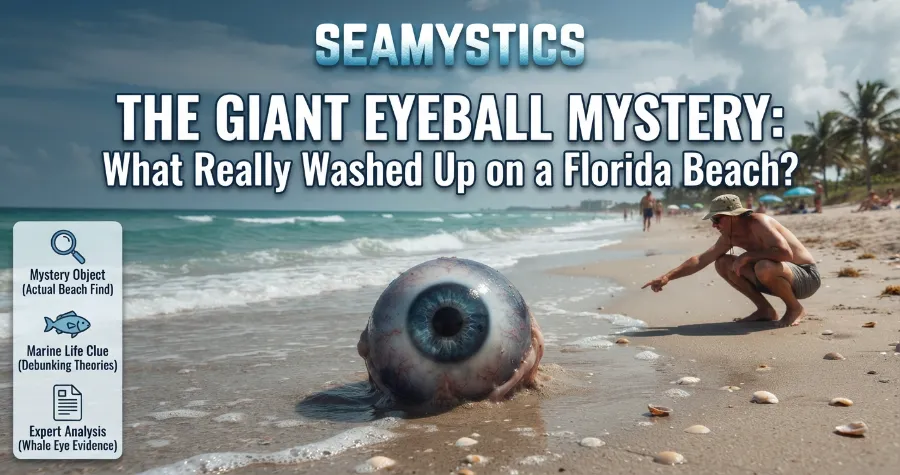

On a quiet October morning in 2012, a man walking along Pompano Beach picked up something that looked like it came from a horror film. It was a deep blue eyeball the size of a softball, still fresh. Within hours, the internet turned the find into a global giant eyeball mystery, and everyone had a theory. As a marine biologist, I love these moments because they show how fast curiosity can turn into real science.
TL;DR: The giant eyeball found on Pompano Beach, Florida, on October 10, 2012, most likely came from a swordfish, not a giant squid. Florida wildlife experts pointed to its color, size, and the bone around it, plus clean straight cuts that showed a fisherman had removed it. You can use the same clues to judge any unexplained eyeball in the ocean.
Key Takeaways
| Question | Short answer |
|---|---|
| Where was it found? | Pompano Beach, Florida, north of Fort Lauderdale |
| When? | October 10, 2012 (announced as likely swordfish on October 15) |
| How big was it? | About the size of a softball |
| Who found it? | Beachcomber Gino Covacci |
| What was it? | Most likely a swordfish eye |
| Key clue | Bone around the eye and straight-line cuts |
| Why did it wash up? | A fisherman likely cut it out and tossed it overboard |
What Happened at Pompano Beach
The story began on Wednesday, October 10, 2012. A beachcomber named Gino Covacci found the eye on the sand and told local reporters it was fresh. He bagged it and handed it over to the Florida Fish and Wildlife Conservation Commission (FWC). Staff put it on ice and sent it to the Fish and Wildlife Research Institute in St. Petersburg.
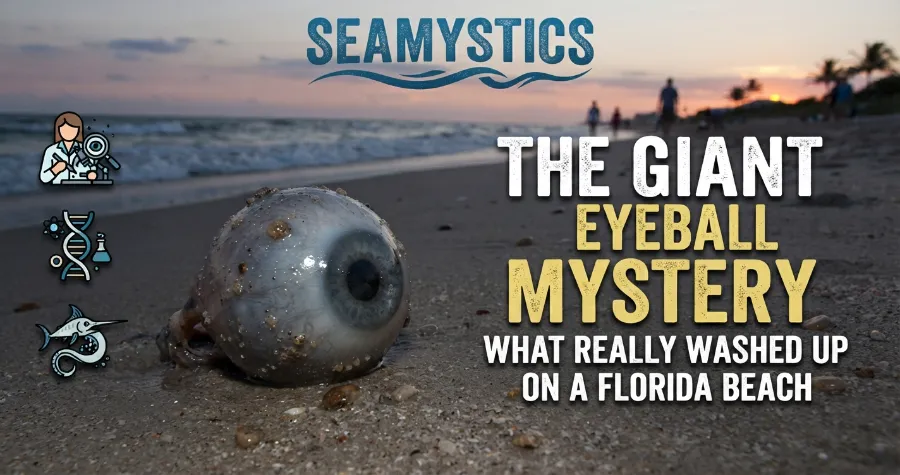
Photos spread quickly. The FWC posted pictures online, and people guessed everything from a giant squid to a whale. National Geographic covered the first wave of speculation and noted that early suspects included a large fish such as a swordfish or tuna. That wide range of guesses is normal. A single photo of a loose eye gives you very little to work with.
The Faceless Fish Rediscovery: Australia’s Strange Deep-Sea Find
By Monday, October 15, the FWC shared its verdict. Joan Herrera, curator of collections at the institute, said the color, size, structure, and bone around the eye pointed to a swordfish. She also said the straight cuts around it suggested a fisherman removed it and discarded it. Live Science reported the same conclusion and added that genetic testing would confirm it.
Why the Giant Eyeball Mystery Fooled So Many People
Most of us have never seen an eye that large outside a body. Without the head, the eye loses all its context. A blue, rounded, glassy ball looks alien, and the brain fills the gap with the scariest answer.
There were three reasons the story spread so fast:
- The eye looked fresh, so people assumed something strange had just died nearby.
- The size felt wrong for a normal fish.
- Giant squid were in the news that year, so many people linked the two.
Here is something I tell students often. A mystery feels bigger when the evidence is small. Once experts looked at the whole eye in person, the story shrank to a simple fishing tale.
How Experts Identified the Mystery Eyeball
Identifying a mystery eyeball identified by science takes a few steps. You do not need a lab for the first ones. You need patience and a calm look at the details.
- Check the structure. Fish eyes often sit in a ring of bone or hard cartilage. Squid eyes do not have that bony ring.
- Measure the size. A softball is large for a fish eye but small for a giant squid eye.
- Look at the edges. Clean, straight cuts mean a blade. Ragged tears mean a predator or rough water.
- Consider the location and season. Swordfish are commonly fished off South Florida in October, according to the FWC.
- Confirm with DNA. Genetic testing settles any doubt.
In the Pompano case, the bone and the straight cuts did most of the work. A giant squid eye would not have a bony ring, and a predator would not leave tidy slices. That combination made the swordfish answer strong.
Unidentified Whale Sounds That Don’t Match Any Known Species
Why Swordfish Have Such Big Eyes
Swordfish live in deep, dim water. They can dive to about 2,000 feet, according to the FWC. Big eyes collect more light, which helps them hunt at depth.
Swordfish also have a special heating organ near the eye. It warms the eye and brain in cold water, which helps them see prey clearly. I find this one of the most underrated tricks in the ocean. A cold eye reacts slowly, but a warm eye keeps up with fast squid.
Adult Atlantic swordfish can top 1,100 pounds, according to NOAA figures reported by the FWC. A fish that big carries a big eye. That is why a swordfish eye can look shocking when it sits alone on the sand.
Giant Squid Eye Washed Up: Could It Really Happen?
Many readers search for a giant squid eye washed up on a beach, so let me answer that directly. Yes, it is possible, but it is rare. Giant squid live deep, and most of what we know comes from dead animals that surfaced or tangled in nets.
Squid eyes are truly huge. A 2012 study in the journal Current Biology reported that giant squid eyes can reach about 27 centimeters, which is roughly 11 inches. That is close to a basketball. The researchers suggested the size helps the squid spot sperm whales in the dark.
Mystery Egg Cases on the Ocean Floor: What Lays Them?
A colossal squid caught in New Zealand’s Ross Sea in 2007 also had an eye near that size. So a squid eye would be much larger than the Pompano find. This is another reason the swordfish answer made sense. The eye was softball sized, not basketball sized.
| Animal | Approximate eye size | Notes |
|---|---|---|
| Swordfish | About 3 to 4 inches (softball range) | Eye sits in bone, heated in cold water |
| Giant squid | Up to about 11 inches | Among the largest eyes known |
| Colossal squid | Around 11 inches | Found in cold Southern Ocean water |
| Large tuna | Several inches | Often confused with swordfish eyes |
Sizes are approximate and based on published reports and general reference values.
What Else Washes Up and Gets Mistaken for a Monster
Beaches have a long history of strange arrivals. The so-called Montauk Monster in New York in 2008 turned heads, though it was likely a decomposed raccoon. People also find globsters, which are shapeless masses of whale blubber or fish tissue. Each case follows the same pattern: a decayed or damaged body part loses its shape and looks like a new species.
When I help review stranding photos, I see this over and over. Decay swells tissue, sun bleaches color, and waves remove fine details. A shark jaw becomes a “sea serpent skull.” A whale spine becomes a “dragon.” The ocean is a very good prop master.
If you enjoy these cases, you will like our guide to unidentified underwater footage. It shows how scientists sort real unknowns from simple misreads. Many of the same tools apply on land and at sea.
Real Clues That Separate a Squid Eye From a Fish Eye
Here is a simple field guide. These are the same points I use when a photo lands in my inbox.
- Bone or cartilage ring: Present in fish, absent in squid.
- Lens shape: Squid lenses are very round. Fish lenses are often round too, but they sit differently in the socket.
- Tissue left behind: Fish eyes often keep a bit of muscle and bone. Squid eyes may keep soft, jelly-like tissue.
- Color: Fresh fish eyes can look blue or silver. Aging eyes cloud over to white or gray.
- Cut marks: Straight lines suggest a knife. Jagged edges suggest teeth or tearing.
Never rely on one clue alone. Always combine at least three before you name an animal. That habit alone prevents most wrong calls.
Why Fishing Waste Matters for Beach Finds
The Pompano eye did not come from a mysterious deep-sea event. It came from fishing activity. Fishermen often remove parts of a catch at sea, and the discards float or drift to shore. This is a normal result of working boats near a busy coast.
Not all fishing waste is that harmless. Lost nets and lines keep killing animals long after they are gone. A widely cited estimate from the UN Food and Agriculture Organization and the UN Environment Programme in 2009 said abandoned gear makes up about 10 percent of all marine litter. I wrote about this problem in our piece on ghost nets, and it connects to strandings more often than people think.
When you see a strange body part on the sand, ask a basic question first. Did people have a hand in this? In my experience, the answer is yes more often than not. Fishing gear, boat strikes, and discarded catch explain a large share of odd finds.
Mystery Seafloor Tracks: The Marks No One Can Identify
A Practical Case Study: Reading the Evidence Step by Step
Let me walk through the Pompano case the way I would teach it in a field workshop. I find it helps to treat every strange find as a short investigation.
Step one, gather the facts. The eye was softball sized, deep blue, and fresh. It had bone around it. It had straight cuts.
Step two, list the suspects. Experts named a swordfish, tuna, whale, and giant squid.
Step three, test each suspect. A whale eye is much larger and sits in thick tissue. A giant squid eye is bigger and has no bony ring. A tuna eye is smaller and often rounder.
Step four, check the context. Swordfish season was active off South Florida. Fresh tissue meant a recent catch.
Step five, confirm. DNA testing was planned to close the case.
This is what good science looks like. We do not jump to the most exciting answer. We rule out the weaker ones until one remains.
Expert Opinions Worth Noting
During the 2012 coverage, the FWC’s Carli Segelson told reporters the primary suspect was a large fish. A researcher quoted by Live Science, identified only by the surname Johnsen, said the eye looked like it came from a large xiphid, likely a swordfish or marlin. Both statements lined up with the final answer.
My own view is a little blunt. The public often asks for “the monster answer,” and science rarely gives it. But I do not think the swordfish answer is boring. A swordfish is a warm-eyed deep diver that can outpace most predators. That is a remarkable animal.
I also think these stories matter for public trust. When agencies explain their reasoning openly, people learn how evidence works. That does more good than any monster headline.
How to Report a Strange Beach Find
If you find a mystery eyeball or any odd body part, you can help science. Follow these simple steps.
- Do not touch it with bare hands. Marine tissue can carry bacteria.
- Take clear photos. Shoot from several angles and place an object, such as a coin or shoe, next to it for scale.
- Note the time and place. Write down the beach, the date, and the tide if you know it.
- Call local wildlife officials. In Florida, that means the FWC. In other regions, call the local fisheries or stranding network.
- Keep it cool if they ask you to. Mr. Covacci handed his find over fast, and that helped experts get a good sample.
Acting quickly matters. Fresh tissue gives the best DNA results. A day in the sun can ruin the sample.
Unexplained Eyeball Ocean Cases Beyond Florida
The Pompano story is not the only one. Reports of large eyes appear every few years, often after a stormy week or a busy fishing season. Most trace back to swordfish, tuna, or marlin. A few turn out to be squid.
Not every strange thing in the sea has an easy answer. Deep sea cameras keep catching odd shapes, lights, and moving forms. Our look at mysterious ROV lights shows how teams decide between bioluminescence and equipment glare. Another piece covers the live Nautilus footage, where scientists watched a creature in real time and had to judge it on the spot.
Sonar adds another layer. Returns on a screen can look like giant objects when they are just schools of fish. Our guide to unidentified sonar shapes explains how experts read those signals. The lesson across all of these cases is the same: slow down and test your first idea.
How Search and AI Tools Now Shape Mystery Stories
A lot of readers now ask search tools and AI assistants about stories like this. These tools pull from clear, well sourced pages. They favor direct answers, named experts, dates, and numbers.
That is why I write mystery posts the way I do. I state the answer early, name the source, and give the date. If a fact has a clear origin, I link to it. This habit helps readers, and it helps the facts travel correctly.
If you share a strange find online, do the same. Post the date, the place, the size, and your photos. Say what you know and what you do not. Clear, honest posts get cited. Wild guesses get ignored.
Frequently Asked Questions
What was the giant eyeball found on a Florida beach?
Experts at the FWC believe it came from a swordfish. They based this on its color, size, structure, and the bone around it.
Where was the giant eyeball beach Florida find made?
It washed up at Pompano Beach, north of Fort Lauderdale, on October 10, 2012.
Could a giant squid eye wash up on a beach?
It could happen, but it is rare. Giant squid eyes can reach about 11 inches, so they are much bigger than the Pompano eye.
Why did the eye look so fresh?
Experts believe a fisherman cut it out of a freshly caught swordfish and tossed it into the water. The straight cuts support that idea.
Was the identification ever confirmed?
The FWC said genetic testing would confirm the result. The early expert call was based on strong physical evidence.
What should I do if I find a strange eye on the beach?
Photograph it with a scale object, record the location, and call local wildlife officials. Keep it cool if they ask you to hold it.
Conclusion
The giant eyeball mystery shows how one odd object can spark a worldwide guessing game. In the end, the clues were simple: a softball-sized size, a ring of bone, and tidy knife cuts that pointed to a swordfish and a fisherman. The real lesson is how to think. Look at the structure, test each idea, check the context, and confirm with data.
The next time you spot something strange on the sand, treat it like a small investigation. Take photos, note details, and call the experts. You might help solve the next big beach mystery. For more cases like this, start with our Sea Mystics home page and explore the deep.
Quick Quiz
1. Where was the giant eyeball found?
a) Miami Beach
b) Pompano Beach
c) Key West
d) Daytona Beach
2. Which animal did experts believe the eye came from?
a) Giant squid
b) Blue whale
c) Swordfish
d) Great white shark
3. Which clue helped rule out a squid?
a) The smell
b) Bone around the eye
c) The beach location
d) The time of day
4. True or false: Giant squid eyes can reach about the size of a basketball.
5. In one sentence, why did the eye look so fresh?
Answers: 1. b) Pompano Beach. 2. c) Swordfish. 3. b) Bone around the eye. 4. True, up to about 11 inches. 5. A fisherman likely cut it from a fresh catch and tossed it overboard.
References
- Florida Fish and Wildlife Conservation Commission statements on the Pompano Beach eyeball, October 15, 2012
- National Geographic, “Mysterious Giant Eyeball Found on Florida Beach,” October 12, 2012
- Live Science, “Mystery of Giant Eyeball on Beach Solved,” October 2012
- NBC Miami, “Mystery Solved! Beach Eyeball Believed to Come From Swordfish,” 2012
- Associated Press, “Giant Eyeball Washes Up on Beach,” 2012
- Nilsson et al., “Giant eyes of giant squid,” Current Biology, 2012
- FAO and UNEP, “Abandoned, lost or otherwise discarded fishing gear,” 2009