
Imagine hauling a net up from four kilometres down and finding a fish with no face. No eyes you can see. No mouth on the front. Just a smooth, pale head. That is what a team of Australian scientists saw in 2017, and the faceless fish rediscovery shocked people all over the world.
The animal looked like a prank, but it was real. It was a rare cusk eel that nobody had recorded in Australian waters for well over a century. I have spent my career studying deep-sea fish, and I still think this is one of the best “how is that even possible” stories in modern ocean science.
TL;DR
The “faceless” fish is a deep-sea cusk eel called Typhlonus nasus. Scientists trawled one up from about 4,000 metres off Australia’s east coast in 2017, the first Australian record since the late 1800s. It has eyes, but they sit under the skin, and its mouth is on the underside of its head.
Key Takeaways
| Question | Short answer |
|---|---|
| What is it? | A cusk eel named Typhlonus nasus, nicknamed the faceless cusk |
| Where was it found? | Off Australia’s east coast, about 4,000 m deep |
| When? | During a 2017 research voyage |
| Why does it look faceless? | Eyes are hidden under skin and the mouth sits underneath |
| Is it a new species? | No. It was first collected in the late 1800s |
| How cold is its home? | About 1°C (34°F) |
| Why does it matter? | It shows how little we know about the deep sea |
What Is the Faceless Fish?
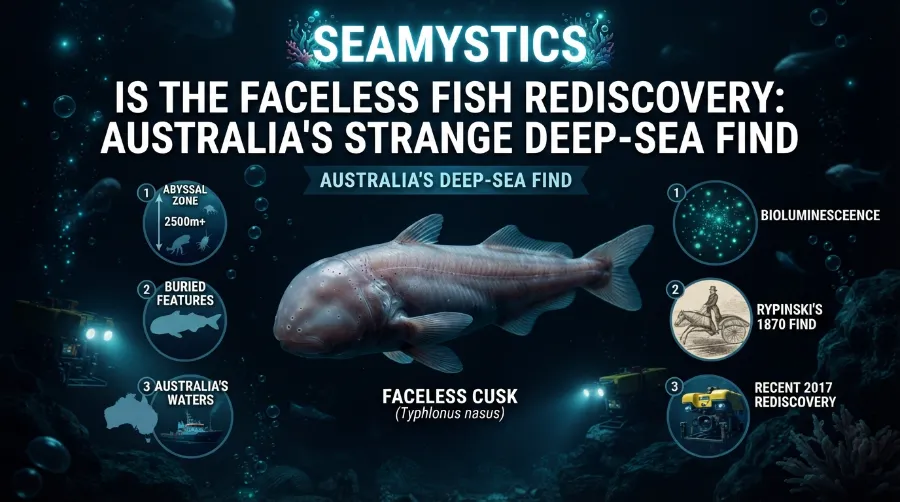
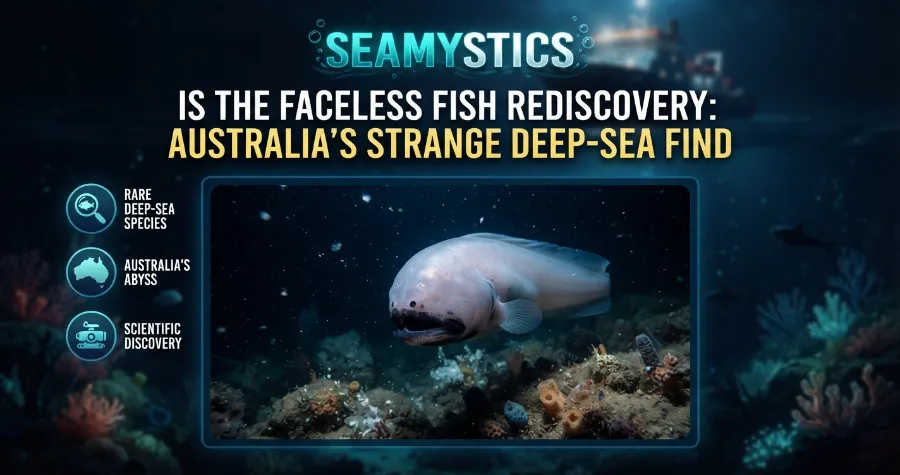
The faceless fish is a real animal with a scientific name: Typhlonus nasus. Scientists call it the faceless cusk. It belongs to the cusk eel group, a family of long, soft-bodied fish that live in dark, cold water.
When the crew first saw it, many people thought it might be a new species. After careful study, the team learned that the fish was already known. The historic HMS Challenger voyage, the first round the world ocean research trip, collected it in the late 1800s. So this was a rediscovery, not a brand new find.
Mystery Egg Cases on the Ocean Floor: What Lays Them?
That detail matters for the story. Finding a new species is exciting. Finding a fish that vanished from a whole country’s records for more than 100 years is exciting in a different way. It tells us the animal was probably always there. We just never looked in the right place with the right gear.
Why Does It Look Like It Has No Face?
Here is the short version. The fish does have eyes. In smaller specimens, scientists can see them under the skin. The big specimen from Australia had no clear eyes at all, and researchers think it may be the largest one ever recorded.
The mouth sits under a bulbous head and snout, not at the front. That is why the fish looks so strange when you view it from the side. Your brain expects a front mouth and two eyes. When both are missing, the face seems to vanish.
Here are the features that create the “no face” look:
- Eyes that are tiny or hidden beneath the skin
- A large, rounded snout that covers the front of the head
- A small mouth on the underside, packed with close teeth
- Pale, soft skin with little colour
These are some of the main faceless cusk eel facts people search for. They also explain why the phrase “weird fish no face” gets so many clicks. The animal is odd, but every odd feature has a reason.
Faceless Fish Australia: Where and How It Was Found
The faceless fish Australia story starts on a research ship. In 2017, a team from Museums Victoria and CSIRO sailed the research vessel Investigator off the east coast. Their goal was to survey life on the deep seafloor, a place scientists call the abyss.
The crew dragged a net along the bottom at roughly 4,000 metres, or about 13,000 feet. At that depth, the water sits near 1°C (34°F). Sunlight never reaches it. The seafloor there is mostly flat and bare, with little food.
When the net came up, the team found the pale, faceless creature among the catch. Photographers and fish experts took pictures right away. The images spread fast, and news sites in the US, the UK, and across Europe ran the story within days. You can see the original photo set in this Live Science photo report on the rediscovered fish, which was published on 14 June 2017.
For a longer look at the voyage and the people on board, read the National Geographic article on the deep sea voyage off Australia. If you want a lighter, ocean lover’s take, the Awesome Ocean guest column on the faceless fish is also worth a few minutes.
Unidentified Whale Sounds That Don’t Match Any Known Species
A Quick Timeline of the Rediscovery
| Period | What happened |
|---|---|
| Late 1800s | HMS Challenger collects the first known faceless cusk |
| 1951 | A deep water search off East Kalimantan, Borneo, collects five specimens |
| 2017 | Australian scientists trawl one up from about 4,000 m off the east coast |
| June 2017 | Photos and reports reach a worldwide audience |
The 1951 detail is a nice clue. Because five fish came up near Borneo, the Australian team said they might find more as they move north of the site. That is a smart, simple idea. If a rare animal lives in one patch of seafloor, it probably lives in nearby patches too.
Life at 4,000 Metres: What the Abyss Is Really Like
Most people picture the deep ocean as one big dark room. In truth, it has layers. Scientists often split the water column by how much light each layer receives.
| Ocean zone | Approximate depth | Light level |
|---|---|---|
| Sunlight zone | 0 to 200 m | Bright enough for plants |
| Twilight zone | 200 to 1,000 m | Faint blue light |
| Midnight zone | 1,000 to 4,000 m | No sunlight |
| Abyssal zone | 4,000 to 6,000 m | None, near freezing |
The faceless cusk lives right at the top of the abyssal zone. For scale, the wreck of the Titanic rests at about 3,800 metres. This fish lives deeper than that. The pressure is around 400 times what you feel at the surface, and the food supply is thin.
Animals down there save energy in every way they can. They grow slowly. They move little. Many have lost features they do not need. Eyes are a good example. If no light reaches you, expensive eyes are a waste of energy. So over a very long time, some deep sea fish have shrunk their eyes or covered them with skin.
That is the secret behind the “face” puzzle. The faceless fish did not lose its face by accident. Evolution trimmed what the dark did not require.
How the Faceless Cusk Likely Feeds
The fish has a small mouth filled with close-set teeth. Researchers say it eats a mix of crustaceans, the small shrimp-like animals that live on the seafloor. A bottom feeder with an underside mouth makes sense. It can glide just above the mud and pick up food from below.
In my own work with deep trawl samples, I have learned to check stomach contents early. A small amount of crab shell or shrimp legs can tell you more about a fish’s life than a pile of measurements. With a rare animal like this one, every clue counts, because you may never get a second specimen.
The Giant Eyeball Mystery: What Really Washed Up on a Florida Beach
What Scientists Learned From One Strange Fish
One fish does not rewrite a textbook. Still, a single rare specimen can teach a lot. Here is what this find added to the record:
- It confirmed that the species lives in Australian waters, not only in far-off places.
- It showed the species ranges widely, from the Arabian Sea to Hawaii.
- It gave scientists a very large specimen, which helps them study how the fish changes as it grows.
- It gave the public a fresh reason to care about the deep sea.
The wide range is worth a second look. A fish found from the Arabian Sea to Hawaii is not a local oddity. It is simply rare, and it lives where few nets ever reach. That is a good reminder for anyone reading a headline about a “lost” species. Lost often means unseen, not gone.
Why Australia Keeps Making Deep Sea Headlines
The phrase Australia deep sea discovery pops up often for a good reason. The country has one of the longest coastlines and largest ocean zones on Earth, and a huge share of its seafloor has never been sampled in detail. Each new voyage tends to bring up species that are new or long forgotten.
Mystery Seafloor Tracks: The Marks No One Can Identify
I like to explain it with a simple comparison. Exploring the abyss with a net is like trying to learn about a forest by dropping a bucket from a helicopter. You get a few scraps, and you guess the rest. Under those rules, strange finds are not rare. They are normal.
Modern tools are changing the game, though. Remote vehicles can now film life on the seafloor without hurting it. If you want to see how that looks in practice, the Sea Mystics page on ROV mystery lights shows what robot cameras can capture when they drift through the dark. A live feed can also surprise you, as in this write up of a Nautilus live creature sighting.
Faceless Fish vs Other Famous Weird Deep Sea Animals
The faceless cusk is not alone in the odd club. Here is how it compares with other famous deep dwellers.
| Animal | Strange trait | Typical depth |
|---|---|---|
| Faceless cusk | Hidden eyes, underside mouth | About 4,000 m |
| Anglerfish | Glowing lure on the head | 1,000 to 4,000 m |
| Barreleye | See-through head with tube eyes | 600 to 800 m |
| Giant squid | Huge eyes, up to 27 cm wide | 300 to 1,000 m |
| Dumbo octopus | Ear-like fins | 3,000 to 4,000 m |
Some of these animals went viral because they look scary. The faceless cusk went viral because it looks confusing. That difference is part of its charm. People did not fear it. They wanted to understand it.
If big, odd eyes fascinate you, you might enjoy this Sea Mystics case about the giant eyeball mystery. It sits at the opposite end of the spectrum from our fish with almost no visible eyes.
Real Case Study: How a Rare Catch Gets Verified
People often ask how scientists can be sure a fish is a rare species and not a new one. The process is slow and careful, and it is a good example of how real marine science works.
Here is the usual path:
- The crew photographs the fish right away, before colour and shape fade.
- Experts take measurements and note where the mouth, nostrils, and fins sit.
- The specimen is preserved and sent to a museum collection.
- Scientists compare it with old descriptions and drawings.
- If it matches a known species, it is logged as a rediscovery. If not, a new description begins.
In the faceless fish case, step four did the heavy lifting. Researchers compared the new fish with the old Challenger records and found the match. A drawing from 1887 in the official Challenger report helped confirm it. A 140 year old drawing solved a modern puzzle. I find that wonderful.
Evidence based opinion: museum collections are the real heroes of stories like this. Without the old specimen and the old drawings, the Australian team might have named a “new” species by mistake. Funding for collections rarely makes headlines, yet it protects the accuracy of everything we claim.
Practical Insight From the Lab Bench
Over many years of handling deep sea samples, a few habits have saved me from mistakes. They apply to any rare find.
- Photograph first, touch second. Colour and texture change fast once a fish leaves the cold.
- Record the exact depth and water temperature. A good record is worth more than a pretty picture.
- Never trust a nickname. “Faceless” is a fun label, but only the scientific name is exact.
- Share the data openly. Other experts may spot what you missed.
These are not complex rules. They are the small, boring steps that make an exciting discovery believable.
What the Faceless Fish Tells Us About Ocean Mysteries
Strange footage and odd animals often start online debates. Some people jump to wild ideas before the facts come in. The faceless fish story is a nice counter example. It looked impossible at first. Then careful work gave a clear, natural answer.
That pattern repeats across ocean science. Odd shapes on sonar, blurry shapes in video, and rare animals in nets usually have real explanations. If you enjoy that kind of detective work, start at the Sea Mystics hub for unidentified underwater footage. You can also read about unidentified sonar shapes or the mystery egg cases that puzzled divers. Each case shows how patient study turns a mystery into knowledge.
For the wider picture of our site and its mission, visit the Sea Mystics home page.
Why This Rediscovery Still Matters in 2026
You might wonder why a 2017 find still gets so much attention. There are three good reasons.
First, the deep sea is under pressure. Fishing nets, mining plans, and warming water all reach deeper each year. We cannot protect animals we do not know exist.
Second, every rediscovery improves our maps of life. Each record adds a data point to range maps and helps scientists predict where to search next.
Third, stories like this inspire the next group of scientists. A teenager who sees a face-free fish may decide to study biology. That outcome alone makes the story worth telling.
How to Explore More Deep Sea Science Yourself
You do not need a ship to join the adventure. Here are some easy ways to start:
- Watch live ROV streams from research vessels when they are online
- Visit a natural history museum with a fish collection
- Read original expedition reports and look at the old drawings
- Follow trusted science outlets for new discoveries
If you would like to learn more about first photos of new species, tips, and expert advice, our guides above are a good starting point. To get a better understanding of how scientists discover a new octopus and what to expect, look at our mystery egg and creature pages, then read the cited reports at the end.
Frequently Asked Questions
What is the faceless fish?
It is a deep sea cusk eel called Typhlonus nasus. People nickname it the faceless cusk because its eyes are hidden and its mouth sits underneath.
Where was the faceless fish found?
Scientists trawled it up off Australia’s east coast at about 4,000 metres during a 2017 research voyage.
Is the faceless fish a new species?
No. Experts first collected it in the late 1800s. The 2017 find was a rediscovery for Australian waters.
Does the faceless fish have eyes?
Yes, in smaller specimens the eyes sit under the skin. The big Australian specimen showed no clear eyes at all.
How deep and cold is its home?
It lives near 4,000 metres, where the water is about 1°C (34°F).
What does the faceless fish eat?
Researchers say it eats crustaceans, which it picks up with the small mouth on its underside.
Is the faceless fish dangerous?
No. It is a small, soft bodied deep sea animal that humans almost never meet.
Conclusion
The faceless fish rediscovery is more than a funny photo. It is proof that the deep sea still hides animals we have barely met. A pale cusk eel with hidden eyes and an underside mouth reminded the world that “weird” usually means “well adapted.”
Next time you see a strange creature online, slow down and ask the scientist’s question: what does the evidence say? That one habit will take you much further than any rumour.
Test Your Knowledge: 5 Question Quiz
1. What is the scientific name of the faceless fish?
a) Anoplogaster cornuta
b) Typhlonus nasus
c) Mola mola
2. About how deep was the faceless fish found?
a) 400 metres
b) 1,000 metres
c) 4,000 metres
3. Where is the mouth of the faceless cusk?
a) On the underside of the head
b) At the tip of the snout
c) On top of the head
4. True or false: The faceless fish was a brand new species in 2017.
5. True or false: The fish was first collected in the late 1800s by HMS Challenger.
Answers: 1) b. 2) c. 3) a. 4) False, it was a rediscovery. 5) True.
References
- Live Science, “In Photos: ‘Faceless’ Fish Rediscovered After More Than a Century,” 14 June 2017
- National Geographic, article on the faceless fish deep sea voyage off Australia
- Awesome Ocean, guest column on the faceless fish
- Museums Victoria and CSIRO, public records of the 2017 Investigator voyage
- HMS Challenger Expedition Reports, Günther (1887), Plate 25