

Picture a live feed from the deep sea. A bright purple ball slides into view, and the scientists in the control room go quiet. Then they laugh, and then they admit they have no idea what it is. That moment turned one Nautilus Live creature into a global puzzle, and people still search for the answer today.
The truth is more interesting than any alien story. These animals are real, they are living in the dark right now, and most of them have clear scientific names. Below, you will see what each famous clip showed, how experts worked it out, and how you can judge a mystery video yourself. If you love this topic, our guide to unidentified underwater footage covers many more cases.
Key Takeaways
| Question | Short Answer |
|---|---|
| Who filmed these creatures? | The research ship E/V Nautilus, run by the Ocean Exploration Trust |
| What tool captured the footage? | A remotely operated vehicle (ROV) called Hercules |
| What was the purple “alien” blob? | A sea slug, first guessed to be a new nudibranch |
| What was the googly eyed one? | A stubby squid, Rossia pacifica, seen at about 2,950 feet |
| Why do deep animals look strange? | Crushing pressure, no sunlight, and soft bodies |
| Were any of them real aliens? | No, every one was an ocean animal |
TL;DR: The “alien” in the viral Nautilus Live videos was a real deep-sea animal. The purple blob was a sea slug, and the googly eyed one was a stubby squid. Deep-ocean life looks odd because it grew up in cold, dark, high-pressure water that has barely been explored.
What Is Nautilus Live and Why Does It Find So Many Weird Things?
Nautilus Live is the public window into the work of the E/V Nautilus, an exploration ship that streams its dives for free. You can watch the official Nautilus Live broadcasts from anywhere in the world. Scientists on shore join the crew by video, so a geologist, a biologist, and a student can all react to the same screen at once. That open style is why a Nautilus Live weird creature moment feels so real and so unscripted.
The ship carries the ROV Hercules, a robot that swims along the seafloor and sends back high-definition video. Because the ship has covered places like the California coast, the Gulf of Mexico, the Caribbean, and Hawaii, the footage keeps showing new faces. NOAA Ocean Exploration states that most of the ocean remains unmapped and unexplored. With that much unseen water, a “what is that?” moment is almost guaranteed.
Here is the main point. These crews do not chase aliens. They map rock, study seep communities, and record every animal they pass, so odd creatures simply show up on camera.
Rare Abyssal Footage: Deep-Sea Creatures Caught on Camera Only Once
The Nautilus Live Viral Video That Started the Alien Talk
The most famous mystery came in the summer of 2016. The ship had left on July 24 and worked the waters off Southern California through mid August. During that trip, the team found a bright purple object tucked under a rocky overhang. A crab wandered up and poked at it while the scientists tried to guess what they were seeing.
What the Team Saw
The object looked like a smooth purple orb with no obvious head, eyes, or limbs. It sat still, and that made it harder to read. Some viewers called it an egg sac, and others guessed it was a sponge. The Inertia reported that the crew in the room could not agree on an answer.
That honest confusion is part of the charm. Scientists rarely get a clean answer from a ten second clip. Instead, they list what they can see, compare it with known groups, and then they wait for better evidence.
The Faceless Fish Rediscovery: Australia’s Strange Deep-Sea Find
What It Turned Out to Be
The expedition page later offered a best guess that the animal could be a new kind of nudibranch, which is a soft bodied sea slug. LAist later wrote that the “alien orb” turned out to be a sea slug. So the final answer is simple: it was a slug, not a visitor from space.
Sea slugs often shock people because they come in wild colors. Many use bright shades to warn predators that they taste bad or carry toxins. That means the purple glow was not a mystery signal. It was a natural warning label.
The Googly Eyed Squid: Another Alien Looking Sea Creature
A few weeks after the purple blob, the same expedition filmed an animal that broke the internet. It had big round eyes, a squat body, and a color that looked painted on. The clip showed an alien looking sea creature that many viewers thought was a toy.
KHOU reported that Hercules filmed it at 2,950 feet while exploring off California. The team named it a stubby squid. They also noted it is closest to the cuttlefish, even though it looks like a mix of an octopus and a squid. The video passed 300,000 views within about a week, according to that report.
The scientists in the room reacted just like the viewers. One of them said it looked like a dropped toy. A second said it looked fake. That human reaction did as much for the clip’s spread as the animal did.
The Real Biology Behind the Face
The species is Rossia pacifica. According to the Nautilus team, it spends its life on the seafloor. It makes a sticky mucus coat, digs into the sediment, and leaves only its eyes sticking out. From that spot, it watches for shrimp and small fish.
So the “googly eyes” are not a joke of nature. They are a hunting tool. A buried predator needs a clear view, and that is why the eyes look so large against the body.
Sonar Unidentified Shapes: Real Cases From the Ocean Floor Explained
The Time Out writers asked whether scientists had the ID right, and many readers voiced the same doubt. The answer is yes. The animal matches the known features of the species, and the ID came from experts who study these groups.
Depth matters here as well. Stubby squid usually live in shallower waters across the North Pacific. LAist noted that they can also live deep, and this clip shows that clearly.
More EV Nautilus Mystery Animal Moments
The purple slug and the stubby squid were not alone. The crew has filmed a long list of strange animals, and each one set off its own wave of “is that real?” comments. This EV Nautilus mystery animal list shows a pattern: nearly every “alien” has a normal identity once experts look closely.
Mystery Egg Cases on the Ocean Floor: What Lays Them?
Here are the best known cases:
- Gulper eel: Filmed in Papahānaumokuākea Marine National Monument near Hawaii. The Inertia reported the clip passed 2 million views. The animal is Eurypharynx pelecanoides, and its pouch like mouth can inflate fast to catch prey.
- “Hairy tennis ball”: A fuzzy ball that researchers gently poked. It was a terebellid worm, also called a bristle worm, that lives in a burrow and uses its tentacles to scoop food.
- Siphonophore: A long, glowing chain filmed in the Gulf of Mexico and Caribbean in 2014. It is not one animal. It is a colony of many smaller animals, called zooids, that each do a different job.
- Neon flying squid: Recorded off Montserrat in 2015, and the crew called the view extremely rare.
- Chimaera: Also called a ratfish or ghost shark, a cartilage fish that looks ghostly under ROV lights.
Notice how many of these are soft, see through, or odd shaped. That is not a coincidence. We will cover why in a moment.
Case File Table: What Looked Alien and What It Was
| Year | Place | Depth or Detail | What People Thought | Real Answer |
|---|---|---|---|---|
| 2014 | Gulf of Mexico and Caribbean | Open water | Glowing alien chain | Siphonophore colony |
| 2015 | Off Montserrat | Deep water | Neon space squid | Neon flying squid |
| 2016 | Channel Islands, California | Under a rock ledge | Alien orb or egg sac | Sea slug (possible new nudibranch) |
| 2016 | Trask Knoll, California | About 2,950 ft | Toy or cartoon | Stubby squid, Rossia pacifica |
| Later | Papahānaumokuākea | Deep water | Muppet | Gulper eel, Eurypharynx pelecanoides |
Compiled by Sea Mystics from public expedition reports and news coverage.
Why Deep Sea Animals Look Like Aliens
An alien looking sea creature is really a normal animal built for a harsh home. The deep ocean has three big rules: heavy pressure, almost no light, and very little food. Every odd feature you see answers one of those rules.
Pressure Shapes the Body
At 2,950 feet, which is about 900 meters, the water pushes with roughly 90 times the pressure at the surface. Hard shells and air filled spaces would be a problem in that setting. So many deep animals have soft, watery bodies that move with the pressure instead of fighting it.
That is why many of them look like jelly, balloons, or blobs. On land, that body plan would collapse. In the deep, it is a smart design.
Light and Color Work Differently
Sunlight fades fast in the sea. Red light disappears first, so a red animal looks black or gray in natural deep light. Many species use red skin as a cloak against predators that can only see blue.
Then the ROV arrives with bright lamps. Suddenly, a creature that spent its whole life in the dark appears in full color. The purple orb and the neon squid both owe part of their “alien” look to those lights.
Small Animals Look Huge on Camera
A viewer rarely knows the size of what they see. A stubby squid is small, but a close camera makes it feel enormous. Without a scale, the brain fills in a monster or a spaceship.
That is why the best Nautilus clips include laser dots on the screen. The two dots sit a set distance apart, so scientists can measure the animal at a glance.
The Giant Eyeball Mystery: What Really Washed Up on a Florida Beach
How to Tell a Real Discovery From a Viral Mystery
Many people ask whether a video shows something truly new. My practical advice, drawn from how marine biologists review ROV clips, is to slow down and run a short check. These steps catch most false alarms:
- Find the source. Look for the ship name, the date, and the dive location. A clip with no source is just a rumor.
- Check the depth. Depth narrows the list of possible animals fast. A squid at 900 meters belongs to a different group than a fish at 50 meters.
- Look for scale. Search for laser dots or a tool in the frame. Without scale, size claims mean nothing.
- Watch the whole clip. Short edits hide movement, and movement often gives away the animal group.
- Wait for the expert. Scientists usually post an ID within days. If they say “we don’t know,” that is also useful information.
My evidence based view is this: most “new species” claims in viral videos fail step one or step five. Real discoveries arrive with a name, a paper, and a specimen in a collection. Viral clips arrive with a caption.
Nautilus Live Weird Creature or New Species? How Scientists Confirm
A strange face on camera does not equal a new species. Confirming a species takes a careful path, and that path explains why the expedition said “could be” instead of “is” for the purple slug.
Here is how the process usually runs:
- The ROV records video and sometimes collects a sample with a soft arm.
- Scientists compare the animal with known species in books and databases.
- Experts in that group study the body parts, and often the DNA.
- If the animal does not match, they describe it in a scientific paper and give it a name.
Video alone rarely finishes the job. That is why a good team collects a specimen when the rules allow it. Research groups like MBARI also publish deep-sea survey results that help experts match a face on camera to a known species.
It also helps to remember that “new to the camera” differs from “new to science.” Many animals have a name already, but almost nobody has seen them alive. The Nautilus team gives the world a rare look at those living animals in their real homes.
Don’t Mix Up the Nautilus Names
Searches for a Nautilus Live creature sometimes land on pages about completely different things. The name “Nautilus” appears across the ocean world, and that causes confusion. So let me sort out three common mix-ups.
First, there is the research ship we have covered, which is run by the Ocean Exploration Trust. Second, there is a Mexico based dive company called Nautilus Liveaboards. Its crew writes trip diaries about hammerheads, sea turtles, and whale sharks, and you can browse the Nautilus Crew author page for those posts. One good example is their report on the Gulf of California, once called “the world’s aquarium”, which shows what shallow water exploration by divers looks like.
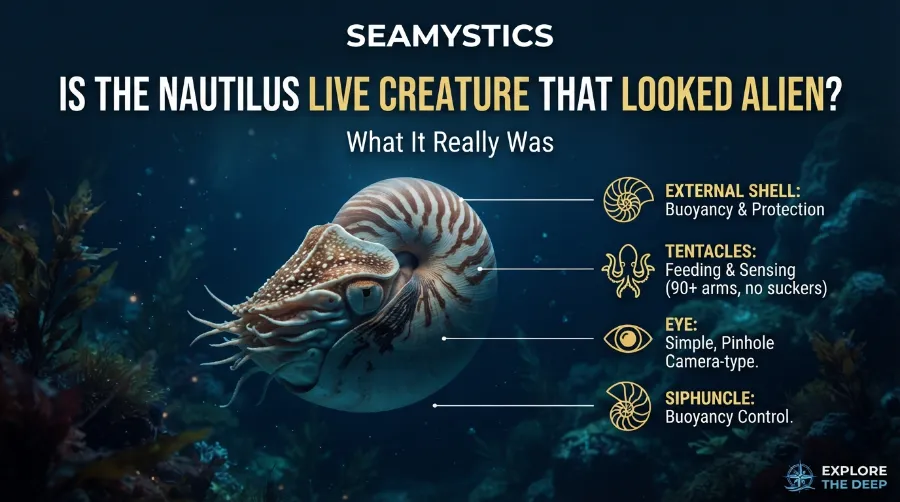
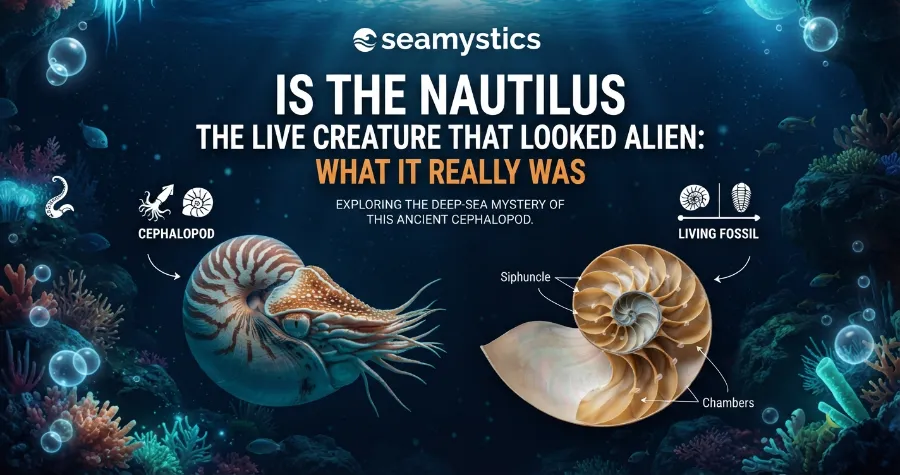
Third, there is the chambered nautilus, a real animal. It has lived in the oceans for around 480 million years and is the only living cephalopod with an outside shell. The team at WiseOceans wrote a clear creature feature on the nautilus if you want the animal facts.
So the ship, the dive boats, and the shelled animal share a name but nothing else. Keeping them apart makes it easier to find the right footage.
Unidentified Whale Sounds That Don’t Match Any Known Species
Why These Clips Go Viral
The animals matter, but the people on screen matter just as much. The best Nautilus videos include live reactions. When a scientist laughs and says a squid looks fake, the audience feels invited into the room.
Three ingredients show up again and again:
- A face. Eyes, a mouth, or a smile give viewers someone to connect with.
- Honest confusion. Experts saying “I don’t know” builds trust and curiosity.
- A quick payoff. A name arrives soon after, so the story feels complete.
Numbers show the effect. The stubby squid clip passed 300,000 views in about a week, and the gulper eel passed 2 million. That level of attention for a science livestream is unusual.
| Viral Clip | Reported Views | Main Hook |
|---|---|---|
| Stubby squid | 300,000 plus in about one week | Cartoon eyes |
| Gulper eel | 2 million plus | Inflating “muppet” mouth |
Figures come from the news reports cited in this post. Counts keep changing, so treat them as snapshots.
Another reason is trust. Viewers watch the same screen the scientists watch, so nothing feels edited or staged. In a time of fake videos, that open view is a strong selling point.
Mystery Seafloor Tracks: The Marks No One Can Identify
What These Clips Teach Us About Ocean Science
Every “alien” clip shares the same hidden lesson. We know very little about the deep ocean, and each dive adds facts. A single frame can show where an animal lives, what it eats, and how it hides.
Take the stubby squid. The footage added to the record that this normally shallow species also lives deeper. That small detail helps map its range.
Clips also pull in new fans. A student who laughs at a squid today might study marine biology next year. Meanwhile, curious readers can explore related cases, like the strange glows covered in our post about mystery lights seen by ROV cameras.
For readers who enjoy this kind of deep sea detective work, you can find more at Sea Mystics, where Dr. Rabica breaks down odd footage in plain words.
Frequently Asked Questions
What was the alien creature filmed by Nautilus Live?
The best known “alien” was a purple orb seen off Southern California in 2016. It turned out to be a sea slug, and the crew first guessed it might be a new nudibranch. A second famous clip showed a stubby squid.
What is the Nautilus Live creature with googly eyes?
It is a stubby squid, Rossia pacifica. It lives on the seafloor, buries itself in sediment, and keeps its eyes above the mud to spot prey.
Is the stubby squid a real animal?
Yes. It is a real species related to cuttlefish. Its toy like look comes from its round body and large eyes.
How deep was the stubby squid filmed?
The ROV Hercules filmed it at about 2,950 feet, which is roughly 900 meters.
Did Nautilus Live find a new species in these videos?
Not in the clips covered here, at least not confirmed. The purple slug was a possible new nudibranch, but a video alone cannot prove a new species. Experts need a specimen and a published description.
Where can I watch Nautilus Live?
You can watch dives on the official Nautilus Live website, which streams from the ship while it is on an expedition.
Why do deep sea creatures look so strange?
They grow up under heavy pressure, in the dark, with little food. Soft bodies, large eyes, and odd colors help them survive in that setting.
Quick Quiz: Test What You Learned
- What is the name of the ROV used by E/V Nautilus?
a) Poseidon b) Hercules c) Triton - What was the purple “alien orb” later identified as?
a) A sea slug b) A jellyfish c) A sponge - About how deep was the stubby squid filmed?
a) 295 feet b) 2,950 feet c) 29,500 feet - Name the scientific name of the stubby squid.
- Why do scientists place laser dots on the screen during a dive?
Answers: 1) b, Hercules. 2) a, a sea slug. 3) b, about 2,950 feet. 4) Rossia pacifica. 5) The dots sit a fixed distance apart, so scientists can judge an animal’s size.
Conclusion
The Nautilus Live creature that looked like an alien was never an alien at all. It was a sea slug, and the next famous one was a stubby squid, both living ordinary lives in dark water far below the surface. Their odd looks come from pressure, darkness, and strong lights on a robot camera. Next time a deep sea clip makes you gasp, check the source, the depth, and the scale, then wait for the experts. The real story is almost always better than the rumor.
About the author: Dr. Rabica is the marine biologist behind Sea Mystics, where deep-sea footage and ocean science get explained in plain language. Every post goes through a science accuracy check before it goes live.
References
- Ocean Exploration Trust, Nautilus Live expedition pages
- NOAA Ocean Exploration, public information on ocean exploration
- MBARI, deep-sea research programs
- KHOU, “Researchers spot ‘googly-eyed’ stubby squid”
- LAist, “Video: Check Out This Adorable Googly-Eyed Squid Found Off Our Coast”
- The Inertia, coverage of the purple blob and the gulper eel
- Time Out Los Angeles, coverage of the stubby squid
- Nautilus Liveaboards, “The Gulf of California, ‘The World’s Aquarium'”
- WiseOceans, “Creature Feature: Nautilus”