
Stand on any beach and look out at the water. It looks blue, right? Most people believe the ocean simply reflects the sky above it. That idea sounds logical, but it is only half true, and honestly, it misses the real story. The real reason the ocean is blue has more to do with physics, light, and water molecules than with clouds or weather. Once you learn how this works, you will never look at the sea the same way again, and a few simple ocean facts will make the whole picture click into place.
To get a better understanding of how ocean depth affects temperature our guide breaks down exactly what to expect.
If you want to learn more about Write whatOrigins of Earth’s oceans explainedout our detailed guide for practical tips and expert advice.
Key Takeaways
| Point | Quick Explanation |
|---|---|
| Main cause | Water absorbs red light and lets blue light bounce back to our eyes |
| Sky reflection | Only a small part of the story, not the main reason |
| Depth matters | Red light disappears within the first few meters underwater |
| Color changes | Algae, sediment, and minerals can turn the ocean green, brown, or even pink |
| Darkest zone | Below roughly 1,000 meters, almost no sunlight remains |
The Real Reason The Ocean Is Blue Comes Down To Light
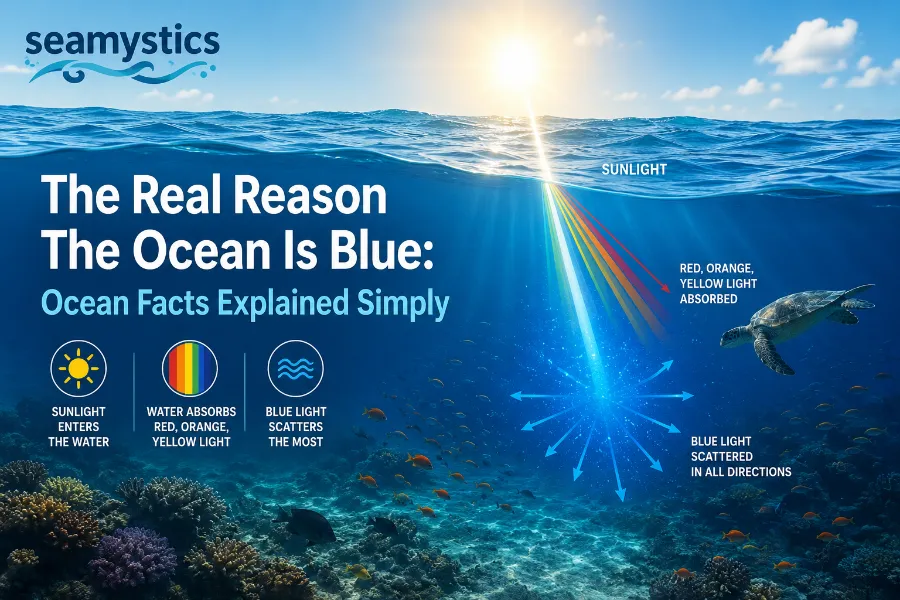
Sunlight looks white, but it actually carries every color of the rainbow bundled together. Each color travels as a different wavelength, and red carries the longest wavelength while blue and violet carry the shortest. When sunlight hits ocean water, something interesting happens almost right away.
To get a better understanding of the real reason the ocean is blue our guide breaks down exactly what to expect.
Water molecules absorb red, orange, and yellow light first because these wavelengths lose energy faster in water. Meanwhile, blue and violet light have shorter wavelengths, so they travel deeper before fading. According to the National Oceanic and Atmospheric Administration, the ocean is blue because water absorbs colors in the red part of the light spectrum, and this acts like a natural filter that leaves blue light behind for us to see. That single fact explains most of what we see when we look at the sea. NOAA National Ocean Service
Why Blue Light Survives Longer Than Other Colors
Think of sunlight as a group of runners entering a race. Red light tires out quickly and drops out within the first few meters. Yellow and green fall away not long after. Blue and violet, however, keep running much further into the water column.
To get a better understanding of tides explained ocean science, our guide breaks down exactly what to expect.
Scientific American backs this up clearly, noting that red, orange, and yellow light get absorbed more strongly by water than blue light does, so when white sunlight enters the ocean, it is mostly blue that gets returned to our eyes. So the next time someone tells you the ocean is just mirroring the sky, you will know there is a deeper answer waiting underneath the surface, quite literally. Scientific American
The Sky Reflection Myth, Debunked
Yes, the ocean surface can pick up hints of gray on a cloudy day or pink during sunset. However, if that were the whole story, the sea would turn black at night or gray during storms. It does not. Divers who swim below the surface, far from any sky reflection, still see that same blue color glowing around them.
If you want to learn more about Write what how the ocean shapes global weather out our detailed guide for practical tips and expert advice.
This tells scientists something important. The blue color comes from within the water itself, not from what is happening above it. Water is behaving like a filter and a light source combined, and that is the real reason the ocean is blue no matter the weather outside.
If you want to learn more about Write what actually drives ocean currentscheck out our detailed guide for practical tips and expert advice.
Ocean Facts That Reveal How Deep This Goes
Once you understand the light absorption process, a lot of strange ocean facts start making sense. Here are a few numbers worth knowing.
- Within the first 10 meters, most red light has already disappeared from view.
- By around 100 meters deep, the water looks deep blue because almost all red light is gone.
- Beyond roughly 1,000 meters, sunlight barely exists, and the ocean turns pitch dark.
- Ocean researchers at Woods Hole Oceanographic Institution have documented that blue and violet wavelengths scatter off tiny particles in the water, which is part of why the color appears so vivid even in clear open water.
These numbers are not just trivia. They explain why deep sea creatures often look completely different in color once they are brought up to the surface. Many deep sea fish appear red or black in their natural habitat, since there is no red light left to reflect off their bodies at that depth, so predators simply cannot see them.
Table: Light Penetration By Depth
| Approximate Depth | What Happens To Light | Visible Color Effect |
|---|---|---|
| 0 to 10 meters | Red and orange light absorbed quickly | Water looks turquoise or bright blue |
| 10 to 100 meters | Yellow and green light fade out | Water turns deep royal blue |
| 100 to 1,000 meters | Only blue and violet remain | Water looks dark navy blue |
| Below 1,000 meters | Almost no visible light remains | Water appears completely black |
This is one reason submarines and deep sea vehicles carry powerful artificial lighting. Without it, crews would see nothing but darkness once they pass a certain point, since sunlight simply cannot reach that far down.
Real Examples That Prove This Isn’t Just Theory
In August 2019, NASA’s ocean color satellite data showed a noticeable shift in the Pacific Ocean’s hue near algae bloom zones, turning parts of the water a murky green instead of the usual blue. This happened because phytoplankton, tiny plant like organisms, absorbed blue and red light while reflecting green, changing the water’s appearance almost overnight.
Another example comes from the Caribbean Sea, where tourists often notice a striking turquoise shade near shallow reefs. This happens because sunlight bounces off the white sandy ocean floor in shallow areas, mixing with the natural blue scattering of the water above it. Meanwhile, in rivers like the Mississippi Delta, the ocean often looks brown near the coast because sediment and silt reflect longer wavelengths of light instead of absorbing them.
These real world cases prove that ocean color is not fixed. It shifts based on depth, sediment, marine life, and even the ocean floor itself.
Why Does The Ocean Sometimes Look Green, Brown, Or Pink?
Water color is not always a simple blue. Several natural factors can change what we see from the surface.
- Phytoplankton blooms can shift color toward green because chlorophyll absorbs blue and red light while reflecting green wavelengths.
- Sediment from rivers can turn coastal water brown or muddy, especially after heavy storms.
- Mineral deposits and volcanic activity near certain coastlines can create reddish or rust colored water.
- Sunset and sunrise lighting can temporarily paint the surface pink or orange, though this fades once the sun rises higher.
If you have ever wondered why the sea near your favorite beach does not always look the same shade of blue, this list explains most of the reasons behind it. For a deeper dive into how minerals and dissolved particles affect ocean chemistry, our guide on why the ocean tastes salty covers a related piece of this puzzle.
How Deep Does This Effect Actually Go?
Many people assume the ocean is blue everywhere and at every depth, but that is not accurate. As mentioned earlier, sunlight fades quickly the deeper you travel. Marine biologists studying deep sea ecosystems often rely on specialized instruments because natural light disappears almost entirely past a certain threshold.
If this topic interests you, our detailed breakdown on the true depth of the ocean explained walks through exactly how far down researchers have measured, and what conditions exist at those extreme depths. It pairs well with everything covered here, since light behavior and depth are closely connected.
What This Means For Marine Life
Color plays a bigger role in ocean ecosystems than most people realize. Fish, coral, and other marine creatures have adapted their coloring based on what light actually reaches them at different depths. Predators and prey alike depend on these light patterns for survival, camouflage, and hunting.
For example, many species living below 200 meters have reddish or black coloring, since there is no red light left to reflect and give away their position. This adaptation happens naturally over generations, shaped entirely by the physics of how light behaves underwater. It is one small example of how ocean facts connect directly to evolution and survival.
Why This Topic Still Confuses So Many People
Textbooks in the past oversimplified this topic, teaching that the ocean simply mirrors the sky. That explanation is easy to remember, but it skips the actual science. Today, researchers and educators are working to correct this misunderstanding, especially since satellite imaging and better ocean sensors have made the truth easier to prove.
If you want to explore more surprising truths about our oceans, our full resource hub on amazing ocean facts breaks down dozens of topics like this one in simple terms. It is a great place to continue learning after finishing this article.
Frequently Asked Questions
Is the ocean blue because it reflects the sky?
Not really. While the surface can pick up some sky color, the main reason is that water absorbs red light and lets blue light bounce back toward our eyes, even below the surface where no sky is visible.
Why does the ocean look green in some places?
Green coloring usually comes from phytoplankton or algae, which absorb red and blue light but reflect green wavelengths back toward the surface.
Does the ocean stay blue at every depth?
No. Blue light itself gets absorbed eventually too, which is why the deep ocean beyond roughly 1,000 meters appears completely black.
Why do some beaches have turquoise water?
Shallow water near white sand reflects light differently than deep water, creating that bright turquoise shade tourists often notice in places like the Caribbean.
Can pollution change ocean color?
Yes. Oil spills, algae blooms caused by fertilizer runoff, and heavy sediment from storms can all shift the natural color of coastal waters temporarily.
Conclusion
The real reason the ocean is blue has nothing to do with mirrored skies and everything to do with how sunlight behaves once it hits water. Red light fades fast, blue light survives longer, and that simple physics lesson explains one of nature’s most beautiful sights. Once you understand this, ocean facts like color changes near reefs, rivers, and algae blooms all start making sense too. Next time you visit the coast, take a moment to appreciate the science quietly working beneath the waves, since there is far more happening below the surface than most people ever realize.
References
National Oceanic and Atmospheric Administration. Why is the ocean blue. Available at oceanservice.noaa.gov/facts/oceanblue.html
Scientific American. Why does the ocean appear blue, is it because it reflects the color of the sky. Available at scientificamerican.com/article/why-does-the-ocean-appear
Woods Hole Oceanographic Institution. Why is the ocean blue. Ocean Learning Hub resource.
Library of Congress. Why is the ocean blue. Everyday Mysteries physics collection.