
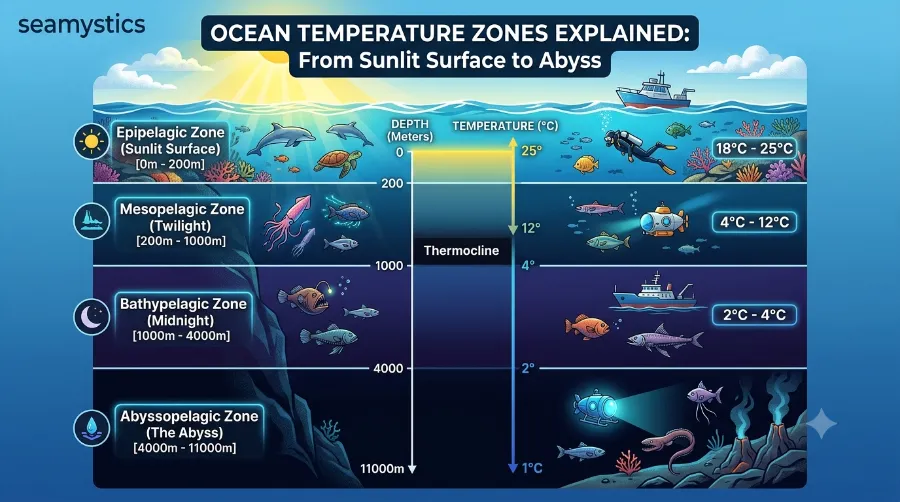

Picture yourself jumping into warm turquoise water on a beach in Florida, then imagine sinking straight down, past 1,000 meters, past 4,000 meters, all the way to the black, silent floor of the sea. Your skin would go from sunburned to frostbitten in a single afternoon. That single dive explains, in the simplest way possible, how ocean depth affects temperature. As sunlight fades, heat fades with it, and the water around you drops from a pleasant 26°C near the surface to a bone chilling 1°C to 4°C in the deep zones. This single fact shapes weather patterns, fish migration, coral survival, and even how fast our planet is warming. So, before we go further, here is a quick snapshot of what you are about to learn.
If you want to learn more about Write what how the ocean shapes global weather out our detailed guide for practical tips and expert advice.
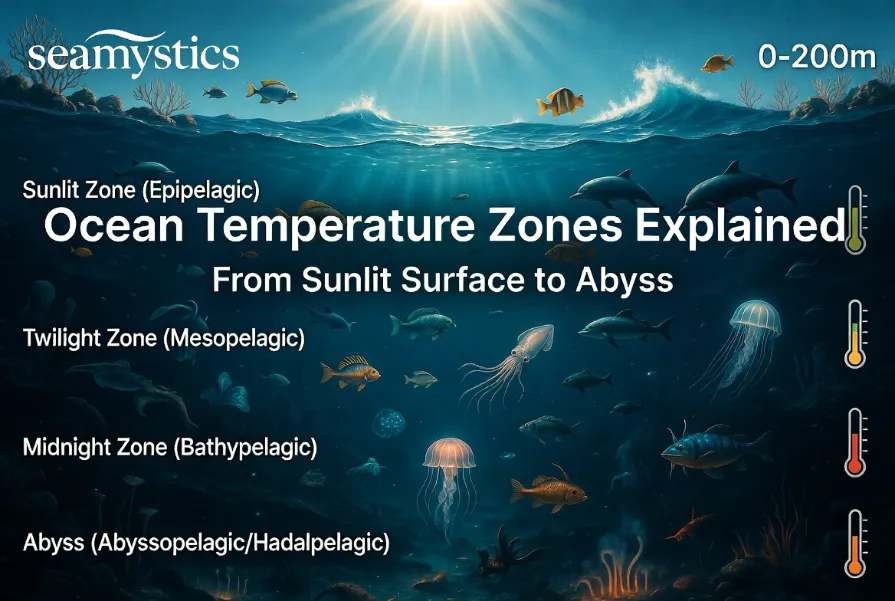
Key Takeaways
| Ocean Zone | Depth Range | Typical Temperature | Sunlight |
|---|---|---|---|
| Sunlight (Epipelagic) | 0 to 200 meters | 20°C to 30°C | Full sunlight |
| Twilight (Mesopelagic) | 200 to 1,000 meters | 4°C to 15°C | Dim, fading light |
| Midnight (Bathypelagic) | 1,000 to 4,000 meters | About 4°C | No light |
| Abyssal | 4,000 to 6,000 meters | 1°C to 4°C | No light |
| Hadal (Trenches) | 6,000 to 11,000 meters | Just above freezing | No light |
Now, let us walk through each of these layers, one by one, so you can see exactly why the ocean behaves the way it does.
Why Ocean Depth Affects Temperature So Dramatically
The ocean is not one giant tub of water sitting at a single temperature. Instead, it behaves like a layered cake, and each layer has its own personality. Sunlight is the main reason for this layering, because water absorbs heat from the sun only near the surface. Consequently, warmth cannot travel far down on its own, and gravity keeps the colder, denser water sitting quietly below.
Salinity and pressure also play a role, though a smaller one compared to sunlight. Once you understand this basic idea, the entire structure of the ocean starts to make sense, almost like reading a map for the first time. If you want a deeper look at how far our oceans truly reach, our guide on the true depth of the ocean breaks that down further.
The Sunlight Zone: Where Warmth and Life Begin
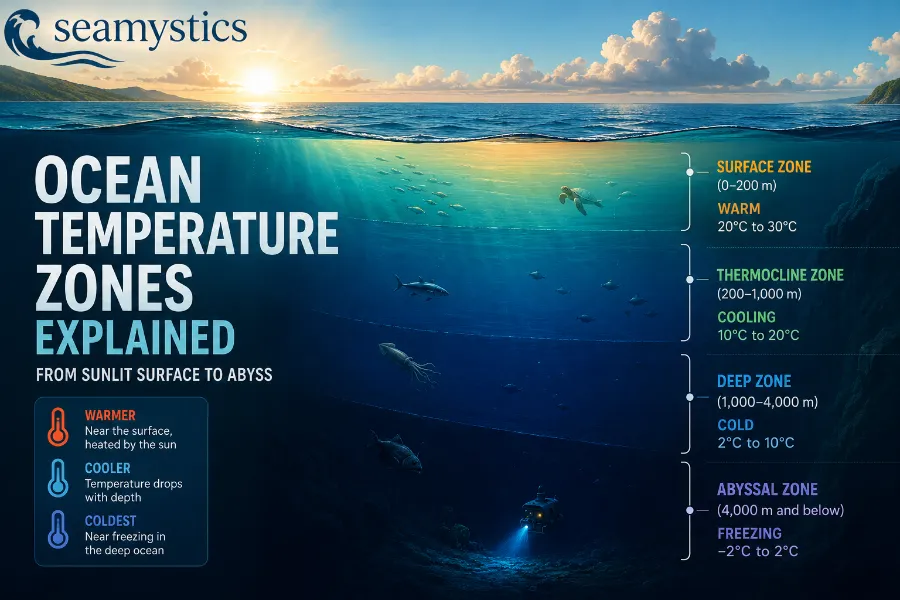
The sunlight zone, also called the epipelagic zone, stretches from the surface down to roughly 200 meters. This is the only layer where enough light reaches the water for photosynthesis to happen, and it is why this zone holds most of the ocean’s fish, coral reefs, and plankton. Temperatures here usually range from 20°C to 30°C near the equator, though they drop closer to 0°C near the poles.
This zone is also where marine heatwaves show up first, and 2025 gave scientists plenty to study. According to NOAA and international climate researchers, global sea surface temperature in 2025 ranked as the third warmest year on record, sitting about 0.49°C above the 1981 to 2010 average. That number might sound small, but for coral reefs and fish populations, even half a degree can be the difference between thriving and dying.
Interestingly, this same sunlit water is also responsible for the ocean’s brilliant blue color, something we explain in detail in why the ocean looks blue.
The Twilight Zone: The Great Temperature Drop
Below 200 meters lies the twilight zone, or mesopelagic zone, reaching down to about 1,000 meters. This is where the thermocline lives, a thin but powerful boundary where temperature falls sharply within just a few hundred meters. Water here can range anywhere from 15°C near the top to as low as 4°C near the bottom.
Light becomes faint and blue tinted, and only about 20 percent of surface sunlight ever makes it this deep, based on NOAA Ocean Exploration data. Because of this dim light, animals like lanternfish and squid have developed glowing organs to find food and mates. This zone is often called the “twilight” for good reason, since it genuinely feels like dusk underwater.
The Midnight Zone: Total Darkness Sets In
Once you pass 1,000 meters, sunlight disappears completely, and you enter the bathypelagic zone, also known as the midnight zone. This layer stretches down to about 4,000 meters, and temperatures stay fairly steady around 4°C throughout. Pressure at this depth is intense, reaching hundreds of times what we feel at sea level.
Despite the darkness and cold, life still exists here in surprising forms, such as anglerfish, vampire squid, and giant isopods. These creatures survive on food that drifts down from above, a slow but steady supply scientists call “marine snow.” Interestingly, sperm whales are known to dive into this zone while hunting giant squid, sometimes reaching depths beyond 2,000 meters.
The Abyssal Zone: Near Freezing and Nearly Silent
The abyssal zone begins at 4,000 meters and continues to roughly 6,000 meters, covering about 83 percent of the entire ocean floor. Temperatures here hover between 1°C and 4°C, and the water remains almost perfectly still. Pressure can reach up to 600 times what we experience on land, yet life still finds a way, including sea cucumbers, tube worms, and bacteria clustered around hydrothermal vents.
This is also one of the least explored regions on Earth, since only a tiny fraction of the abyssal seafloor has ever been mapped in detail. If that surprises you, our piece on how much of the ocean remains unexplored puts the number into perspective, and it might shock you.
The Hadal Zone: The Coldest, Deepest Frontier
Finally, we reach the hadal zone, found only in deep ocean trenches between 6,000 and 11,000 meters. The Mariana Trench’s Challenger Deep, sitting at roughly 10,935 meters, is the most famous example, and only a handful of people have ever visited it. Temperatures here stay just above freezing, typically between 1°C and 4°C, and pressure is crushing enough to flatten most man made objects instantly.
Even so, researchers have found shrimp like creatures and unique bacteria surviving in this extreme environment. This shows just how adaptable life can be, even in places humans could never survive without heavy protection.
Ocean Facts That Explain the Bigger Picture
Beyond the five zones, a few extra ocean facts help explain why depth and temperature matter so much for our planet. Here are some numbers worth remembering:
- The ocean has absorbed more than 90 percent of the excess heat trapped by human caused warming since the 1970s, according to NOAA Climate.gov.
- Global ocean heat content in 2025 rose by roughly 24 zettajoules compared to 2024, based on data published in Advances in Atmospheric Sciences in January 2026.
- About 33 percent of the world’s ocean surface ranked among its three warmest years on record during 2025.
- Upper ocean layers are warming faster than deep layers, though deep warming is now measurable too, according to recent studies from NOAA.
These figures matter because warming does not stop at the surface. Heat slowly works its way downward, and as detailed in a Carbon Brief guest analysis on ocean depth and marine life, even small temperature shifts at depth can disrupt fish breeding cycles and reshape entire food webs. Coastal ecosystems face similar pressure, as outlined by California’s Office of Environmental Health Hazard Assessment in its review of coastal ocean temperature impacts.
How Scientists Measure Temperature at Different Depths
You might wonder how researchers actually gather this data from thousands of meters underwater. The process is more advanced than most people realize, and it relies on a mix of technology and decades of patience.
- Argo floats, a global network of over 4,000 robotic devices, drift through the ocean and dive to 2,000 meters, recording temperature and salinity every ten days.
- Satellites measure sea surface temperature from space, giving scientists a broad, real time view of surface conditions.
- Research ships lower instruments called CTD sensors, which measure conductivity, temperature, and depth as they descend.
- Deep sea submersibles and remotely operated vehicles collect direct readings from the midnight, abyssal, and even hadal zones.
Thanks to this combination of tools, we now have one of the most detailed pictures of ocean temperature ever recorded. For readers curious about what drives the movement of all this water, our guide on what actually drives ocean currents connects nicely with this topic.
Why This Matters for Everyday Life
It is easy to assume ocean temperature only matters to marine biologists, but that is far from true. Warmer surface layers fuel stronger hurricanes, since storms draw energy from heat sitting near the top of the ocean. Fisheries also shift as fish chase cooler water, which affects seafood prices and coastal economies across the United States and Europe.
Meanwhile, changes in deep ocean temperature influence long term sea level rise through thermal expansion, a slow but steady process. Understanding these zones, therefore, is not just an academic exercise. It directly connects to weather forecasts, food supply, and even the salty taste of the sea itself, something we explore further in why the ocean tastes salty.
A Quick Look at Global Warming Trends by Depth
| Ocean Layer | 1993 to 2024 Warming Rate | Main Driver |
|---|---|---|
| Surface (0 to 700m) | Fastest warming layer | Direct solar heating |
| Upper ocean (0 to 2,000m) | 0.66 to 0.74 watts per square meter | Greenhouse gas absorption |
| Deep ocean (below 2,000m) | Slower, but measurable | Heat transfer from above |
This table, based on NOAA Climate.gov figures, shows a clear pattern. Warming starts at the top and slowly works its way down, which explains why surface ecosystems feel the effects first, while deep sea creatures experience change more gradually.
If you are curious about where all this water originally came from, our article on the origins of Earth’s oceans offers a fascinating look at the bigger picture. And since tides also interact with these layered temperatures, our explainer on how tides actually work rounds out the full story nicely.
Frequently Asked Questions
Does ocean temperature drop the same way in every location?
Not exactly. Polar regions start cold at the surface, so the drop is smaller, while tropical regions show a much sharper thermocline.
Why doesn’t warm surface water simply sink and warm the deep ocean?
Warm water is less dense than cold water, so it naturally floats above colder layers instead of sinking, which keeps the layers separate.
Is the deep ocean warming too, or just the surface?
Both are warming, though the surface warms faster. Deep ocean warming is smaller but has been measured consistently since the 1990s.
What is the coldest natural ocean temperature ever recorded?
Water near the seafloor in polar regions can drop slightly below 0°C due to high salinity, which lowers the freezing point.
How deep do submarines typically travel compared to these zones?
Most military submarines stay within the sunlight and twilight zones, rarely exceeding 500 meters, while research submersibles can reach the abyssal zone.
Final Thoughts
Ocean depth and temperature are tightly connected, and once you understand this relationship, the entire ocean starts to feel less like a mystery and more like a living, breathing system. From the warm, sunlit surface teeming with coral and fish, down to the freezing, pitch black trenches, every zone plays its own role in supporting life and shaping our climate. As global ocean heat content continues climbing, understanding these layers becomes more important than ever, not just for scientists, but for anyone who eats seafood, lives near a coast, or simply loves the sea. For more fascinating deep dives like this one, explore our full ocean facts hub or head back to our homepage to keep exploring.
References
- NOAA Ocean Exploration, “How Far Does Light Travel in the Ocean?”
- NOAA Climate.gov, “Climate Change: Ocean Heat Content”
- Carbon Brief, “Why Ocean Depth Is Key for How Warming Will Affect Marine Life”
- California OEHHA, “Impacts on Physical Systems: Coastal Ocean Temperature”
- Advances in Atmospheric Sciences, “Ocean Heat Content Sets Another Record in 2025”
- Woods Hole Oceanographic Institution, “Midnight Zone”
- NWS JetStream, “Layers of the Ocean”