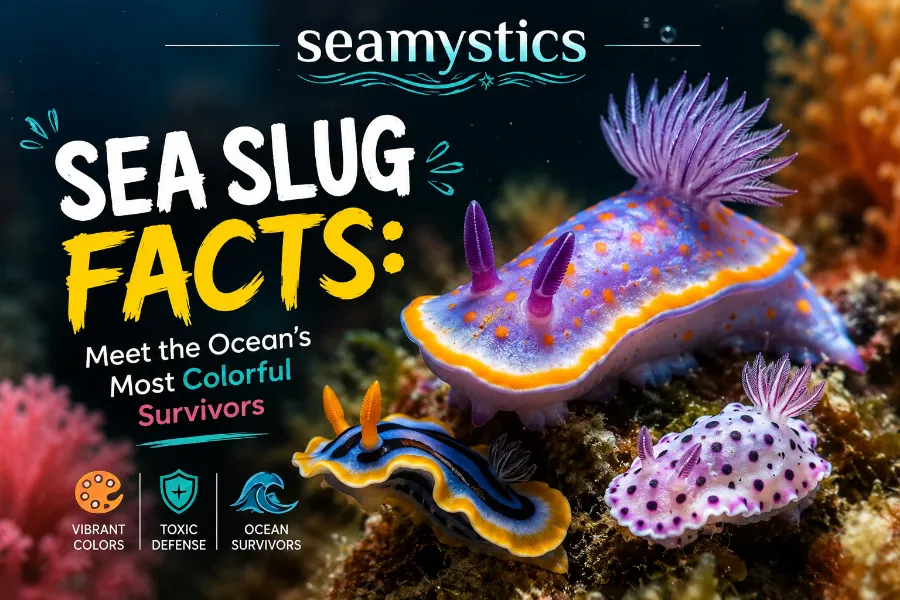

A creature with no shell, no shell to hide in, and skin like a painted canvas should not survive long in the open ocean. Yet it does, and it thrives. These are the colorful sea slug species facts that most people never learn in school, and they explain why marine biologists like myself still get excited every time we spot one on a reef. Sea slugs are small, soft, and slow, but they are some of the toughest animals in ocean life today. This guide walks through their colors, their weapons, their homes, and the real numbers behind their survival, all pulled from current research and years of fieldwork.
To get a better understanding of how colorful sea slug species facts breaks down exactly what to expect.
Key Takeaways
| Fact | Detail |
|---|---|
| Known species | Over 3,000 nudibranch species identified worldwide, with scientists estimating thousands more still undiscovered |
| Size range | From 1.5 cm (Doto species) to 60 cm (Spanish dancer) |
| Depth range | Intertidal pools down to nearly 2,500 meters |
| Diet source of color | Sponges, coral, anemones, and algae they eat |
| Defense trick | Many steal stinging cells from prey and reuse them |
| Lifespan | Most species live less than one year |
| Newest discovery | A bioluminescent deep-sea nudibranch, Bathydevius, described in 2024 |
What Makes Sea Slugs So Colorful?
Color in nature usually means one of two things. It either warns predators to stay away, or it helps an animal blend into its surroundings. Sea slugs mostly choose the first option, and they do it loudly. Their bright pinks, electric blues, and neon oranges are not random. They are built from the food these animals eat and the chemicals they absorb along the way.
To get a better understanding of how seahorse facts ocean life breaks down exactly what to expect.
Where Their Colors Come From
Nudibranchs, the most famous group of sea slugs, do not produce their own pigment the way a bird or a fish might. Instead, their coloring often comes directly from their diet. A slug that feeds on a red sponge may take on a reddish hue, while one that grazes on blue-tinted algae can turn a similar shade. This diet-based coloring is one of the most fascinating colorful sea slug species facts marine biologists study today.
The process does not stop at color. Many sea slugs also absorb toxins from their prey, and they store those toxins in their skin as a chemical shield. As a result, a predator that takes one bite quickly learns to avoid anything that looks similar in the future. This is a textbook example of what scientists call aposematism, or warning coloration, and it works because ocean predators have decent memories.
Warning Colors vs Camouflage
Not every sea slug wants to be seen. Some species, particularly the sea hares and certain sap-sucking slugs, use muted greens and browns to disappear into seagrass beds. However, the flashiest members of the group, especially dorid and aeolid nudibranchs, rely on visibility as their main defense.
Here is a simple way to remember the pattern:
- Bright red, orange, or purple bodies usually signal toxicity or a bad taste
- Soft greens and browns usually mean the animal wants to hide
- Metallic blues and golds, like those seen on the Nembrotha genus, often combine both warning and camouflage depending on the reef background
This link between diet, chemistry, and appearance connects closely to broader patterns seen across strange ocean animals, a topic covered in more depth in our weird ocean creatures hub.
Colorful Sea Slug Species Facts You Need to Know
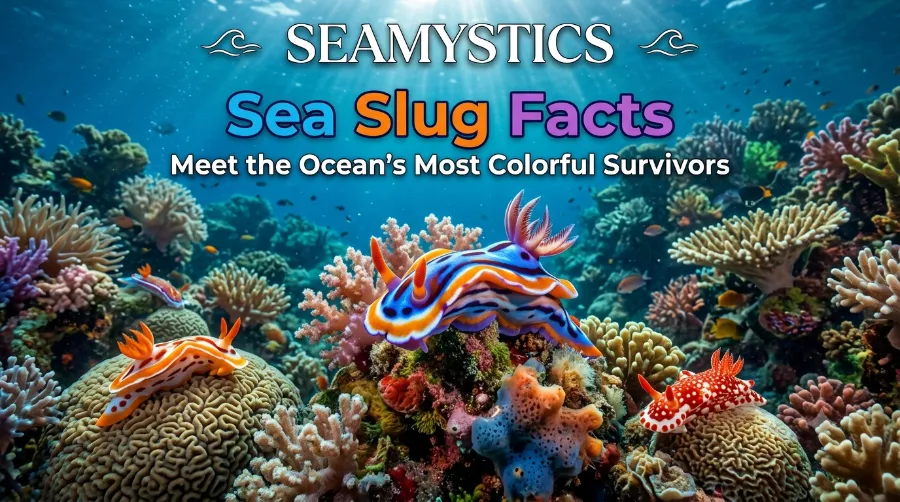
Marine biologists have documented roughly 3,000 nudibranch species so far, and many researchers believe that number represents only half of what actually exists in the ocean. New species turn up almost every year. In fact, a single diver identified 14 new nudibranch species during survey work in 2022, which shows just how much of this world remains unmapped
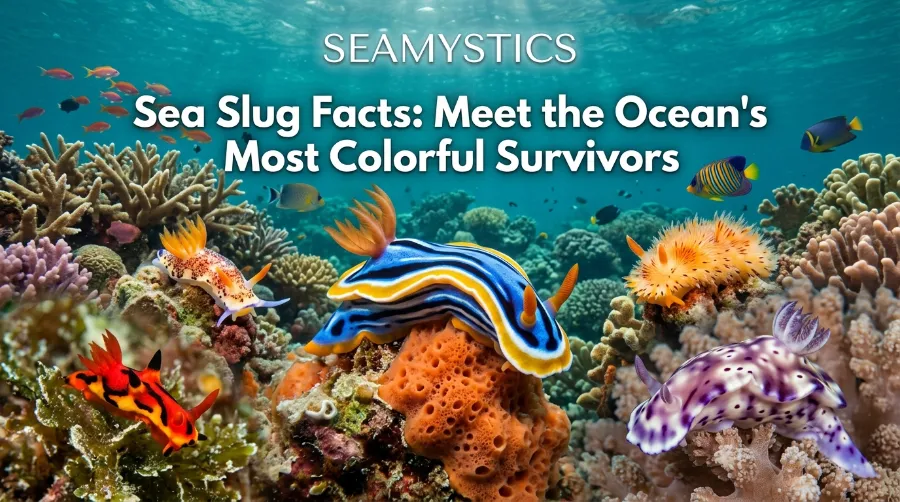
Below are a few standout species that show the range of size, color, and behavior across the group.
| Species | Common Name | Size | Notable Trait |
|---|---|---|---|
| Hexabranchus sanguineus | Spanish Dancer | Up to 60 cm | Largest known nudibranch, swims by flapping its mantle |
| Glaucus atlanticus | Blue Dragon | 2 to 4 cm | Floats upside down, eats venomous jellyfish and stores their stingers |
| Nembrotha kubaryana | Gold Lace Nudibranch | 6 to 12 cm | Feeds on toxic sea squirts, bright green and orange pattern |
| Chromodoris annae | Ann’s Chromodoris | 3 to 5 cm | Deep purple body with an orange stripe, common in the Coral Triangle |
| Doto species | Doto | 1 to 1.5 cm | One of the smallest nudibranch genera in the world |
| Bathydevius caudactylus | Deep-sea Nudibranch | Roughly 20 cm | Bioluminescent, lives near 2,500 meters, described in 2024 |
The Spanish dancer earns its name from the way it swims, flapping its wide mantle like a flamenco skirt. Meanwhile, the blue dragon takes a much more dangerous approach to survival. It hunts the Portuguese man o’ war, a jellyfish relative with a painful sting, and then stores the stinging cells for its own defense. As a result, a blue dragon can deliver a sting far stronger than the jellyfish it originally ate.
For readers who enjoy comparing venomous ocean animals, the jellyfish connection here pairs well with our guide on jellyfish facts and ocean life, since the two groups often cross paths on the same reefs.
Sea Slugs vs Other Odd Ocean Creatures
Sea slugs are often lumped together with other unusual sea life, but their biology is quite different from deep-sea oddities like the blobfish or the vampire squid. Unlike the blobfish, which relies on low body density to survive crushing pressure, sea slugs depend almost entirely on chemistry and color for protection. Readers curious about that contrast can check our full breakdown of blobfish facts from the deep sea.
Similarly, while the vampire squid uses bioluminescence and a cloak-like defense to avoid predators, most sea slugs rely on their skin chemistry instead. Our vampire squid facts guide covers that comparison for anyone building a mental map of deep-sea survival strategies.
How Sea Slugs Survive in Tough Ocean Conditions
Survival in the ocean is not easy, especially for a soft-bodied animal without a shell. Sea slugs make up for this weakness with three main strategies: stolen weapons, solar power, and rapid reproduction.
Stolen Weapons: Kleptocnidae
Some aeolid nudibranchs eat jellyfish, anemones, and hydroids, all animals armed with stinging cells called nematocysts. Instead of digesting these stinging cells, the slug moves them through its body and stores them in structures called cnidosacs, located at the tips of the finger-like projections on its back. This process is known as kleptocnidae, and it turns a predator’s own weapon into the slug’s personal armory.
This trick sounds almost too clever for such a small animal, yet it works consistently across dozens of species. Scientists still study exactly how the slug avoids triggering the stingers during digestion, and new details continue to emerge from ongoing research.
Solar-Powered Slugs
A separate group of sea slugs, mainly in the Sacoglossa order, has taken survival even further. These slugs eat algae and then keep the algae’s chloroplasts alive inside their own tissue, a process called kleptoplasty. The chloroplasts continue to photosynthesize, giving the slug a source of energy that does not require constant feeding.
One well-studied example, Elysia chlorotica, can survive for months on stored chloroplasts alone. This is one of the few known cases in the animal kingdom where a creature performs something close to photosynthesis, and it remains a favorite topic in marine biology classrooms across the United States and Europe.
Threats from Climate Change
Ocean life is changing fast, and sea slugs are not immune to it. Rising sea temperatures and shifting currents are pushing some species into new ranges, while others struggle to find the specific sponges or coral they depend on for food and color. A 2025 study from researchers surveying reefs in northwestern Japan compared nudibranch communities recorded between 2001 and 2003 against new survey data collected from 2023 to 2024, and found meaningful shifts in which species were present. This kind of long-term comparison gives scientists a clearer picture of how ocean life responds to environmental change over time.
Because sea slugs are so sensitive to changes in their food source and water chemistry, researchers increasingly use them as bioindicators, meaning their presence or absence can signal the overall health of a reef.
Sea Slug Behavior and Reproduction
Sea slugs live fast. Most species survive less than a year, so reproduction happens quickly and often. Nearly all nudibranchs are hermaphrodites, meaning each individual carries both male and female reproductive organs. This trait allows any two adults of the same species to mate, which improves the odds of reproduction in a world where finding a partner is not guaranteed.
A few quick behavioral facts worth knowing:
- Most sea slugs lay eggs in ribbon-shaped or spiral clusters attached to rocks or algae
- A single egg mass can contain thousands of eggs, though survival rates to adulthood are low
- Many species use rhinophores, the horn-like structures on their heads, to detect chemical signals from food and potential mates
- Some species can regenerate damaged rhinophores within a few weeks
This rapid reproductive cycle helps explain why new nudibranch species keep appearing in survey data almost every year, even in well-studied regions.
Where to Find Colorful Sea Slugs
Sea slugs live at nearly every ocean depth, from shallow tide pools to depths beyond 2,000 meters. However, divers looking to spot the most colorful species usually head toward specific hotspots.
- The Coral Triangle, spanning parts of Indonesia, the Philippines, and Papua New Guinea, holds the highest known diversity of nudibranch species
- The Mediterranean and Atlantic coasts of Europe host well-documented populations, including several species tracked by UK conservation groups
- The Pacific coast of the United States, particularly around Puget Sound and California, offers accessible sea slug spotting for beginner divers and beach walkers at low tide
According to the Marine Conservation Society, sea slugs found in UK and wider European waters show remarkable color variety even in cooler temperate seas, proving that vivid color is not limited to tropical reefs alone. For readers in the United States, the California Academy of Sciences runs an ongoing community science project that invites divers and beachgoers to photograph and log sea slug sightings, which has helped researchers track range shifts and new species records over the past decade.
Sea slugs share their habitats with several other unusual ocean creatures covered on this site. Divers exploring reef systems often encounter octopuses known for their problem-solving intelligence in the same crevices where nudibranchs graze, while deeper dives sometimes cross paths with the elusive subjects of our giant squid facts guide. Even the ambush-style hunters featured in our anglerfish facts from the deep sea share the same broader ocean ecosystem, even though their survival strategies could not be more different from a slow-moving sea slug.
Conservation Status and Why It Matters
Most sea slug species do not carry a formal conservation status, largely because so many remain undiscovered or understudied. That said, researchers agree that reef health directly affects sea slug populations. Coral bleaching, ocean acidification, and pollution all reduce the sponges, coral, and algae that sea slugs depend on for both food and color.
Protecting reef ecosystems, therefore, protects sea slugs indirectly. Marine protected areas in the Mediterranean, the Caribbean, and parts of Southeast Asia have shown early signs of supporting healthier nudibranch populations compared to unprotected reefs nearby. Continued citizen science efforts, like photo logging programs, give researchers real data without requiring massive funding, which matters a great deal for a group of animals this understudied.
Frequently Asked Questions
Are sea slugs poisonous to touch?
Some species carry toxins in their skin or stinging cells in their cerata, so handling them is not recommended. Most sea slugs are not dangerous to touch briefly, but a sting from a species that has stored jellyfish nematocysts can still cause irritation.
How long do sea slugs live?
Most nudibranch species live less than one year, with many surviving only a few months. Their short lifespan is balanced by fast reproduction and large egg clutches.
What do colorful sea slugs eat?
Diet varies by species, but common food sources include sponges, coral polyps, sea anemones, algae, and other soft-bodied invertebrates. Their diet often directly determines their body color.
Why are sea slugs so colorful if they have no shell to protect?
Color replaces the shell as a defense tool. Bright patterns warn predators of toxicity, while stored chemicals from their diet back up that warning with an unpleasant taste or sting.
Where is the best place to see sea slugs in the wild?
The Coral Triangle offers the highest diversity, though temperate coastlines in the UK, Europe, and the US Pacific Northwest also host colorful species that are easy to spot during low tide.
Conclusion
Sea slugs prove that survival in the ocean does not always require size, speed, or a hard shell. Instead, these animals rely on borrowed chemistry, stolen weapons, and colors bold enough to send a clear warning to anything nearby. From the giant Spanish dancer to the tiny Doto species barely visible to the naked eye, colorful sea slug species facts reveal an entire branch of ocean life built on cleverness rather than force. As reefs continue to change under climate pressure, these small, bright animals remain one of the clearest signals scientists have for tracking the health of our oceans, and that alone makes them worth protecting.
References
- Marine Conservation Society, “Sea Slugs: A Rainbow of Life in Our Seas,” https://www.mcsuk.org/insights/sea-slugs-a-rainbow-of-life-in-our-seas/
- California Academy of Sciences, “Sea Slug Search Community Science Project,” https://www.calacademy.org/community-science/sea-slug-search
- Seattle Aquarium, “Getting to Know Nudibranchs,” 2025
- Wikipedia, “Nudibranch,” updated 2025
- Biorxiv preprint, “A Different World: Temporal Changes in Nudibranch Community Structure Over a Half-Century,” 2025