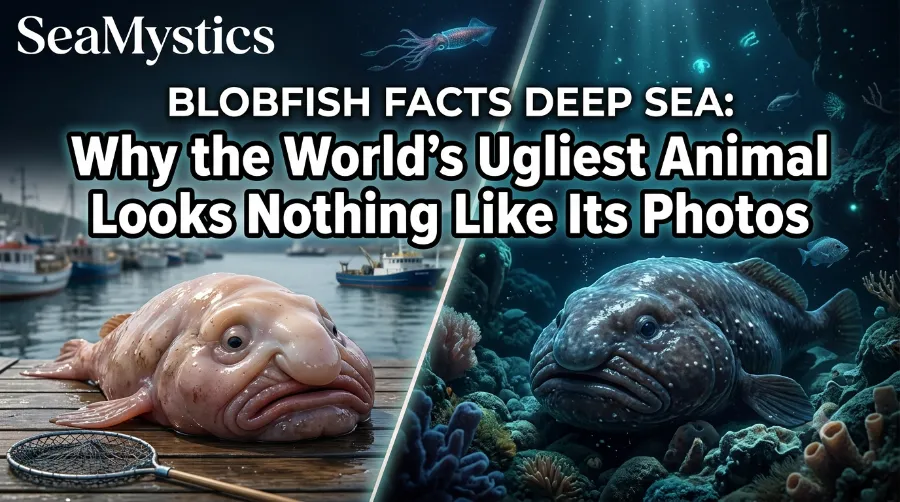

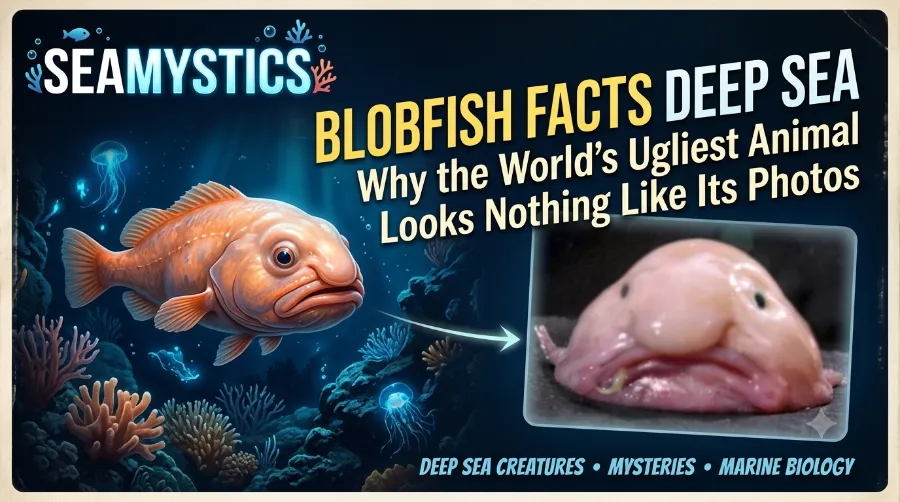
You have seen the picture. A sad, pink, melting face that looks like it lost a fight with gravity. That single photo turned this fish into a global joke and even won it the title of world’s ugliest animal back in 2013. But here is the twist that most articles skip. The real blobfish facts deep sea researchers have gathered over the years paint a picture that looks nothing like the meme. Down in its true home, this fish is calm, smooth, and honestly quite ordinary looking.
To get a better understanding of how jellyfish facts ocean life breaks down exactly what to expect.
So why did one photo fool the entire internet? And what does ocean life actually look like at 2,000 feet below the surface? This guide breaks down the science, the myths, and the surprising truth behind one of the deep sea’s most misunderstood creatures.If you want to learn more about out vampire squid facts explained detailed guide for practical tips and expert advice.
Key Takeaways
| Quick Fact | Details |
|---|---|
| Scientific name | Psychrolutes marcidus (and close relatives like P. microporos) |
| Habitat depth | 600 to 4,000 feet below the surface |
| Body type | Gelatinous flesh, slightly less dense than water |
| Diet | Crustaceans, sea pens, and whatever drifts close enough |
| Famous title | Named “world’s ugliest animal” in 2013 by public vote |
| True appearance | Looks like a normal fish underwater, not droopy or melted |
| Main threat | Deep-sea bottom trawling, not direct hunting |
What Is a Blobfish, Really?
A blobfish belongs to the family Psychrolutidae, a group of fish built for cold, dark, and crushing environments. The name itself comes from a Greek word meaning “to have a cold bath,” which fits perfectly since these fish spend their entire lives in near-freezing water. There are actually nine known species in the Psychrolutes genus, though most people only know about the one from the viral photo.
That famous image usuTo get a better understanding of how colorful sea slug species facts breaks down exactly what to expect.ally shows Psychrolutes microporos, first collected by a research vessel off New Zealand in 1983. Scientists did not formally describe and name the species until roughly a decade later. Even now, gaps remain in what we know about its full life cycle, because studying an animal that lives thousands of feet underwater is never simple.
To get a better understanding of how seahorse facts ocean life breaks down exactly what to expect.
The Science Behind the Squish
Here is where the blobfish facts deep sea story gets interesting. Unlike most fish, this creature has very little muscle and no swim bladder. Instead, its body is made of a gelatinous mass with a density just slightly lower than water.
That single trait explains almost everything about how it lives. Because its flesh floats naturally, the blobfish barely needs to swim. It simply hovers just above the seafloor, saving energy in a place where food is scarce and every calorie counts.
Why the Viral Blobfish Photo Is Misleading
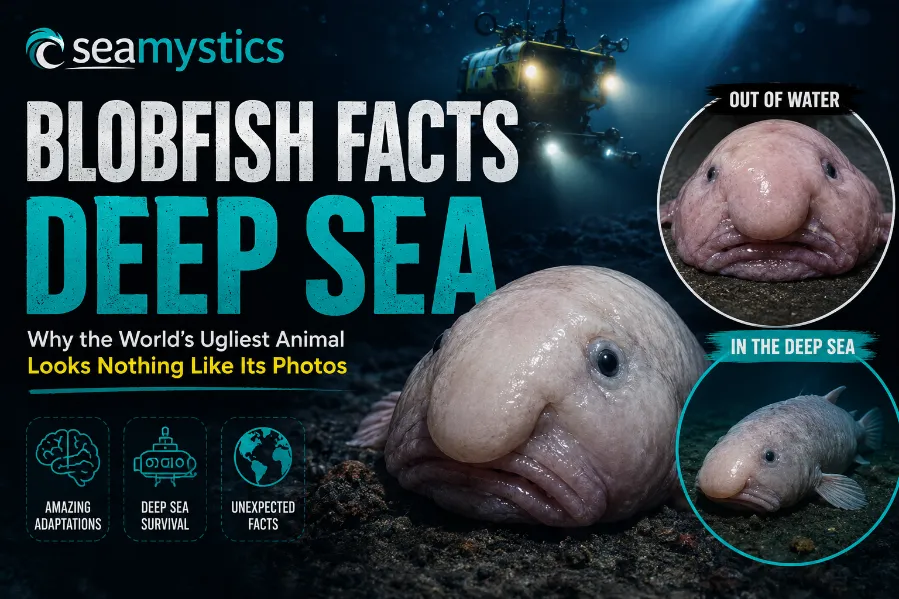
Most people assume that droopy, sagging face is how the fish looks all the time. In truth, that photo captures a fish that has just been pulled up from extreme depth in a trawling net. Once it reaches the surface, the pressure that held its body together disappears almost instantly.
Without that pressure, the gelatinous flesh collapses. The skin sags. The face droops. What you are really looking at is a fish experiencing a dramatic and sudden change in its environment, not its natural resting state. Marine ecologist Dr. Thom Linley, who has studied deep-sea species with the Newcastle University research team, compared the experience to a human being blasted out of an airlock and dragged across a rough surface for miles. That comparison makes it obvious why the fish looks so distressed once it hits the surface.
For a closer look at how other misunderstood sea creatures get judged unfairly by their surface appearance, our weird ocean creatures hub covers several species with the same problem.
The 2013 “Ugliest Animal” Contest
The blobfish earned its nickname almost by accident. In 2013, the Ugly Animal Preservation Society ran a public vote to find a mascot for the group. Out of roughly 3,000 votes cast, the blobfish won with 795 votes, beating out the proboscis monkey and a few other unusual contenders.
That single contest is the reason millions of people around the world now recognize this fish. However, the vote was based entirely on the surface photo, not on how the animal actually looks or behaves in its real habitat.
Blobfish Facts Deep Sea Habitat and Adaptations
Blobfish live far below where sunlight can reach, typically between 600 and 4,000 feet down depending on the species. At that depth, water pressure can be more than 100 times greater than at sea level. Temperatures hover just above freezing, and food is scattered and unpredictable.
According to the National Oceanography Centre, the flesh of the blobfish allows it to float just above the seafloor without expending much energy to swim, which is a critical survival trait in an environment where meals are rare. This kind of efficient, low-effort lifestyle is common across many deep-sea species, but the blobfish takes it to an extreme.
Depth and Pressure Comparison Chart
| Location | Approximate Depth | Pressure Compared to Surface |
|---|---|---|
| Swimming pool | 10 feet | Roughly 1.3x |
| Scuba diving limit | 130 feet | Roughly 5x |
| Blobfish shallow range | 600 feet | Roughly 19x |
| Blobfish deep range | 4,000 feet | Roughly 122x |
| Deepest ocean trench | 36,000 feet | Roughly 1,100x |
That jump between 600 and 4,000 feet shows why blobfish cannot simply be released back into shallow water. Their bodies are built for one narrow slice of the ocean, and nothing else.
Blobfish are usually found in waters around Australia and New Zealand, according to research summarized by BBC Science Focus, though related species in the wider Psychrolutidae family also appear across parts of the Atlantic, Pacific, and Indian Oceans. If you enjoy learning about other deep-sea specialists with strange hunting styles, our guide on anglerfish facts deep sea covers a creature that survives in a very similar type of darkness.
What Do Blobfish Eat and How Do They Survive
Since chasing prey burns energy the blobfish simply does not have to spare, it relies on an ambush strategy instead. It waits, mostly motionless, until something edible drifts within reach.
Their diet generally includes:
- Small crustaceans such as crabs and shrimp
- Sea pens, a type of soft coral found on the seafloor
- Mollusks and other small invertebrates that pass nearby
- Basically anything edible that happens to float close enough
This feeding style is common among deep-sea predators, but it works especially well for a fish with almost no muscle mass. Because it barely moves, it needs very little food to survive.
Reproduction remains one of the least understood parts of blobfish biology. Female blobfish are known to guard their eggs on the seafloor until they hatch, based on observations noted by researchers at the Institute for Environmental Research and Education. Scientists still are not entirely sure how blobfish pairs find each other in such a vast, dark environment, though limited mobility suggests they simply stay close once they meet.
Ocean Life Lessons From the Blobfish
Beyond the memes, blobfish actually teach marine biologists a great deal about how ocean life adapts to extreme conditions. Researchers study this species for several reasons:
- Its gelatinous body shows how organisms can evolve completely different structures depending on pressure and temperature
- Its low-energy lifestyle offers clues about food scarcity in deep ocean ecosystems
- Its limited range helps scientists track how sensitive certain species are to habitat disruption
- Its slow growth and long lifespan mirror patterns seen across many other deep-sea animals
This kind of research connects to broader questions about climate change and ocean health, since deep-sea ecosystems are notoriously slow to recover once disturbed. Readers curious about how other ocean creatures show surprising intelligence or adaptation might also enjoy our piece on octopus intelligence facts explained, which covers a very different but equally fascinating survival strategy.
Are Blobfish Endangered? Threats and Conservation
Blobfish have no known natural predators, largely because so few animals venture that deep. Still, that does not mean they are safe. According to National Geographic, the biggest threat to blobfish comes from destructive human activities like deep-sea fishing and bottom trawling, where a weighted net is dragged along the ocean floor.
The fish are not usually the target of these operations. Instead, they end up as bycatch, caught accidentally while fishing boats search for other species such as crabs and lobster. Because deep-sea ecosystems recover so slowly, even accidental disruption from trawling can affect blobfish populations over time.
Right now, blobfish are not formally classified as endangered, mainly because so little population data exists. That gap in knowledge is itself part of the problem, since conservation groups struggle to protect a species they cannot fully study or count.
For readers interested in comparing how different deep-sea giants handle survival, our guide on giant squid facts revealed explores another creature that spent decades as more myth than confirmed science.
Frequently Asked Questions
Is the blobfish really the ugliest animal in the world?
Not underwater. The famous title came from a 2013 public vote based on a surface photo, not from how the fish actually looks in its natural habitat at depth.
Why does the blobfish look different in photos than it does alive underwater?
Sudden pressure loss during trawling causes its gelatinous body to collapse and its skin to sag, creating the droopy appearance seen in viral images.
How deep in the ocean does a blobfish live?
Most blobfish live between 600 and 4,000 feet below the surface, always in cold, dark water far from sunlight.
What does a blobfish eat?
Its diet mainly consists of small crustaceans, sea pens, and other invertebrates that drift close enough for it to eat without chasing.
Are blobfish dangerous to humans?
No. Blobfish have no teeth or venom capable of harming people, and they rarely, if ever, come into contact with humans in their natural deep-sea habitat.
Conclusion
The blobfish deserves a much better reputation than the internet gave it. Once you understand the science, that famous droopy face turns out to be a side effect of sudden pressure change, not a true reflection of the animal. In its real home, thousands of feet below the surface, this fish looks calm, stable, and surprisingly ordinary. Its story is really a reminder that so much of ocean life remains hidden, misunderstood, and worth a second look before we judge it by a single unfair photo.
References
- National Geographic. Blobfish, facts and information. https://www.nationalgeographic.com/animals/fish/facts/blobfish
- BBC Science Focus. Blobfish: Facts about the ugliest animal in the world. https://www.sciencefocus.com/nature/the-blobfish-a-bloated-guide-to-the-worlds-ugliest-animal
- National Oceanography Centre. Deep-Sea Creatures. https://www.noc.ac.uk/discover-the-ocean/life-in-the-ocean/deep-sea-creatures
- Institute for Environmental Research and Education. What happens to blobfish?