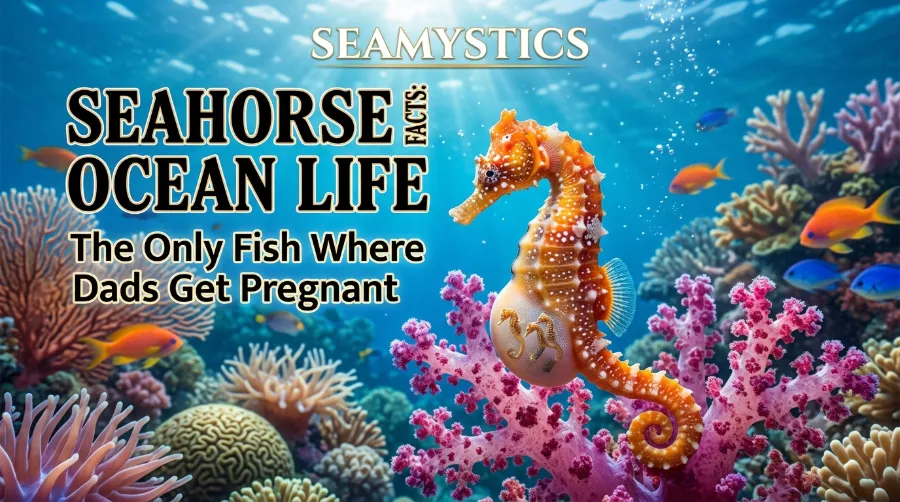

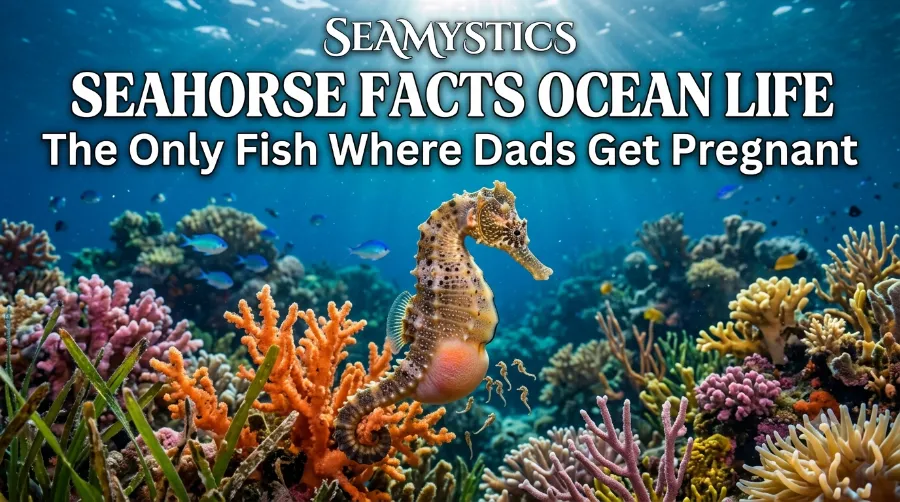
Picture a fish that stands upright, wears armor instead of scales, and lets the father carry the babies. That fish is real, and it lives in shallow seas from Florida to the Philippines. Seahorse facts ocean life explorers love to share usually start right here, with one strange detail: male seahorses get pregnant, not females. This single fact flips everything people think they know about fish reproduction on its head.
Dr. Rabica has spent years diving alongside seagrass beds, watching these small fish cling to blades of grass with curled tails. Few creatures pack this much wonder into a body smaller than a human finger. This guide walks through the science, the surprises, and the real threats seahorses face in today’s oceans, all explained in plain language anyone can follow.
Key Takeaway Table
| Fact | Detail |
|---|---|
| Species count | Around 46 recognized seahorse species worldwide |
| Who gets pregnant | Only the male, inside a specialized brood pouch |
| Pregnancy length | Roughly 2 to 4 weeks, depending on water temperature |
| Babies per birth | 100 to 200 on average, some broods top 1,000 |
| Conservation status | 2 species Endangered, 12 Vulnerable, 17 Data Deficient |
| Trade protection | Listed under CITES Appendix II since 2004 |
| Top threats | Bottom trawling, habitat loss, wildlife trade |
| Swimming style | Weak swimmers, dorsal fin beats 30 to 70 times per second |
What Makes Seahorse Facts Ocean Life So Fascinating
Seahorses belong to the genus Hippocampus, and scientists currently recognize about 46 species. That number keeps shifting because researchers keep finding new populations tucked into reefs and estuaries. Each species carries its own size, color pattern, and habitat preference, yet they all share the same body plan that makes them instantly recognizable.
Unlike most ocean life, seahorses do not have scales at all. Instead, thin skin stretches over bony plates fused together in rings, almost like a suit of armor. This structure protects them from predators, though it also means they cannot bend their bodies the way other fish do. Their tails, however, curl and grip like a monkey’s, letting them anchor to coral, seagrass, or drifting debris.
Body Features That Set Them Apart
Seahorses look like a patchwork of different animals stitched together, and that comparison is not far off. A horse-shaped head sits atop a body ringed with bony segments, while a flexible tail curls like a primate’s. Their eyes move independently of each other, much like a chameleon, letting them scan for food and danger at the same time.
Here are a few standout physical traits worth knowing:
- No scales, only bony plates covered in skin
- A crown-like structure called a coronet on top of the head, unique to each individual like a fingerprint
- Pectoral fins near the head for steering, though overall swimming ability stays weak
- A prehensile tail that grips seagrass, coral, or sponges to avoid drifting away in currents
These features connect seahorses to a wider family of oddball marine species. Readers curious about other strange body plans in the ocean might enjoy this deep dive into weird ocean creatures, which covers several species that defy typical fish anatomy.
The Only Fish Where Dads Get Pregnant
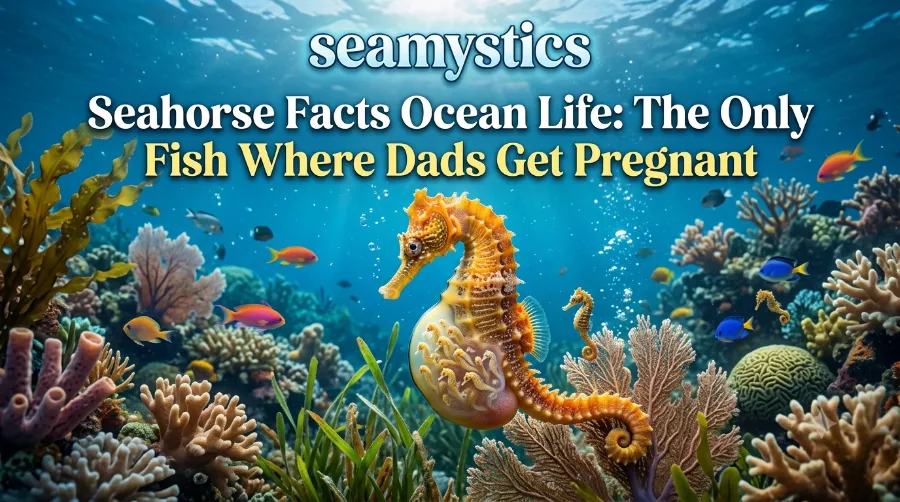
This is the fact that hooks almost everyone, and it deserves a full explanation. Female seahorses produce the eggs, but they transfer them into the male’s brood pouch during mating. From that point forward, the male carries, nourishes, and eventually gives birth to the young.
The brood pouch works almost like a womb. It supplies oxygen, controls salinity levels for the developing embryos, and even provides some nutrients as the babies grow. Researchers studying this process have compared it to early forms of pregnancy seen in mammals, which makes seahorses one of biology’s favorite examples of role reversal.
How Male Pregnancy Actually Works
The process follows a fairly consistent pattern across most species, though timing varies by water temperature and species size.
- Courtship begins with a dance, often lasting hours, where the pair changes color and swims side by side.
- The female inserts her ovipositor into the male’s pouch opening and deposits eggs directly inside.
- The male fertilizes the eggs internally and seals the pouch to begin gestation.
- Pregnancy lasts roughly two to four weeks, shortening in warmer water and lengthening in cooler conditions.
- Labor happens mostly at night, with the male pumping and thrusting for hours to release the brood.
According to Project Seahorse, most males give birth to somewhere between 100 and 200 babies at once, though smaller pygmy species may release only a handful. One recorded case involved a male Hippocampus reidi releasing 1,572 young in a single birth, an extraordinary number for such a small animal. Newborns measure only 7 to 12 millimeters long and receive zero parental care after birth, so they must fend for themselves from the very first hour.
Where Seahorses Live and How They Survive
Seahorses live exclusively in saltwater, generally within seagrass meadows, mangrove roots, and coral reefs. Their range stretches from about 50 degrees north to 50 degrees south latitude, with the highest concentrations found in the West Atlantic and Indo-Pacific regions. Some species tolerate estuaries as well, adjusting to shifting salinity levels along the way.
Camouflage plays a massive role in seahorse survival because they are such poor swimmers. A seahorse’s dorsal fin beats between 30 and 70 times per second just to move it forward slowly, which leaves it vulnerable in open water. To compensate, seahorses shift color to match their surroundings and sometimes grow skin filaments that mimic algae or coral texture.
Diet and Daily Habits
Seahorses lack both teeth and a true stomach, so food passes through their digestive system extremely fast. Because of that, they must eat almost constantly throughout the day. A single seahorse can consume thousands of tiny shrimp and plankton in one day just to maintain its energy levels.
Their feeding method relies on suction. A seahorse locks its tail around a stationary object, waits patiently, then snaps its long snout forward to suck in prey within milliseconds. This hunting style resembles the ambush tactics used by other unusual ocean predators, including the anglerfish, whose bizarre feeding adaptations are covered in this anglerfish facts guide.
Seahorse Species Around the World
Not every seahorse looks alike, and size differences across species are dramatic. The table below breaks down a few well documented species so readers can compare traits side by side.
| Species | Common Name | Approximate Height | Notable Trait |
|---|---|---|---|
| Hippocampus abdominalis | Big-bellied seahorse | Up to 30 cm | Largest seahorse species known |
| Hippocampus satomiae | Satomi’s pygmy seahorse | About 13.8 mm | One of the smallest fish on record |
| Hippocampus capensis | Cape seahorse | 8 to 10 cm | Endangered, found only in South African estuaries |
| Hippocampus whitei | White’s seahorse | Around 13 cm | Endangered, native to eastern Australia |
| Hippocampus reidi | Longsnout seahorse | Up to 17 cm | Recorded the largest single brood on file |
| Hippocampus hippocampus | Short-snouted seahorse | Up to 15 cm | Near Threatened, found in the Mediterranean |
Size extremes like these show how varied seahorse anatomy can be, even within a single genus. The pygmy species in particular rely heavily on camouflage since their small size offers little physical defense against predators.
Conservation Status and Real Threats Today
Seahorses face mounting pressure from human activity, and the data paints a serious picture. Of the roughly 42 species assessed so far by the IUCN Red List, 2 are classified as Endangered, 12 as Vulnerable, 1 as Near Threatened, and 10 as Least Concern. The remaining species fall under Data Deficient, meaning scientists simply lack enough information to judge their risk level yet.
A 2021 global extinction risk study published in the journal Oryx confirmed that industrial trawl fishing remains the single biggest threat to seahorses and their relatives. Bottom trawling scrapes across seagrass beds and reef systems, destroying habitat while also catching seahorses as unintended bycatch. Traditional medicine trade, the aquarium trade, and curio sales add further pressure, together removing millions of seahorses from the wild each year.
Notable Conservation Efforts
Conservation groups have started testing creative solutions to slow the decline. In 2021, researchers working with SeaLife Aquarium in Australia lowered 18 biodegradable seahorse hotels into Sydney Harbour and Port Stephens, aiming to rebuild lost habitat for the endangered White’s seahorse. These structures let marine growth accumulate naturally, giving seahorses both shelter and a steady food source.
Some additional protective measures now in place include:
- CITES Appendix II listing since 2004, which regulates international trade of every seahorse species
- Marine protected areas across parts of the Philippines, Vietnam, and Australia designed to reduce fishing pressure
- Community science platforms like iSeahorse, which let divers and snorkelers report sightings to help researchers track populations
- Captive breeding programs at public aquariums that reduce demand for wild-caught individuals
According to the IUCN Red List assessment, of over 40 recognized seahorse species, a substantial number are threatened, with two classified as Endangered and twelve as Vulnerable. That level of risk places seahorses among the more vulnerable groups within the broader Syngnathiformes order, which also includes pipefish and seadragons. Biology Insights
For readers interested in comparing conservation challenges across other marine species, this piece on octopus intelligence and survival offers a useful side by side look at how different ocean animals cope with shrinking habitats.
Seahorse Population Trends Chart
The chart below summarizes current IUCN status categories across assessed seahorse species, based on the latest published data.
| IUCN Status | Number of Species | Percentage of Assessed Species |
|---|---|---|
| Endangered | 2 | 5% |
| Vulnerable | 12 | 29% |
| Near Threatened | 1 | 2% |
| Least Concern | 10 | 24% |
| Data Deficient | 17 | 40% |
This breakdown shows something important. Nearly 40% of assessed seahorse species remain Data Deficient, which means researchers still cannot say for certain how many are actually at risk. That gap highlights why ongoing field research matters so much for future protection efforts.
Fun and Surprising Seahorse Facts
Beyond pregnancy and camouflage, seahorses carry a long list of quirky traits that rarely make headlines. These details help explain why marine biologists find this genus endlessly interesting.
- Seahorses mate for life in many species, performing daily greeting dances with their partner even outside of breeding season.
- Their independently moving eyes let them watch for predators and prey simultaneously, a trait shared with chameleons.
- Seahorses swim upright, unlike almost every other fish species on the planet, which swim horizontally.
- Captive lifespans range from about one year in the smallest species to three to five years in larger species, though wild lifespans remain largely unknown.
- The coronet on top of a seahorse’s head is unique to each individual, functioning almost like a human fingerprint.
Other bizarre deep sea creatures share this kind of unexpected biology. The blobfish, for example, looks nothing like its viral internet image once seen at ocean depth and pressure, a topic explored further in this blobfish facts breakdown.
Why Seahorses Matter to Ocean Health
Seahorses act as indicator species, meaning their presence or absence tells scientists a lot about the overall health of seagrass beds and coral reefs. When seahorse populations decline sharply in a region, it often signals broader ecosystem stress from pollution, warming water, or habitat destruction. Protecting seahorses, in that sense, protects the wider marine environment they call home.
Seagrass meadows in particular provide enormous value beyond housing seahorses. According to the National Oceanic and Atmospheric Administration, seagrass beds store carbon, stabilize coastlines, and support juvenile fish nurseries that feed commercial fisheries worldwide. Losing seahorses often means losing these ecosystems too, since both face the same coastal development and trawling pressures.
Jellyfish blooms offer another example of how ocean life responds to environmental change, sometimes thriving even as other species decline. Readers interested in that contrast can explore more in this guide covering jellyfish facts and ocean life patterns.
How People Can Help Protect Seahorses
Individual choices genuinely add up when it comes to seahorse conservation. Anyone wanting to support these animals can start with a few practical, low effort steps.
- Avoid purchasing seahorse curios, jewelry, or dried specimens sold as souvenirs or traditional medicine.
- Choose seafood certified as sustainably caught, since bycatch from trawling remains the top seahorse threat.
- Support aquariums and organizations running captive breeding and habitat restoration programs.
- Report seahorse sightings through community science apps like iSeahorse if diving or snorkeling in seahorse habitat.
- Reduce plastic use and participate in local beach cleanups to protect seagrass and reef ecosystems.
Small actions like these, multiplied across thousands of ocean lovers, genuinely shift demand away from harmful trade practices. Conservation groups consistently report that public pressure and awareness campaigns influence policy changes over time.
Frequently Asked Questions
Why do male seahorses get pregnant instead of females?
Males evolved a specialized brood pouch that provides oxygen and nutrients to developing embryos. This role reversal likely evolved because it allowed females to produce more eggs faster, since they were not burdened with a lengthy gestation period.
How many babies can a seahorse have at once?
Most seahorse species give birth to 100 to 200 babies per brood. However, one recorded Hippocampus reidi birth produced 1,572 babies, an unusually large brood even by seahorse standards.
Are seahorses endangered?
Two species are currently classified as Endangered, and 12 more are Vulnerable according to the IUCN Red List. Many additional species remain Data Deficient, meaning their true risk level is still unknown.
What do seahorses eat?
Seahorses eat tiny shrimp, plankton, and small crustaceans, consuming thousands of prey items daily since they lack a stomach. Their fast digestion means they must feed almost constantly to stay alive.
How long do seahorses live?
Captive seahorses live between one and five years depending on species size, though natural lifespans in the wild remain largely undocumented. Smaller species tend to have shorter lifespans than larger ones.
Can seahorses swim well?
Seahorses are actually poor swimmers compared to most fish. They rely on rapid dorsal fin movement, beating 30 to 70 times per second, and often anchor themselves to seagrass or coral using their tails instead of swimming freely.
Conclusion
Seahorses prove that the ocean still holds surprises even after centuries of scientific study. From male pregnancy to fingerprint-like coronets, these small fish challenge nearly every assumption people carry about marine life. Their survival now depends heavily on reduced trawling, protected habitats, and continued public awareness.
Anyone fascinated by seahorse facts ocean life stories should remember that curiosity can translate into real conservation support. Choosing sustainable seafood, avoiding curio purchases, and backing habitat restoration projects all make a measurable difference. The next time someone spots a seahorse curled around a blade of seagrass, they are witnessing one of the ocean’s most quietly remarkable creatures still holding on.
For more strange and wonderful marine species, explore related guides on giant squid biology, vampire squid adaptations, and colorful sea slug species available across Sea Mystics.
References
- National Geographic Kids, Seahorse Facts, https://www.natgeokids.com/nz/discover/animals/sea-life/seahorse-facts/
- Oceana, Creature Feature: Seahorse, https://usa.oceana.org/blog/creature-feature-seahorse/
- Project Seahorse, Seahorse FAQs and Conservation Assessments, https://projectseahorse.org/
- IUCN Red List of Threatened Species, Seahorse and Syngnathiformes Assessments, https://www.iucnredlist.org/
- Pollom, R.A., Ralph, G.M., Pollock, C.M. & Vincent, A.C.J. (2021). Global extinction risk for seahorses, pipefishes and their near relatives (Syngnathiformes). Oryx, 55(4), 497-506.
- PBS Nature, Seahorse Fact Sheet, https://www.pbs.org/wnet/nature/blog/seahorse-fact-sheet/