
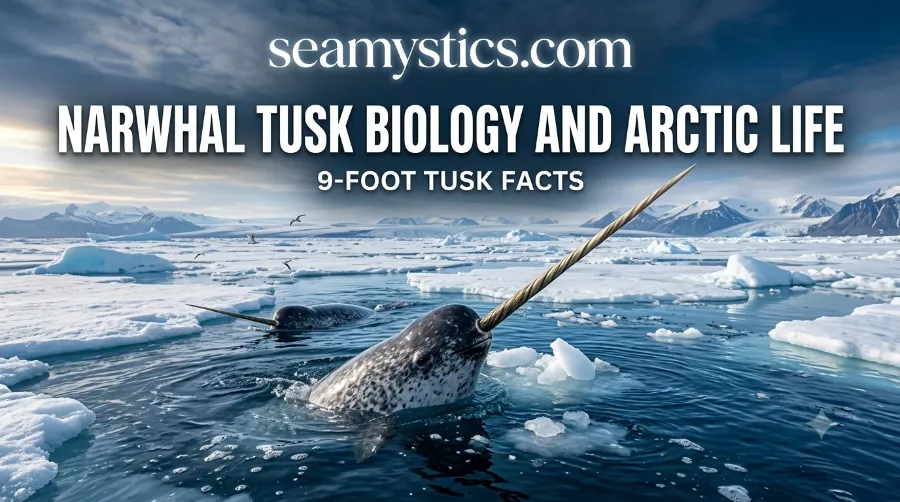

Picture a whale swimming under three feet of Arctic ice, carrying a spiral tusk almost as long as a canoe. That is not a myth from an old sailor’s logbook. It is the narwhal, and its tusk is one of the strangest tools in the animal kingdom. Narwhal tusk biology and Arctic life go hand in hand, because everything about this whale, from its diet to its migration, is shaped by the frozen world it calls home.
If you want to learn more about seal vs sea lion tips and expert advice.
If you want to learn more about Humpback whale’s annual migration route guide for practical tips and expert advice.
If you want to learn more about whale song communication explained tips and expert advice.
At Sea Mystics, we cover whale facts marine mammals lovers actually want to know, not recycled trivia. So before we go further, here is a quick snapshot of what you are about to learn.
If you want to learn more about narwhal facts arctic whale guide for practical tips and expert advice.
Key Takeaways
| Fact | Detail |
|---|---|
| Tusk length | Up to 3 meters (about 9.8 feet), usually on males |
| Population | Roughly 123,000 to 170,000 individuals worldwide |
| Conservation status | Least Concern (IUCN), but some regional groups are at risk |
| Diving depth | Can exceed 1,500 meters, among the deepest of any whale |
| Habitat | Arctic waters of Canada, Greenland, Norway, and Russia |
| Diet | Arctic cod, Greenland halibut, squid, and shrimp |
| Lifespan | Can live past 50 years |
| Tusk function | Sensory organ, not just a weapon |
Now let’s dig into the science behind this Arctic icon.
What Exactly Is a Narwhal?
The narwhal, or Monodon monoceros, is a medium sized toothed whale that lives only in the Arctic. Its name comes from the Icelandic words for corpse and whale, because early sailors thought its blotchy gray skin looked like a drowned body floating in the sea. Despite that grim nickname, narwhals are gentle, social animals that travel in pods of three to eight, though groups of up to 1,000 can gather in summer.
If you want to learn more about sperm whale deep divetips and expert advice.
Unlike dolphins or orcas, narwhals have no dorsal fin. Instead, they have a low ridge along their back, which helps them glide beneath tight sea ice without getting stuck. This is one of many small adaptations that make narwhal survival possible in one of the harshest environments on Earth. If you want to compare this to another apex predator built for icy hunting grounds, our guide on orca whale hunting behavior shows how differently two Arctic and sub-Arctic hunters approach survival.
Narwhal Tusk Biology and Arctic Life: The Science Behind the Spiral
This is where narwhal tusk biology and Arctic life truly overlap. The tusk is not a horn, and it is not made of ivory in the decorative sense people imagine. It is actually an elongated left canine tooth that grows straight through the narwhal’s upper lip in a counterclockwise spiral.
If you want to learn more about manatee facts marine mammal tips and expert advice.
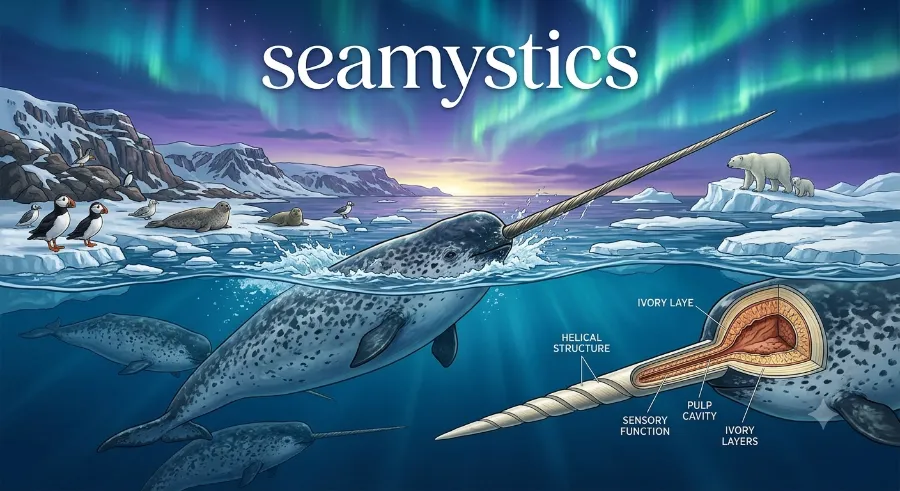
Almost all tusks belong to males. Females rarely grow one, and when they do, it is usually shorter. A full grown tusk can reach 3 meters, close to 9.8 feet, which explains why narwhals are often called the unicorns of the sea.
Why Does the Tusk Spiral?
Scientists are still studying the exact mechanics, but the spiral shape appears linked to how the tooth grows asymmetrically over years of steady development. Because it twists in one direction only, no two tusks look identical, similar to a fingerprint.
What Is the Tusk Actually For?
For decades, people assumed the tusk was purely a weapon used in male to male combat. Researchers have since found something far more interesting. A team led by Dr. Martin Nweeia discovered that the tusk works like a sensory organ, packed with as many as 10 million nerve endings connected directly to the brain.
Here is how that sensory system works, according to research published through Aarhus University’s biology department:
- Seawater enters through tiny channels in the outer layer of the tusk, called cementum.
- This water reaches a network of microscopic tubules running through the tooth.
- Signals from these tubules travel through the tusk’s pulp to nerve endings near its base.
- The fifth cranial nerve then carries this information straight to the brain.
Through this pathway, a narwhal can sense subtle shifts in water salinity, temperature, and pressure. In field tests, scientists slipped a sealed tube over a live narwhal’s tusk and ran different salt solutions through it. As a result, the animal’s heart rate changed in response, confirming the tusk really does detect its surroundings. You can read more about this study directly from Aarhus University’s biology research.
That said, the tusk is not only about sensing water. Researchers have also filmed narwhals using their tusks to tap and stun small fish before eating them, a hunting trick documented as recently as 2017 by drone footage over Tremblay Sound, Nunavut. So the tusk likely serves multiple roles at once: sensing the environment, competing for mates, and occasionally helping catch dinner.
Where Narwhals Live: Understanding Arctic Life
Narwhal tusk biology and Arctic life cannot be separated from geography, because this whale exists almost nowhere else on Earth. Narwhals live year round in the Arctic waters surrounding Canada, Greenland, Norway, and Russia. Roughly three quarters of the global population spends its summers in the Canadian Arctic, particularly around Baffin Bay and Hudson Bay.
During winter, narwhals move offshore into dense pack ice, often diving beneath ice that covers more than 95 percent of the surface. They rely on small cracks called leads to breathe. This tight relationship with sea ice means that as the Arctic warms, narwhal migration patterns and feeding grounds are shifting too.
How Deep Can a Narwhal Dive?
Very deep. Narwhals regularly dive to depths of 800 meters, and some dives have been recorded past 1,500 meters, with a maximum close to 2,370 meters, nearly a mile and a half down. That places them among the deepest diving whales on the planet, alongside sperm whales and beaked whales. For comparison, our detailed breakdown of blue whale facts and size shows how the largest whale on Earth actually stays much closer to the surface.
A single dive can last around 25 minutes, and narwhals may repeat these deep dives more than 15 times a day during winter months, according to 2025 satellite telemetry research published in PLOS ONE. That same study tracked narwhals migrating more than 1,700 kilometers between summer and winter grounds, data that is now being used to help design Marine Protected Areas in the Arctic.
Physical Facts: Size, Weight, and Appearance
Adult narwhals typically grow between 3.5 and 5 meters long, not counting the tusk, and weigh between 800 and 1,600 kilograms. Males are generally larger than females. Their skin is mottled gray, black, and white, which fades to a paler, almost white shade as the animal ages.
Because narwhals belong to the same family as beluga whales, called Monodontidae, they share several traits with their white cousins, including a flexible neck. This flexibility comes from the fact that narwhals have jointed neck vertebrae, unlike most whales whose neck bones are fused together. That single feature allows them to turn their heads more freely while navigating narrow leads in the ice.
What Do Narwhals Eat?
Narwhal diet is fairly specialized. Their main food sources include:
- Arctic cod
- Greenland halibut
- Polar cod
- Squid and cuttlefish
- Shrimp and armhook squid
Because narwhals have very few functional teeth besides the tusk, they cannot chew. Instead, they are believed to swim close to prey and suck it into their mouths, a feeding method scientists call suction feeding. Interestingly, narwhals eat far more during winter than summer, likely because their preferred prey is easier to find near the ocean floor when ice covers the surface above.
Social Life, Communication, and Reproduction
Narwhals are social animals that communicate using clicks, whistles, and knocking sounds. These calls help them coordinate within pods and likely assist with echolocation while hunting in dark, ice covered water.
Mating happens offshore among pack ice, generally between March and May. Female narwhals usually begin reproducing between six and eight years old, and pregnancy lasts about 15 months, longer than almost any other whale species. Calves are born the following summer, typically in July or August, measuring around 1.5 meters at birth.
Because females only give birth every two to three years, narwhal populations grow slowly. This slow reproduction rate is one reason conservationists watch smaller regional populations so closely, even though the species overall is not considered endangered.
Narwhal Population and Conservation Status Table
| Region or Group | Estimated Population | Status |
|---|---|---|
| Global total | 123,000 to 170,000 | Least Concern (IUCN) |
| Baffin Bay | Over 20,000 | Stable |
| Smith Sound | Around 16,000 | Stable |
| Inglefield Bredning | Around 8,000 | Monitored |
| East Greenland (Ittoqqortoormiit) | Roughly 400, down from 1,900 in 2008 | At risk |
| Svalbard | Around 800 | Small, isolated |
Source data compiled from IUCN Red List assessments, Wikipedia’s cited population figures, and COSEWIC’s May 2024 reassessment.
As the table shows, the global picture looks fairly stable, yet some local populations tell a very different story. The East Greenland decline, dropping from roughly 1,900 individuals in 2008 to around 400 by 2016, is a clear example of how regional pressure can hit hard even when a species overall carries a low risk rating. Because of this, three narwhal populations in Greenland were flagged as facing elevated extinction risk between 2025 and 2028 if current hunting quotas continue unchanged.
Main Threats Facing Narwhals
- Melting sea ice, which reduces shelter from predators like orcas and shrinks access to prey.
- Industrial noise from shipping, oil exploration, and seismic surveys, which interferes with echolocation.
- Ice entrapment events, where shifting ice suddenly seals off breathing holes.
- Regulated but still meaningful subsistence hunting in parts of Greenland and Canada.
- Contaminant buildup in blubber, since narwhals sit near the top of the Arctic food chain.
Conservation groups such as the World Wildlife Fund track these pressures closely through satellite tagging programs, which follow individual narwhals for close to a year at a time. You can see WWF’s own field data and photography on their dedicated narwhal facts page, which remains one of the most reliable public resources on the species. Ocean Generation has also published an accessible look at how warming Arctic conditions are reshaping narwhal habitat, available on their piece about narwhals, unicorns, and Arctic change.
How Narwhals Compare to Other Whale Facts and Marine Mammals
Understanding whale facts marine mammals share helps put the narwhal in perspective. Unlike the highly social, acrobatic behavior seen in our guide to humpback whale migration facts, narwhals stay almost entirely within Arctic waters year round rather than traveling thousands of miles toward tropical breeding grounds. Narwhals also lack the complex problem solving displays covered in our piece on dolphin intelligence facts explained, though their sensory tusk system arguably rivals dolphin echolocation in terms of biological complexity.
If you want a broader overview before going deeper into any single species, our full whale facts and marine mammals guide is a good starting point.
Narwhal Diving and Feeding Behavior Chart
| Behavior Metric | Typical Range | Notable Record |
|---|---|---|
| Average dive depth | 800 meters | Up to 2,370 meters |
| Dive duration | 20 to 25 minutes | Some exceed 25 minutes |
| Dives per day (winter) | 15 or more | Recorded via satellite tags |
| Migration distance | 1,000 to 1,700 km seasonally | 2025 PLOS ONE telemetry study |
| Group size | 3 to 8 individuals | Up to 1,000 in summer aggregations |
This kind of data matters because it shows narwhals are not passive drifters. They are active, deep ranging hunters whose entire daily rhythm depends on the health of Arctic sea ice and the fish populations beneath it.
Frequently Asked Questions
How long is a narwhal’s tusk?
A fully grown narwhal tusk usually measures between 1.5 and 3 meters, roughly 5 to 9.8 feet, and grows almost entirely on males.
Do female narwhals have tusks?
Rarely. Fewer than 15 percent of females grow a tusk, and when they do it is generally shorter and less pronounced than a male’s.
Are narwhals dangerous to humans?
No. Narwhals are not known to be aggressive toward people, and interactions in the wild are extremely rare since they live in remote, ice covered regions.
Is the narwhal endangered?
Globally, no. The IUCN lists narwhals as Least Concern, though certain regional populations, especially in East Greenland, face a much higher risk of local decline.
Why do narwhals have tusks instead of two full tusks?
Only the left canine erupts into a tusk in most males. The right canine typically stays embedded in the jaw, though double tusked narwhals do occasionally occur.
How deep do narwhals dive compared to other whales?
Narwhals dive deeper than most whale species, regularly exceeding 800 meters and occasionally passing 2,000 meters, placing them close to sperm whales in diving ability.
Conclusion
Narwhal tusk biology and Arctic life reveal a whale that is far stranger, and far more finely tuned to its environment, than folklore ever suggested. That spiral tusk is not simply a weapon or a curiosity for legends about unicorns. It is a living sensor, wired straight to the brain, helping this whale survive in one of the coldest, darkest corners of the ocean. As Arctic ice continues to shrink, understanding narwhal biology is not just fascinating science. It is a window into how quickly life at the top of the world is changing, and how much still depends on protecting the ice these whales have relied on for thousands of years.
References
- World Wildlife Fund. Unicorn of the Sea: Narwhal Facts. https://www.worldwildlife.org/resources/facts/unicorn-of-the-sea-narwhal-facts/
- Ocean Generation. Narwhals and Unicorns: How the Magic of the Arctic Has Changed. https://oceangeneration.org/narwhals-and-unicorns-how-the-magic-of-the-arctic-has-changed/
- Aarhus University, Department of Biology. Sensory Ability in the Narwhal Tooth Organ System. https://bio.au.dk/en/about-biology/news-and-events/show/artikel/narhvalens-tand-afsloerer-dyrets-livsbetingelser-1
- IUCN Red List, Narwhal (Monodon monoceros) species assessment
- Committee on the Status of Endangered Wildlife in Canada (COSEWIC), 2024 reassessment
- PLOS ONE, 2025 narwhal satellite telemetry migration study