
Picture a world with no sun, crushing pressure, and water hot enough to melt lead. Now picture that world full of life. That is exactly what scientists found in 1977 near the Galapagos Rift, and it changed biology forever. These strange, glowing hot springs on the ocean floor hold some of the most fascinating hydrothermal vent ecosystem facts ever recorded, and they still surprise researchers today. In this guide, we will walk through how these ecosystems form, what lives there, and why they matter to everyone, not just marine biologists. Along the way, we will look at real expeditions, real dates, and real numbers so you get the full picture, not just the highlights.
If you want to learn more about mangrove ecosystem ocean role tips and expert advice.
If you want to learn more about kelp forest ecosystem facts tips and expert advice.
Before we go deeper, here is a quick snapshot of what you are about to learn.
Key Takeaways
| Fact | Detail |
|---|---|
| First discovery | Galapagos Rift, 1977, by researchers using the submersible Alvin |
| Vent temperature range | Up to 400°C (752°F) at black smokers |
| Energy source | Chemosynthesis, not photosynthesis |
| Depth range | Typically 2,000 to 4,000 meters below sea level |
| Notable creatures | Giant tube worms, Yeti crabs, scaly-foot snails, vent shrimp |
| Newest discovery | Sub-seafloor vent ecosystem found in 2023 by Schmidt Ocean Institute |
| Latest find | Hybrid vent fields discovered in July 2026 near the Doldrums Fracture Zone |
Now, let us break these hydrothermal vent ecosystem facts down one by one.
What Are Hydrothermal Vents?
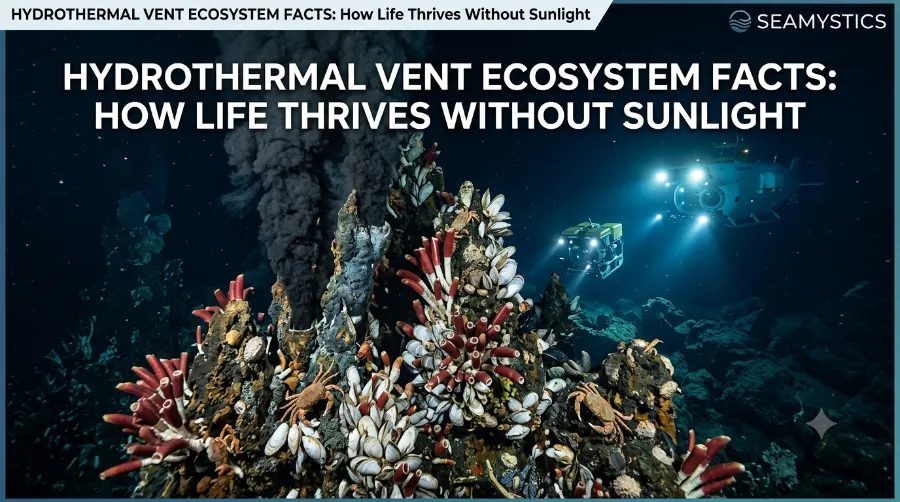
Hydrothermal vents are cracks in the seafloor where mineral rich, superheated water shoots out from deep inside the earth. Cold seawater seeps down through cracks in the ocean crust. As it sinks, it meets magma near the earth’s mantle and heats up fast. This heated water then rushes back up, carrying dissolved minerals and gases with it, and bursts out through the seafloor as a vent.
If you want to learn more about hydrothermal vent ecosystem facts tips and expert advice.
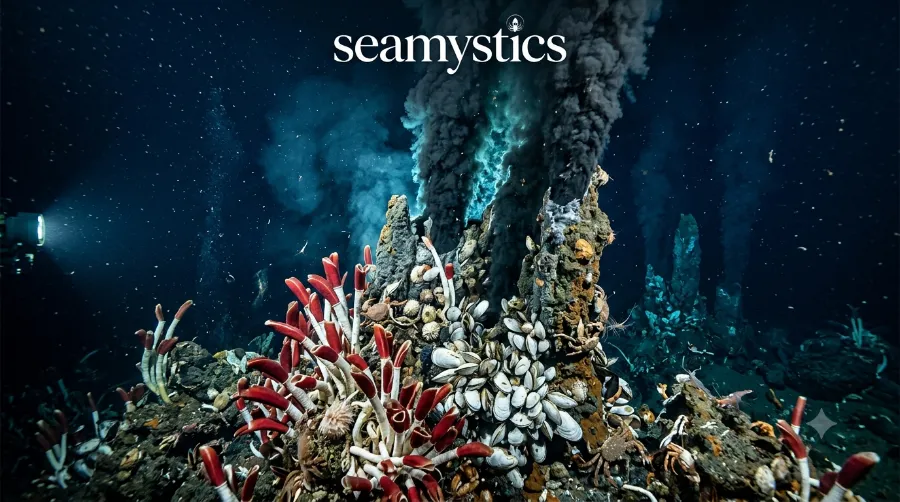
Because the surrounding ocean water is near freezing, the contrast creates a dramatic effect. The hot mineral water often looks like black or white smoke pouring out of a chimney. That is why scientists often call these formations smokers. According to the Woods Hole Oceanographic Institution, these systems can reach temperatures of nearly 400 degrees Celsius, yet life still thrives just inches away in near freezing water (WHOI, Seafloor Below).
How Hydrothermal Vents Form
The formation process is tied directly to plate tectonics. Most vents sit along mid ocean ridges, where tectonic plates slowly pull apart. As magma rises to fill the gap, it heats the surrounding rock and seawater above it.
If you want to learn more about deep sea food web tips and expert advice.
Here is a simple breakdown of the process:
- Seawater seeps into cracks in the ocean crust near a spreading ridge.
- The water travels down toward hot magma chambers below the crust.
- Heat and pressure cause chemical reactions, pulling minerals like sulfur, iron, and copper into the water.
- The now superheated, mineral rich fluid rises quickly through the crust.
- It bursts out of the seafloor, mixing with cold seawater to form a vent.
This cycle can run for decades in one spot before the vent goes quiet and a new one forms nearby. Some vent fields, like those on the Juan de Fuca Ridge, have been actively monitored by scientists for more than 30 years.
learn more about Seagrass meadows and ocean health tips and expert advice.
Types of Hydrothermal Vents
Not every vent looks or acts the same. Marine researchers usually split them into a few main types based on temperature and mineral content.
- Black smokers: These release the hottest fluids, often above 300°C, rich in iron and sulfide minerals that turn the water dark.
- White smokers: Cooler than black smokers, these release lighter minerals like barium, calcium, and silica, giving the plume a pale, milky color.
- Diffuse flow vents: These leak warm water slowly through cracks in the seafloor instead of shooting it out, and they often support the densest animal life.
If you want to understand how these vent types connect to the wider ocean food web, our guide on how marine ecosystems work breaks down the bigger picture in simple terms.
Hydrothermal Vent Ecosystem Facts You Should Know
So far, we have covered how vents form. Now let us look at what actually makes them ecosystems, because heat and minerals alone do not create life. The real magic happens through a process most people never learned about in school.
Chemosynthesis: Life’s Engine Without Sunlight
Every ecosystem on land, and nearly every one in shallow water, relies on photosynthesis. Plants and algae use sunlight to build sugars, and everything else eats them or eats something that ate them. Hydrothermal vents flip this rule completely.
want to learn more aboutwhale fall ecosystem explained health tips and expert advice.
Instead of sunlight, bacteria and archaea near the vents use chemosynthesis. They pull energy from chemical reactions, mainly by converting hydrogen sulfide, a toxic gas to most life, into usable energy. This process forms the base of the entire vent food web, similar to how plants form the base of a forest food web.
If you want to learn more about symbiosis in coral reefs tips and expert advice.
These microbes do not just float freely either. Many live inside the bodies of larger animals in a partnership called symbiosis. Giant tube worms, for example, have no mouth or stomach as adults. Instead, they host colonies of chemosynthetic bacteria inside a special organ, and the bacteria feed the worm from the inside out.
This is one of the reasons hydrothermal vent ecosystem facts fascinate astrobiologists too. NASA has pointed to vent life as strong evidence that life could exist on icy moons like Europa or Enceladus, where sunlight never reaches but internal heat might still support chemosynthesis.
If you want to learn more about open ocean ecosystem zones tips and expert advice.
Vent Temperature and Depth Comparison
To put these extreme conditions into perspective, here is how vent environments compare to more familiar ocean zones.
| Environment | Depth | Typical Temperature | Light Present |
|---|---|---|---|
| Coral reef | 0 to 30 meters | 23°C to 29°C | Yes |
| Open ocean twilight zone | 200 to 1,000 meters | 4°C to 10°C | Very dim |
| Deep sea floor (no vent) | 2,000 to 6,000 meters | 1°C to 4°C | None |
| Hydrothermal vent (black smoker) | 2,000 to 4,000 meters | Up to 400°C | None |
This massive temperature swing, sometimes within a few feet of space, is part of what makes vent biology so unusual. Animals living there have adapted proteins and cell structures that would break down instantly in most other marine environments.
Unusual Creatures Behind Deep Sea Mysteries
Every trip to a hydrothermal vent uncovers new deep sea mysteries, and the creatures found there rarely resemble anything from shallow water. Many species living around vents exist nowhere else on the planet.
Here are some of the most well documented vent animals:
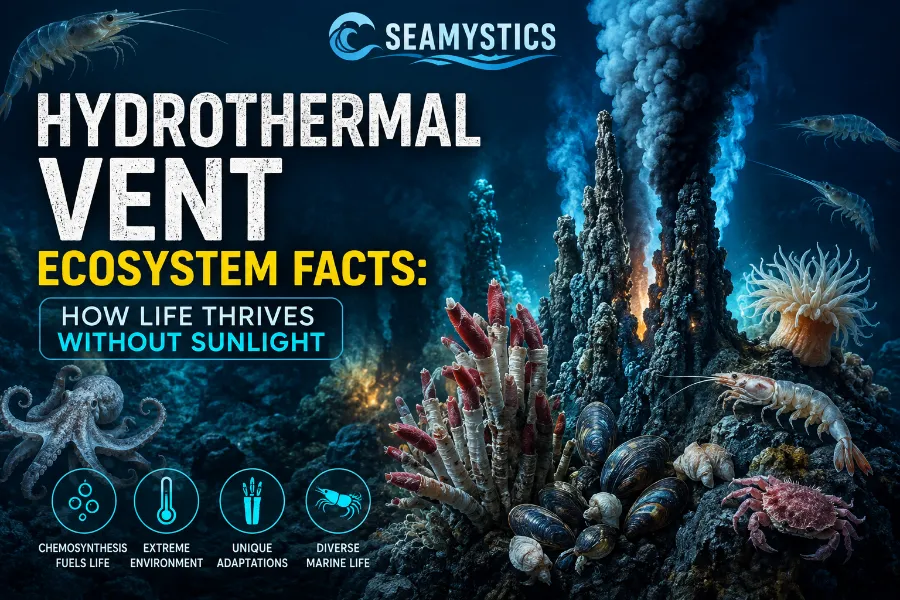
- Giant tube worms (Riftia pachyptila): These can grow over 2 meters long and rely entirely on internal bacteria for food.
- Yeti crabs: First described in 2005 near hydrothermal vents on the Pacific-Antarctic Ridge, these crabs farm bacteria on their hairy claws for food.
- Scaly-foot snails: Discovered in the Indian Ocean in 2001, this snail builds its shell from iron sulfide, making it the only known animal with an iron based body armor.
- Pompeii worms: Considered one of the most heat tolerant animals on earth, they can survive temperatures near 80°C on one end of their body.
- Vent shrimp: Found in dense swarms around Atlantic vents, these shrimp use light sensing organs on their backs instead of eyes to detect faint thermal glow from the vents.
According to MarineBio, vent communities can reach astonishing densities, sometimes supporting more biomass per square meter than a tropical rainforest floor, despite total darkness (MarineBio, Hydrothermal Vents). This level of productivity in total darkness remains one of the strongest examples of how flexible life can actually be.
For readers who enjoy comparing extreme habitats, our piece on the coral reef ecosystem shows just how differently life organizes itself when sunlight is part of the equation.
Recent Discoveries Expanding Hydrothermal Vent Ecosystem Facts
Vent science moves fast, and new expeditions keep rewriting what we thought we knew. Because so much of the deep sea remains unmapped, researchers estimate we have explored less than a quarter of the total vent fields likely to exist worldwide.
A few standout discoveries from recent years show just how much is still out there.
- In 2022, scientists located a new hydrothermal vent field on the Knipovich Ridge near Svalbard, Norway, expanding known vent activity further into Arctic waters than previously confirmed.
- In 2023, a team led by Dr. Monika Bright of the University of Vienna, aboard Schmidt Ocean Institute’s research vessel Falkor (too), discovered an entirely new ecosystem hidden inside volcanic cavities beneath the seafloor near the East Pacific Rise. Worms, snails, and chemosynthetic bacteria were found living in cave systems at roughly 25°C, proving that vent life extends below the ocean floor, not just above it (Schmidt Ocean Institute).
- In 2024, researchers announced five newly identified hydrothermal vents in the Eastern Tropical Pacific Ocean, adding fresh data to global vent maps.
- In July 2026, an MBARI led expedition to the Doldrums Fracture Zone revealed a rare hybrid vent system that combines typical volcanic venting with serpentinization, a chemical process where seawater reacts with mantle rock. Researchers noted that fracture zones, once thought to be geologically quiet, can actually host thriving, active ecosystems.
These findings matter because each one adjusts our estimate of how much life the deep ocean can actually support, and how many chemical pathways life can use to survive without sunlight.
Why Hydrothermal Vent Ecosystem Facts Matter to Everyone
It is easy to assume vent research only matters to marine biologists, but the impact reaches much further. Vent microbes have already influenced medicine, industry, and even the search for life beyond earth.
Enzymes isolated from heat loving vent bacteria are now used in industrial processes, including ethanol production and DNA testing technology. Scientists also study vent organisms to understand how proteins stay stable under extreme heat and pressure, which has applications in biotechnology and materials science.
Beyond practical uses, vent ecosystems continue to shape how we think about the origin of life itself. Many researchers now believe the first life on earth may have formed near ancient hydrothermal vents, using chemical energy long before sunlight became a factor. If that theory holds, these ecosystems are not just unusual corners of the ocean. They may be a window into how life began in the first place.
If this topic has sparked your curiosity, our main resource on how marine ecosystems work is a good next stop, along with the full seamystics.com library for more deep sea coverage.
Frequently Asked Questions
What is the main energy source in a hydrothermal vent ecosystem?
Chemosynthesis powers these ecosystems. Bacteria convert chemicals like hydrogen sulfide into energy, replacing the role sunlight plays in most other ecosystems.
How hot can hydrothermal vents get?
Black smoker vents can reach temperatures close to 400°C, though the surrounding seawater usually stays near freezing just a short distance away.
Do hydrothermal vents exist in every ocean?
Yes, active vent fields have been found in the Pacific, Atlantic, Indian, and Arctic Oceans, mostly along mid ocean ridges and fracture zones.
Can humans visit hydrothermal vents?
Only through submersibles or remotely operated vehicles like Alvin or SuBastian. The depth, pressure, and heat make direct human access impossible without specialized equipment.
Why are scientists interested in hydrothermal vents for space research?
Because vent life proves organisms can survive without sunlight using chemical energy alone, which raises the possibility of similar life existing on icy moons like Europa or Enceladus.
Conclusion
Hydrothermal vents show us that life does not need sunlight to survive, it just needs energy, and the ocean floor has plenty of it hidden beneath cracks in the crust. From giant tube worms to iron armored snails, every hydrothermal vent ecosystem fact we uncover adds another layer to how flexible and resilient life can truly be. New expeditions, including the July 2026 discovery near the Doldrums Fracture Zone, remind us that the deep sea still holds far more than we have mapped. As research continues, these dark, scorching corners of our planet may end up teaching us more about life’s origins, and life elsewhere in the universe, than almost anywhere else on earth.
References
- Woods Hole Oceanographic Institution. Hydrothermal Vents. https://www.whoi.edu/ocean-learning-hub/ocean-topics/how-the-ocean-works/seafloor-below/hydrothermal-vents/
- MarineBio Conservation Society. Hydrothermal Vents. https://www.marinebio.org/oceans/deep-sea/hydrothermal-vents/
- Schmidt Ocean Institute. Understanding Life Through Hydrothermal Vents. https://schmidtocean.org/cruise-log-post/understanding-life-through-hydrothermal-vents/
- NASA Astrobiology. Life in the Extreme: Hydrothermal Vents. https://astrobiology.nasa.gov/news/life-in-the-extreme-hydrothermal-vents/
- Astrobiology.com. MBARI Doldrums Fracture Zone Expedition, July 2026. https://astrobiology.com/2026/07/10/expedition-led-by-mbari-researchers-reveals-a-remarkable-and-rare-form-of-deep-sea-hydrothermal-vents/