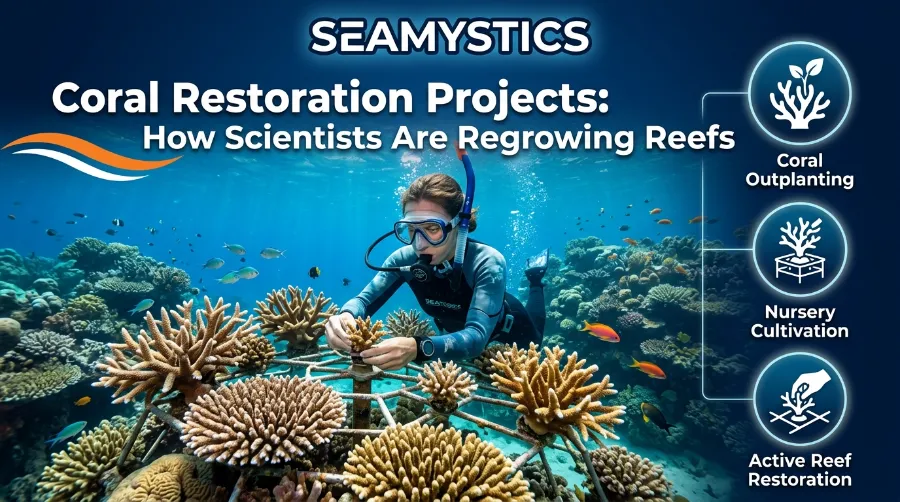

Coral reefs cover less than one percent of the ocean floor, yet they support roughly a quarter of all marine life. That single fact is why coral restoration projects have become one of the most closely watched fields in ocean science today. Reefs are dying faster than most people realize, but for the first time, scientists have workable methods to grow them back, and some of those methods are already producing measurable results on real reefs.
This guide walks through how coral restoration actually works, which methods are proving effective, and what the data says about where this field is heading next.
Key takeaways
| Point | What it means |
|---|---|
| Reefs are collapsing fast | 84% of the world’s reef area was hit by bleaching-level heat stress between 2023 and 2025 |
| Restoration is scaling up | Groups like Coral Restoration Foundation have outplanted over 250,000 corals since 2007 |
| Multiple methods now exist | Coral gardening, micro-fragmentation, larval propagation, and 3D-printed substrates all work differently |
| Cost still limits scale | Restoring reef habitat can run into the tens of thousands of dollars per hectare |
| Citizen involvement matters | Volunteer divers and monitoring programs materially speed up outplanting and tracking |
TL;DR: Coral restoration projects use nurseries, coral farming, and gardening techniques to regrow damaged reefs, with organizations like the Coral Restoration Foundation and SECORE International leading large-scale outplanting efforts. The work is genuinely making a dent, but it can’t outrun ocean warming on its own, so restoration is now paired with heat-tolerant coral breeding and stricter local protections. Read on for the real numbers, the methods, and what scientists expect over the next decade.
Why Coral Reefs Are in Trouble
Coral reefs have always faced natural stress, but the past decade has pushed many past their recovery limit. Rising ocean temperatures cause corals to expel the algae living in their tissue, a process called bleaching, which starves the coral if warm water lingers too long.
According to NOAA’s Coral Reef Watch program, the fourth global mass bleaching event ran from early 2023 through mid-2025 and affected 84 percent of the planet’s coral reef area across the Pacific, Atlantic, and Indian Oceans. Mass bleaching was documented in at least 83 countries and territories, making it the most widespread event on record.
Microplastics Seafood Research: What the Data Actually Shows
Meanwhile, other ocean threats compound the damage. Ghost fishing gear drifts through reef zones and snags on coral structures, breaking off decades of growth in seconds, a problem covered in more depth in our piece on ghost fishing gear. Illegal fishing practices, discussed in our illegal fishing impact report, also physically damage reef structures through destructive gear like dynamite and cyanide fishing.
What Coral Restoration Projects Actually Do
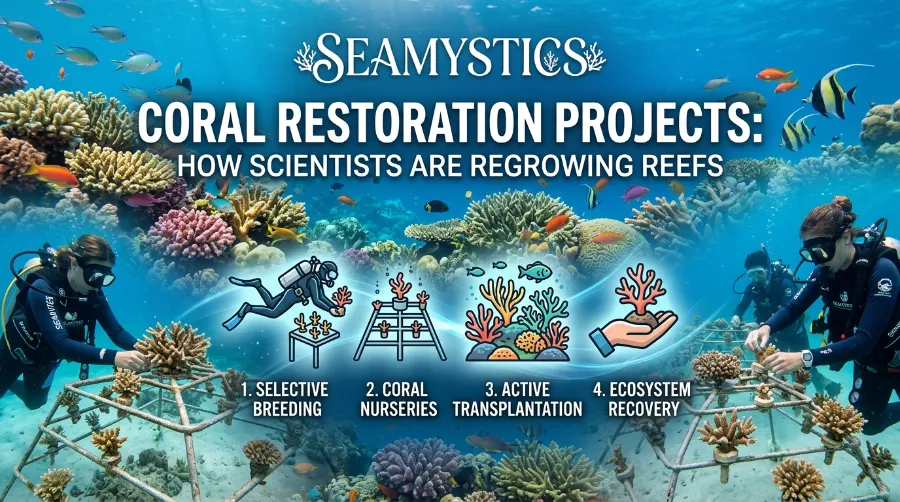
Coral restoration projects aim to rebuild reef structure and coral cover faster than nature can manage on its own. Most programs follow a similar arc, even if their techniques differ.
- Scientists collect coral fragments or spawn from healthy donor colonies
- Fragments are grown in nurseries, either underwater on structures or in land-based tanks
- Once large enough, the coral is “outplanted” back onto degraded reef
- Teams monitor survival and growth for months or years afterward
Coral farming projects like Coral Restoration Foundation’s offshore nurseries near Tavernier, Florida, have restored more than 250,000 corals since the organization’s founding in 2007, according to its own reporting. That scale didn’t happen overnight. It took nearly two decades of refining nursery design, genetic diversity tracking, and outplanting technique.
Coral Gardening Ocean Method
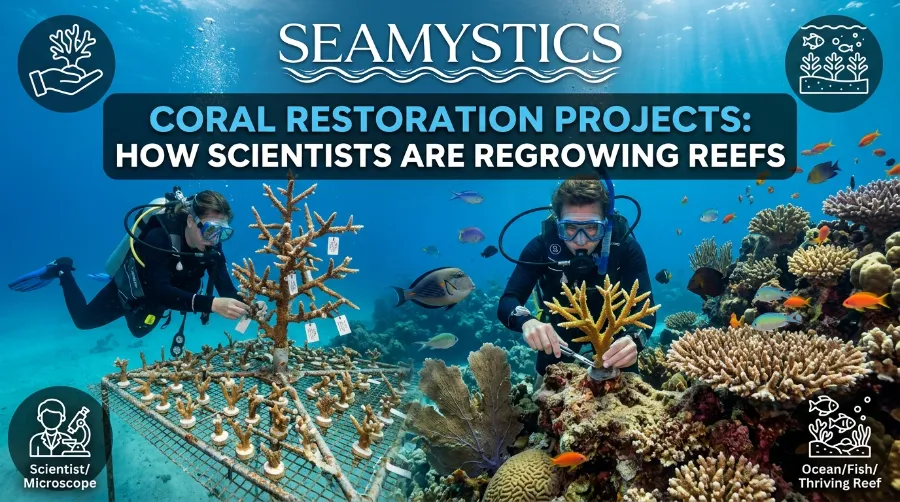
Coral gardening ocean techniques are the most widely used coral reef restoration methods in the world. Small fragments, sometimes just a few centimeters long, are hung on underwater “trees” made of PVC pipe and monofilament line. The coral grows quickly in this suspended position because it gets consistent water flow and light without competing with algae on the seafloor.
Once a fragment reaches roughly the size of a fist, divers transplant it onto a cleared patch of degraded reef using marine epoxy or cement. UK-based Mossy Earth documents a similar process in its Wilder Reefs project, where community-based nurseries have become the standard model across parts of the Mediterranean and Caribbean.
Micro-Fragmentation
Micro-fragmentation, developed by Dr. David Vaughan at Mote Marine Laboratory, cuts coral into tiny pieces, sometimes just a single polyp. Corals grow far faster in small fragments because the injury triggers a rapid healing and growth response. Boulder corals that would normally take 25 to 75 years to reach full size can reach the same size in two to three years using this method.
Marine Protected Species Laws: What’s Actually Protected in the US
Larval Propagation and Coral Spawning
Larval propagation captures coral spawn during the handful of nights each year when reef-building species release eggs and sperm into the water column. SECORE International, based in Germany with projects across the Caribbean, has pioneered “seeding units,” small ceramic substrates seeded with coral larvae, that can be produced and deployed at a scale traditional fragment nurseries can’t match.
This approach also helps preserve genetic diversity, since it combines genetic material from many parent colonies rather than cloning a single donor coral repeatedly.
Ocean Cleanup Technology: Do These Devices Actually Work?
Real Reef Rebuilding Efforts With Measurable Results
Numbers matter more than intentions in this field, so here’s what a few real projects have actually delivered.
- Coral Restoration Foundation has restored over 250,000 corals across roughly 40,000 square meters of Florida’s Coral Reef since 2007
- Coral Vita’s land-based farm in the Bahamas has grown coral up to 50 times faster than natural growth rates using micro-fragmentation
- In American Samoa, CRF has partnered with local teams to expand nursery capacity after years of bleaching pressure, work outlined in its Samoa program updates
- Diverse International reef programs in the UK, including those featured by Divеrace, combine dive tourism with direct participation in outplanting
That last point matters more than it sounds. Reef rebuilding efforts increasingly rely on recreational divers, not just marine biologists, to physically place coral fragments and record survival data. It turns tourism dollars into direct conservation labor.
The Limits Scientists Are Honest About
No restoration scientist claims this work can outpace ocean warming by itself. Outplanted coral is still vulnerable to the same heat stress that killed the original reef. During the 2023 to 2025 bleaching event, several Florida nurseries lost significant portions of their stock despite years of careful cultivation.
That’s why the field has shifted toward breeding heat-tolerant coral strains, sometimes called “super corals,” and pairing restoration with local protections against runoff, overfishing, and physical damage. Restoration without addressing the underlying stressors is, in the words of several marine biologists interviewed for reef status reports, treating the symptom rather than the disease.
For a look at how other destructive practices compound reef stress, our coverage of shark finning’s ripple effects on reef ecosystems is worth a read, since apex predator loss changes the entire balance of a reef food web.
What This Means for the Next Decade
Coral restoration projects are moving from small pilot programs into coordinated global networks. The International Coral Reef Initiative now connects government agencies, universities, and nonprofits across dozens of countries to standardize monitoring and share restoration techniques.
Funding has grown alongside the science. Grants in the multi-million dollar range, like the $5 million awarded to a Florida restoration project at Eastern Dry Rocks, are becoming more common as governments recognize reefs as economic infrastructure, not just scenery. Coastal tourism and fisheries tied to healthy reefs generate billions annually, which makes restoration a financial argument as much as an ecological one.
Frequently Asked Questions
How long does it take to restore a coral reef?
Individual fragments can be outplant-ready within one to three years depending on species and method, but full reef recovery, meaning a self-sustaining ecosystem, typically takes a decade or longer.
Is coral restoration actually working?
Yes, in measurable ways. Outplanted corals have shown survival rates above 80 percent in several monitored projects, and some outplanted colonies have already spawned naturally in the wild, a strong sign of long-term success.
How much does coral restoration cost?
Costs vary widely by method and location, but large-scale reef restoration can run from a few thousand to tens of thousands of dollars per hectare, depending on labor, materials, and monitoring needs.
Can I get involved in coral restoration projects?
Many organizations, including Coral Restoration Foundation and dive-tourism partners, train volunteer divers to help with outplanting and monitoring, often through short certification courses.
Will restoration alone save coral reefs?
No. Scientists are clear that restoration must be paired with reducing ocean warming, curbing pollution, and stopping destructive fishing practices to have lasting impact.
Conclusion
Coral restoration projects have moved from experimental fringe science to a genuine, measurable field of ocean recovery. The methods work. Nurseries are producing coral faster than ever, larval propagation is scaling genetic diversity, and volunteer divers are turning tourism into hands-on conservation. None of it replaces the need to slow ocean warming, but it buys reefs time, and time is exactly what a recovering ecosystem needs. For anyone who has watched a bleached reef and wondered if anything could be done, the honest answer now is yes, something is being done, and it’s working better than most people realize.
Quick Recap Quiz
1. What percentage of the world’s reef area was affected by the fourth global bleaching event?
A) 25%
B) 50%
C) 84%
D) 95%
Answer: C — 84%, as confirmed by NOAA’s Coral Reef Watch.
2. Who developed the micro-fragmentation technique?
A) Dr. Sylvia Earle
B) Dr. David Vaughan
C) Jacques Cousteau
D) Dr. Ruth Gates
Answer: B — Dr. David Vaughan at Mote Marine Laboratory.
3. Roughly how many corals has Coral Restoration Foundation outplanted since 2007?
A) 10,000
B) 50,000
C) 250,000
D) 1 million
Answer: C — over 250,000 corals.
4. What is coral bleaching primarily caused by?
A) Ocean acidification alone
B) Rising water temperatures
C) Overfishing
D) Coral disease
Answer: B — sustained rising water temperatures cause corals to expel their algae.
5. What is a major limitation of restoration efforts on their own?
A) Lack of volunteers
B) They can’t outpace ongoing ocean warming
C) Corals grow too fast
D) Too much genetic diversity
Answer: B — restoration alone can’t outrun continued warming.
References
- NOAA National Centers for Environmental Information, “World’s Fourth Mass Coral Bleaching Event Likely Ended in 2025”
- Coral Restoration Foundation, official program data and blog
- Mossy Earth, Wilder Reefs project documentation
- SECORE International, larval propagation research
- Mote Marine Laboratory, micro-fragmentation studies