
Somewhere on the high seas tonight, a fishing vessel is turning off its tracking transponder. No one will know where it went, what it caught, or how much it took. This is the quiet, unglamorous heart of the illegal fishing impact problem, and it is bigger than most people realize.
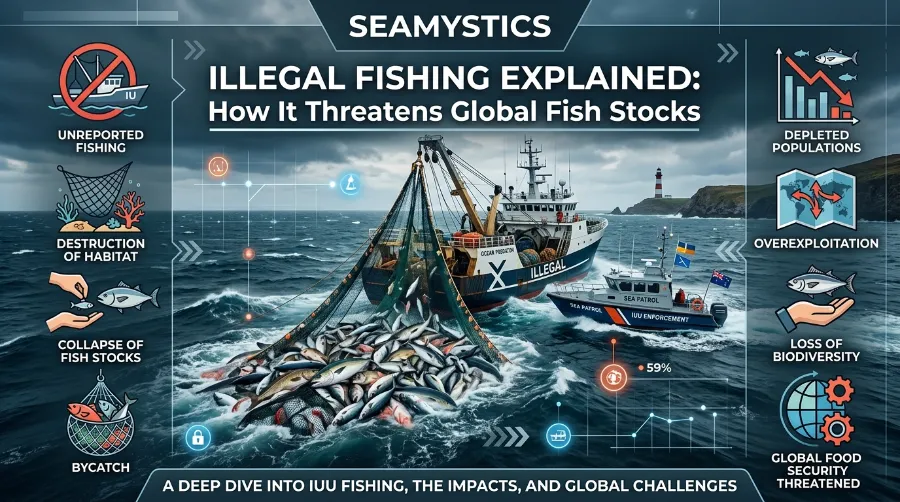
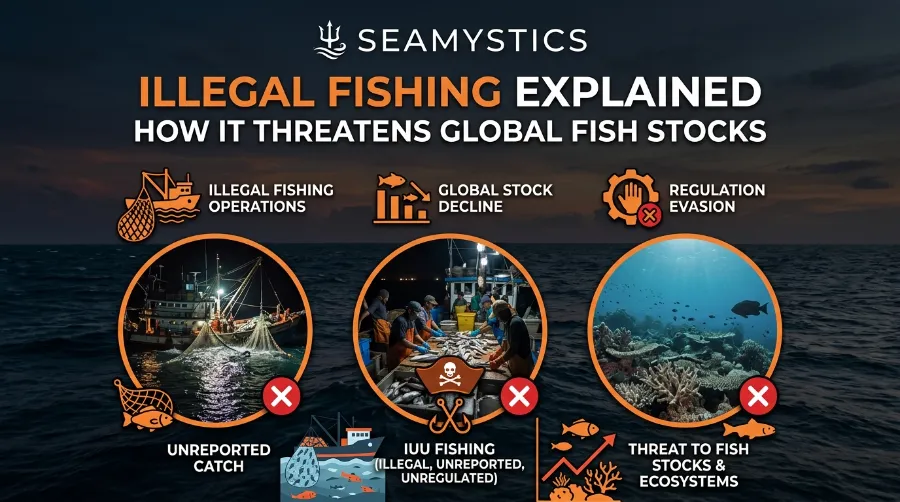
Illegal, unreported, and unregulated fishing, commonly shortened to IUU fishing, now accounts for somewhere between 11% and 19% of the global catch every single year. That is not a rounding error. That is tens of millions of tonnes of fish moving through the seafood supply chain with no record, no quota, and no accountability.
If you eat seafood, work in coastal policy, or simply care about the ocean, this piece from Sea Mystics is for you. We are going to walk through what illegal fishing actually looks like, why it matters so much right now, and what the newest data tells us about where the fight against it stands in 2026.
TL;DR
- Illegal, unreported, and unregulated fishing costs the global economy an estimated $10 to $23 billion a year and removes 10 to 26 million tonnes of fish from the ocean annually.
- The share of fish stocks fished within biologically sustainable limits has fallen from 90% in 1974 to just 62.3% today, and illegal fishing is a major driver of that decline.
- Enforcement is improving through satellite tracking and international task forces, but weak governance in many coastal nations still lets IUU vessels slip through.
Key Takeaways
| Focus Area | What the Data Shows |
|---|---|
| Global economic loss | $10 billion to $23 billion lost annually to IUU fishing |
| Illegal catch volume | 10 to 26 million tonnes taken outside legal limits each year |
| Share of global catch | 11% to 19% of all wild-caught seafood worldwide |
| Sustainable stock decline | Dropped from 90% (1974) to 62.3% (2021), per FAO data |
| Worst-affected region | Africa, according to the 2025 IUU Fishing Risk Index |
| Recent enforcement win | 7 Indonesian nationals prosecuted for illegal fishing in Australian waters, September 2025 |
What Illegal Fishing Actually Means
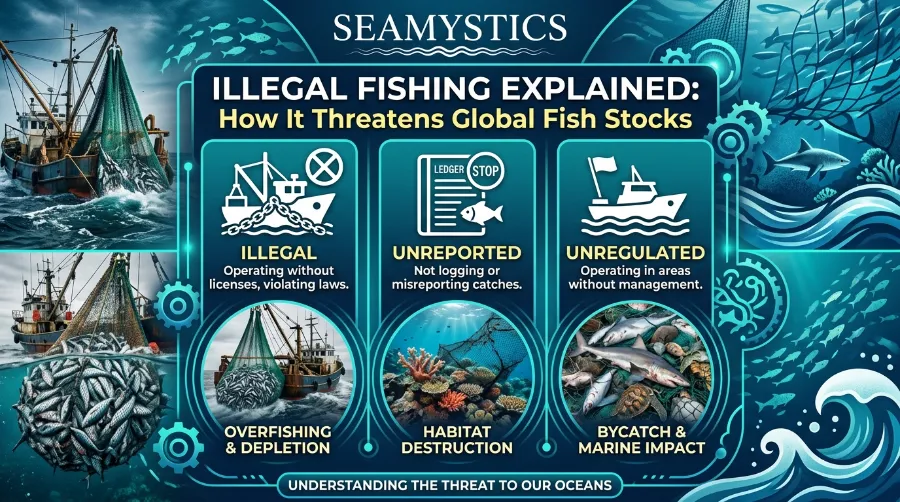
The term illegal fishing gets used loosely, but it actually covers three distinct problems, and understanding the difference matters if you want to grasp the full illegal fishing impact on ocean health.
Illegal fishing happens when a vessel fishes without a license, in a closed area, or in direct violation of national or international law. Unreported fishing is when catch is deliberately misrecorded or simply never logged with the relevant authority. Unregulated fishing takes place in areas or for species where no management rules exist at all, often on the high seas where jurisdiction gets murky fast.
Fish Farming Explained: Is Aquaculture Actually Sustainable?
Put together, these three behaviors form what the industry calls IUU fishing. Oceana breaks this distinction down clearly in its own explainer on the topic, and it is worth reading if you want the regulatory nuance in full.
Why This Distinction Matters for Fish Stocks
Each of these three categories damages fish populations differently, but the cumulative illegal unreported fishing effect is what pushes stocks past their limits.
- Illegal fishing often targets protected species or breeding grounds, disrupting reproduction cycles.
- Unreported fishing throws off the population estimates scientists rely on, so quotas get set using bad data.
- Unregulated fishing exploits legal gray zones, especially in remote or poorly monitored waters.
Consequently, fisheries managers end up making decisions based on catch numbers that are simply wrong. That is one of the quieter but more corrosive parts of the illegal fishing statistics problem: it is not just about stolen fish, it is about stolen information.
Illegal Fishing Statistics: The Numbers Behind the Crisis
Let’s ground this in current figures instead of vague warnings, because the scale here is genuinely hard to picture without real numbers.
According to the IUU Fishing Index 2025, compiled by the Global Initiative Against Transnational Organized Crime, IUU fishing accounts for between 11% and 19% of global fish catches annually. That works out to between 10 million and 26 million tonnes of fish, worth an estimated $10 billion to $23 billion every year. For comparison, the global legal fishing industry produces around 90 million tonnes of capture fisheries annually and supports roughly 34 million jobs worldwide.
Microplastics Seafood Research: What the Data Actually Shows
Meanwhile, the picture for fish stocks overall has been sliding for decades. The proportion of global fish stocks within biologically sustainable levels fell from 90% in 1974 to just 62.3% in 2021, according to the same 2025 index. Africa remains the worst-performing region for tackling the problem, though the issue is genuinely global, touching European, American, and Asian waters alike.
A Snapshot of Regional Enforcement Data
| Region or Country | Recent Data Point | Year |
|---|---|---|
| Global | 10-26 million tonnes caught illegally per year | 2025 |
| Sri Lanka | 14,436 suspects apprehended for IUU fishing since 2013 | 2026 |
| Australia | 35 Indonesian fishers prosecuted in Darwin since July 2025 | 2025 |
| Seychelles | Foreign vessel intercepted in Seychelles EEZ, 6 crew detained | Dec 2025 |
| Africa (regional index) | Worst-scoring region on IUU governance metrics | 2025 |
These are not abstract percentages. Each row represents actual boats, actual crews, and actual fish that would otherwise have gone unaccounted for.
Real Cases: What Fishing Law Violations Look Like on the Water
Numbers can feel distant, so here are two recent, dated examples that show how fishing law violations actually play out in practice.
On 16 September 2025, seven Indonesian nationals pleaded guilty in Darwin Local Court to illegally fishing in Australian waters across three separate incidents. In one case from 24 August 2025, Australian authorities intercepted a vessel near Cape Don, seizing 500 kilograms of salt used to preserve illegal catch along with trawling equipment. The vessel was destroyed at sea under Australian law, and the crew received recognisance orders with three-year good behaviour undertakings. Since 1 July 2025 alone, 35 Indonesian fishers have faced prosecution in that same court.
A second example comes from the other side of the world. On 30 December 2025, the Seychelles Defence Forces intercepted a foreign-flagged vessel actively fishing inside the Seychelles Exclusive Economic Zone without authorization. The six crew members, of Sri Lankan origin, were detained after a coordinated operation involving the Seychelles Coast Guard and its Special Operations Unit, acting on intelligence from the National Information Sharing and Coordination Centre.
Ocean Cleanup Technology: Do These Devices Actually Work?
Both cases share a pattern worth noticing:
- Detection typically comes from satellite tracking, tip-offs, or coast guard patrols rather than the vessels self-reporting.
- Enforcement usually results in vessel seizure or destruction, plus fines or short-term custody for crew.
- Repeat offenses are common, since the financial incentive to fish illegally often outweighs the penalty.
That last point is, frankly, the crux of the problem. Illegal fishing keeps happening because it remains profitable, and until that math changes, the illegal fishing impact on struggling fish populations will keep compounding.
How Illegal Fishing Impact Ripples Through the Ocean Ecosystem
It is tempting to think of illegal fishing purely as an economic crime, a matter of stolen revenue and unpaid taxes. However, the ecological damage runs much deeper than the balance sheet suggests.
Ghost Fishing Gear: The Silent Ocean Killer Explained
IUU vessels frequently ignore bycatch limits, meaning they haul in sharks, sea turtles, and seabirds alongside their target species without any obligation to report or minimize the harm. Because these operations skip monitoring requirements entirely, marine mammals and endangered species often die as unrecorded collateral damage. WWF has documented how illegal fishing directly undermines efforts to protect vulnerable marine life, and its detailed page on the subject is a useful companion resource if you want the conservation angle explored further.
There is also a slower, less visible consequence: habitat destruction. Illegal trawlers sometimes drag heavy nets across coral reefs and seagrass beds that take decades to recover, if they recover at all. This is closely tied to the ghost fishing gear problem, where abandoned or illegal nets continue killing marine life long after the vessel that dropped them has moved on. We’ve covered how these abandoned nets silently devastate ocean life in a separate deep dive, which is worth reading alongside this piece.
Marine Protected Species Laws: What’s Actually Protected in the US
Species Most Affected by Illegal Fishing Practices
- Sharks, frequently caught for fins in operations tied to illegal fishing networks, a practice explored in more depth in our piece on the true cost of shark finning.
- Bluefin tuna, historically overexploited due to unreported catch exceeding legal quotas in the Mediterranean and Atlantic.
- Sea turtles, regularly caught as bycatch in unregulated longline and trawl operations.
- Reef fish species in Southeast Asia and West Africa, where local IUU activity has been linked to catches 40% higher than officially reported figures.
The Global Response: What Is Actually Being Done
It would be misleading to end on despair, because meaningful progress has been made, even if it remains uneven across regions.
Satellite-based monitoring, such as the systems used by Global Fishing Watch, now allows conservationists and governments to track vessel movement in near real time, flagging suspicious behavior like transponder shutoffs or unauthorized zone entry. INTERPOL’s Global Fisheries Enforcement programme has also become a key player, coordinating cross-border operations that would otherwise stall at national jurisdiction lines.
Shark Finning Impact: Why This Practice Still Threatens Ocean Health
The European Union’s IUU Regulation, one of the stricter frameworks currently in force, requires catch certification for all seafood imports, effectively blocking illegally caught fish from entering EU markets unless properly documented. The United States enforces a similar mechanism through its Seafood Import Monitoring Program. Krusta Group’s overview of illegal fishing outlines how these certification systems function from an industry compliance perspective, which is a helpful read for anyone in the seafood supply chain.
Steps That Have Measurably Reduced IUU Activity
- Mandatory vessel tracking systems, which make it far harder for boats to fish undetected in restricted zones.
- Port state measures, which deny illegally caught fish entry at the dock rather than trying to intercept it at sea.
- Catch documentation schemes, requiring paperwork that traces seafood back to a legal, licensed vessel.
- International task forces, pooling naval and coast guard resources across borders to patrol high-risk waters.
Still, gaps remain. The 2025 IUU Fishing Risk Index specifically noted a persistent lack of standardized methodology for estimating IUU catches across all countries, meaning enforcement often depends on which nation happens to be watching closely at a given time.
What You Can Actually Do About It
This is not solely a problem for governments and navies to solve. Everyday seafood consumers have more leverage than most people assume.
Look for third-party sustainability certifications, such as the Marine Stewardship Council label, when buying seafood, since these programs audit supply chains for IUU involvement. Ask questions at restaurants and fish counters about where the seafood was sourced, because transparency pressure genuinely shifts purchasing behavior at scale. Support organizations funding satellite monitoring and enforcement work, since this technology is precisely what closes the detection gap.
Coral Restoration Projects: How Scientists Are Regrowing Reefs
If you want to understand the bigger sustainability picture beyond fishing alone, our aquaculture sustainability guide covers how farmed seafood factors into the broader solution.
Frequently Asked Questions
What is the difference between illegal, unreported, and unregulated fishing?
Illegal fishing violates existing laws or licenses, unreported fishing involves catch that goes unrecorded to authorities, and unregulated fishing occurs in areas or for species with no formal management rules in place.
How much does illegal fishing cost the global economy each year?
Current estimates place the annual loss between $10 billion and $23 billion, based on the 2025 IUU Fishing Index and earlier peer-reviewed research from Imperial College London.
Which countries are most affected by illegal fishing?
Africa currently scores worst on IUU governance indicators, though Southeast Asia, the Pacific, and parts of Latin America also face significant IUU activity, according to regional index data.
Can consumers actually help reduce illegal fishing?
Yes. Choosing certified sustainable seafood, asking suppliers about sourcing, and supporting monitoring organizations all place real pressure on the supply chains that IUU operators depend on.
Is illegal fishing linked to other ocean threats like ghost nets?
Very much so. Illegal vessels are more likely to abandon gear to avoid detection, directly contributing to the ghost fishing gear problem that continues killing marine life long after the boat has left.
Quick Knowledge Check
1. What percentage of global fish catch is estimated to come from IUU fishing?
a) 1% to 3%
b) 11% to 19%
c) 40% to 50%
Answer: b) 11% to 19%
2. What has the global share of biologically sustainable fish stocks dropped to as of 2021?
a) 90%
b) 75%
c) 62.3%
Answer: c) 62.3%
3. What organization compiles the IUU Fishing Risk Index?
a) NOAA
b) The Global Initiative Against Transnational Organized Crime
c) INTERPOL
Answer: b) The Global Initiative Against Transnational Organized Crime
4. Which region currently scores worst on IUU fishing governance?
a) Europe
b) Africa
c) North America
Answer: b) Africa
5. What does the EU’s IUU Regulation require of seafood imports?
a) Nothing, it is voluntary
b) A catch certificate proving legal origin
c) A minimum price per kilogram
Answer: b) A catch certificate proving legal origin
Conclusion
Illegal fishing is not a distant, abstract crime happening somewhere out past the horizon. It is a daily, measurable force pulling fish stocks toward collapse, one unreported catch at a time, and the 2025 data makes that decline impossible to ignore. The good news is that satellite tracking, international cooperation, and consumer awareness are all making real dents in the problem, even if progress remains uneven across regions. What happens next largely depends on whether enforcement keeps pace with the scale of the crime, and whether ordinary seafood buyers keep asking where their fish actually came from.
References
- Oceana, “The I, U, and U in IUU Fishing” — usa.oceana.org
- World Wildlife Fund, “Illegal Fishing” — worldwildlife.org
- Krusta Group, “Illegal Fishing” overview — krustagroup.com
- Global Initiative Against Transnational Organized Crime, IUU Fishing Risk Index 2025
- Agnew, D.J. et al., “Estimating the Worldwide Extent of Illegal Fishing,” PLoS ONE
- Australian Fisheries Management Authority, September 2025 case reporting
- Seychelles Defence Forces, December 2025 incident report