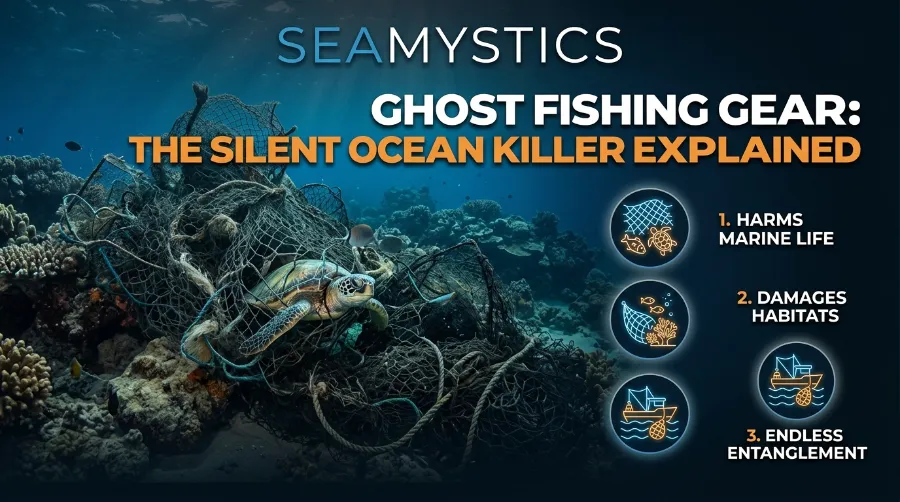

A single net, torn loose in a storm, can keep killing for a hundred years. That is the quiet horror of ghost fishing gear. Nobody holds the net anymore. Nobody profits from what it catches. Yet it keeps working, silently, on the seafloor and in reefs, long after the boat that lost it has gone home. This guide explains what ghost fishing gear is, why it has become one of the ocean’s deadliest problems, and what people are doing about it, based on current data from marine agencies across the USA and Europe.
Key Takeaways
| Point | Detail |
|---|---|
| What it is | Abandoned, lost, or discarded fishing gear (ALDFG) that still actively catches marine life |
| Scale | Between 500,000 and 1 million tons of gear lost or dumped in the ocean every year |
| Deadliest form | Marine biologists rank it as the single most lethal type of ocean plastic |
| Hardest hit | Sea turtles, whales, sharks, seabirds, and coral reef systems |
| Economic cost | Roughly €641 million a year in the Mediterranean alone, per a 2019 WWF report |
| Fix in progress | Recycling programs, buy-back schemes, biodegradable nets, and diver-led cleanups |
TL;DR: Ghost fishing gear is lost or abandoned fishing equipment that keeps trapping and killing marine animals for years, sometimes centuries. It causes an estimated 10% of all ocean plastic pollution, and researchers consider it the deadliest form of marine debris to wildlife. Cleanup groups and new biodegradable nets are slowly turning the tide, but stopping the gear from getting lost in the first place still matters most.
Marine Protected Species Laws: What’s Actually Protected in the US
What Is Ghost Fishing Gear?
Ghost fishing gear means any net, trap, line, or pot that drifts free but still catches animals. Fishing gear exists to trap. It doesn’t stop trapping just because a person no longer holds the other end. Once it drifts away, marine biologists label it ALDFG: abandoned, lost, or discarded fishing gear.
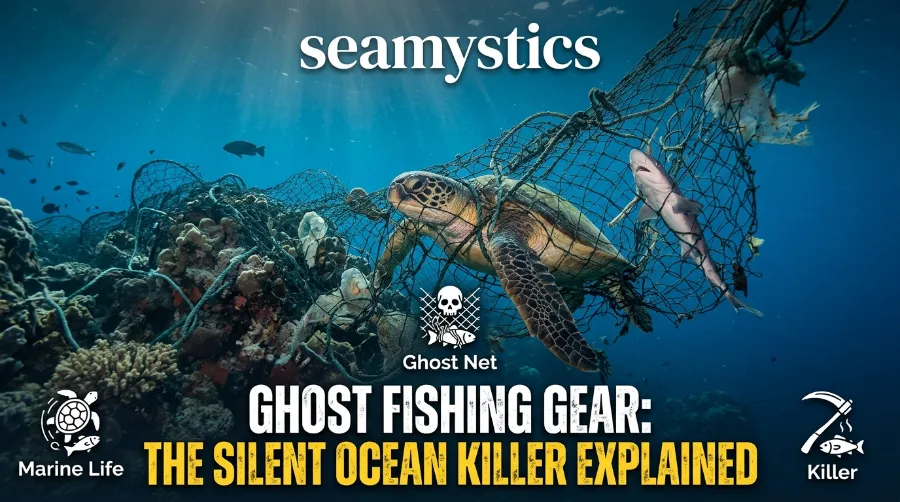
Most fishers don’t dump this gear on purpose. The Global Ghost Gear Initiative notes that equipment represents real income, so losing it hurts a fisher’s bottom line too. Storms tear nets loose. Propellers slice through lines. Gear snags on wrecks and coral and simply won’t come free. Some crews do cut gear away to hide illegal fishing, but that happens far less often than accidental loss.
Microplastics Seafood Research: What the Data Actually Shows
Modern gear makes the problem worse. Before the 1960s, nets came from biodegradable hemp or cotton. Today’s nylon and polypropylene nets resist decay for decades. Some researchers believe certain nets could remain lethal for centuries.
Fish Farming Explained: Is Aquaculture Actually Sustainable?
How Ghost Gear Impacts Ocean Ecosystems
The phrase “ghost gear impact ocean” undersells the damage. This isn’t a one-species problem. It touches food chains, coral habitats, coastal economies, and human safety all at once.
Consider what a single piece of lost gear can do over its “afterlife”:
- It entangles marine mammals and turtles. Whales, dolphins, seals, and sea turtles get wrapped in netting and can’t surface for air, so they drown slowly.
- It smothers coral reefs. Heavy nets settle over reef structures, block sunlight, and crush coral polyps that took decades to grow.
- It keeps “ghost fishing.” Trapped fish attract predators, which then get caught too. Researchers call this a self-baiting cycle, and it can run indefinitely.
- It damages commercial fisheries. Lost lobster and crab pots keep killing target species that never reach a market, which strains stocks that are already under pressure.
- It creates navigation hazards. Large drifting nets foul boat propellers and rudders, an underappreciated risk for coastal fishing communities.
Ocean Conservancy researchers recovered 870 ghost nets from Puget Sound, Washington. Those nets alone held more than 32,000 marine animals: over 1,000 fish, roughly 500 seabirds, and around 20 marine mammals. One dataset. One region. That scale repeats worldwide.
Coral Restoration Projects: How Scientists Are Regrowing Reefs
Abandoned Fishing Gear Danger: Why the Numbers Keep Climbing
The abandoned fishing gear danger isn’t shrinking. Global fishing effort has grown, gear has gotten cheaper and more disposable, and many ports still lack a simple bin for gear disposal.
The Numbers Behind the Problem
A few figures put the scale in perspective:
- WWF estimates fishing gear makes up roughly 10% of all ocean debris, and between 500,000 and 1 million tons get lost or discarded every year.
- Discarded nets, lines, and ropes make up about 46% of the Great Pacific Garbage Patch, according to WWF.
- NOAA estimates more than 85,000 ghost lobster and crab traps sit scattered across the Florida Keys National Marine Sanctuary.
- Chesapeake Bay watermen deploy roughly 250,000 crab pots on a typical summer day, yet they lose about 30% of those traps each season to propellers and currents.
- Ocean Conservancy’s 2016 analysis named ghost gear the single deadliest form of marine debris to wildlife, ahead of straws, bags, and bottles combined.
Chart: Estimated Wildlife Losses Attributed to Ghost Gear, By Group
The figures below, compiled from IUCN and World Animal Protection data, show how losses split across major marine animal groups.Seabirds take the biggest hit proportionally, which surprises most people since they assume whales and turtles suffer the most. Coastal foraging grounds put birds in constant contact with drifting gillnets and lines, so the sheer volume of entanglements adds up fast.
Ghost Nets Wildlife Death: Real Cases That Made Headlines
Statistics feel abstract until you attach them to one animal. A few documented cases show exactly why ghost nets wildlife death keeps happening, and why it’s largely preventable.
Ocean Cleanup Technology: Do These Devices Actually Work?
Sandy Hook Bay, New Jersey, 2018
A juvenile humpback whale, about 30 feet long, showed up with a gillnet wrapped tightly around its mouth and blowhole. Months later, the Center for Coastal Studies’ disentanglement team finally freed the whale using a custom hook-shaped knife on a 15-foot pole.
Maine Coastline, Recent GGGI Cleanup
One retrieval effort pulled up a “gear ball,” a tangled mass of lost lobster traps and line. It weighed more than 20,000 pounds, nearly ten metric tons, and crews brought it ashore for recycling in a single operation.
North Pacific Net Recovery
A single derelict net, recovered from open water, contained 99 dead seabirds, two dead sharks, and more than 200 fish. No one was fishing that net. It caught everything anyway.
The Mediterranean, 2019
WWF’s regional report calculated the cost of ghost fishing and related plastic pollution at roughly €641 million a year for the Mediterranean economy. That total breaks down into €268 million in tourism losses, €235 million in marine industry losses, and €138 million in fisheries losses.
These aren’t edge cases. They repeat in nearly every coastal region with active commercial fishing.
Illegal Fishing Explained: How It Threatens Global Fish Stocks
Ghost Gear Cleanup: What’s Actually Working
The good news: ghost gear cleanup has grown from a niche hobby for volunteer divers into a coordinated, funded, international effort. A few approaches stand out as genuinely effective, not just symbolic.
- Port-based recycling. The port of Wellfleet, Massachusetts has collected more than 367,000 pounds of old gear from fishers since 2008, turning what used to go overboard into recyclable material instead.
- Diver-led retrieval networks. Healthy Seas, based in Europe, sends divers into the Adriatic and North Sea, and increasingly the Mediterranean and California coast, to recover nets. Those nets then become ECONYL, a regenerated nylon yarn used in clothing and carpet tiles.
- The Ghost Fishing Foundation, started by Dutch divers in 2009, now runs recovery projects across the Netherlands, Belgium, Croatia, Malta, and the United States.
- Government buy-back programs. South Korea pays fishers roughly $10 per 100-liter bag of collected marine litter through its Waste Fishing Gear Buy-back project, so bringing gear ashore actually pays.
- Biodegradable net research. Researchers tested nets made from a blend of polybutylene succinate and polybutylene adipate-co-terephthalate, published in Animal Conservation. In real fishing conditions the nets performed close to standard nylon, and they began breaking down after roughly 24 months in seawater.
If you want to see how these recovery efforts connect to broader fishing practices, check our pillar guide on aquaculture sustainability, which covers how farmed seafood operations try to cut their own gear waste. Our piece on shark finning’s impact on ocean food chains looks at another human-driven threat that compounds the pressure ghost gear already puts on shark populations.
Shark Finning Impact: Why This Practice Still Threatens Ocean Health
For deeper technical and policy reading, Oceana’s overview of derelict fishing gear and the Global Ghost Gear Initiative’s resource hub stay consistently updated on this issue internationally. Save Coastal Wildlife’s explainer also covers more on-the-water solutions worth a look.
Quick Answers
What is ghost fishing gear? Fishing equipment, nets, traps, lines, or pots, that has drifted free but still traps and kills marine animals.
How long does ghost gear stay dangerous? Modern synthetic nets can stay intact and lethal for decades, and by some estimates, centuries.
Which animals suffer most? Seabirds, sea turtles, sharks, dolphins, seals, and commercially valuable fish and crustacean species.
Is ghost gear the worst kind of ocean plastic? Researchers, including those behind Ocean Conservancy’s 2016 findings, rank it as the deadliest form of marine debris to wildlife, even though bottles and bags outweigh it by total volume.
Can people actually stop it? Not entirely, but gear marking, port disposal incentives, biodegradable materials, and organized recovery diving can cut the damage dramatically.
Frequently Asked Questions
Is ghost fishing gear illegal?
Losing gear by accident isn’t illegal in most places, though many countries now require gear marking so lost equipment traces back to its owner. Deliberately dumping gear to hide illegal fishing, however, counts as a prosecutable offense in most fishing nations.
How much ghost gear sits in the ocean right now?
Nobody has an exact figure, since so much of it rests undetected on the seafloor. Still, estimates from the United Nations and World Animal Protection put the annual addition at roughly 640,000 to 1 million tons.
Does ghost gear affect the seafood I buy?
Indirectly, yes. Ghost gear keeps catching crab, lobster, and fish that never reach a market, which can strain regulated stocks and, over time, shift prices and availability.
What can one person actually do about it?
Support organizations running verified cleanup and recycling programs, avoid products tied to unregulated fisheries, and report any derelict gear you spot while diving or fishing to local marine debris hotlines.
Are biodegradable nets a real solution yet?
They show promise, but they aren’t a full replacement yet. Early trials matched standard nylon on catch performance, and material breakdown started around 24 months in seawater, though wider fleet adoption is still years away.
Test What You’ve Learned
The quiz above still applies here, so scroll up if you’d like to retake it before finishing.
Conclusion
Ghost fishing gear will never make headlines the way an oil spill does, since there’s no dramatic image and no single moment of disaster. It just works quietly, sometimes for generations, doing exactly what it was built to do. That quiet persistence is precisely what makes it dangerous. Meanwhile, the scale of the problem, hundreds of thousands of tons added every year, is matched by how solvable parts of it actually are. Gear marking, port recycling, biodegradable materials, and diver-led recovery aren’t experimental ideas anymore; they’re working programs with real tonnage removed and real animals freed. The next step, simply put, is funding and scaling what already works faster than new gear gets lost. For more on how fishing practices intersect with ocean health, explore seamystics.com for related deep dives.
References
- Ocean Conservancy, Global Ghost Gear Initiative, “Ten Animals Impacted by Ghost Gear” and program reports
- World Wildlife Fund, “Ghost Fishing Gear” explainer and WWF 2019 Mediterranean plastic pollution report
- NOAA Marine Debris Program, “Ghost Fishing” blog and Florida Keys/Chesapeake Bay trap-loss estimates
- Oceana USA, “Ghost Fishing: Derelict Gear”
- IUCN, ocean and coasts ghost fishing topic page, citing a 2009 United Nations marine litter study
- Save Coastal Wildlife, “Stop Ghost Fishing”
- Healthy Seas and the Ghost Fishing Foundation, net recovery and ECONYL recycling program data
- Study on biodegradable fishing nets, Animal Conservation journal