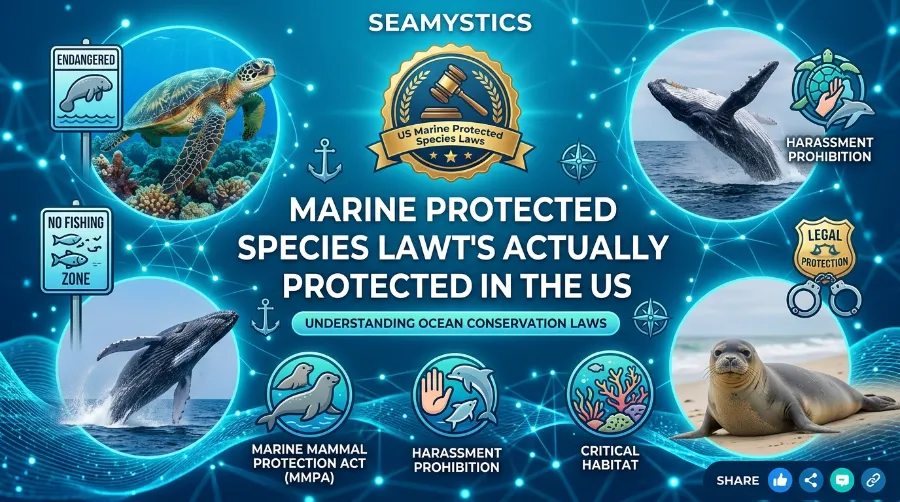

A humpback whale gets tangled in a lost crab line off the coast of Maine. A fisherman off Florida hooks a loggerhead turtle by accident. Customs officers flag a shipment of shark fins at a US port. Each case triggers a different piece of the law, and most people cannot name a single one. Marine species laws quietly drive almost every headline about ocean wildlife, yet few people outside the field understand how they actually work. This guide breaks down what US marine protection laws cover, who they protect, where they fall short, and what real enforcement looks like on the water.
TL;DR: US marine protection laws run through two main pillars: the Endangered Species Act ocean provisions and the Marine Mammal Protection Act. NOAA Fisheries enforces most of it. Together these laws cover roughly 165 species directly, including every marine mammal in US waters, several sea turtle populations, and select fish and coral species. Gaps still remain around bycatch, ghost gear, and species that are declining but not yet formally listed.
Key Takeaways
| Law or Rule | Year Passed | What It Covers | Lead Agency |
|---|---|---|---|
| Marine Mammal Protection Act (MMPA) | 1972 | All marine mammals in US waters, roughly 119 species under NOAA plus polar bears, walruses, sea otters, manatees, and dugongs under US Fish and Wildlife | NOAA Fisheries and US Fish and Wildlife Service |
| Endangered Species Act (ESA) | 1973 | Species at risk of extinction, including whales, sea turtles, corals, and some fish | NOAA Fisheries and US Fish and Wildlife Service |
| Magnuson-Stevens Act | 1976 | Fishery management and bycatch reduction in federal waters | NOAA Fisheries |
| Lacey Act | 1900, amended over time | Illegal trade and trafficking of protected wildlife, including marine species | US Fish and Wildlife Service |
Why Marine Species Laws Exist in the First Place
Ocean wildlife does not respect state lines or national borders. A single population can face pressure from fishing fleets, shipping traffic, and coastal development happening thousands of miles apart. Marine species laws give agencies legal grounds to step in before a population collapses, not after. The humpback whale’s recovery proves the model works: decades of MMPA and ESA protection pulled the species back from near extinction.
Coral Restoration Projects: How Scientists Are Regrowing Reefs
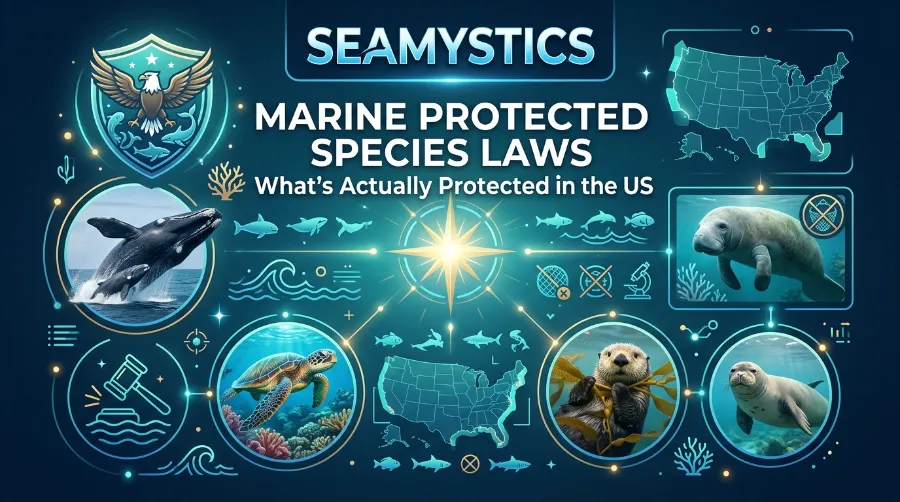
These laws form a layered system rather than one single rulebook. Some rules protect an entire category of animal no matter how common it is. Others only apply once regulators formally classify a species as threatened or endangered. That distinction matters for understanding what the protected marine species list really means in practice.
The Marine Mammal Protection Act: Blanket Protection, No Exceptions Needed
The Marine Mammal Protection Act of 1972 works differently than most conservation law. It does not wait for a species to become rare before it offers protection. Every whale, dolphin, seal, sea lion, manatee, and otter in US waters gains protection the moment the law applies, regardless of population size. NOAA Fisheries currently manages jurisdiction over roughly 119 marine mammal species, while the US Fish and Wildlife Service separately manages polar bears, walruses, sea otters, manatees, and dugongs.
Microplastics Seafood Research: What the Data Actually Shows
The MMPA bans hunting, harassment, capture, and importing of marine mammals or their parts. It carries narrow exceptions for Alaska Native subsistence use and specific research or rescue permits. In 2026, the law marked more than fifty years in effect, and NOAA used the milestone to spotlight four marine mammal species facing the highest near-term extinction risk. You can review the Marine Mammal Protection Act directly through NOAA Fisheries for the full legal text and current amendments.
The MMPA’s Hidden Fishing Rule
Many people miss one practical detail: the MMPA also governs commercial fishing indirectly. NOAA publishes a List of Fisheries every year that classifies commercial operations by how often they accidentally injure or kill marine mammals. The 2026 proposed list, published in the Federal Register in May, reflected new bycatch data and adjusted several fishery classifications. Fisheries placed in higher-risk categories now face mandatory observer coverage and take-reduction plans. This single tool cuts accidental marine mammal deaths without banning fishing outright.
The Endangered Species Act Ocean Provisions
The Endangered Species Act, passed in 1973, follows a different model than the MMPA. It requires a formal listing process based on population science before protection begins. Once regulators list a marine species as threatened or endangered, harming, harassing, capturing, or trading it becomes illegal. Federal agencies must also consult with NOAA or the Fish and Wildlife Service before they approve any project that might affect that species’ habitat.
Ocean species under ESA protection include several whale populations, six of the seven sea turtle species worldwide, coral species like elkhorn and staghorn coral, and select fish populations such as Atlantic salmon and specific sturgeon stocks. Listings do not stay fixed forever. Regulators can down-list a species as it recovers or up-list it if new data shows a steeper decline. The Marine Mammal Climate Change Protection Act, introduced in Congress in 2026, would add a climate-risk category on top of this existing framework for the first time.
A good resource for tracking these changes as they happen is the National Marine Fisheries Service listing updates, which tracks proposed and final rules as they move through the federal process.
What Actually Gets a Species Listed
Getting a species onto the endangered list takes longer than most people expect. Here is roughly how the process runs:
- Someone, often a conservation group, scientist, or agency, submits a petition requesting review of a specific species.
- NOAA or the Fish and Wildlife Service conducts a 90-day initial finding to decide if the petition has merit.
- If it does, a full status review follows, drawing on population data, habitat trends, and threat assessments.
- Regulators publish a proposed rule for public comment, typically open for 60 to 90 days.
- A final decision follows, which can take years from the original petition depending on funding and data availability.
This slow timeline explains why critics argue the protected marine species list lags behind reality. A species can decline for a decade before the paperwork catches up.
The Protected Marine Species List: Who’s Actually On It
People often assume a single master document called the protected marine species list exists somewhere. In practice, the list splits across multiple overlapping registries. NOAA Fisheries maintains a species directory covering marine mammals, threatened fish, corals, and turtles, and the agency updates it as new science comes in.
A few categories worth knowing:
- Marine mammals: Every species automatically gains MMPA protection, and a subset also carries ESA status, such as the North Atlantic right whale. Fewer than 370 individuals remained in the most recent NOAA stock assessment.
- Sea turtles: Loggerhead, green, leatherback, hawksbill, Kemp’s ridley, and olive ridley turtles all carry ESA protection in US waters, though population status varies by region.
- Corals: Roughly 20 coral species carry threatened or endangered status, largely due to bleaching events tied to warming ocean temperatures.
- Fish: A smaller group of commercially significant species, including specific salmon runs and sturgeon populations, hold ESA-listed status where overfishing or habitat loss pushed numbers dangerously low.
For a broader look at how these categories intersect with international treaty obligations, the marine conservation laws and regulations guide from MarineBio offers a solid overview of the global regulatory landscape alongside the US framework.
How US Marine Protection Laws Get Enforced
Passing a law is one thing. Enforcing it across millions of square miles of ocean is a different challenge entirely, and this is where things get messier than most explainer articles admit. NOAA’s Office of Law Enforcement handles most marine species violations. The Coast Guard supports at-sea incidents, and the Fish and Wildlife Service manages trade-related cases under the Lacey Act.
Ocean Cleanup Technology: Do These Devices Actually Work?
Shark Finning Still Slips Through
Shark finning remains one of the more persistent violations despite a federal ban on finning practices in US waters. Traffickers still move fins internationally, often through transshipment routes that become hard to trace once product enters processing facilities. Our related piece on shark finning’s impact on global shark populations breaks down the numbers by region.
Ghost Gear Is the Quietest Killer
Ghost gear causes the least visible but most damaging enforcement gap. Lost and abandoned fishing nets, traps, and lines keep catching and killing marine life for years after fishers lose them. Global estimates put the volume between 600,000 and 800,000 tonnes of gear entering oceans annually, according to World Economic Forum reporting on the issue. Ghost nets alone kill more than 100,000 seals, sea lions, and large whales every year, based on World Animal Protection figures. Nobody owns a lost net once it drifts away, so prosecuting the loss itself is nearly impossible. Most current policy instead focuses on gear-recovery programs and biodegradable net design. We cover recovery efforts in more depth in our guide to ghost fishing gear and cleanup programs.
Illegal Fishing Undercuts Everything Else
Illegal, unreported, and unregulated fishing, often shortened to IUU fishing, undercuts almost every protection listed above. A species can carry perfect protection on paper while fleets still harvest it off the books elsewhere. NOAA submits a biennial IUU report to Congress that flags specific nations and fleets for non-compliance, which can trigger trade restrictions under the Magnuson-Stevens Act. Our related breakdown of illegal fishing’s broader impact on marine ecosystems covers how this connects to the seafood supply chain, which ties directly into the sustainability challenges facing modern aquaculture as wild stocks come under pressure.
Real Cases: What Enforcement Looks Like
Numbers on a page rarely capture how these laws play out, so a few real examples help ground the theory.
In 2017, NOAA fined a commercial vessel operator in the Gulf of Mexico for repeated sea turtle violations after observer data showed the crew disabling required turtle excluder devices. In 2021, a coordinated multi-agency operation intercepted a shipment of illegally harvested shark fins moving through a US port, one of dozens of similar interdictions carried out under Lacey Act authority that year. In early 2026, NOAA’s proposed List of Fisheries update reclassified several West Coast gillnet fisheries after new bycatch data showed higher-than-expected marine mammal interactions, which triggered mandatory observer coverage for the upcoming season.
These cases share a pattern. Protection exists on paper long before enforcement catches every violator, and monitoring, not tougher statutes alone, drives most meaningful change. Fishery scientists and enforcement officers working the water every day echo this conclusion, not just policy analysts reading reports from a desk.
Where the System Still Falls Short
No honest discussion of marine species laws skips the gaps.
- Listing delays let species decline for years before formal ESA protection applies, sometimes past the point where recovery stays realistic.
- International waters fall largely outside US jurisdiction. A species protected domestically can still face legal harvest once it crosses into open ocean or another nation’s waters.
- Bycatch data depends heavily on observer coverage, and many smaller fisheries operate with little to no independent monitoring.
- Climate-driven range shifts push species into new regions faster than management plans can adapt, a gap the newly introduced Marine Mammal Climate Change Protection Act aims to address directly.
None of this means the system fails outright. Species like the humpback whale and the California gray whale recovered enough under MMPA and ESA protection to earn full delisting, real proof that sustained legal protection paired with enforcement produces results over decades.
What This Means If You’re Not a Policymaker
Most readers do not draft legislation, but these laws still shape everyday choices. Buying seafood from fisheries certified under Magnuson-Stevens management standards supports lower-bycatch practices. Reporting entangled or stranded marine mammals to NOAA’s stranding network, rather than attempting a rescue alone, keeps both the animal and the reporter safer and feeds directly into the stock assessment data that shapes future MMPA decisions. Supporting gear-recovery nonprofits also helps address the ghost net problem that formal law still struggles to touch.
Conclusion
Marine species laws form a layered system, not a single rulebook. The Marine Mammal Protection Act, the Endangered Species Act, and a handful of supporting statutes each cover a different slice of ocean life. The protection is real, and it has produced genuine recovery stories, but it stays uneven, moves slower than the pace of decline for many species, and loses most of its power once an animal crosses into international waters. Knowing which law applies to which species, and where enforcement gaps sit, separates vague concern for ocean wildlife from actually tracking whether protection works.
FAQs
What is the main US law protecting marine mammals?
The Marine Mammal Protection Act of 1972 serves as the primary law, covering all marine mammals in US waters regardless of population size.
Are sharks protected under US marine species laws?
Some shark species carry ESA protection, and federal law bans finning practices, but fishery regulations, not blanket endangered species protection, manage most shark species.
How does a species get added to the protected marine species list?
A formal ESA petition and review process handles new listings. It can take several years and involves population assessments plus public comment periods before a final decision.
Do marine species laws apply outside US waters?
Generally no. US jurisdiction typically ends at the exclusive economic zone, roughly 200 nautical miles from shore, though trade laws like the Lacey Act can still apply to imported products.
What can an individual do to support marine species law enforcement?
Report stranded or entangled animals to NOAA’s stranding network, choose seafood from sustainably certified fisheries, and support organizations working on ghost gear recovery.
Quick Quiz: Test What You Just Learned
- Which law protects all marine mammals in US waters automatically, without requiring an endangered listing?
a) Endangered Species Act
b) Marine Mammal Protection Act
c) Lacey Act
Answer: b) Marine Mammal Protection Act - Roughly how many marine mammal species fall under NOAA Fisheries jurisdiction?
a) 40
b) 75
c) 119
Answer: c) 119 - What is the estimated annual amount of ghost fishing gear entering the world’s oceans?
a) 50,000 to 100,000 tonnes
b) 600,000 to 800,000 tonnes
c) 2 million tonnes
Answer: b) 600,000 to 800,000 tonnes - Which law addresses illegal trafficking of protected marine species and their parts?
a) Magnuson-Stevens Act
b) Lacey Act
c) Clean Water Act
Answer: b) Lacey Act - What recent legislative proposal would add climate-risk planning to marine mammal protections?
a) Marine Mammal Climate Change Protection Act
b) Ocean Warming Prevention Act
c) Blue Carbon Act
Answer: a) Marine Mammal Climate Change Protection Act
References
- NOAA Fisheries, Marine Mammal Protection Act
- MarineBio Conservation Society, Marine Conservation Laws and Regulations
- Endangered Species Law and Policy, National Marine Fisheries Service Category
- Federal Register, Marine Mammal Protection Act List of Fisheries for 2026, Docket No. 260430-0120
- World Economic Forum, Nature and Biodiversity reporting on ghost fishing gear
- World Animal Protection, ghost gear wildlife mortality estimates