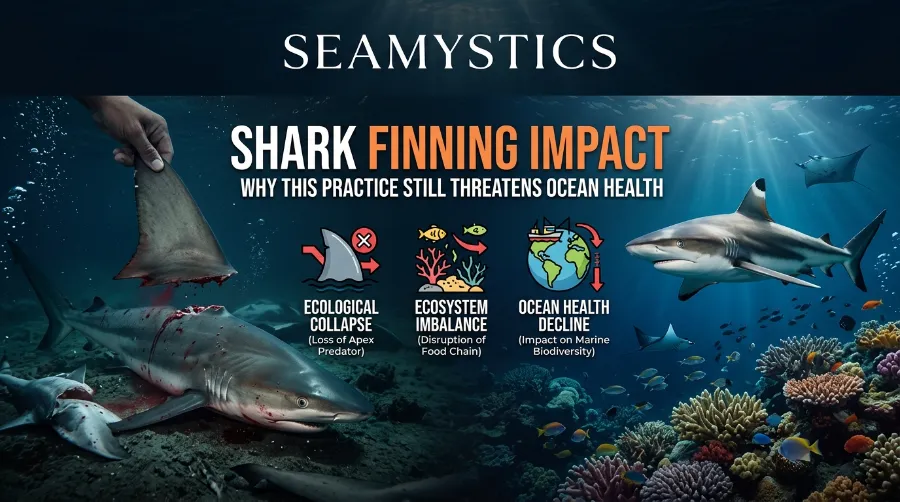

A fin gets sliced off. The body drops back into the water. A shark that can no longer swim sinks to the seafloor and dies. That single image explains most of what people need to know about the shark finning impact on our oceans. Laws have tightened over the past two decades. Sharks are still dying in numbers that outpace almost anything else happening in our seas today.
Key Takeaways
| Topic | What the data shows |
|---|---|
| Sharks killed yearly | Roughly 80 to 101 million, up from 76 million in 2012 |
| Shark fin trade value | Around $1 to $2 billion a year, still active despite bans |
| US status | Federal fin sales ban signed into law in December 2022 |
| EU status | “Fins naturally attached” rule in force since 2013 |
| Population decline | Oceanic shark and ray numbers down more than 70% since 1970 |
| Species at risk | Over 300 shark and ray species are Red Listed by the IUCN |
TL;DR: Shark finning means cutting off a shark’s fins and discarding the rest of the animal at sea. It still drives tens of millions of shark deaths a year. Bans exist across the US, UK, and EU, yet loopholes and weak enforcement keep the trade moving. Ocean health depends on sharks because they sit at the top of the food chain, so their decline ripples down through fish stocks, coral reefs, and coastal economies.
Shark Finning Explained: What Actually Happens at Sea
Shark finning explained simply is this: fishers catch a shark. They slice off its dorsal, pectoral, and tail fins. Then they throw the rest of the body overboard, often while the shark is still alive. Without fins, a shark cannot hold its position in the water. It sinks. It dies from suffocation, blood loss, or predation within hours.
Marine Protected Species Laws: What’s Actually Protected in the US
This method exists for one blunt reason: fins sell for far more than shark meat by weight. Boats can carry more product if they only keep the fins. Dried fin has sold for hundreds of dollars per kilogram in Hong Kong markets, largely to supply shark fin soup. That dish carries status and tradition in some Asian cuisines. Shark meat, by comparison, is bulky and low value, so crews save cargo space by dumping it.
Why the Law Hasn’t Stopped It
Most countries now ban shark finning outright, including the United States and the EU. Yet the practice continues. Under-reporting, illegal fishing, and enforcement gaps all keep it alive. That gap between the law on paper and what happens on deck is where most of today’s shark finning impact plays out.
Shark Fin Trade Facts: The Numbers Behind the Headlines
The shark fin trade facts get sobering fast once you line them up. A 2024 study in the journal Science tracked shark fishing deaths from 2012 to 2019. The number climbed from about 76 million a year to as many as 101 million, despite a decade of new protective laws. Researchers found that 95% of those deaths happened in coastal waters, not the open ocean, which is where most conservation efforts have traditionally focused.
Coral Restoration Projects: How Scientists Are Regrowing Reefs
Here is how the trade breaks down in practice:
- Fishers kill an estimated 73 to 100 million sharks annually for their fins, meat, and other products combined.
- The global shark fin trade still generates roughly $1 to $2 billion a year.
- Hong Kong imports thousands of tons of dried shark fin annually. Consumption there has still fallen close to 50% since 2014.
- Between 2003 and 2020, Spain, Portugal, the Netherlands, Italy, and France supplied roughly half of the fins entering Hong Kong, Singapore, and Taiwan, per trade data compiled by conservation groups.
- Tuna longline fisheries catch blue sharks and oceanic whitetips heavily as bycatch, and both species make up a large share of the trade.
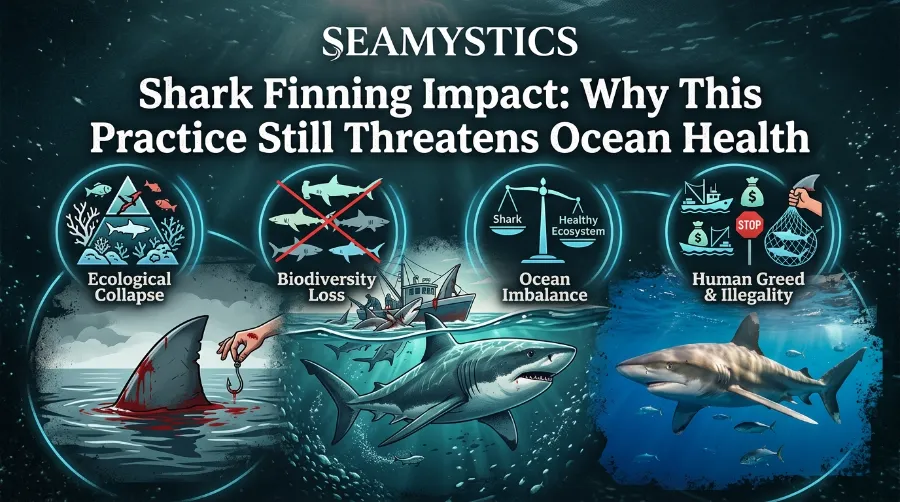
That last point matters. It shows the shark finning impact is not just a story about a small group of illegal poachers. Much of it happens inside legal tuna and swordfish fisheries, where sharks are an unwanted but profitable catch.
Shark Population Decline: What the Science Says
Shark population decline shows up across nearly every ocean basin now. A 2021 study in Nature found that oceanic shark and ray populations had fallen more than 70% since 1970, mainly because of fishing pressure. The IUCN currently lists over 300 shark and ray species as vulnerable, endangered, or critically endangered.
A few species-level numbers make the trend concrete:
- Conservationists classify the scalloped hammerhead as critically endangered, largely because of its high-value fins.
- The oceanic whitetip has dropped an estimated 70 to 90% in some regions since the 1990s.
- Scientists now consider several reef shark populations near heavily fished coastlines functionally extinct. Their numbers are too low to fill their ecological role.
Sharks grow slowly and reproduce late in life, often not until their teens. That means populations cannot rebound quickly, even after fishing pressure eases. Slow biology is a big reason shark population decline keeps outpacing the legal protections meant to stop it.
Ghost Fishing Gear: The Silent Ocean Killer Explained
The Push for a Shark Finning Ban: Where the Law Actually Stands
A shark finning ban sounds simple. The legal picture is more layered than most headlines suggest. In the United States, finning itself was already illegal under the 2010 Shark Conservation Act. But importers could still bring in, sell, and serve fins caught by other countries’ boats. Congress closed that loophole in December 2022, when President Biden signed the federal Shark Fin Sales Elimination Act into law following a Senate vote of 83 to 11. Seventeen states, including California, Illinois, and Maryland, had already passed their own bans before that.
Fish Farming Explained: Is Aquaculture Actually Sustainable?
The EU moved earlier. EU rules have required fishers to land sharks with fins still naturally attached since July 2013. That closed a permit loophole that let Spanish and Portuguese vessels remove fins at sea and land them separately. The European Commission is now studying whether to extend that fins-attached rule to all shark products traded through the EU, with public consultation results published through 2024.
Here is how enforcement compares across regions:
| Region | Key law | Year in force | Main gap |
|---|---|---|---|
| United States | Shark Fin Sales Elimination Act | 2022 | Import checks still uneven at ports |
| European Union | Fins Naturally Attached Regulation | 2013 | Trade loopholes for processed fin products |
| Hong Kong | Voluntary industry pledges | Ongoing since 2014 | No full legal sales ban |
| CITES (global) | Appendix II listings | Expanded 2023 | Weak enforcement in non-signatory waters |
The University of Florida’s economic review of the US ban makes a sharp point. A domestic sales ban removes the US as a fin market. It does not stop American boats from catching sharks as bycatch. It also does little to touch demand in countries without similar rules. A shark finning ban only works as well as the weakest link in the supply chain around it.
Why Ocean Health Depends on Sharks
Sharks sit at the top of most marine food webs. When apex predators disappear, mid-level predator fish often multiply unchecked. Those fish can then strip out the smaller herbivorous fish that keep coral reefs clean of algae. Researchers studying Caribbean and Pacific reef systems have linked shark loss to slower reef recovery after bleaching events.
There is an economic angle too, one that gets less attention. A single reef shark can generate far more tourism revenue alive, through repeat dive trips over its lifetime, than its fins would earn in one sale. Palau’s shark sanctuary, established in 2009, shows up repeatedly in tourism studies as a driver of tens of millions of dollars a year in dive revenue tied directly to healthy shark numbers.
Microplastics Seafood Research: What the Data Actually Shows
For a broader look at how ocean-based food systems connect to these same pressures, check our guide on aquaculture sustainability facts. It breaks down how fishing practices across species interact in ways that rarely make headlines.
Real Case Studies: What Progress and Failure Both Look Like
Hong Kong’s Falling Demand, 2014 to 2024
Consumer awareness campaigns and airline shipping bans helped cut shark fin consumption in Hong Kong by close to half over this decade. No full legal sales ban made this happen. Demand-side pressure alone moved the needle.
Palau’s Shark Sanctuary, Since 2009
Palau declared its entire exclusive economic zone, roughly 600,000 square kilometers, a shark sanctuary. WWF and partner groups have since helped establish around 50 shark sanctuaries covering an estimated 20 million square kilometers worldwide by 2023. Other Pacific nations have since copied the model.
CITES Expansion, 2023
Delegates at the 2022 CITES conference voted to list nearly all requiem sharks, including the blue shark used heavily in the fin trade, under Appendix II protections. The listing took effect in 2023. That single decision brought roughly 90% of the shark fin trade under some form of international oversight for the first time.
These cases prove the fight against shark finning is not a lost cause. Real progress tends to come from consumer pressure, trade regulation, and sanctuary designation working together, not any single law acting alone.
Illegal Fishing Explained: How It Threatens Global Fish Stocks

What Actually Helps Right Now
Want to support shark populations beyond reading about the problem? A few actions carry real weight:
- Choose seafood certified by the Marine Stewardship Council or similar programs, since bycatch reduction is part of their standards.
- Avoid shark fin soup and shark-derived supplements, including squalene-based cosmetics not clearly labeled as plant-derived.
- Support groups pushing for fins-naturally-attached policies in fisheries that still allow at-sea fin removal.
- Ask restaurants and grocery chains whether their seafood suppliers document shark bycatch.
For a deeper look at another overlooked driver of shark and marine mammal deaths, read our related piece on ghost nets and abandoned fishing gear. It rarely gets the same media attention as finning does.
Ocean Cleanup Technology: Do These Devices Actually Work?
Quick Answers (For Search and AI Summaries)
Is shark finning illegal everywhere? No. The US, EU, and many other countries ban it, but enforcement gaps and demand in non-signatory nations keep the practice alive.
How many sharks die from finning each year? Estimates range from 73 to over 100 million sharks killed annually across all shark fisheries. Finning specifically accounts for a large share of that total.
Does banning shark fin sales actually reduce shark deaths? It cuts demand and market access. Bycatch in tuna and swordfish fisheries stays largely unaffected unless bycatch rules change too.
Frequently Asked Questions
What is the difference between shark finning and shark fishing? Shark finning means removing only the fins and discarding the body. Shark fishing can include the full, legal harvest of the animal for meat, oil, or other products under quota systems.
Which countries still allow the shark fin trade? Several Asian markets, along with parts of Africa and South America with weaker fisheries enforcement, still process and sell shark fins legally or with minimal oversight.
Are all shark species affected equally? No. Species with high fin value and slow reproduction, like hammerheads and oceanic whitetips, take the hardest hit. Faster-reproducing species fare comparatively better.
Can shark populations recover once fishing pressure drops? Yes, but slowly. Great whites in parts of the Northwest Atlantic have shown modest recovery over 20 to 30 years under strict protection. Most sharks still need a decade or more to show measurable rebound.
What role does bycatch play compared to direct finning? Bycatch in tuna, swordfish, and shrimp trawl fisheries now accounts for a large share of total shark deaths. In some regions it rivals or exceeds deaths from targeted fin fisheries.
Test What You Just Learned
- Roughly how many sharks are killed globally each year across all fisheries?
a) 5 to 10 million
b) 30 to 40 million
c) 80 to 101 million
Answer: c. Recent estimates from Science put the figure between 76 million in 2012 and as high as 101 million by 2019. - When did the US federal Shark Fin Sales Elimination Act become law?
a) 2010
b) 2022
c) 2013
Answer: b. President Biden signed it into law in December 2022 as part of the National Defense Authorization Act. - What does the EU’s “fins naturally attached” rule require?
a) Fins must be sold separately from the body
b) Sharks must be landed with fins still attached to the body
c) Only fin exports are banned
Answer: b. This rule, in force since 2013, closes the loophole that let boats remove fins at sea. - Roughly what percentage decline have oceanic shark and ray populations seen since 1970?
a) 20%
b) 45%
c) Over 70%
Answer: c. A widely cited 2021 study found oceanic shark and ray populations fell more than 70% over that period. - What is one major, often overlooked source of shark deaths besides direct finning?
a) Coral bleaching
b) Bycatch in tuna and swordfish fisheries
c) Ocean acidification
Answer: b. Bycatch in longline tuna and swordfish fisheries kills large numbers of sharks that were never the intended target.
Conclusion
Shark finning has not disappeared just because laws now exist in most major fishing nations. The practice survives through loopholes, bycatch, and demand that has simply shifted rather than shrunk. The shark finning impact on ocean food webs keeps compounding every year enforcement stays uneven. Real progress exists too. Hong Kong’s falling consumption, Palau’s sanctuary model, and the 2023 CITES listings all show change is possible when consumer pressure, trade law, and habitat protection move together. Protecting sharks is not really about saving one dramatic-looking predator. It is about keeping the entire ocean food web intact for the fisheries, reefs, and coastal economies that depend on it, ours included.
References
- Worm, B. et al. (2024). Global shark and ray mortality study. Science.
- Oceana. Sharks Under Threat. oceana.org/blog/sharks-under-threat
- Marine Stewardship Council. Ending Shark Finning. msc.org
- University of Florida IFAS. Economic Considerations of the US Shark Fin Ban (2024).
- IUCN Red List of Threatened Species, shark and ray assessments.
- CITES CoP19 (2022) Appendix II shark listing decisions, effective 2023.