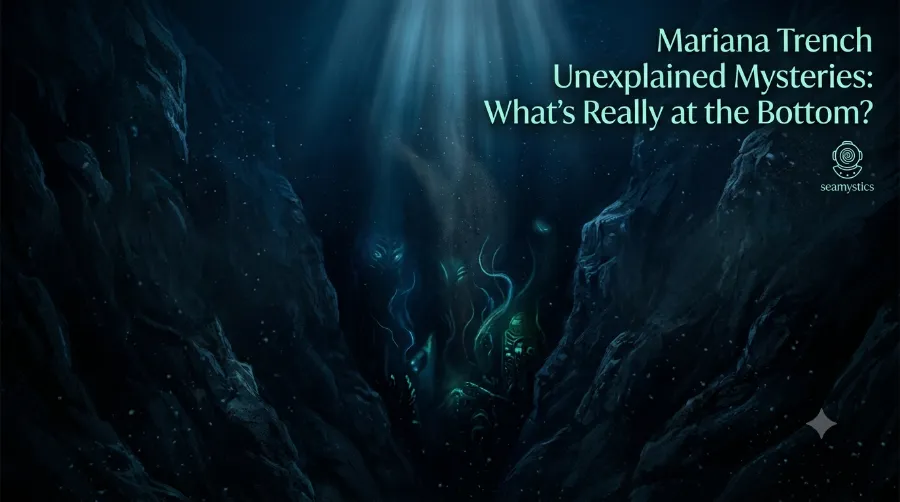

Seven miles down, in total darkness, under pressure that would crush a car like a soda can, something is moving. Nobody knows exactly what. The Mariana Trench unexplained mysteries have puzzled oceanographers for over a century, and honestly, we are still catching up. Every expedition brings back a question mark instead of an answer. That is the strange part about this place. We can send a submersible to the deepest point on the planet, yet we still cannot say for certain what lives there or why some of it behaves the way it does.
To get a better understanding of how Mariana Trench unexplained mysteries exactly what to expect.
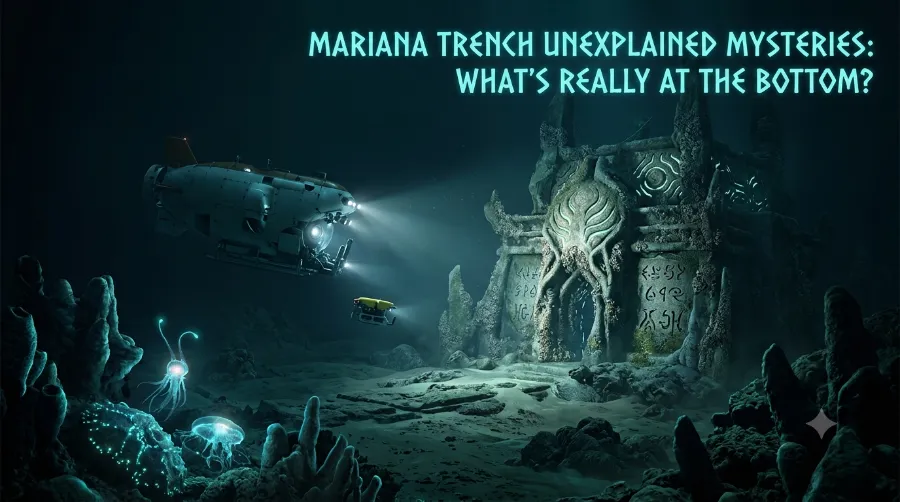
Before we go further, here is a quick snapshot of what you are about to read.
To get a better understanding of how famous ghost ship mysteries exactly what to expect.
Key Takeaways
| Mystery | What We Know | What We Still Don’t Know |
|---|---|---|
| True depth | Measured between 10,898 m and 11,034 m across expeditions | Why readings still vary despite modern sonar |
| Deep sea sounds | The “Bloop” recorded in 1997 was later linked to icequakes | Several other sounds remain unidentified |
| Alien-like creatures | Species like the Enigma seamount jellyfish were filmed in 2015 | How many undiscovered species remain |
| Toxic chemicals | Banned PCBs found in trench amphipods in a 2016 study | How pollutants travel that far down |
| New microbes | Over 7,000 microbial species identified in 2025 studies | The role most of them play in the ecosystem |
| Trench structure | The Mariana system is actually five separate hadal zones | How isolated these zones truly are genetically |
| Human trash | A plastic bag and a beer bottle were found near the bottom | The full extent of pollution at extreme depth |
Why the Mariana Trench Still Puzzles Scientists
The ocean floor near Guam drops into a crescent-shaped scar more than 1,500 miles long. That scar is the Mariana Trench, and its lowest point, the Challenger Deep, sits close to 11 kilometers below the surface. For comparison, if you dropped Mount Everest into that spot, its peak would still sit more than a mile underwater. It is hard to picture, but that is roughly how far down we are talking about.
If you want to learn more about deep sea creatures unphotographed tips and expert advice.
I have spent years reading survey data from hadal zone research, and one thing keeps standing out. The deeper researchers look, the more deep sea mysteries they uncover instead of fewer. Pressure at that depth reaches over 1,000 times what we feel at sea level. Sunlight never reaches it. Temperatures hover just above freezing. Yet somehow, life not only survives there, it thrives in ways that still surprise marine biologists.
If you want to learn more about The real science of bioluminescence tips and expert advice.
At Sea Mystics, we track these findings closely because they change what textbooks say every few years. If you want the wider picture of what else hides in our oceans, our guide to unexplained deep sea mysteries covers more than just this trench. But for now, let us focus on the seven biggest unanswered questions sitting at the bottom of the world.
If you want to learn more about creatures thought extinct found tips and expert advice.
Mystery 1: We Still Cannot Agree on the Exact Depth
You would think measuring the deepest point on Earth would be settled science by now. It is not. Different expeditions have recorded different numbers, and the gap between them is bigger than most people expect.
If you want to learn more about mysterious lights deep ocean tips and expert advice.
A Timeline of Conflicting Measurements
Here is how the depth readings have shifted over time, based on major expeditions.
| Year | Team or Vessel | Recorded Depth |
|---|---|---|
| 1875 | HMS Challenger | 8,184 m |
| 1951 | HMS Challenger II | 10,900 m |
| 1995 | ROV Kaiko | 10,911 m |
| 2012 | James Cameron, Deepsea Challenger | 10,898 to 10,908 m |
| 2019 | Victor Vescovo, Five Deeps Expedition | 10,925 to 10,934 m |
So which one is correct? Honestly, all of them are close, but none of them match exactly. Sonar accuracy, tidal shifts, and even the salinity of the water can change a reading by several meters. This is not a case of bad science. It is a case of the ocean being harder to measure than most people assume, and that alone qualifies as one of the more overlooked deep sea mysteries out there.
If you want to learn more about lost shipwrecks ocean floor tips and expert advice.
Mystery 2: The Bloop and Other Deep Sea Mysteries We Cannot Fully Explain
In the summer of 1997, hydrophones operated by NOAA picked up a sound unlike anything on record. It was loud, it was low, and it came from somewhere in the South Pacific near the Mariana region. Scientists nicknamed it the Bloop, and for years it fueled every theory imaginable, including some involving unknown sea monsters.
If you want to learn more about living fossils found alive tips and expert advice.
Researchers eventually traced the sound to icequakes, massive cracking events in Antarctic ice shelves. That explanation satisfied most experts. Still, it did not close the book entirely, because several other trench recordings remain unidentified to this day.
In 2015, NOAA and Oregon State University lowered a titanium hydrophone into the Challenger Deep itself. The device filled its entire data capacity in just 23 days. What it picked up included:
- Earthquake rumbles from nearby fault lines
- Whale calls traveling from surprising distances
- Ship propeller noise from the surface, far above
- Unexplained low frequency pulses with no confirmed source
We go into far more detail on this topic, including audio patterns researchers are still trying to classify, in our piece on mysterious sounds in the deep ocean. It is one of the clearest examples of how much noise, quite literally, still goes unexplained.
Mystery 3: Creatures That Look Like They Belong on Another Planet
If you want proof that the trench hides genuinely strange life, look no further than the Enigma seamount jellyfish. In April 2015, NOAA’s Okeanos Explorer expedition filmed a jellyfish so transparent and so oddly shaped near the Mariana region that researchers openly admitted it looked unreal on camera. Scientific American covered the discovery, noting how its glowing, ribbon-like structure baffled even experienced marine biologists.
That is not an isolated case either. Supergiant amphipods, creatures that grow far larger than their shallow water cousins due to a process called deep sea gigantism, were filmed during a 2014 expedition. A newly named Mariana snailfish was later recorded at 8,178 meters in May 2017, making it one of the deepest living fish ever documented on camera.
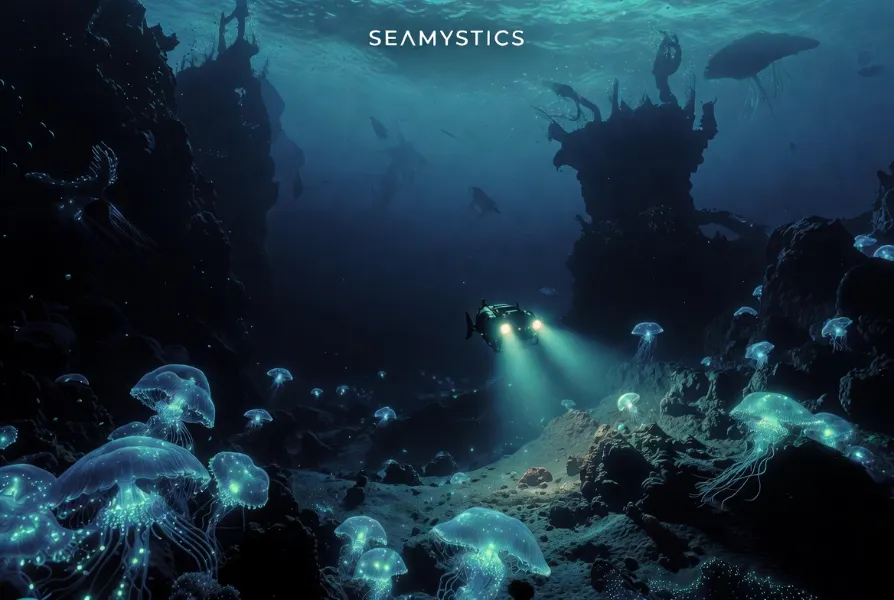
What makes these sightings frustrating for scientists is simple. Every dive reveals new species, yet only a tiny fraction of the trench has actually been explored. Some researchers estimate less than 20 percent of the global seafloor has been mapped in real detail, and the hadal zone lags even further behind. So when you ask what is really down there, the honest answer is that nobody has a complete list, and probably won’t for decades.
Mystery 4: Banned Chemicals Found in the Deepest Animals on Earth
This mystery is less about mythical creatures and more about something genuinely disturbing. In a 2016 study, researchers collected crustacean scavengers from depths between 7,841 and 10,250 meters within the trench. What they found inside those animals shocked even seasoned scientists.
The tissue samples contained extremely high levels of PCBs, a class of industrial chemicals banned worldwide in the 1970s because of their environmental harm. These are the same toxins linked to pollution disasters decades ago, yet somehow they had traveled all the way to one of the most isolated places on the planet.
How did they get there? The leading theory involves dead marine animals and plastic debris sinking from the surface, carrying pollutants down with them over years. Once in the trench, these toxins settle into the sediment and stay there, because almost nothing disturbs the ocean floor at that depth. It raises an uncomfortable question that connects directly to Mystery 7 further down this list, because pollution and human waste are turning out to be far more present in the deep sea than anyone expected.
Mystery 5: Thousands of New Microbes Nobody Knew Existed
Here is where things get genuinely exciting from a science standpoint. In 2025, three separate papers published in the journal Cell described life across the hadal zone in unprecedented detail, covering depths between 6,000 and 11,000 meters. One of these studies alone identified more than 7,000 microbial species living in the Mariana Trench.
Nearly 89 percent of those microbes had never been documented by science before that research. Think about that for a second. In one study, researchers uncovered thousands of life forms that simply did not exist in any database, textbook, or record anywhere on Earth. This came from a Chinese expedition using the deep sea submarine Fendouzhe, which completed 33 separate dives to collect seawater, sediment, and organism samples from the bottom of Challenger Deep.
These microbes matter more than their tiny size suggests. Some appear to process chemicals in ways that could inform future medicine or industrial applications. Others may hold clues about how life first began, since conditions in the hadal zone resemble what early Earth may have looked like billions of years ago. This single discovery reshaped how scientists think about biodiversity, and it is a strong reminder that most deep sea mysteries are still waiting for someone to simply look closely enough.
Mystery 6: The Trench Might Not Actually Be One Trench at All
For decades, scientists assumed the Mariana Trench functioned as one long, connected habitat. A 2021 study led by Newcastle University, working alongside the British Geological Survey, proved that assumption wrong. According to their findings, the Mariana Volcano trench system is actually made up of five physically isolated hadal habitats, separated by ridges scientists had previously overlooked.
Heather Stewart, a marine geologist involved in the research, explained that this structure means genetic flow between populations of trench species is far more limited than anyone realized. In simple terms, creatures living in one section of the trench may rarely, if ever, interact with creatures from another section just a short distance away.
This discovery matters because it changes how we think about evolution at extreme depths. Isolated populations tend to develop unique traits over time, which could explain why so many trench species look nothing like anything found elsewhere in the ocean. It also means the trench is not one single mystery. It is closer to five separate ecosystems, each hiding its own unanswered questions, and each deserving its own research attention going forward.
Mystery 7: Human Trash Beat Us to the Bottom
Perhaps the most unsettling mystery on this list has nothing to do with strange creatures or unexplained sounds. It involves us. During his record breaking 2019 dive as part of the Five Deeps Expedition, explorer Victor Vescovo reported spotting what appeared to be a plastic bag and candy wrappers near the bottom of Challenger Deep, at a depth of roughly 10,927 meters.
Oceanographer Dawn Wright described a similarly strange moment during her own descent, recalling in an October 2024 interview that when her team reached the bottom, they saw a beer bottle resting on the seafloor. These are not one-off stories either. Multiple crewed and uncrewed missions since 2019 have documented plastic debris scattered across the deepest known point on Earth.
So what does that tell us? Mainly this. Pollution has reached places humans have barely managed to visit ourselves. If trash can travel nearly seven miles down to a spot fewer than 30 people have ever seen in person, it raises real concerns about how far our environmental footprint actually extends, and how much cleanup work future generations may inherit from decisions made decades ago.
Depth Comparison Chart
To put the trench’s scale into perspective, here is a simple visual comparison based on the latest confirmed measurements.
Mount Everest height        ██████████████ 8,849 m
Average ocean depth         ███████ 3,700 m
Titanic wreck depth         ██████ 3,800 m
Challenger Deep (trench)    ██████████████████ 10,935 m
Notice how the trench dwarfs even the tallest mountain on Earth. That single comparison explains why exploring it remains so difficult, and why so many deep sea mysteries down there stay unsolved for years at a time.
Final Thoughts on Mariana Trench Unexplained Mysteries and Deep Sea Mysteries
Every one of these seven mysteries points to the same conclusion. We know surprisingly little about the deepest place on our own planet, despite decades of expeditions and improving technology. New microbes, isolated habitats, unexplained sounds, and even human trash keep reshaping what scientists thought they understood just a few years earlier.
That is not a discouraging thought though. If anything, it means there is still real discovery waiting down there, the kind that rewrites textbooks and changes how we understand life itself. As sonar technology improves and more crewed dives take place, some of these Mariana Trench unexplained mysteries will likely get answered within our lifetime. Others, based on how this research has gone so far, will probably just lead to new questions instead.
Frequently Asked Questions
How deep is the Mariana Trench really?
Most modern measurements place the deepest point, Challenger Deep, between 10,898 and 10,935 meters below sea level, though slight variations still exist between expeditions.
Has anyone actually been to the bottom?
Yes. Jacques Piccard and Don Walsh made the first descent on January 23, 1960, followed by James Cameron in 2012, and Victor Vescovo completed 15 separate dives between 2019 and 2022.
What kind of creatures live in the Mariana Trench?
Scientists have documented snailfish, supergiant amphipods, xenophyophores, and thousands of newly identified microbial species, with new discoveries reported as recently as 2025.
Is the Mariana Trench dangerous to explore?
Extremely. Pressure at the bottom exceeds 1,000 times surface level, meaning only specially engineered submersibles can survive the descent without being crushed.
Why do scientists still call it unexplored?
Because less than 20 percent of the global seafloor has been mapped in detail, and the hadal zone within the trench remains one of the least studied environments on Earth.
References
- British Geological Survey, Uncovering secrets of the Mariana Trench
- Scientific American, A jellyfish so surreal it looks unreal discovered on the Enigma seamount
- BBC Newsround, Coverage of Mariana Trench discoveries
- Britannica, Challenger Deep: Depth, Expeditions, and Facts
- History.com, The 1875 Expedition That Found the Deepest Part of the Ocean