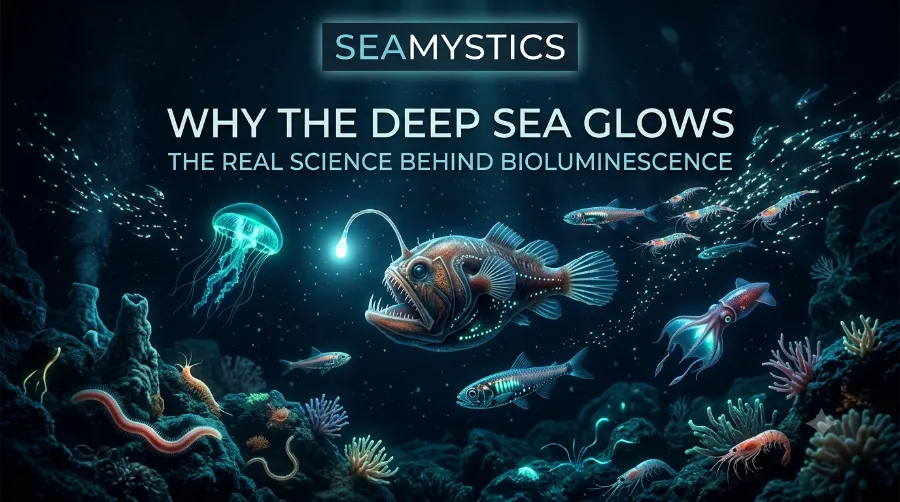

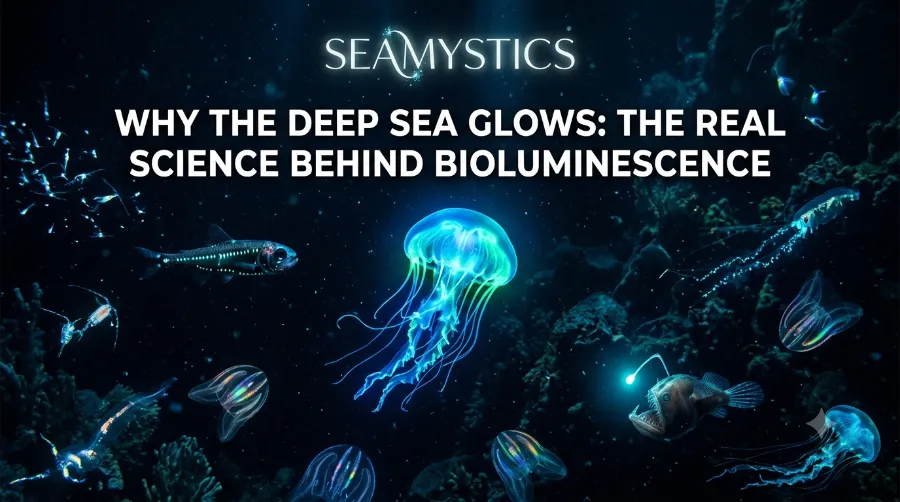
Picture this. You drop 600 meters below the ocean surface, past the point where sunlight gives up completely, and suddenly the black water around you starts to sparkle. A jelly flashes blue. A tiny shrimp spits a glowing cloud into the dark. A fish with a built in lantern drifts by like it owns the place. This is not science fiction, and it is not rare either. If you have ever wondered why deep sea glows the way it does, the answer sits at the heart of one of the ocean’s most fascinating survival stories, and it connects directly to the wider world of Deep Sea Mysteries that scientists are still working to fully understand.
To get a better understanding of how famous ghost ship mysteries exactly what to expect.
Bioluminescence, the ability of a living creature to make its own light, is one of nature’s oldest tricks. It shows up in bacteria, fish, squid, worms, and even sharks. Because sunlight cannot reach past a few hundred meters, deep sea animals had to build their own light source or live without one entirely. Most chose to glow.
To get a better understanding of how Mariana Trench unexplained mysteries exactly what to expect.
Key Takeaways
| Point | What It Means |
|---|---|
| Why deep sea glows | Sunlight disappears below 1,000 meters, so animals produce their own light through a chemical reaction |
| How common it is | Roughly 75 to 90 percent of deep sea animals can bioluminesce, according to MBARI and FIU research |
| Main reasons | Defense, hunting, mating, and camouflage through a trick called counterillumination |
| Where it happens most | The twilight zone (200 to 1,000 meters) and midnight zone (1,000 to 4,000 meters) |
| Latest research | Duke University’s 2026 study and new bioluminescent algae lighting technology are reshaping what we know |
What Is Bioluminescence and Why Deep Sea Glows So Often
Bioluminescence is a chemical reaction, not magic and not electricity. A molecule called luciferin reacts with an enzyme called luciferase, and this reaction releases energy in the form of light instead of heat. Fireflies use a version of this same trick on land, but on land it stays rare. In the ocean, it becomes almost the rule rather than the exception.
If you want to learn more about deep sea creatures unphotographed tips and expert advice.
According to the Monterey Bay Aquarium, roughly 75 percent of species found in the deep waters they study are able to produce their own light. Meanwhile, researchers at Florida International University found that bioluminescence appears in about 80 percent of animals living between 200 and 1,000 meters deep. Some estimates from recent studies push that number even higher, suggesting that as many as 90 percent of deep sea creatures might glow in some form. These numbers explain a lot about why deep sea glows so consistently across so many completely unrelated species.
If you want to learn more about mysterious lights deep ocean tips and expert advice.
The Chemistry Behind the Glow
The luciferin and luciferase reaction sounds complicated, but the concept is simple once you break it down.
- The animal stores luciferin in special cells or organs called photophores.
- When triggered, luciferase acts as a catalyst and speeds up the chemical reaction.
- The reaction releases a photon of light, usually blue or green, because those wavelengths travel the farthest through seawater.
- Some animals control the light with precision, flashing it on and off like a switch, while others release it as a glowing cloud into the water.
-
If you want to learn more about living fossils found alive tips and expert advice.
This process barely produces any heat, which is why scientists often call it cold light. As a result, animals can use it constantly without burning valuable energy that they need to survive in a food scarce environment.
If you want to learn more about The real science of bioluminescence tips and expert advice.
How Common Is Bioluminescence in the Ocean
A 17 year study by researchers at MBARI recorded more than 350,000 observations using remotely operated vehicles off the California coast, from the surface down to nearly 3,900 meters. The results, published in Scientific Reports, confirmed that bioluminescence is not a rare oddity but a dominant ecological trait across the water column. In other words, glowing is closer to normal than strange once you leave the sunlit surface behind.
If you want to learn more about creatures thought extinct found tips and expert advice.
If you want to explore how deep this rabbit hole goes, our full guide on unexplained deep sea mysteries covers dozens of ocean phenomena that scientists are still piecing together.
The Ocean Zones Where Deep Sea Mysteries Begin
Understanding why deep sea glows also means understanding where the light disappears in the first place. The ocean is not one uniform dark space. It splits into distinct zones, and each one shapes how animals evolved to use light.
| Zone | Depth Range | Light Condition | Common Glowing Life |
|---|---|---|---|
| Sunlight Zone | 0 to 200 meters | Full sunlight | Rarely glows, plenty of natural light |
| Twilight Zone | 200 to 1,000 meters | Dim blue light only | Lanternfish, hatchetfish, comb jellies |
| Midnight Zone | 1,000 to 4,000 meters | Total darkness | Anglerfish, dragonfish, viperfish |
| Abyssal Zone | 4,000 to 6,000 meters | Total darkness, near freezing | Sea cucumbers, deep sea shrimp |
| Hadal Zone | Below 6,000 meters | Total darkness, extreme pressure | Amphipods, specialized bacteria |
Most bioluminescent activity clusters in the twilight and midnight zones, because that is exactly where the transition from dim light to complete darkness forces animals to adapt fast. This is also the same region explored in our piece on the Mariana Trench and its unexplained mysteries, where pressure and darkness combine to create some of the strangest life on the planet.
Why Deep Sea Glows: Four Real Reasons Marine Life Lights Up
Light in the deep sea is never decoration. Every flash, glow, or spark serves a purpose, and this is really the core of why deep sea glows in the first place. Researchers generally group the reasons into four main categories.
Defense and Startling Predators
Many small animals use a burst of light as an emergency alarm. A comb jelly or a dinoflagellate, for example, can flash brightly the instant something touches it. This sudden light can startle a predator for just long enough to allow an escape. Some species take it further and release a glowing chemical cloud, essentially leaving a decoy behind while they swim away in the dark.
Hunting and Luring Prey
The anglerfish is probably the most famous example of this strategy. It dangles a glowing lure directly in front of its mouth, and curious prey swim close enough to investigate before getting swallowed whole. Meanwhile, the loosejaw dragonfish uses a rarer trick. It emits red light from an organ beneath its eye, and because most deep sea animals cannot see red light, it works almost like a pair of night vision goggles that only the dragonfish can use.
Mating and Communication
Lanternfish males and females display different light patterns along their bodies, and scientists believe this helps them recognize a suitable mate of the same species in complete darkness. Because visual cues are so limited at depth, these light signals essentially replace the role that color, sound, or scent might play for animals elsewhere.
Camouflage Through Counterillumination
This might be the cleverest use of all. Hatchetfish have rows of light producing organs along their bellies. When a predator looks upward from below, it normally sees a dark silhouette against the faint light coming from the surface. However, hatchetfish match that faint light with their own glow, effectively erasing their own shadow. This strategy, called counterillumination, works so well that only a few predators, like the strawberry squid, have evolved special eye adaptations to see through it.
- Defense flashes to startle predators
- Glowing lures to attract prey
- Species specific light patterns for mating
- Counterillumination to hide from predators below
Real Creatures Behind the Glow
Numbers and theory only go so far, so it helps to look at real examples with real data attached. These cases show exactly why deep sea glows across such a wide range of species and behaviors.
| Creature | Depth | Glow Purpose | Notable Detail |
|---|---|---|---|
| Anglerfish | 1,000 to 4,000 m | Hunting lure | Lure powered by symbiotic bioluminescent bacteria |
| Hatchetfish | 200 to 1,000 m | Counterillumination | Belly organs match surface light intensity |
| Strawberry Squid | 400 to 1,000 m | Vision and camouflage | One large eye scans upward, one small eye scans for flashes below |
| Vampire Squid | 600 to 900 m | Defense | Releases glowing mucus instead of ink |
| Oplophorid Shrimp | 500 to 1,500 m | Defense | Discharges luminescent secretion from the mouth |
| Gossamer Worm | 700 to 3,000 m | Unknown, possibly defense | One of the only species that produces yellow light instead of blue |
The Oplophoridae shrimp family is a particularly good case study. Researchers at Florida International University have been studying how this family evolved two separate bioluminescent systems, one from a mouth discharged secretion and another from body wide photophores, each glowing at a slightly different wavelength. This kind of layered adaptation shows just how far evolution pushed light production once it became a survival advantage.
For a closer look at species that scientists have documented but almost never managed to photograph alive in their natural habitat, our guide on deep sea creatures rarely photographed digs into some genuinely strange discoveries.
Latest Research Explaining Why Deep Sea Glows
Marine science around bioluminescence is moving fast, and 2026 has already produced some genuinely exciting updates.
In July 2026, Duke University published new research led by biologist Sönke Johnsen, who has studied light in the ocean for nearly three decades. His team’s work highlights how deep sea animals rely on transparency, mirror like skin, and bioluminescent flashes together, not as separate tricks but as a combined survival toolkit. According to the Duke Today feature on this research, Johnsen describes the deep sea as feeling like an entirely different planet, where animals behave in ways that simply do not exist anywhere on land.
Separately, in May 2026, researchers reported a breakthrough using bioluminescent marine algae to power experimental, electricity free 3D printed lamps. Because as many as 90 percent of deep sea creatures may be capable of producing light, scientists see real potential in applying these natural chemical reactions to sustainable lighting technology. This is a great example of how understanding Deep Sea Mysteries can eventually lead to practical, real world innovation.
Researchers at the Monterey Bay Aquarium have also continued tracking how counterillumination and defensive flashing evolved across different families of ocean life, reinforcing that this is not a single trait but dozens of independent evolutionary experiments that all arrived at the same basic solution, light.
How Scientists Study Deep Sea Mysteries
Studying an environment with crushing pressure and zero natural light is not easy, and it requires specialized tools that most people never think about.
- Remotely operated vehicles, or ROVs, carry cameras and sensors down thousands of meters without risking a human crew.
- Bathyphotometers measure the amount of light produced in a given volume of water in real time.
- Deep sea submersibles allow limited crewed dives for direct observation and sample collection.
- Genomic sequencing helps researchers trace how bioluminescent genes evolved and spread across unrelated species.
The MBARI team mentioned earlier used ROVs continuously for 17 years just to build a reliable picture of how common bioluminescence really is. That kind of patience is often what separates confirmed science from guesswork, and the NOAA Teacher at Sea program has documented similar long term fieldwork from researchers living aboard research vessels for weeks at a time.
Interestingly, sound plays a role in ocean mystery research too, even though it is separate from light. If this kind of ocean science interests you, our article on mysterious sounds recorded in the deep ocean covers acoustic phenomena that remain just as puzzling as glowing sea life. And if you enjoy stories where the ocean’s darkness plays a starring role, our piece on famous ghost ship mysteries explores a very different but equally eerie side of the sea.
Frequently Asked Questions
Why does the deep sea glow so much compared to land?
The deep sea glows far more often than land environments because sunlight disappears completely below roughly 1,000 meters. As a result, animals evolved their own light source instead of depending on the sun, while land creatures rarely needed to.
Is bioluminescence the same as fluorescence?
No, and this trips people up often. Bioluminescence creates its own light through a chemical reaction inside the organism. Fluorescence, on the other hand, only reflects and re emits light that is already hitting the creature from an outside source.
What color do deep sea animals usually glow?
Most deep sea animals produce blue or green light because those wavelengths travel the farthest through seawater. Red light is rare and only a few species, like the loosejaw dragonfish, use it as a hunting advantage.
Can humans see bioluminescence with the naked eye?
Yes, in shallow water it is often visible during plankton blooms along coastlines, sometimes called glowing waves. In the deep sea, however, special cameras and lighting equipment are usually needed to capture it clearly.
Why do scientists still call this a mystery if we understand the chemistry?
The chemical reaction itself is well understood, but researchers are still uncovering new species, new light patterns, and new behavioral functions every year. This ongoing discovery is exactly what keeps bioluminescence classified among the broader Deep Sea Mysteries that marine biology continues to explore.
Conclusion
The deep sea glows because darkness demanded a solution, and evolution answered with light. From anglerfish lures to hatchetfish camouflage, every flash and glimmer beneath the waves serves a clear survival purpose. As research from Duke University, MBARI, and other institutions continues in 2026, our picture of why deep sea glows keeps getting sharper, even while new questions keep surfacing. The ocean still holds far more secrets than answers, and that is precisely what makes it worth exploring further at Sea Mystics.
References
Monterey Bay Aquarium. Illuminating the Facts of Deep Sea Bioluminescence. montereybayaquarium.org
Duke Today. What the Deep, Dark Sea Teaches Us About Light. July 2026. today.duke.edu
NOAA Teacher at Sea Program. Bioluminescence Field Notes. noaateacheratsea.blog
Martini, S., Haddock, S. Quantification of Bioluminescence From the Surface to the Deep Sea. Scientific Reports, 2017.
Florida International University Institute of Environment. Bioluminescence and Light Detection in the Deep Sea.
Smithsonian Magazine. Marine Algae Bioluminescence and Sustainable Lighting Research. May 2026.