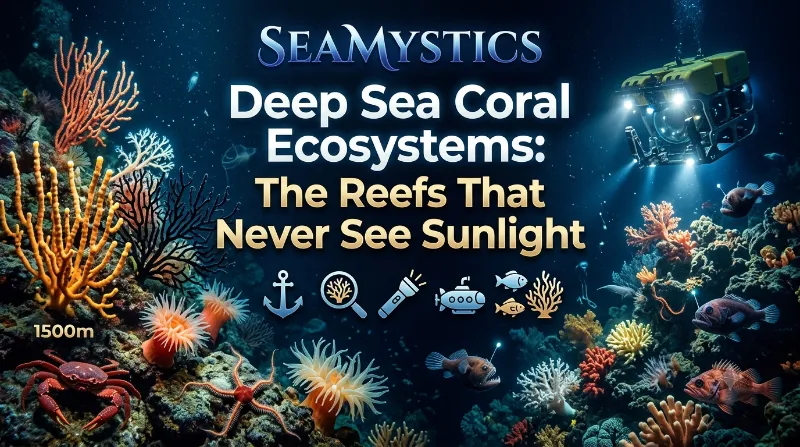

Picture a coral reef. Most people imagine turquoise water, bright fish, and warm sunshine bouncing off the surface. Now forget all of that. Somewhere below 200 meters, in water so cold it would numb your hands in seconds, deep sea coral builds entire cities out of stone and time, without a single ray of light to guide it. These reefs have existed for thousands of years, quietly growing in total darkness, and until recently, most of us had no idea they were even there.
Tide Pool Ecosystem A Complete Guide to Life Between the Tides
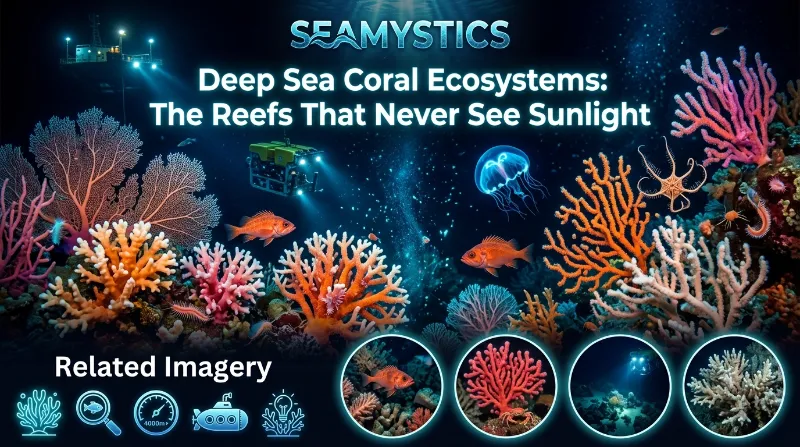
In April 2026, researchers aboard the R/V Falkor (too) announced something that stunned the marine science community. Off the coast of Argentina, they mapped a cold water coral system stretching roughly 900 kilometers, one of the largest deep sea coral reefs ever documented. That single discovery changed how scientists talk about the ocean floor, and it is exactly why this topic deserves a closer look.
Mesopelagic Zone Ecosystem Life in the Ocean’s Twilight Zone
Key Takeaways
| Fact | Detail |
|---|---|
| Depth range | Deep sea coral typically grows between 200 and 4,000 meters below the surface |
| Light requirement | None. These corals do not rely on sunlight or photosynthesis to survive |
| Largest recent find | A 900 km cold water reef discovered off Argentina in 2025 and 2026 |
| Growth speed | As little as 4 mm to 25 mm per year, depending on species |
| Age of oldest colonies | Some black coral colonies exceed 4,000 years old |
| New species found | Roughly 40 species believed new to science in the Argentina reef alone |
| Main threats | Bottom trawling, ocean acidification, deep sea mining, warming currents |
TL;DR: Deep sea coral lives far below sunlight, feeding on drifting particles instead of relying on algae for energy. These reefs support massive biodiversity, take centuries to grow back once damaged, and new ones are still being found today, including a reef system off Argentina roughly the size of a small country. They matter for fisheries, climate research, and ocean health worldwide.
Abyssal Plain Ecosystem What Lives on the Ocean’s Flattest Floor
What Is Deep Sea Coral, Exactly?
Deep sea coral, also called cold water coral, is not a single species. It is a broad group of coral animals that live far below the sunlit zone of the ocean. Unlike the coral you might picture in the Caribbean or the Great Barrier Reef, these corals do not host the tiny algae, known as zooxanthellae, that tropical coral depends on for food and color.
Because there is no sunlight this deep, photosynthesis simply cannot happen. So how does coral without sunlight stay alive? The answer comes down to feeding strategy. Deep sea coral is a filter feeder. It stretches out its tentacles and captures plankton, organic particles, and drifting debris that fall from higher up in the water column, a process scientists often call marine snow.
Oyster Reef Ecosystems The Underrated Filter of Coastal Waters
This difference in diet is the reason cold water coral can survive at depths where tropical coral would die within hours. It also explains why these reefs grow so slowly. Without the extra energy boost from photosynthesis, some deep sea coral species add only a few millimeters of skeleton each year.
How Cold Water Coral Reefs Survive Without Sunlight
Surviving in permanent darkness takes more than just switching food sources. Several other adaptations work together to keep a deep coral reef alive for centuries, sometimes even thousands of years.
Coastal Upwelling Ecosystems Why Some Waters Explode With Life
The Science Behind Coral Without Sunlight
First, cold water coral has adapted to extreme pressure. At 1,000 meters, the pressure is roughly 100 times what we feel at sea level, yet these delicate looking animals build hard, stable skeletons anyway. Second, they thrive in cold, stable temperatures, often between 4°C and 12°C, which is far steadier than the temperature swings seen near the surface.
Third, and this part surprises a lot of people, deep sea coral actually needs strong currents. Fast moving water carries food particles toward the coral and prevents sediment from smothering it. That is why so many deep reefs form on the edges of underwater canyons, seamounts, and continental shelves, where currents naturally pick up speed.
Finally, chemistry plays a quiet but critical role. Coral skeletons are built from calcium carbonate, and the ocean needs enough of a mineral called aragonite for that process to work. A 2017 study published in Scientific Reports found live coral reefs on seamounts near Hawaii at aragonite saturation levels as low as 0.71, far below what scientists once believed was survivable. That single finding forced researchers to rethink where deep coral reefs could actually exist.
Cold Water Coral vs Tropical Coral
| Feature | Cold Water Coral | Tropical Coral |
|---|---|---|
| Light needed | None | Yes, required for algae partnership |
| Typical depth | 200 to 4,000 meters | 0 to 40 meters |
| Water temperature | 4°C to 12°C | 23°C to 29°C |
| Food source | Filter feeding on plankton and marine snow | Algae photosynthesis plus some filter feeding |
| Growth rate | 4 mm to 25 mm per year | Up to 20 cm per year for branching species |
| Color | Usually white, orange, or pale pink | Wide range of vivid colors |
Deep Coral Reef Hotspots Around the World
Deep sea coral is not rare. It is simply hidden. Reefs have now been documented on nearly every continental margin, and mapping technology keeps revealing more of them every year. If you enjoy learning about other hidden coastal habitats, our guide on the salt marsh ecosystem covers a very different but equally overlooked environment closer to shore.
Some of the most significant deep coral reef hotspots include:
- The Argentine continental margin, where the newly mapped reef stretches nearly 900 kilometers
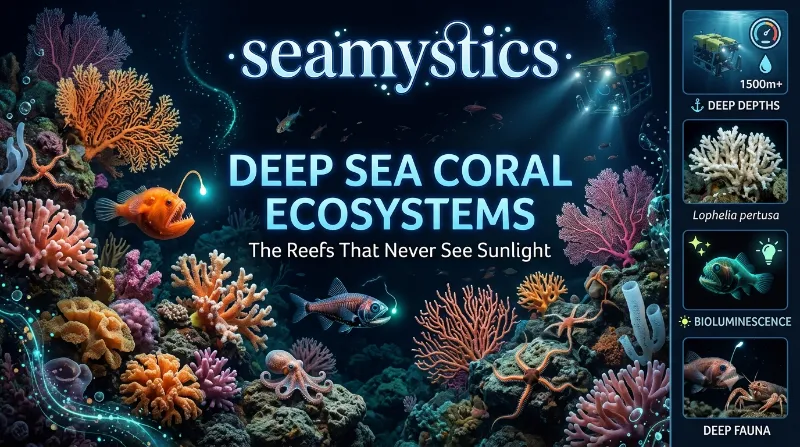
- The Norwegian coast, home to some of the best studied Lophelia pertusa reefs on the planet
- The Gulf of Mexico, where NOAA has tracked coral communities for over two decades
- Seamounts near the Northwestern Hawaiian Islands, found at depths between 535 and 732 meters
- The coast of Benin in West Africa, where a coral garden thought lost for 60 years was rediscovered in 2025
Recent Discoveries Worth Knowing About
The Argentina find deserves special attention because of how it happened. Biologist Erik Cordes and his team spent two separate expeditions, one in July 2025 and another spanning December 2025 into January 2026, surveying the Mar Del Plata Submarine Canyon. One single coral mound they mapped covered about 0.4 square kilometers, nearly the size of Vatican City, built almost entirely from a rare species called Bathelia candida rather than the more common Lophelia pertusa found in Atlantic reefs.
Around the same reef, researchers also encountered glass squid, brittle stars, and squat lobsters, alongside roughly 40 species believed to be entirely new to science. However, the expedition also found fishing lines tangled in the coral and damage that looked consistent with trawling, a reminder that even undiscovered reefs are not out of reach of human activity.
Seamount Ecosystems The Underwater Mountains Teeming With Life
Halfway around the world, off Benin, a research team led by Gérard Zinzindohoué used sonar and an underwater drone in 2025 to revisit a reef barrier presumed dead for six decades. Instead of finding a graveyard, they found a thriving coral garden, published in Frontiers in Marine Science. It was a rare piece of good news in a field that usually reports loss rather than recovery.
Meanwhile, in November 2025, scientists from the National Oceanography Centre described a brand new coral species, Deltocyathus zoemetallicus, living directly on polymetallic nodules over 4,000 meters deep in the Clarion Clipperton Zone. This was the first known hard coral species ever documented growing on these mineral rich rocks, which happen to be a major target for future deep sea mining operations.
Deep Sea Reef Facts and Figures
Numbers tell this story better than adjectives ever could. Below is a quick snapshot of what current research shows about deep sea coral reef distribution, longevity, and biodiversity value.
| Metric | Figure | Source Context |
|---|---|---|
| Depth range for cold water coral | 50 m to 4,000 m | NOAA and international survey data |
| Argentina reef length | Approximately 900 km | Schmidt Ocean Institute expeditions, 2025 to 2026 |
| Recovery time after trawl damage | Decades to centuries | Peer reviewed deep sea ecology studies |
| Estimated global deep coral reef coverage | Still being mapped, likely far larger than known | Ongoing NOAA and academic surveys |
| New species per major expedition | 40 to 110+ | Argentina reef and Coral Sea 2026 surveys |
Interestingly, a 2026 survey by CSIRO in the Coral Sea catalogued more than 110 new species across invertebrate groups like jellyfish, sponges, and polychaete worms, most pulled from deep or remote seamount waters near the Great Barrier Reef. These numbers keep climbing every year as ships gain access to better mapping sonar and remotely operated vehicles.
Why Deep Sea Coral Ecosystems Actually Matter
It would be easy to assume that a reef nobody can see is not particularly important. That assumption would be wrong. Deep sea coral reefs act as three dimensional habitat structures on an otherwise flat, featureless seafloor, and that structure supports an enormous amount of life.
Commercial fish species, including several types of rockfish and deep water shrimp, rely on these reefs for shelter and breeding grounds. In turn, healthy deep reefs help support commercial fisheries that coastal communities depend on for income. If a reef collapses, that support system collapses with it, sometimes permanently.
There is also a scientific angle that gets less attention. Coral skeletons grow in layers, similar to tree rings, and scientists can read those layers to reconstruct ocean temperature and chemistry going back thousands of years. This gives researchers a natural climate archive that would otherwise be impossible to access. For readers curious about how ocean habitats shift near the coastline instead of the deep sea, our tide pool ecosystem guide offers a useful contrast.
Deep coral reefs also intersect with polar research in ways many people do not expect. Cold water coral has been documented in extremely high latitude waters, connecting directly to topics covered in our breakdown of the polar ocean ecosystem, where freezing temperatures shape marine life in equally extreme ways.
Threats Facing Deep Coral Reef Systems
Despite living far from human eyes, deep sea coral is not safe from human impact. Several pressures are already reshaping these ecosystems, and most of them are accelerating rather than slowing down.
The biggest threats currently include:
- Bottom trawling, which can flatten centuries old reef structures in a single pass
- Ocean acidification, which reduces the aragonite available for coral skeleton growth
- Deep sea mining exploration, particularly in mineral rich zones like the Clarion Clipperton Zone
- Warming deep currents, which can shift coral distribution over time
- Discarded fishing gear, which entangles and smothers coral colonies
Recovery is the real problem here. Because deep sea coral grows so slowly, sometimes just a few millimeters a year, damage from trawling can take decades or even centuries to reverse, if it reverses at all. The USGS Coastal and Marine Hazards program has spent years documenting exactly this kind of long term vulnerability across United States waters, and its findings consistently point to the same conclusion: prevention works far better than restoration once a reef is already gone.
Conservation and Protection Efforts
The good news is that conservation strategies are catching up, even if slowly. Many deep coral reef sites, including the seamounts near Hawaii, now qualify as ecologically and biologically significant areas, which grants them special protection status even in international waters.
Scientists are also experimenting with active restoration. Following the Argentina discovery, researchers began testing methods borrowed from shallow reef restoration, including installing structures that coral larvae can attach to and building 3D printed artificial coral bases. These techniques are still young, but early results suggest coral larvae will settle on artificial substrate if it mimics natural reef texture closely enough.
Meanwhile, organizations like NOAA maintain public deep sea coral databases that track reef locations, condition, and research history across United States waters. These databases matter because they give policymakers actual evidence to work from instead of guesswork. If you want a broader look at how connected coastal habitats function together, our pillar guide on the estuary ecosystem explains how nutrient flow from rivers eventually reaches these deeper marine systems too.
Frequently Asked Questions
Does deep sea coral need sunlight to survive?
No. Deep sea coral survives entirely through filter feeding on plankton and organic particles, since there is no sunlight available at these depths for photosynthesis.
How deep does deep sea coral actually live?
Most cold water coral reefs form between 200 and 4,000 meters below the surface, although a few species have been recorded even deeper, including one recently found at over 4,000 meters in the Pacific Ocean.
Why are deep coral reefs still being discovered in 2026?
Roughly 80% of the ocean floor remains unmapped in detail, so newer sonar technology and remotely operated vehicles continue to reveal reef systems that were previously invisible to researchers.
How long does it take for a damaged deep sea reef to recover?
Recovery can take decades to centuries, largely because cold water coral grows extremely slowly compared to tropical coral.
Are deep sea coral reefs protected by law?
Some are. Many qualify as vulnerable marine ecosystems or ecologically and biologically significant areas, which grants added legal protection, though enforcement varies widely between countries and international waters.
Conclusion
Deep sea coral proves that life does not need sunlight to build something extraordinary. These reefs have been quietly growing in total darkness for thousands of years, feeding on scraps that drift down from above, surviving pressure that would crush most living things, and supporting biodiversity that scientists are only beginning to fully document. The Argentina discovery alone shows how much of this world remains unmapped, and every new expedition seems to uncover something researchers did not expect. Protecting what little we understand about these reefs matters, not just for the coral itself, but for the fisheries, climate records, and ocean health that depend on it. For more on how different marine habitats connect to one another, explore the full ecosystem library at Sea Mystics.
References
- NOAA Deep Sea Coral Research and Technology Program. deepseacoraldata.noaa.gov
- USGS Coastal and Marine Hazards and Resources Program, Deep Sea Corals. usgs.gov
- Ocean Biodiversity Information System (OBIS) Deep Sea Coral Dataset. obis.org
- Baco, A. et al. Defying Dissolution: Discovery of Deep-Sea Scleractinian Coral Reefs in the North Pacific. Scientific Reports, 2017.
- Alberts, E. C. One of the world’s largest deep-sea coral reefs discovered off Argentina. Mongabay, 2026.
- Zinzindohoué, G. et al. Rediscovery of a deep coral garden off Benin. Frontiers in Marine Science, 2025.