
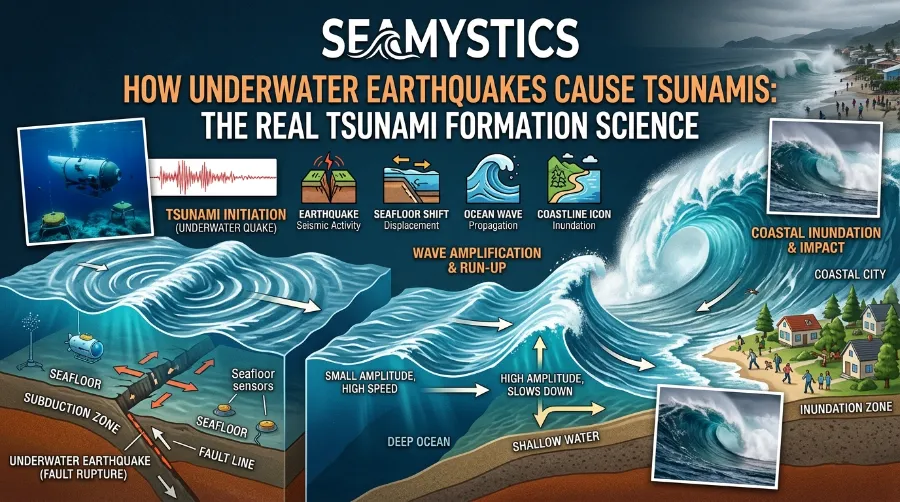

At 11:24 a.m. local time on July 30, 2025, the seafloor off Russia’s Kamchatka Peninsula lurched violently, and within minutes tsunami warnings had reached Japan, Hawaii, and the west coast of the United States. That single event, an 8.8 magnitude earthquake, is one of the clearest recent demonstrations of tsunami formation science in action. It shows exactly how underwater earthquakes cause tsunamis, and why understanding this process matters far beyond the science classroom.
For coastal communities across the US, UK, and Europe, tsunamis are no longer a distant hazard confined to the Pacific Ring of Fire. Warning systems, satellite monitoring, and international cooperation now shape how the world responds when the seafloor shifts. This guide walks through the tsunami wave science behind these events, using real, dated examples, so you understand not just what happens, but why.
Key Takeaway Table
| Question | Quick Answer |
|---|---|
| What mainly causes tsunamis? | Underwater earthquakes at subduction zones, when the seafloor moves up or down suddenly |
| What magnitude is dangerous? | Roughly magnitude 7.0 and above, with magnitude 8.0+ needed for ocean-crossing tsunamis |
| How fast do tsunamis travel? | Up to 800 km/h (about 500 mph) in the open ocean |
| Do all underwater earthquakes cause tsunamis? | No. The seafloor has to move vertically, not just side to side |
| Most recent major example? | The magnitude 8.8 Kamchatka earthquake on July 29, 2025, which triggered Pacific-wide warnings |
TL;DR: Tsunamis form when a large underwater earthquake, usually at a subduction zone, snaps the seafloor upward or downward and shoves the entire water column above it out of balance. That energy spreads out as long, fast waves that barely register in the open ocean but grow into walls of water as they reach shallow coastlines. Not every quake does this, only ones with enough size and the right kind of vertical fault movement.
What Causes Ocean Currents to Reverse Seasonally
What Is a Tsunami, Really
A tsunami is not simply a big wave. It is a series of waves created when an enormous volume of ocean water gets displaced all at once. Wind-driven waves only move the surface of the water. A tsunami moves the entire column, from the seafloor to the surface.
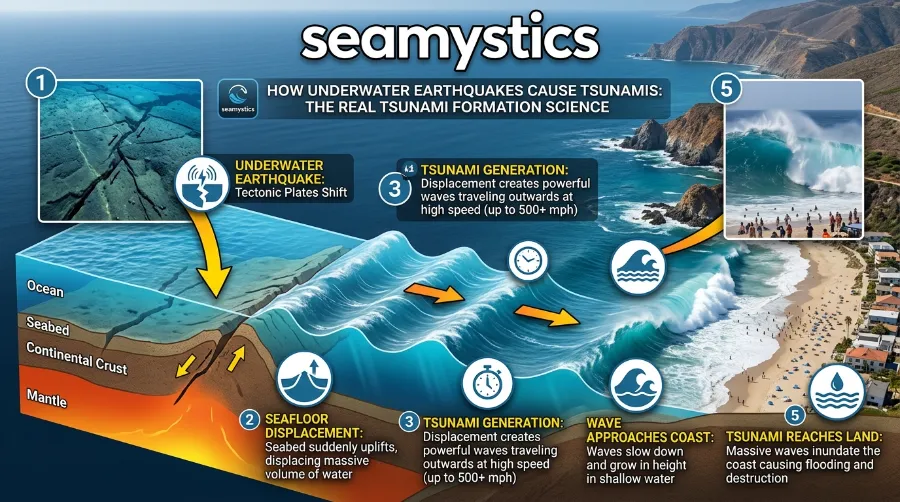
That distinction matters. According to the National Oceanic and Atmospheric Administration, the amount the ocean floor moves, how large an area is affected, and how deep the water is at the source all determine how big the resulting tsunami becomes. This is the foundation of underwater earthquake tsunami science, and it is also why some very strong earthquakes never produce a dangerous wave at all.
Why the Dead Sea Isn’t Technically an Ocean The Dead Sea Science Behind the Myth
How Tsunamis Form: The Step-by-Step Mechanics
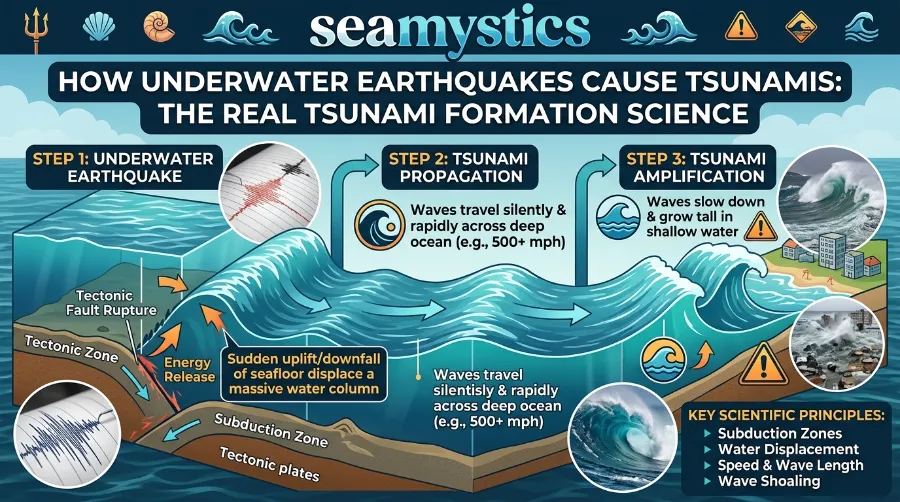
So how do tsunamis form after an earthquake strikes beneath the ocean? The process generally unfolds in four stages.
- Stress builds for decades. At subduction zones, one tectonic plate slides beneath another. The plates lock together and stress accumulates slowly, sometimes over a century or more.
- The fault ruptures. When the built-up stress finally exceeds the strength of the rock, the plates snap free. This is the earthquake itself.
- The seafloor moves vertically. If the rupture pushes the seafloor sharply upward or drops it downward, it displaces the water sitting directly above it.
- Waves radiate outward. The displaced water tries to rebalance itself under gravity, and that energy spreads out in all directions as long-wavelength waves.
This is essentially what happened during the March 11, 2011 Tōhoku earthquake off Japan, a magnitude 9.0 event that struck roughly 80 miles offshore and triggered a series of tsunamis that devastated the coastline and reached the Fukushima Daiichi nuclear plant, according to the Woods Hole Oceanographic Institution.
Why Some Underwater Earthquakes Never Cause a Tsunami
This is where the underwater earthquake tsunami connection gets misunderstood. Not every offshore earthquake produces a tsunami, even a large one. The type of fault movement matters just as much as the magnitude.
Earthquakes on strike-slip faults, where the plates slide past each other horizontally, rarely generate meaningful tsunamis. Water is largely unaffected by sideways motion. It is reverse and thrust faults, where one block of crust is forced up and over another, that push water vertically and create the conditions for a tsunami.
Two thresholds tend to matter most in tsunami formation science:
- Earthquakes need to be roughly magnitude 7.0 or larger to generate a noticeable tsunami.
- Widely destructive, ocean-crossing tsunamis typically require magnitude 8.0 or greater, paired with substantial vertical seafloor displacement.
This explains why California’s offshore sections of the San Andreas Fault, which move mostly horizontally, are not considered major tsunami generators, while the Pacific’s subduction zones are.
Tsunami Wave Science: Speed, Shape, and Why the Ocean “Disappears” First
Once a tsunami is generated, it behaves unlike any wave most people have ever seen. In the open ocean, tsunami waves can travel at speeds up to 800 kilometers per hour (about 500 miles per hour), roughly the cruising speed of a jet airliner, while often standing less than a meter tall and stretching for many kilometers.
What Determines Ocean Water Temperature by Region
As the wave approaches shallower coastal water, something called shoaling takes over. The wave slows down, but because its total energy has to go somewhere, the wavelength compresses and the height increases dramatically. A wave that was barely visible in deep water can grow to several meters by the time it reaches shore.
Sea Spray Science How Ocean Droplets Shape Coastal Weather
This is also why the ocean sometimes appears to retreat dramatically before a tsunami strikes. If the trough of the wave arrives before the crest, the sea level along the coast drops sharply, exposing seafloor that is normally submerged. That drawback is one of nature’s few genuine tsunami warning signs, and anyone who witnesses it should move to high ground immediately rather than approach the exposed shoreline.
Real Tsunami Events That Explain the Science
Numbers and diagrams only go so far. These documented events show tsunami formation science playing out in the real world.
| Event | Date | Magnitude | Notable Detail |
|---|---|---|---|
| Great Chilean Earthquake | May 22, 1960 | 9.5 | Largest earthquake ever recorded; tsunami reached Hawaii and Japan |
| Indian Ocean Tsunami | December 26, 2004 | 9.1 | Fault ruptured over 1,300 km; killed roughly 230,000 people across multiple countries |
| Tōhoku Earthquake | March 11, 2011 | 9.0 | Struck 80 miles off Japan; caused the Fukushima nuclear disaster |
| Kamchatka Earthquake | July 29 to 30, 2025 | 8.8 | Sixth-largest quake since 1900; triggered Pacific-wide evacuations, including 1.9 million people in Japan |
The 2025 Kamchatka event is particularly instructive for tsunami warning facts. According to the International Oceanographic Commission of UNESCO, the Pacific Tsunami Warning Center issued its first threat message within ten minutes of the earthquake, and confirmed waves reached Hawaii roughly eight hours later. Despite the earthquake’s enormous size, the resulting tsunami turned out smaller than initial models predicted, a reminder that magnitude alone does not determine tsunami size. Vertical displacement, rupture geometry, and local seafloor shape all play a role.
How Salinity Affects Marine Life Survival
How Warning Systems Actually Work
Modern tsunami warning networks combine several types of instruments working together in real time.
- Seismometers detect the earthquake itself within seconds
- Deep-ocean pressure sensors, known as DART buoys, measure changes in water pressure as a tsunami passes overhead
- Coastal tide gauges confirm wave arrival and height
- Satellite systems, including newer tools like NASA’s SWOT mission, now help scientists map tsunami wave patterns in far greater detail
During the Kamchatka event, this network allowed authorities to evacuate over a million people in Japan and issue warnings across a dozen countries within an hour of the earthquake. That kind of coordinated response traces directly back to lessons learned after the 2004 Indian Ocean disaster, which exposed how unprepared the world had been for a tsunami of that scale.
What This Means for Coastal Readers Today
If you live anywhere along a coastline, a few practical facts from tsunami formation science are worth remembering.
- A receding, unusually low tide with no clear explanation can be a warning sign, not a curiosity to walk toward.
- Strong or prolonged shaking near the coast is itself a natural warning. Official alerts may not arrive before the first wave does.
- A tsunami is a series of waves. The first one is not always the largest, so returning to low ground too soon is dangerous.
- Moving inland and uphill, even a short distance, is more effective than trying to outrun a wave in a vehicle.
Readers who want to understand the ocean processes that shape coastal hazards more broadly may find our guide to the ocean water cycle useful, since tsunami behavior is closely tied to how ocean water moves and redistributes energy. It also pairs naturally with how icebergs form, another process driven by sudden physical displacement rather than weather.
Frequently Asked Questions
What is the main cause of tsunami formation?
Underwater earthquakes at subduction zones are the leading cause, responsible for the large majority of tsunamis worldwide.
Can a small earthquake cause a tsunami?
It is unlikely. Most damaging tsunamis come from earthquakes above magnitude 7.0, though underwater landslides triggered by smaller quakes can occasionally generate local tsunamis.
How much warning time do coastal areas get?
It depends on distance from the earthquake. Nearby coastlines may have only minutes, while distant shores can have several hours, as seen when the 2025 Kamchatka tsunami took roughly eight hours to reach Hawaii.
Do volcanoes cause tsunamis too?
Yes. Underwater volcanic eruptions and collapsing volcanic slopes can displace water in much the same way an earthquake does, though this is less common than earthquake-driven tsunamis.
Is the US or Europe at risk from tsunamis?
Yes, though the risk is uneven. The US Pacific coast, Alaska, and Hawaii face regular tsunami warnings tied to Pacific Ring of Fire activity. European coastlines, particularly around Portugal, Spain, and the Mediterranean, have historical tsunami risk from the Azores-Gibraltar fault zone, including the 1755 Lisbon earthquake and tsunami.
Conclusion
Tsunami formation science comes down to one basic idea: when the seafloor moves up or down suddenly, the ocean above it has to move too, and that movement doesn’t stay contained near the source. From the 1960 Chilean earthquake to the 2025 Kamchatka event, every major tsunami on record traces back to the same physical process, just at different scales and in different corners of the Pacific and beyond. Understanding how underwater earthquakes cause tsunamis will not stop the next one from happening, but it does explain why warning systems work the way they do, and why a few minutes of awareness on a receding shoreline can matter more than any amount of engineering after the fact.
If you’re curious how this connects to broader ocean dynamics, our pieces on seas without noticeable tides and seasonal current reversals explore other ways the ocean behaves outside everyday expectations.
References
- National Oceanic and Atmospheric Administration, The Science Behind Tsunamis
- Woods Hole Oceanographic Institution, Tsunamis
- International Oceanographic Commission of UNESCO, Global Tsunami Response to the July 2025 Kamchatka Earthquake
- U.S. Geological Survey, M 8.8 Kamchatka Peninsula Earthquake Event Page
- Science Focus, How Do Tsunamis Form
- UCSB College of Engineering, The Science of Tsunamis