
Salt water doesn’t taste the same everywhere, and neither does it behave the same way. Ocean salinity effects ripple through nearly every layer of marine life, from the plankton drifting near the surface to the fish navigating estuaries where rivers meet the sea. A shift of just a few parts per thousand can decide whether a species thrives, struggles, or disappears from a region entirely.
Key Takeaways
| Topic | Quick Insight |
|---|---|
| Average ocean salinity | About 35 parts per thousand (ppt), though it varies by region |
| Most sensitive zones | Estuaries, polar melt zones, and enclosed seas |
| Salinity tolerance | Ranges from stenohaline (narrow tolerance) to euryhaline (wide tolerance) species |
| Climate link | Melting ice and rising rainfall are diluting salinity in several ocean basins |
| Fisheries impact | Salinity shifts are already changing where commercial fish stocks are found |
TL;DR: Ocean salinity directly controls which marine species can survive in a given area, because salt concentration affects everything from cell function to oxygen availability in water. As climate change alters rainfall and ice melt patterns, salinity levels ocean-wide are shifting, and species with narrow salt tolerance are the first to feel it. Fish, corals, and plankton are already responding by shifting ranges, adapting physiologically, or, in some cases, dying off.
Ocean Salinity Explained: Why Salt Levels Matter So Much
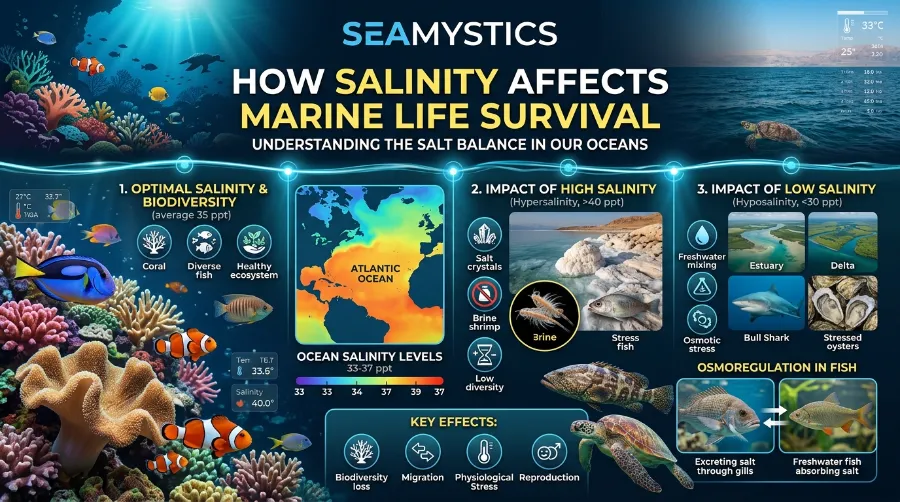
Salinity refers to the amount of dissolved salt in seawater, usually measured in parts per thousand. The global average sits around 35 ppt, but that number swings widely depending on location. The Baltic Sea can drop below 10 ppt because of heavy freshwater inflow, while the Red Sea often exceeds 40 ppt due to high evaporation and low rainfall.
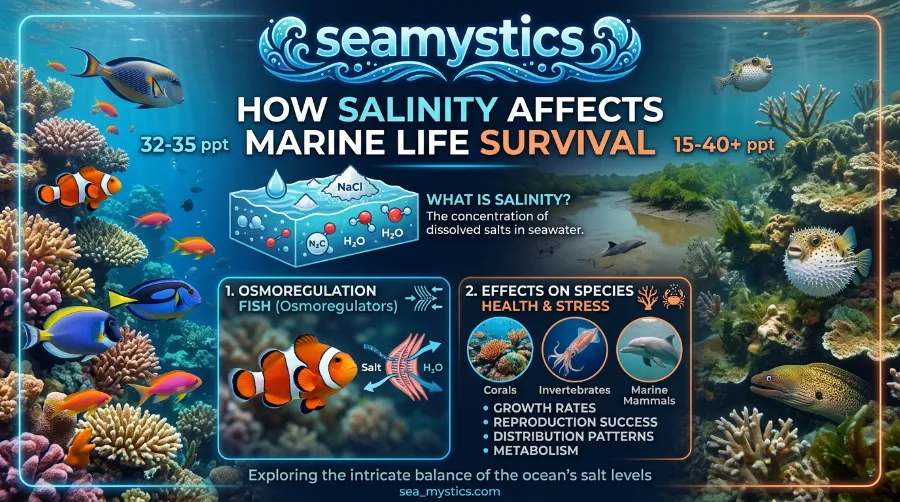
This isn’t just a chemistry detail. Salinity determines water density, which drives ocean currents, and it directly affects how marine organisms manage water balance inside their own cells. For most sea creatures, keeping the right salt concentration inside their bodies is a constant, energy-costly job.
Sea Spray Science How Ocean Droplets Shape Coastal Weather
According to research compiled by the Ocean Sciences Salinity Highlights project, even small salinity anomalies detected by satellite have been linked to measurable shifts in regional marine productivity. That’s a strong signal that salinity isn’t a background variable, it’s an active force shaping ocean ecosystems.
Salinity Levels Ocean-Wide: A Snapshot by Region
Salinity isn’t uniform, and understanding the map helps explain why some species thrive in one sea and vanish in another.
- Open ocean average: roughly 35 ppt
- Polar regions: lower salinity due to ice melt and reduced evaporation
- Subtropical gyres (e.g., Sargasso Sea): higher salinity due to intense evaporation
- Estuaries and river mouths: highly variable, sometimes swinging daily with tides
- Enclosed seas (Dead Sea, Red Sea): extreme highs, sometimes far beyond typical ocean ranges
For a deeper dive into how salt water circulates and mixes across these zones, our guide on the ocean water cycle breaks down the physical mechanics behind these regional differences.
NASA’s ocean salinity monitoring work, described in this 2012 field report from the Aquarius mission, was one of the first efforts to track these patterns from space, and it confirmed that salinity gradients are far more dynamic year to year than earlier ship-based data suggested.
Salinity Marine Life Impact: Who Adapts, Who Struggles
Not every species handles salt fluctuation the same way. Marine biologists sort organisms into two broad categories based on tolerance.
- Stenohaline species can only survive within a narrow salinity range. Most deep-ocean fish and many reef-building corals fall into this group, which makes them highly vulnerable when conditions shift even slightly.
- Euryhaline species can handle a wide range of salt concentrations. Salmon, eels, and certain crab species are classic examples, since they naturally move between freshwater and saltwater during their life cycles.
This distinction matters more now than it used to. Freshwater input from melting ice sheets and shifting rainfall patterns is diluting surface salinity in parts of the North Atlantic, and stenohaline species in those zones have far less room to adjust than their euryhaline neighbors.
Research led by oceanographer Caroline Ummenhofer and her team, detailed in the WHOI ocean salinity and global water cycle project, has tracked how these freshwater pulses are reshaping salinity patterns basin by basin, and the data shows the changes are accelerating rather than leveling off.
Salt Water Tolerance Fish: A Closer Look
Fish offer some of the clearest examples of salinity’s real-world impact, partly because they’re so easy to track and study.
- Salmon move from freshwater rivers to full ocean salinity and back again, relying on specialized gill cells to switch osmoregulation modes.
- Tilapia show unusually broad salt tolerance, which is one reason they’ve become a common aquaculture species across brackish coastal farms.
- Cod populations in parts of the Baltic Sea have declined partly because falling salinity has reduced the oxygen content their eggs need to develop properly.
- Clownfish and many reef fish are far more sensitive, and lab studies have shown measurable stress responses when salinity drops even a few ppt below their reef’s normal range.
These aren’t isolated lab curiosities. Coastal fisheries in the US and UK have already reported shifting catch locations as salinity and temperature patterns move, which has real consequences for local economies dependent on predictable fish populations.
How Salinity Connects to Broader Ocean Systems
Salinity doesn’t act alone. It’s tightly linked to temperature, density, and current formation, which is why marine scientists rarely study it in isolation.
For instance, salinity differences help drive the seasonal current reversals discussed in our piece on seasonal current reversal, and they play a role in the layered water columns behind iceberg formation. Even phenomena like sea foam can be influenced by salinity, since salt concentration affects how organic matter and bubbles interact at the surface.
Extreme salinity cases also help illustrate the outer limits of marine tolerance. The Dead Sea, for example, is so saline that almost nothing survives in it, which stands in sharp contrast to the delicate balance most ocean species depend on.
Why This Matters Now: A Changing Baseline
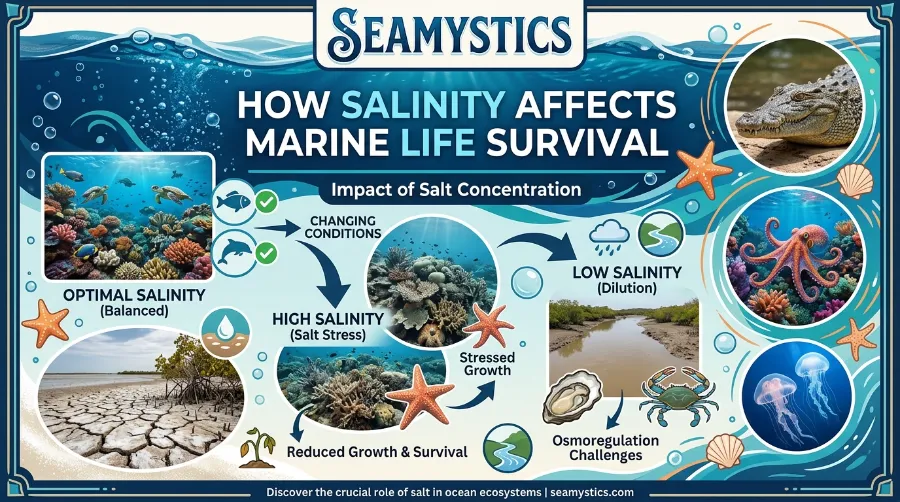
Ocean salinity has never been static, but the pace of change is what’s drawing attention from marine researchers. Increased rainfall in some regions, faster polar ice melt, and shifting evaporation patterns are all nudging salinity levels ocean-wide in new directions.
For species with narrow tolerance windows, this isn’t a distant future problem, it’s already playing out in measurable population shifts, range changes, and, in some documented cases, localized die-offs. Fisheries management agencies in both the US and Europe have started factoring salinity trend data into stock assessments, which shows how seriously the scientific community is treating this shift.
Understanding these dynamics also connects to broader ocean behavior, including how tides interact with salinity in enclosed seas, and how ocean temperature regions overlap with salinity zones to create the specific habitats marine life depends on.
Frequently Asked Questions
What is considered a normal ocean salinity level?
Most open ocean water sits around 35 parts per thousand, though this varies significantly by region and season.
Can fish survive sudden salinity changes?
Euryhaline species like salmon and eels can handle sudden shifts fairly well, but stenohaline species such as many reef fish and deep-sea species have very limited tolerance and can experience stress or death from rapid changes.
Is climate change affecting ocean salinity?
Yes. Increased ice melt and changing rainfall patterns are diluting salinity in several regions, particularly near the poles, while evaporation-heavy zones are seeing salinity rise.
Why do estuaries have such variable salinity?
Estuaries sit where freshwater rivers meet the salty ocean, so salinity there shifts constantly with tides, rainfall, and river flow, making them some of the most dynamic salinity zones on the planet.
Conclusion
Salinity is far more than a number on a chemistry chart, it’s a quiet but powerful force shaping where marine life can survive, thrive, or struggle. From salmon navigating river mouths to coral reefs holding steady within narrow salt ranges, the ocean’s chemistry sets the rules for nearly every creature living within it. As salinity patterns continue shifting under changing climate conditions, understanding these effects isn’t just academic, it’s becoming essential for predicting the future of ocean ecosystems and the fisheries and coastal communities that depend on them.
References
- Ocean Sciences Salinity Highlights: https://salinity.oceansciences.org/highlights10.htm
- NASA Notes from the Field, Ocean Salinity Viewed from Sea and Space (2012): https://science.nasa.gov/blogs/notes-from-the-field/2012/08/15/ocean-salinity-viewed-from-sea-and-space/
- WHOI, Ocean Salinity and the Global Water Cycle Project: https://ummenhofer.whoi.edu/projects/ocean-salinity-global-water-cycle/