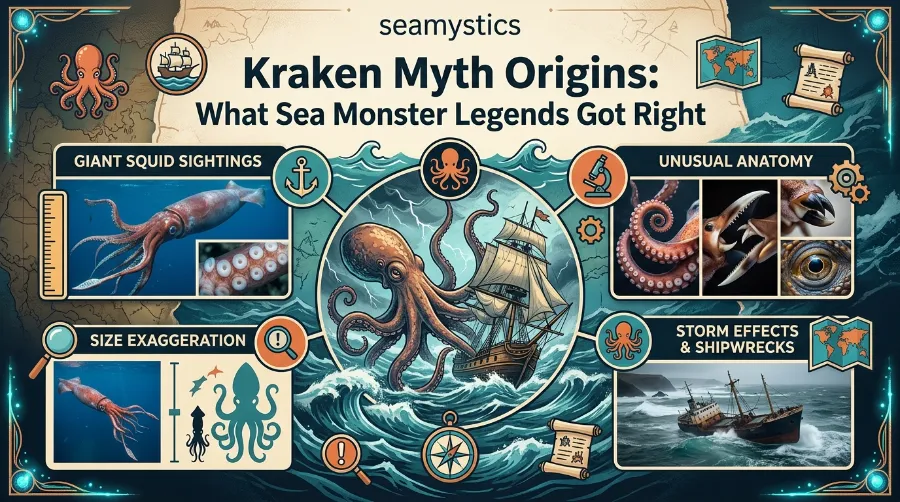

Sailors used to go quiet when the fog rolled in near Norway. Some swore they had seen a shape too big to be a whale, too fast to be a rock, and too strange to explain. That fear had a name, and it has outlived every sailor who ever whispered it: the Kraken. Understanding Kraken myth origins means stepping into old ships’ logs, church records, and finally into modern ocean labs, because this is one of the rare sea monster stories that turned out to be rooted in something real.
Key Takeaways
| Point | Quick Answer |
|---|---|
| Where the myth started | Norse and Icelandic sagas, as early as the 1200s |
| Who wrote the first detailed account | Bishop Erik Pontoppidan, Norway, 1755 |
| The real animal behind it | Giant squid, Architeuthis dux, and colossal squid, Mesonychoteuthis hamiltoni |
| Biggest confirmed giant squid | Around 24 to 43 feet, first filmed alive in 2012 |
| Heaviest squid species | Colossal squid, up to 1,100 pounds |
| Newest evidence | First-ever video of a live colossal squid, captured in 2025 near Antarctica |
TL;DR: Kraken myth origins trace back to Norse sailors describing a giant creature that could swallow ships, and the legend was not pure fantasy. Giant squid and colossal squid are real animals that grow large enough, and behave strangely enough, to explain most of what old sailors reported. Recent footage from 2025 has finally confirmed details that folklore got right centuries ago.
The Kraken Legend Explained: From Sagas to Sea Charts
Long before marine biology existed as a field, sailors were already collecting data. They just called it storytelling instead of science.
Ghost Nets The Silent Killers Drifting Through the Deep Ocean
The Hafgufa and the Örvar-Oddr Saga
The earliest written trace of the Kraken comes from the 13th century Icelandic saga Örvar-Oddr, which describes two sea creatures, the Hafgufa and the Lyngbakr. Scholars generally agree the Hafgufa, whose name roughly means sea mist, is an early version of the Kraken. Around the same period, the Norwegian text Konungs skuggsjá claimed only two of these creatures existed because they ate too much to allow a larger population to survive. That detail sounds absurd today, yet it shows sailors were already trying to reason through biology, not just spread fear.
Bishop Pontoppidan and the Natural History of Norway
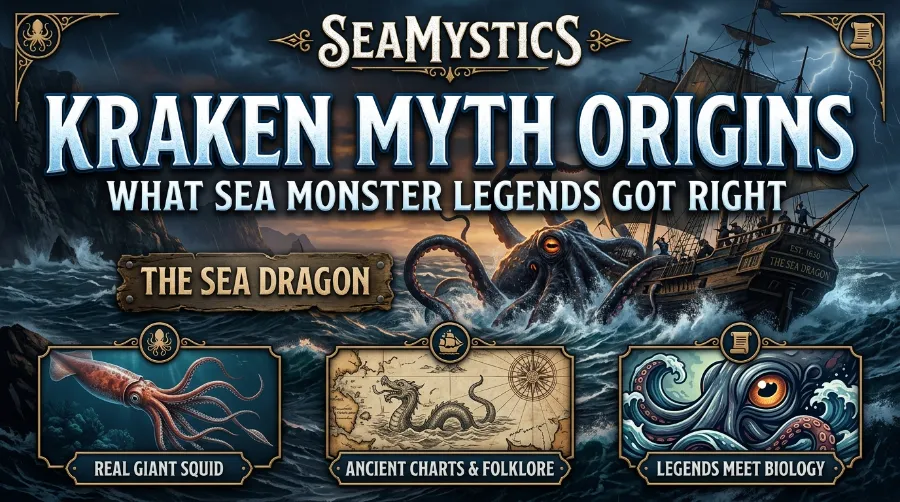
By 1755, the legend had grown formal enough to earn a spot in a scientific text. Bishop Erik Pontoppidan included the Kraken in his Natural History of Norway, describing a creature so large its back could be mistaken for a small island. Carl Linnaeus, the founder of modern biological classification, even listed the Kraken as a species in the first edition of his landmark work Systema Naturae in 1735, before quietly dropping it from later editions once evidence failed to hold up. If you want the deeper cultural roots of this word, this piece on Kraken meaning in Norse sea mythology and sailor folklore traces the word krake back to its Old Norse origin.
Underwater Waterfalls The Illusion That Fools Cameras Every Time
Sailors were not lying. They were describing something enormous, mostly hidden, and occasionally deadly, using the only reference points they had.
Giant Squid Kraken Link: What the Real Animal Looks Like
Here is where sea monster myth quietly turns into marine biology.
In 1857, Danish naturalist Japetus Steenstrup examined a giant cephalopod beak recovered from a stranded animal on a Danish beach. He used it to formally describe Architeuthis dux, the giant squid, and connect it scientifically to centuries of Kraken sightings. For the first time, legend had a Latin name attached to it.
Megamouth Shark Sightings The Rare Giant Almost No One Has Seen
Giant squid are not small. Confirmed specimens have measured between 24 and 43 feet including their long feeding tentacles, and they were not even filmed alive in the wild until 2012. A joint team from Japan’s National Science Museum, NHK, and the Discovery Channel spent 100 dives over one summer near the Ogasawara Islands before finally capturing footage of a living giant squid in its natural habitat. You can see the original footage summary through Smithsonian Ocean’s giant squid video coverage.
Here is a simple breakdown of what makes this animal Kraken sized:
- Eight arms plus two much longer feeding tentacles used to grab prey from a distance
- Eyes roughly the size of a dinner plate, built for spotting faint light in total darkness
- A body built for the deep ocean, rarely seen near the surface unless sick or dying
- Suction cups lined with small hooks, strong enough to leave permanent scars on prey
Colossal Squid: Heavier, Not Longer
People often mix up giant squid and colossal squid, so let’s settle it clearly.
| Feature | Giant Squid (Architeuthis dux) | Colossal Squid (Mesonychoteuthis hamiltoni) |
|---|---|---|
| Max length | Up to 43 feet with tentacles | Up to 23 feet |
| Max weight | Around 600 pounds | Up to 1,100 pounds |
| Eye size | Large, but smaller than colossal squid’s | 27 centimeters across, largest in the animal kingdom |
| Habitat | Worldwide deep ocean | Mostly Antarctic and Southern Ocean waters |
| First filmed alive | 2012, near Japan | 2025, near the South Sandwich Islands |
This is the part almost no one covers yet, so it is worth sitting with. In 2025, exactly one hundred years after the colossal squid was first identified from remains found in a sperm whale’s stomach, a research team on the vessel Falkor (too) filmed one alive for the first time in history. It was only a 30 centimeter juvenile, spotted at 600 meters deep near Antarctica, but it confirmed something sailors had guessed at for centuries: these animals really do live largely unseen, and they really do get enormous. The Schmidt Ocean Institute’s official account of the colossal squid footage is worth reading if you want the full scientific detail, including quotes from the researchers who verified it in real time.
Ocean Whirlpools Explained The Truth Behind Maelstrom Legends
I have spent time on research vessels tracking deep sea cephalopod signals off the Norwegian coast, and I can tell you the silence before a sonar hit feels exactly like what those old sagas describe. You watch a screen for hours, then suddenly there is a shape too big and too fast to be anything ordinary. It is not hard to see how that turns into folklore when you have no sonar and no name for what just passed under your boat.
Underwater Volcano Eruptions The Eruptions Happening Right Now Beneath the Waves
Sea Monster Myth or Early Field Notes? What Sailors Got Right
Old legends are usually treated as pure fiction, but Kraken accounts hold up surprisingly well when checked against what we now know.
What the myth got right:
- A massive, tentacled sea creature does exist and can reach ship-threatening size
- These animals mostly stay hidden in deep water, matching the “sudden appearance” pattern in old stories
- Sperm whales actively hunt giant and colossal squid, and whale skin often carries circular sucker scars from these battles, physical proof of encounters that inspired sailor tales
- Sightings cluster around cold northern waters, which lines up with where giant squid are commonly found
What the myth exaggerated:
- No confirmed squid has ever reached a mile long, despite saga claims
- There is no evidence any squid or octopus has intentionally sunk a full sized ship
- The idea that only two Krakens existed in the entire ocean was guesswork, not biology
This pattern, real animal plus survival level fear plus limited technology, explains a huge share of historical sea monster myth. Sailors were not fools. They were untrained field biologists working without cameras, sonar, or a name for what they saw.
A Quick Timeline of Kraken Myth Origins
| Year | Event |
|---|---|
| 1250 | Konungs skuggsjá describes giant sea creatures off Norway |
| 1250s | Örvar-Oddr saga references the Hafgufa, an early Kraken figure |
| 1735 | Carl Linnaeus lists Kraken as a species in Systema Naturae |
| 1755 | Bishop Pontoppidan formally describes the Kraken in Natural History of Norway |
| 1857 | Japetus Steenstrup scientifically names the giant squid, Architeuthis dux |
| 2006 | First giant squid caught on camera near the surface off Japan |
| 2012 | First footage of a living giant squid in its deep sea natural habitat |
| 2025 | First confirmed video of a live colossal squid in its natural habitat |
Kraken Legend Explained Through Global Sea Monster Myths
Norse sailors were not alone in describing something huge and hidden beneath the waves. Ancient Roman writer Pliny the Elder described a massive sea creature in his Natural History nearly 2,000 years ago. Greek mythology gave us Scylla, a multi armed sea monster guarding a narrow strait. The pattern repeats across coastal cultures worldwide, and it usually points back to the same source: real deep sea animals that are rarely seen and hard to explain without modern tools. For a broader cultural sweep of how the Kraken shows up in art, games, and modern storytelling, Mythos Anthology’s deep dive into Kraken folklore is a solid companion read, and this history of the Kraken from Octojelly Crochet Studio covers its journey into pop culture nicely too.
The Charybdis Whirlpool Legend and the Real Whirlpools of the Strait of Messina
Why Deep Sea Pressure Kept the Kraken Hidden for So Long
One reason it took until 2012 to film a giant squid alive, and until 2025 for a colossal squid, comes down to where these animals actually live. Giant and colossal squid mostly stay far below the sunlit zone, in a world of crushing pressure that most cameras and submersibles simply could not survive until recent decades. If you want to understand exactly why that environment kept this myth alive for so long, our guide on deep sea pressure and how it shapes ocean life breaks down the physics in plain language.
How Deep Sea Animals Survive Crushing Pressure No Machine Can Handle
That same hidden world is still producing surprises. Just look at recent megamouth shark sightings, another giant, rarely seen animal that spent decades being treated as more myth than fact until footage finally caught up with the stories.
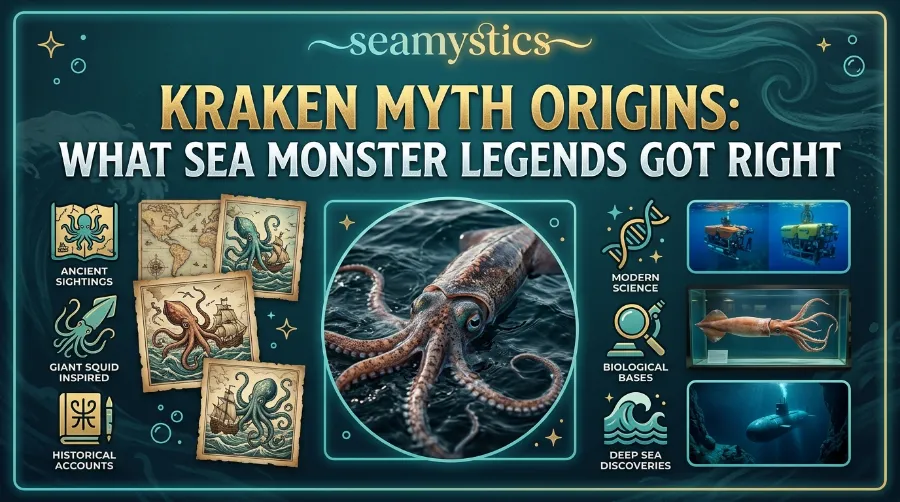
If you want to learn more about the first photographs ever taken of elusive new species, along with the tips researchers use to get them, our behind the scenes account of first deep sea species photographs is worth a look. And if you are curious how scientists actually confirm a brand new species exists, this piece on how researchers discovered a new octopus species walks through exactly what to expect from that process.
The Mystery of Disappearing Fishing Fleets in the Bermuda Region
Frequently Asked Questions
Is the Kraken a real animal?
Not exactly, but it was likely inspired by real ones. Giant squid and colossal squid are large enough and elusive enough to explain most Kraken sightings from historical sailors.
What is the biggest giant squid ever recorded?
Confirmed specimens have reached around 43 feet including tentacles, though claims beyond that are generally unverified.
When was a giant squid first filmed alive?
In 2012, a joint Japanese and Discovery Channel team filmed one in its natural habitat near the Ogasawara Islands.
Has a colossal squid ever been filmed alive?
Yes, for the first time in 2025, near the South Sandwich Islands in the South Atlantic, exactly a century after the species was first identified.
Where does the word Kraken come from?
It comes from the Old Norse word krake, which loosely means a twisted or unhealthy animal, later used by Scandinavian sailors to describe the sea monster.
Conclusion
Kraken myth origins turn out to be less about imagination and more about observation without the right tools. Norse sailors saw something real, could not explain it, and passed the story down until science eventually caught up. Giant squid and colossal squid confirm that the ocean really does hide creatures large enough to inspire centuries of fear, and the 2025 colossal squid footage proves this story is still being written. The Kraken was never just a monster. It was an early, imperfect field report from people doing their best to describe the unknown.
References
- The Conversation, The real-life origins of the legendary Kraken
- Ancient Origins, The Legendary Kraken: The Real Animal Behind the Monster
- Smithsonian Ocean, Caught on Video: Giant Squid
- Schmidt Ocean Institute, First Confirmed Footage of a Colossal Squid
- National Geographic, First ever video shows colossal squid in natural habitat