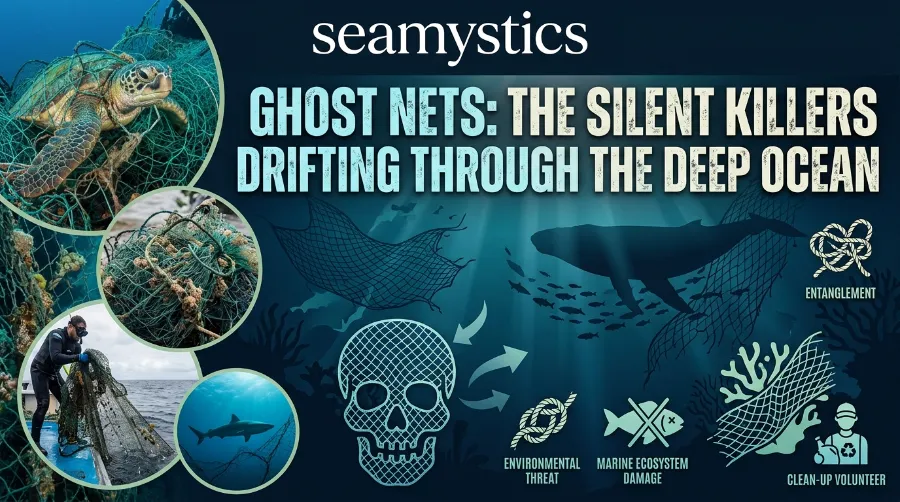

Somewhere off the coast of California right now, a tangle of nylon mesh slides along a shipwreck 150 feet below the surface. It catches whatever swims into it. Nobody owns this net anymore, and nobody is coming back for it. Yet it keeps fishing anyway, and that is exactly the problem with ghost fishing nets: they do not know when to stop. As a marine biologist who has spent two decades pulling this kind of gear off reefs and wrecks, I can tell you the ocean is full of these forgotten hunters, and most people have no idea how many are still out there.
Key Takeaways
| Fact | Detail |
|---|---|
| Annual volume | Between 500,000 and 1 million tons of fishing gear are lost or abandoned in the ocean each year |
| Share of marine litter | Ghost gear makes up roughly 10 percent of all ocean debris, and up to 46 percent of the Great Pacific Garbage Patch |
| Wildlife impact | An estimated 100,000 marine mammals and sea turtles are harmed by entanglement every year |
| Recovery rate | Only about 2 percent of lost fishing gear is ever recovered |
| Longevity | Nylon nets can persist in the ocean for 400 to 600 years before fully breaking down |
| Hotspot example | The Florida Keys National Marine Sanctuary alone holds an estimated 85,000 ghost lobster and crab traps |
TL;DR: Ghost fishing nets are lost, abandoned, or discarded fishing gear that keep trapping and killing marine life for decades after fishers walk away from them. They make up roughly a tenth of all ocean trash. Volunteer groups from California to the Maldives are now racing to cut them free before more animals die, and recovery technology, biodegradable gear, and citizen reporting networks are finally starting to close the gap.
What Are Ghost Fishing Nets, Exactly?
A ghost fishing net is any net, trap, or line that has been lost, cut loose in a storm, or simply abandoned by a boat crew. Sometimes hauling it back in just is not worth the fuel. Once it slips beneath the surface, nobody controls it anymore, yet it keeps doing the only job its makers built it to do. Fish swim in, gills catch on the mesh, and the struggle to escape only tightens the trap further.
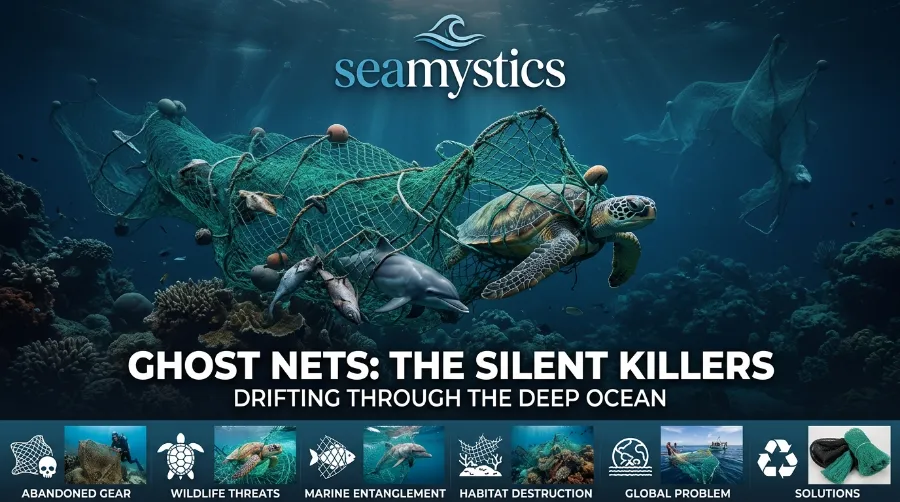
This distinguishes ghost gear from ordinary marine litter. A plastic bottle floats and pollutes, but it does not actively hunt. Manufacturers design derelict fishing nets to be nearly invisible underwater, and that is precisely what makes them so lethal to anything that brushes against them.
According to the World Wildlife Fund, fishing gear accounts for roughly 10 percent of ocean debris. Fishers discard or lose between 500,000 and 1 million tons of it every single year. That single category of trash now makes up an estimated 46 percent of the mass floating in the Great Pacific Garbage Patch, according to the same report. Nearly half of that infamous ocean trash vortex is not plastic bags or straws. It is fishing gear that outlived its owners’ interest in it.
The Charybdis Whirlpool Legend and the Real Whirlpools of the Strait of Messina
How Derelict Fishing Nets End Up in the Deep Ocean
Most abandoned fishing gear does not start out abandoned. It starts as a working tool on a working boat, and then something goes wrong. Storms snap mooring lines. Currents drag gear into rocks. Sometimes crews simply cut a net loose because retrieving it would cost more time than the catch is worth.
A handful of patterns show up again and again in the field:
- Snagged and abandoned: Nets catch on reefs, wrecks, or rock formations and tear free of their float lines, leaving crews unable to retrieve them.
- Storm loss: Sudden weather can rip gear from boats faster than a crew can react, especially with longline and gillnet setups left unattended overnight.
- Illegal or unregulated fishing: Vessels operating outside legal quotas sometimes cut nets loose deliberately to avoid detection by patrol boats.
- Gear conflict: Nets from one vessel sometimes tangle with another crew’s lines, and both sides walk away rather than sort out the mess.
- End of life discard: Crews occasionally dump old, torn gear overboard simply because shore-side disposal costs money.
Once loose, gear rarely stays in one place. Currents pull it into deep water, where cold temperatures and low light slow the breakdown of synthetic fibers to a crawl. A Wikipedia summary of ghost net research puts total annual gear loss as high as 48,000 kilotons when abandoned and discarded gear are combined. That volume keeps compounding year after year, because divers and fishers pull so little of it back out.
The Toll on Ghost Net Wildlife
This is the part of the job that never gets easier, no matter how many seasons you spend doing it. Ghost net wildlife casualties are not rare or occasional. They happen daily across every ocean basin on the planet, and the injuries are often brutal rather than quick.
Sea Turtles Pay an Outsized Price
Sea turtles surface to breathe. A net that pins their flippers or wraps around their neck can drown them within minutes if nobody intervenes. The Olive Ridley Project, a charity working across the Indian Ocean, has documented that olive ridley turtles account for roughly 94 percent of recorded sea turtle entanglements in the Maldives. Since 2017 they have also made up around 80 percent of admissions to the charity’s rescue clinics. Between 2016 and 2020, researchers there logged 651 injured turtles, and 86.8 percent of those injuries traced back to ghost gear or plastic entanglement.
Underwater Volcano Eruptions The Eruptions Happening Right Now Beneath the Waves
A 2019 phylogeographic study went further. It estimated that 752 nets, recorded over a 51 month monitoring period, could have entangled between 3,400 and 12,200 turtles across the wider Indian Ocean before ever washing up in Maldivian waters. Many survivors arrive at rescue centers with partial or full flipper amputations, having dragged the net for days or even weeks before reaching shore.
Marine Mammals and Seabirds
Nets snag whales, dolphins, seals, and sea lions the same way they snag turtles, through the flippers, tail, or neck. Larger animals often drag gear for months, slowly losing weight as the net cuts into their skin. Seabirds fare no better. Researchers have documented albatross chicks ingesting net fragments that parents mistake for food during long foraging trips.
The Mystery of Disappearing Fishing Fleets in the Bermuda Region
Researchers who examined 870 recovered ghost nets off the coast of Washington State found they had collectively trapped more than 32,000 marine animals over their lifetime. That figure still stops me cold every time I cite it in a lecture. Multiply that single sample across the hundreds of thousands of tons of gear still adrift worldwide, and the scale of ghost net wildlife loss becomes almost impossible to fully quantify.
Even the Ocean’s Rarest Species Are Not Safe
What surprises most divers new to this work is how often ghost gear turns up wrapped around animals that almost nobody ever sees alive. During one Maldives survey, responders found a sperm whale carcass decomposing at the surface, a ghost net still wrapped around its body. Entanglement does not discriminate between common species and rarely sighted deep water giants. For readers curious about how deep water predators normally behave without human interference, our earlier feature on megamouth shark sightings covers just how little we still know about life at those depths, and how easily an encounter with drifting gear can end a rare sighting before anyone ever records it.
Real Cleanup Missions: Ghost Gear Ocean Recovery in Action
Numbers only tell part of the story, so let me walk you through what recovery actually looks like on a working dive.
California: The UB-88 and USS Moody Missions
In April 2022, six volunteer divers with the newly formed Ghost Diving USA chapter descended 150 feet to the wreck of the USS Moody off San Pedro, California. The vessel sank in 1933 during the filming of the movie “Hell Below.” Despite poor visibility and a strong current, the team surfaced with 300 pounds of tuna and squid netting in a single dive, according to Ghost Diving’s own field report. As the nets came up, volunteers carefully released crabs, worms, and sea anemones that had colonized the mesh, while humpback whales and dolphins surfaced nearby, a reminder of exactly what was at stake.
The same organization returned in December 2024 to tackle a far bigger target, the UB-88, a World War I era German submarine resting 200 feet down in the mouth of San Pedro Harbor. Over five days, four diver teams worked alongside documentation and safety divers to strip nearly 3,000 square feet of accumulated net from the hull. Marine biologist Norbert Lee, who took part in the mission, described the cascading harm plainly: the net snags a small crab, something bigger eats that crab and gets snagged too, and the cycle keeps climbing the food chain until divers step in to break it by hand.
How Recovered Nets Get a Second Life
Recovered gear rarely goes to a landfill anymore. Through the Healthy Seas initiative, manufacturers regenerate nylon netting into ECONYL yarn, which later turns up in socks, swimwear, and carpet products. It is a small but meaningful example of a circular economy replacing what used to be pure waste.
Here is a quick snapshot of how a handful of documented missions compare:
| Mission | Location | Year | Result |
|---|---|---|---|
| USS Moody wreck cleanup | San Pedro, California | 2022 | 300 lbs of tuna and squid net recovered in one dive |
| UB-88 submarine project | San Pedro, California | 2024 | Nearly 3,000 sq ft of net removed over 5 days |
| Laamu Atoll net response | Maldives | 2026 | Single abandoned net found holding a juvenile olive ridley post-hatchling |
| Ghost net turtle survey | Maldives archipelago | 2019 study | 752 nets linked to an estimated 3,400 to 12,200 turtle entanglements |
Ghost Gear by the Numbers
Seeing the statistics side by side makes the scale of abandoned fishing gear easier to grasp than reading them one at a time. The following figures come from a mix of government, NGO, and peer reviewed sources.
| Metric | Figure | Source |
|---|---|---|
| Global annual gear loss | 500,000 to 1,000,000 tons | World Wildlife Fund |
| Ghost gear as share of ocean debris | ~10 percent | World Wildlife Fund, IUCN |
| Share of Great Pacific Garbage Patch | ~46 percent | World Wildlife Fund |
| Ghost lobster and crab traps, Florida Keys | ~85,000 | NOAA, cited via IUCN |
| Marine mammals and turtles affected yearly | ~100,000 | Multiple aggregated wildlife studies |
| Recovery rate of lost gear | ~2 percent | Marine debris research summaries |
| Estimated economic value of lost gear annually | ~10 billion USD | Marine debris research summaries |
Ocean debris is notoriously hard to measure precisely, so these estimates carry a range. Even so, every credible source lands in the same neighborhood. Fishing gear is one of the single largest categories of ocean plastic, and recovery teams pull almost none of it back out once it disappears below the waterline.
Ghost Gear in European Waters
Europe has its own version of this crisis, and the scale surprised even me when I first dug into the regional numbers. Abandoned, lost, or discarded fishing gear makes up roughly a third of all marine litter in European seas, amounting to more than 11,000 tons per year, according to the European Commission. The Commission also estimates that EU fishers lose around 20 percent of all gear used in their waters each season, whether through storms, accidental snagging, or deliberate abandonment.
EU Rules Have Tightened Since 2018
Fishing gear alone makes up about 27 percent of all litter on European beaches, a figure the Commission cited when it proposed its 2018 Single-Use Plastics Directive. That directive now requires producers of plastic fishing gear to help cover the cost of waste collection at port reception facilities. This shifts some of the financial burden away from fishers, who previously had few affordable options for disposing of worn out equipment.
More recent rulemaking has sharpened the requirements further. Commission Implementing Regulation (EU) 2025/274, which entered into force in early 2025, set detailed marking rules for passive recreational fishing gear such as nets, longlines, traps, and creels. Owners must now make each piece traceable back to them. The regulation also now requires Union fishing vessels to carry equipment on board for retrieving their own lost gear, and if retrieval proves impossible, crews must log the loss in the vessel’s fishing logbook.
Enforcement Still Has Gaps
This regulatory push matters because it targets the problem at its source, rather than relying entirely on volunteer divers to clean up after the fact. Still, enforcement varies widely between member states. Small scale fishers in some regions report that port reception facilities remain either unavailable or too costly to use regularly, a gap the FAO specifically designed its Voluntary Guidelines on Marking Fishing Gear to help close on a global scale.
Myths That Still Cloud the Ghost Net Conversation
Sea Mystics publishes stories built around ocean mysteries, so I hear a lot of folklore mixed in with legitimate science. Ghost nets attract more than their share of misconceptions, and clearing a few of them up tends to help people understand the real threat more clearly.
- Myth: Ghost nets only drift near the surface. In reality, dense netting sinks and settles on reefs, wrecks, and the seafloor itself, which is exactly why wreck sites like the UB-88 accumulate so much of it over time.
- Myth: Modern GPS tracking has solved the problem. Tracking helps, but most small scale fishing operations worldwide still cannot afford satellite tags, and gear lost during sudden storms often goes untracked regardless of technology.
- Myth: Ghost nets are a distant, rare occurrence. As the statistics throughout this piece show, hundreds of thousands of tons enter the ocean annually, and recovery teams from California to the Maldives report new entanglements on nearly every mission.
- Myth: Once a net sinks, it stops causing harm. Sunken nets keep snagging bottom dwelling species, smothering coral, and shedding microplastics for centuries, long after they disappear from view.
It is a strange irony that an ocean capable of inspiring legends like the ones we cover in our piece on kraken myth origins now faces a threat that is entirely human made rather than mythical. It stays just as invisible to most people until they see the damage firsthand.
What’s Being Done About It
Nobody working in this field believes cleanup alone will solve the problem, so efforts have branched in several directions at once.
- Gear tagging technology. Projects such as NetTag are developing matchbox sized acoustic transponders that fishers can attach to their gear, allowing them to locate and retrieve lost equipment before it drifts far.
- Biodegradable netting. Manufacturers are experimenting with nets that break down faster once lost, shrinking the window during which they can keep killing wildlife.
- Seabed mapping. European initiatives like MarGnet use sonar arrays to generate 360 degree underwater maps, flagging pollution hotspots for diver investigation rather than searching blindly.
- Volunteer dive recovery. Groups like Ghost Diving USA and its parent organization Healthy Seas physically remove gear from wrecks and reefs, then funnel the recovered nylon into recycling streams.
- Citizen reporting networks. The Olive Ridley Project trains local fishers and dive operators across the Indian Ocean to log every net sighting, building a dataset that has already reshaped scientific understanding of where entangled turtles originate.
None of these approaches works in isolation. Tagging technology only helps if fishers actually use it. Biodegradable gear only matters if the industry adopts it at commercial scale, and dive recovery can only reach wrecks that divers can safely access. Deep water beyond recreational dive limits, the kind of crushing depth I have written about in a related piece on deep-sea pressure, remains almost entirely untouched by human cleanup efforts.
What You Can Do
You do not need a dive certification to help reduce the flow of derelict fishing nets into the water. A few practical steps make a real difference:
- Choose seafood that a credible sustainability program certifies, since certified fisheries face stricter gear accountability requirements.
- Report any net or trap debris you spot on a beach or shoreline to a local marine debris hotline rather than leaving it for someone else.
- Support organizations that fund gear buyback programs, which pay fishers to turn in old or damaged nets instead of dumping them.
- Avoid buying products made from virgin nylon when recycled ECONYL alternatives are available, since demand for recycled material funds further net recovery.
- Volunteer for a beach or reef cleanup in your region. Even inland waterways eventually feed into the same ocean systems.
Frequently Asked Questions
What exactly counts as a ghost net?
Any lost, abandoned, or discarded piece of fishing gear counts as ghost gear once nobody is actively controlling or retrieving it. This includes trawl nets, gillnets, longlines, and crab traps.
How long do ghost nets last in the ocean?
Manufacturers make most commercial nets from nylon or polypropylene. These materials can persist for 400 to 600 years before fully breaking down, all while shedding microplastic fibers into the water column.
Which animals are most affected by ghost gear?
Researchers most frequently document entanglement cases involving sea turtles, particularly olive ridleys in the Indian Ocean, along with seals, dolphins, whales, and seabirds like albatross.
Can ghost nets be recycled?
Yes. Programs like Healthy Seas regenerate recovered nylon netting into ECONYL yarn, which manufacturers then use in textiles, swimwear, and carpeting.
Where are the worst ghost net hotspots?
The Great Pacific Garbage Patch, the Florida Keys National Marine Sanctuary, and monsoon current pathways feeding into the Maldives rank among the most heavily documented hotspots for derelict gear.
Is ghost fishing gear regulated by law?
Yes, though enforcement varies by region. The European Union requires gear marking and onboard retrieval equipment under Regulation (EU) 2025/274. The FAO has also published Voluntary Guidelines on Marking Fishing Gear that many nations reference, though international waters remain far harder to police.
Do ghost nets affect coral reefs too?
Absolutely. Currents drag heavy netting across reefs, smothering and breaking coral colonies on contact. Nets rubbing against a reef over months or years can abrade away decades of coral growth in a single entanglement event.
Conclusion
Ghost fishing nets do not make headlines the way an oil spill does, and that is precisely why they have accumulated for decades without the public pressure that faster, louder disasters attract. Yet the damage adds up quietly, one entangled turtle and one drowned seal at a time, until the total reaches numbers that rival any single catastrophic spill. The volunteers pulling nets off the UB-88, the researchers logging every entanglement in the Maldives, and the engineers building acoustic tags are proof that this problem is solvable, provided enough people treat it with the urgency it deserves. If you found this piece useful, our readers researching related ocean threats often continue on to look at ocean whirlpool legends and how currents shape everything that drifts through them, including the very nets we discuss here.
References
- World Wildlife Fund. Ghost Fishing Gear: Ocean’s Silent Killer. worldwildlife.org
- Olive Ridley Project. What Are Ghost Nets: The Ghost Fishing Cycle of Devastation. oliveridleyproject.org
- Ghost Diving. Ghost Diving USA Remove Ghost Nets From Shipwreck Off San Pedro, California. ghostdiving.org
- IUCN Ocean and Coasts Group. Ghost Fishing. engage.iucn.org
- Bow Seat Creative Action for Conservation. Ghost Nets: The Climate and Wildlife Toll of Lost Fishing Gear. bowseat.org
- East Puget Sound Magazine. Ghost Nets. eopugetsound.org
- Wikipedia. Ghost Net. en.wikipedia.org
- Stelfox, M. et al. Untangling the Origin of Ghost Gear Within the Maldivian Archipelago and Its Impact on Olive Ridley Populations. Endangered Species Research, Vol 40.
- European Commission. New Proposal Will Tackle Marine Litter and Ghost Fishing. ec.europa.eu