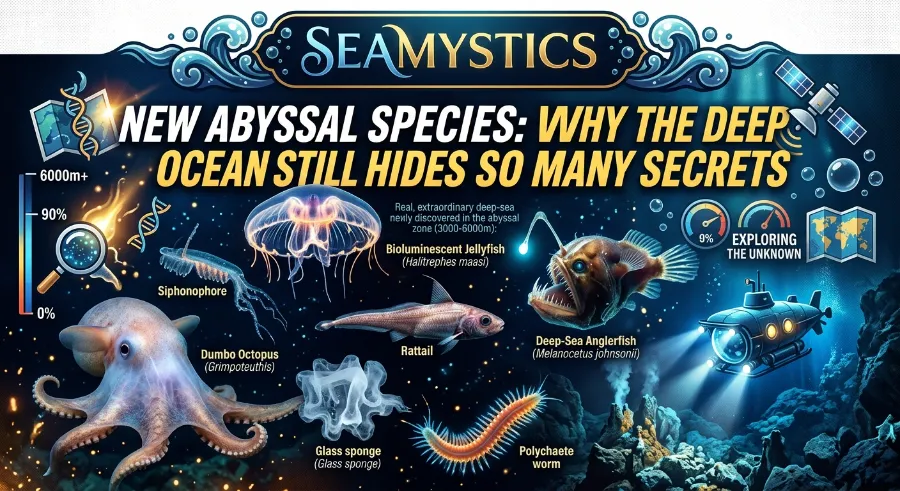

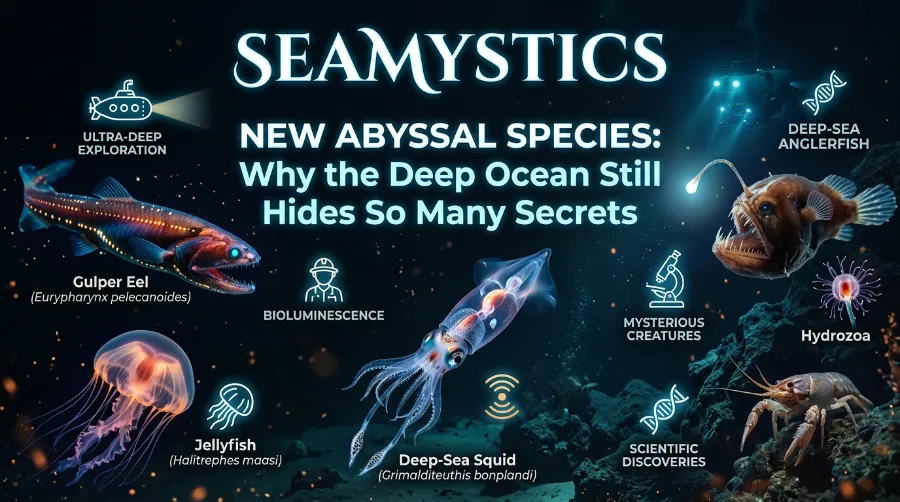
Every year, marine scientists add roughly 2,000 to 2,500 species to the official record of ocean life. Naturally, it is tempting to picture most of them rising out of the pitch black abyss. In reality, the truth is a little stranger. Right now, a new abyssal species is one of the rarest things in taxonomy, not the most common one, and that gap between what we expect and what we find makes the deep sea the most exciting frontier left in biology.
TL;DR: Fewer than 1 in 10 newly described marine species come from below 1,000 meters. Even so, scientists believe the deep sea holds the largest share of species we have not found yet. The mismatch comes from cost, pressure, and access, not an empty ocean. As a result, robotic exploration is already starting to shift that balance.
Key Takeaways
| Fact | Number | Why it matters |
|---|---|---|
| Share of new marine species from below 1,000m | ~7% | Contradicts the common assumption |
| Total marine species described (WoRMS) | ~242,000 | Roughly a third of the estimated total |
| New species described per year globally | 2,000 to 2,500 | Steady pace, concentrated in shallow water |
| Deep sea (below 200m) share of new fish species | ~30% | Second largest source after coral reefs |
| Ocean Census new species, 2025 to 2026 | 1,121 | A 54% jump year over year |
| Estimated undiscovered marine species | 700,000 to 1,000,000+ | Likely concentrated in deep, unsampled zones |
How Many New Species Turn Up in the Deep Ocean Each Year
The Overall Number Behind New Species
Two different questions get mixed up here. One is how many new species scientists describe overall, while the other is how many come specifically from the deep sea. According to the World Register of Marine Species, the total sits at around 242,000 valid marine species, and researchers add roughly 2,300 new ones a year. That number is the backdrop every deep-sea find has to compete against.
Reef vs Deep Sea: Where the 30% Really Comes From
Coral reefs supply about 30% of newly described marine fish, mainly because they are shallow and easy to reach, full of small, colorful species that divers can spot fast. Another 30% come from the deep sea, which sounds encouraging at first. However, once you split “deep sea” from “truly abyssal,” the picture changes. Most of that 30%, it turns out, comes from continental shelves and slopes between 200 and 1,000 meters, not the crushing depths below.
New Octopus Species Named After Mythical Creatures The Naming Trend Explained
What the Data Shows Below 1,000 Meters
This is where the Frontiers in Marine Science metrics study matters most. Researchers examined 600 randomly selected species descriptions and found that only 7% came from below 1,000 meters. Meanwhile, scientists collected nearly half between 0 and 60 meters. In plain terms, the average newly named marine animal is a small crustacean or mollusc from shallow tropical water, not a glowing creature from the Mariana Trench.
New Bioluminescent Species Found How Scientists Confirm Glowing Animals
Why the Perception Does Not Match the Numbers
So why does the opposite feeling persist? Largely, headline discoveries drive it, since glitter worms, ghost sharks, and alien-looking sponges tend to come from the deep. Consequently, they dominate the news cycle even though they make up a small fraction of the total. The sheer size of the ocean below 1,000 meters plays a role too, and it is easy to assume that scale alone must produce the bulk of new life. In truth, that scale probably does produce the bulk of undiscovered life. Still, it has not produced the bulk of described life yet, and that distinction is the whole story.
Museum Specimens Reclassified Old Samples That Turned Out to Be New Species
Why So Few New Species Show Up Below 1,000 Meters
The Cost Problem
A single day of ship time on a deep-sea research vessel can cost tens of thousands of dollars. On top of that, reaching abyssal depths requires a remotely operated vehicle (ROV) or a crewed submersible, both expensive to build, maintain, and deploy. Therefore, most research budgets simply cannot fund repeat trips.
Deep-Sea Expedition Discoveries What Research Ships Found This Year
The Physical Extremes
Below 1,000 meters, water pressure exceeds 100 times what it is at the surface. Meanwhile, temperatures hover near freezing, and there is no sunlight at all. Because of this, fast retrieval often damages specimens before scientists can even examine them.
Newly Described Sea Spider Species and Why They’re Larger Than Expected
The Taxonomic Backlog
Collecting a specimen is only step one. In fact, formally describing a new species takes an average of 13.5 years from first collection to publication, according to the Frontiers study. Too few trained taxonomists exist relative to the size of the backlog, so the queue keeps growing.
New Nudibranch Species The Sea Slugs Still Surprising Scientists
Taken together, these three barriers explain why species found deep sea discoveries almost always trace back to a well-funded, multi-year expedition. For instance, a reef biologist can snorkel out from a research station and photograph three new goby species before lunch, while a deep-sea team needs a ship, a robot, and years of patience for the same result.
New Anglerfish Species Discovered in the Pacific Abyss
There is a sampling problem underneath all of this too. Specifically, a 2026 PBS NewsHour segment noted that humans have directly observed less than 0.001 percent of the deep seafloor, an area roughly the size of Rhode Island, even though the deep ocean covers most of the planet’s surface. In other words, we are not finding few deep-sea species because few exist. Rather, we are finding few because we have barely looked.
Real Deep-Sea Discoveries Changing the Picture
The last eighteen months produced some of the clearest evidence yet that the deep ocean’s species count is about to climb, as exploration technology finally starts to catch up with the scale of the habitat.
- In September 2025, Mackenzie Gerringer’s team at SUNY Geneseo described three new species of abyssal snailfish from the eastern Pacific, combining ROV footage from the Monterey Bay Aquarium Research Institute with CT scans to confirm the finds.
- Elsewhere, researchers discovered a new abyssal fishing worm, adding fresh data on predatory adaptations in permanent darkness.
- Meanwhile in the Pacific, the International Seabed Authority documented 24 new species described in a single Clarion-Clipperton Zone survey, an area now drawing scrutiny over potential deep-sea mining.
- By March 2026, Scripps Institution of Oceanography scientists had placed two species, the Iskra glitter worm and the Elven abyss tunicate, on the World Register of Marine Species’ Top 10 New Species list for 2025, a year that produced more than 2,500 identified marine species overall.
- The following month, Tammy Horton’s team at the UK’s National Oceanography Centre described 24 new amphipod species from 4,000 meters down in the same zone, including an entirely new superfamily, Mirabestioidea. Horton compared it to discovering an unknown mammal family on land, saying it would be “like finding dogs.”
- Between mid-2025 and mid-2026, the Ocean Census Alliance confirmed 1,121 new marine species worldwide, a 54% jump over the previous year, with the deepest sample coming from 6,575 meters.
- Most recently, in August 2026, researchers reported 149 new deep-sea species from remote Indian Ocean seamounts, one of the largest single-region hauls on record.
Notably, each example follows the same pattern. None came from a lucky, one-off sighting. Instead, every one required a funded expedition, specialized robotics, and taxonomists willing to spend years on formal description work before the species even entered the record.
New Ray Species Identified Off Unexpected Coastlines
Where New Species in the Deep Ocean Actually Turn Up
Seamounts and Ridges
Nutrient-rich currents collide with hard rock at seamounts and ridges. As a result, that mix produces an outsized share of new coral, sponge, and crustacean species relative to the area involved.
Nodule Fields Under Mining Pressure
Polymetallic nodule fields, like the Clarion-Clipperton Zone, draw urgent attention right now. Interestingly, mining interest funded biodiversity surveys that likely would not exist otherwise, even though that same mining now threatens the habitat.
Vents and Whale Falls
Hydrothermal vents and whale falls keep producing species that depend on chemosynthesis instead of sunlight. Because of that, these communities exist nowhere else on the planet.
Undersea Volcano Discoveries New Species Found Near Hydrothermal Vents
The Midwater Nobody Talks About
The ocean’s midwater sits between roughly 200 and 1,000 meters. Smithsonian zoologist Karen Osborn called it “the largest habitat on Earth” after a Schmidt Ocean Institute expedition off Brazil found 31 new species there in a single two-week survey, including glass squid and gossamer worms. This expedition matters for another reason too, since it shows some of the richest recent discoveries sit just above the true abyss, not within it. After all, a species loosely labeled “deep sea” could sit anywhere from 300 to 6,000 meters down, and that range covers wildly different pressure, temperature, and food conditions.
Tools Making Deep-Ocean Discovery Faster
Robotic Vehicles
ROVs like SuBastian, operated by the Schmidt Ocean Institute, let scientists observe, film, and sample at depths no human diver could survive. Consequently, the footage streams back to the surface in real time.
Passive Collection Systems
Autonomous Reef Monitoring Structures, or ARMS, sit on the seafloor for months. In doing so, they passively collect small organisms that a single expedition would otherwise miss entirely.
Genetic Confirmation
eDNA and genome sequencing now let researchers confirm a new species without needing a fully intact specimen. Because of this shortcut, the step cuts years off the traditional description timeline.
The Museum Backlog Effect
Museum collections are quietly becoming a fourth source of new species. In the most recent Ocean Census count, for example, researchers found 728 of the 1,121 new species simply by combing through specimens that had already been sitting, unidentified, in existing archives.
What This Means for Ocean Conservation
The gap between known and likely ocean life is not just an academic curiosity. Scientists estimate 700,000 to over a million marine species exist in total, which means somewhere between two thirds and nine tenths of ocean life may still be undocumented. Since conservation law generally cannot protect a species that has no formal name, every undescribed species in a mining lease or a fishing ground currently has zero legal protection.
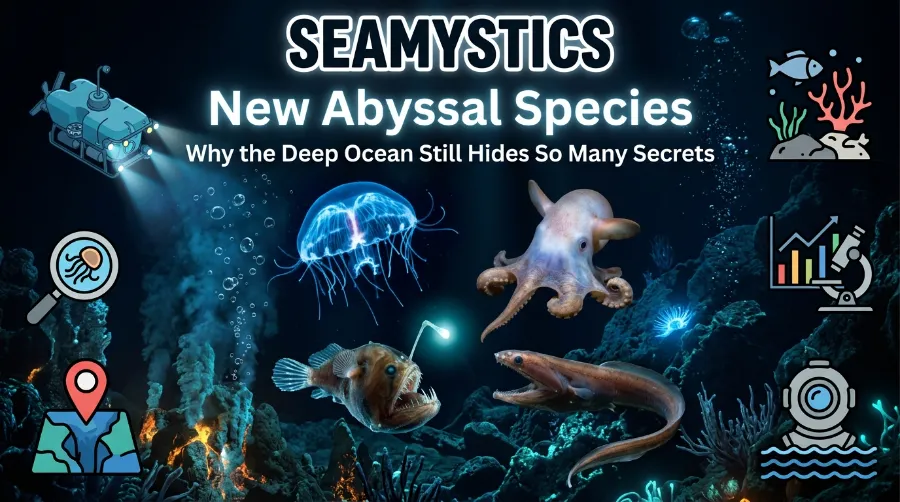
This tension is playing out in the Clarion-Clipperton Zone right now. A December 2025 study found that a single commercial mining trial cut local animal abundance by 37% and species counts by 32% within the equipment’s tracks. At the same time, that same zone has produced some of the richest new-species counts of the last two years. Ultimately, describing species faster is not just a scientific milestone anymore, it is becoming a race against extraction timelines.
Frequently Asked Questions
What counts as an abyssal species?
Most marine biologists define the abyssal zone as roughly 3,000 to 6,000 meters deep, sitting below the shallower bathyal zone and above the deepest hadal trenches, though definitions vary slightly between institutions.
Are most new ocean species actually found in the deep sea?
No. Around 7% of newly described marine species come from below 1,000 meters, while nearly half come from waters shallower than 60 meters, based on the most recent large-scale metrics study of species descriptions.
Why does it take so long to name a new deep-sea species?
On average, 13.5 years pass between first collection and formal publication, largely because too few trained taxonomists exist relative to the size of the backlog.
How many new marine species do scientists discover each year?
Globally, researchers describe roughly 2,000 to 2,500 new marine species a year, though the Ocean Census Alliance recorded a sharper jump, 1,121 new species in a single recent year, through its accelerated program alone.
Is deep-sea mining affecting new species discovery?
Yes, in both directions. On one hand, mining interest funded biodiversity surveys in areas like the Clarion-Clipperton Zone that produced dozens of new species. On the other, a 2025 study found that mining equipment tracks cut local species counts by roughly a third.
Conclusion
The deep ocean has not been holding back on us. We simply have not had the tools, time, or funding to look closely enough for long enough. Only a small share of the species named each year come from below 1,000 meters, but that number says far more about human limitations than about what actually lives down there. As robotic vehicles get cheaper and museum backlogs finally clear, expect that 7% figure to climb steadily over the next decade.
If you want to see what that shift looks like up close, our guide to the first photographs ever taken of newly described species is a good next stop. Also, if you are curious how a single find travels from a submersible camera to an official scientific name, our breakdown of how scientists confirmed a new octopus species walks through exactly what to expect. For ongoing coverage of deep-sea life, visit Sea Mystics.
References
- Bribiesca-Contreras, G. et al. (2025). Hidden gems of the abyss: first species of azooxanthellate scleractinian coral attached to polymetallic nodules in the eastern Pacific Ocean. WoRMS Top 10 New Species, 2025.
- Gerringer, M.E. et al. (2025). Descriptions of three newly discovered abyssal snailfishes (Liparidae) from the Eastern Pacific Ocean. Ichthyology and Herpetology, 113(3): 487 to 506.
- Jażdżewska, A.M. and Horton, T. (2026). New deep-sea Amphipoda from the Clarion-Clipperton Zone: 24 new species described. ZooKeys, 1274, 1 to 16.
- World Register of Marine Species (WoRMS). Ten Remarkable New Marine Species from 2025.
- Frontiers in Marine Science (2023). Marine biodiversity discovery: the metrics of new species descriptions.
- NOAA Ocean Exploration (2025). Deep-Sea Biological Discoveries: Celebrating 20 Years of NOAA Ocean Exploration.
- Scientific American (2026). Ocean Census reveals more than 1,100 new species.
- International Seabed Authority. Acting Locally in the Abyss: How Describing 24 New Species in the Pacific Ocean Is Helping Protect Our Oceans.
- Ecomagazine. New Abyssal Fishing Worm Discovered.