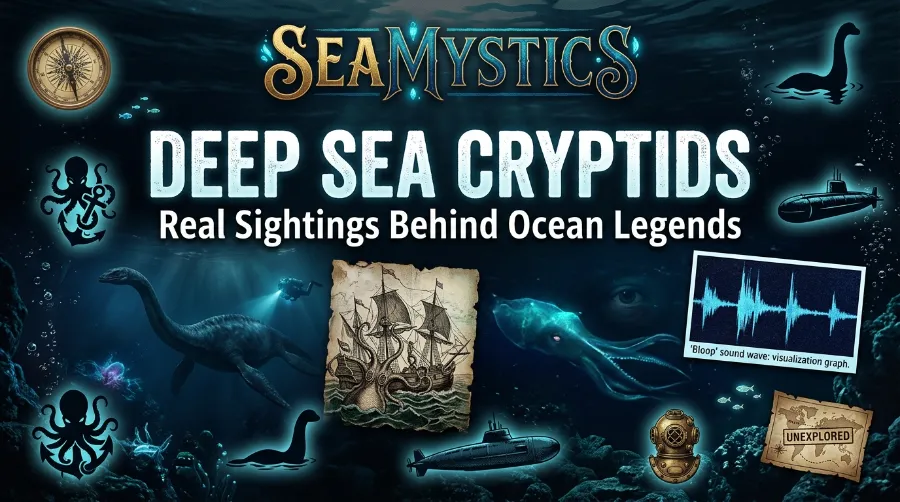

A twelve-foot oarfish washed onto a California beach on November 6, 2024. It was the third one that year. Only 22 have ever turned up in the state since 1901. Weeks later, a magnitude 7.0 earthquake shook the coast, and social media lit up with talk of the “doomsday fish.” That single event explains why deep sea cryptids still grip so many of us. Something ancient looking washes ashore, folklore rushes in to explain it, and science spends the next few months catching up.
Trunko Carcass Mystery: The Bizarre Carcass That Baffled the World
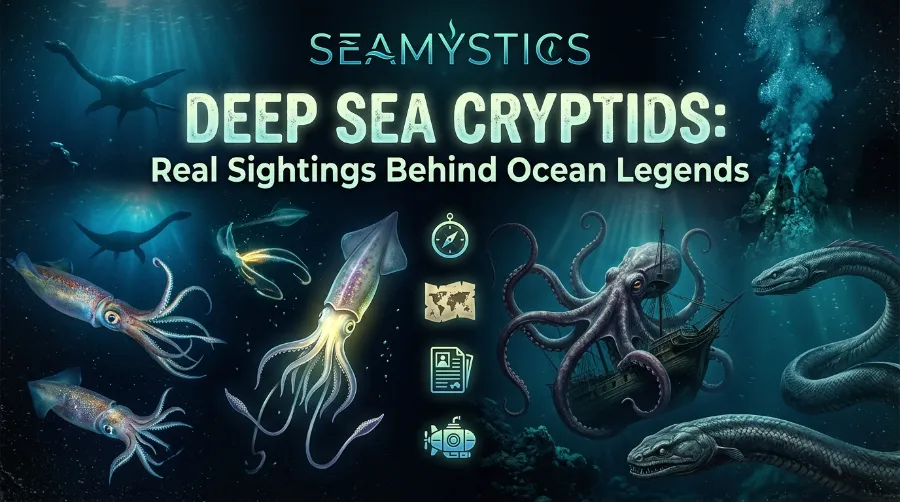
This piece walks through real ocean cryptid sightings behind the legends. It also covers the creatures scientists have since identified, plus the handful of mysteries nobody has fully closed the book on yet. Along the way, you will see why cryptozoology and marine biology keep bumping into each other, sometimes productively, sometimes not.
Key Takeaways
| Topic | What the Research Shows |
|---|---|
| Ocean explored | Researchers have mapped less than 25 percent of the seafloor in detail, according to NOAA |
| Most “cryptid” reports | People usually misidentify real, known species in poor light or from a distance |
| Best-documented case | HMS Daedalus sea serpent sighting, August 6, 1848, South Atlantic |
| Modern trigger events | Oarfish strandings in California, 2024 to 2025, tied to earthquake folklore |
| New species discovery rate | Scientists describe roughly 2,000 new marine species every year |
| Famous “mystery sound” | The Bloop (1997); NOAA linked it to Antarctic icequakes in 2012 |
TL;DR: Most deep sea cryptids trace back to real animals like giant squid, oarfish, and frilled sharks. These animals are simply rare, deep-dwelling, or poorly photographed. A small number of historical sightings, like the 1848 HMS Daedalus report, remain genuinely unexplained, mostly because the witnesses were trained observers with nothing to gain from lying. The ocean stays so unmapped that new species turn up constantly, and that is exactly why the legends refuse to die.
Why Deep Sea Cryptids Keep Resurfacing
Roughly 80 percent of the world’s oceans remain unexplored. That single fact keeps cryptozoology alive more than any grainy photograph ever could. When a region stays this poorly mapped, people find it easy to believe something big still hides down there. Meanwhile, marine science keeps handing us animals so strange looking that fiction barely needs to try.
Sea Serpent Sightings Throughout History: What Sailors Actually Saw
Ocean cryptid sightings tend to follow a familiar pattern. A rare or deep-water species surfaces unexpectedly. A witness with no marine biology training tries to describe it. The story grows a little with every retelling. By the time it reaches a local paper, the “sea serpent” has usually picked up a mane, glowing eyes, or a taste for capsizing boats.
The Ocean Is Still Mostly Unmapped
Scientists have mapped more of Mars’s surface in detail than they have mapped Earth’s own ocean floor, according to NOAA. That gap matters. It means marine biologists cannot always dismiss credible-sounding sightings outright. Researchers describe about 2,000 new species every year, and a fair number of those already carry a folklore name.
The Stronsay Beast Mystery: Scotland’s Sea Carcass That Fooled the Experts
Real Ocean Cryptid Sightings With Dates and Numbers
Some of the most cited “sea monster” cases in cryptozoology are not vague campfire stories. They come with names, dates, and multiple independent witnesses. That combination makes them harder to wave away.
- HMS Daedalus, August 6, 1848: Officers aboard the Royal Navy corvette HMS Daedalus watched a serpentine creature roughly 60 feet long in the South Atlantic for around 20 minutes at close range. Captain Peter M’Quhae filed an official report to the Admiralty. Several other officers independently confirmed the sighting, and a fabricated report to the Royal Navy would have ended a career.
- Gloucester Sea Serpent, 1817: Dozens of witnesses in Cape Ann, Massachusetts, described a similar creature over several months. Clergymen and justices of the peace were among them. The reports stayed consistent enough that the Linnaean Society of New England formed a committee to investigate.
- Falmouth Bay, Cornwall, 1976: Multiple witnesses reported a long-necked creature in the water. A woman known only as “Mary F.” sent two photographs to the Falmouth Packet newspaper.
- California oarfish cluster, 2024 to 2025: Three oarfish washed ashore in Southern California in 2024 alone, the most in a single year in the state’s recorded history. A camera then caught another sighting alive on video in Baja California Sur, Mexico, in February 2025.
These cases make even cautious researchers pause. That is not because the creatures are necessarily unknown. It is because the witnesses were often trained observers who had every reason to stay quiet rather than report something unbelievable.
Cadborosaurus: Canada’s Own Deep-Sea Cryptid Explained
Cryptid Sea Creatures List: Legend vs Known Science
This cryptid sea creatures list matches folklore against what marine biology has actually confirmed. The gap between legend and fact is often smaller than people expect.
| Cryptid Name | Region | Likely Real-World Explanation |
|---|---|---|
| Kraken | North Atlantic, Norway | Giant squid (Architeuthis dux); researchers first filmed it alive in its natural habitat in 2012 |
| Lusca | Bahamas, South Florida | Giant squid or Caribbean reef shark, misidentified in underwater caves |
| Champ | Lake Champlain, USA/Canada | Sturgeon, floating logs, or the disputed 1977 Mansi photograph |
| Cadborosaurus (Caddy) | British Columbia, Canada | Possibly an oarfish or an elongated basking shark carcass |
| Ningen | Southern Ocean, Antarctica | Unconfirmed; some researchers point to distorted icebergs or beluga misidentification |
| Bloop | South Pacific | NOAA officially identified it in 2012 as an Antarctic icequake, not a creature |
| Doomsday fish (oarfish) | Worldwide, notably California and Japan | A real, rarely seen deep-sea species, Regalecus glesne |
Deep Sea Legends That Turned Out to Be Real
Not every legend stays a legend. Some deep sea legends are real, in the sense that the animal behind them genuinely exists. Science simply took a while to catch up with the folklore.
- The giant squid: People dismissed it as pure myth for centuries, until specimens began washing ashore in the 1800s. Researchers did not film one alive in the deep sea until 2012, off Japan.
- The oarfish: Japan’s earthquake harbinger is a real, ribbon-shaped fish that can grow past 30 feet. Its rare 2024 strandings in California renewed the old folklore almost overnight.
- The colossal squid: This animal is larger and heavier than its giant cousin. Researchers filmed it alive in its natural deep-sea habitat for the first time in 2025, more than a century after scientists first described it from washed-up remains.
- The Magnapinna, or “long-armed” squid: It looks so alien that researchers from the Monterey Bay Aquarium Research Institute still get startled by fresh footage of it, including a first confirmed sighting in the Northeastern Pacific near California’s Davidson Seamount.
Unexplained Sea Creature Sightings That Still Puzzle Scientists
A handful of unexplained sea creature sightings resist a tidy explanation, even after modern review. The Bloop is probably the most famous example. In 1997, hydrophones over 3,000 miles apart picked up an extraordinarily loud, low-frequency sound in the South Pacific. Its rising pitch pattern initially looked biological, and that pattern prompted genuine speculation about an animal larger than any known species.
Giant Squid Legends vs Reality: How the Myth Became Science
NOAA eventually traced the sound to an icequake near Antarctica. By 2012, researchers had formally ruled out the biological theory. Even so, a natural, non-living event managed to mimic an animal call almost perfectly. That fact alone says something important about how thin the line really is between “unexplained” and “explained but still strange.”
Globster Mystery Explained: The Unidentified Blobs That Wash Ashore
How Marine Biologists Actually Investigate a Sighting
Readers often wonder how a report moves from a blurry photo to an actual scientific answer. The process stays fairly consistent across cases like the 2024 California oarfish strandings.
- Aquarium or university teams, often from Scripps Institution of Oceanography, recover a specimen or clear footage.
- Researchers take tissue samples and measurements, then preserve the animal in a marine vertebrate collection.
- DNA barcoding confirms the species and rules out claims of an unknown creature within days, not years.
- Researchers log their findings so they can track whether sightings are rising because of real ecological shifts, like changing ocean temperatures, or simply better public reporting through smartphones.
That process looks far less dramatic than most cryptid folklore assumes. It is exactly why we now know what an oarfish is, instead of treating every stranding as a fresh mystery.
The Montauk Monster Identified: What Washed Up in 2008, and What It Really Was
A Practical Note From the Field
I have spent years around necropsy tables and hydrophone data rather than campfires. From that vantage point, the instinct to explain strange sightings with legend is not laziness. It is human nature filling a genuine knowledge gap. The mistake most cryptid content makes is treating “unexplained” as a permanent state rather than a temporary one. Most cases eventually resolve once someone brings a tape measure, a camera, or a DNA kit to the encounter. The cases that still resist resolution are exactly the ones worth taking seriously.
The Gloucester Sea Serpent: New England’s Most Famous Ocean Mystery
Frequently Asked Questions
Are deep sea cryptids real? Most reported deep sea cryptids trace back to real, documented species such as giant squid, oarfish, and frilled sharks. A small number of historical sightings remain genuinely unresolved.
What is the most credible sea monster sighting on record? Many researchers point to the HMS Daedalus sighting of August 6, 1848. Multiple trained Royal Navy officers filed an official report, and none of them had anything to gain from fabricating it.
Why do oarfish sightings spike before earthquakes? Japanese folklore links oarfish strandings to earthquakes. Scripps Institution of Oceanography and NOAA have both said the data shows only a correlation, not a proven scientific link.
What caused the Bloop sound? NOAA identified the Bloop as an Antarctic icequake in 2012. That finding ended years of speculation that an unknown marine animal made the sound.
How much of the ocean is still unexplored? Roughly 80 percent of the world’s oceans remain unmapped in detail. That gap explains why new species, and new cryptid stories, keep surfacing.
Quick Quiz: Test Your Deep Sea Cryptid Knowledge
1. What did NOAA determine caused the mysterious “Bloop” sound? A) A giant squid B) An Antarctic icequake C) A submarine D) A whale migration Answer: B
2. How many oarfish washed ashore in Southern California in 2024? A) One B) Three C) Ten D) Twenty-two Answer: B
3. In what year did researchers first film a giant squid alive in its natural deep-sea habitat? A) 1997 B) 2005 C) 2012 D) 2020 Answer: C
4. Which historical sighting do researchers often cite as one of the most credible sea serpent reports? A) The Loch Ness photograph B) The HMS Daedalus sighting of 1848 C) The Montauk Monster D) The Kraken of Norway Answer: B
5. Roughly what percentage of the world’s oceans remain unexplored? A) 20 percent B) 80 percent C) 50 percent D) 5 percent Answer: B
Conclusion
Deep sea cryptids sit right at the intersection of genuine mystery and genuine science. That overlap is exactly why the topic refuses to fade. Real ocean cryptid sightings, from the 1848 HMS Daedalus report to the 2024 California oarfish strandings, show something important. Eyewitnesses are often describing something true, even when the explanation turns out less monstrous than the legend. As ocean exploration technology improves, expect more of these deep sea legends to turn real in the most satisfying way possible: as documented, photographed animals rather than myths.
For more on the technology driving these discoveries, check our related guide on ROV ocean exploration and new species discoveries. Our pillar guide to marine cryptozoology covers the wider topic in depth, and the full Sea Mystics home page has more expedition-based marine writing.
For deeper regional dives, Outscuba’s breakdown of South Florida and Caribbean sea cryptids covers the Lusca and Key West Sea Serpent in detail. The Armatus Oceanic podcast episode “Here Be Monsters” with Tyler Greenfield is worth a listen for the historical side of sea serpent research. Readers curious about land-adjacent lake cryptids may also enjoy Preston Posits’ rundown of New York cryptids, including Champ of Lake Champlain.
References
- NOAA Ocean Exploration, “How much of the ocean have we explored?”
- Scripps Institution of Oceanography, oarfish stranding records, 2024 to 2025
- CNN, “‘Doomsday fish:’ A rare oarfish returns to California shores,” November 2024
- Smithsonian Magazine, “See a Deep-Sea Oarfish Caught Alive on Video,” 2025
- NOAA Pacific Marine Environmental Laboratory, Acoustics Monitoring Program, Bloop
- Monterey Bay Aquarium Research Institute, Magnapinna squid footage record
- Hangar1Publishing, “Exploring Sea Monsters in Cryptozoology”
- Outscuba, “Cryptids of the Sea: South Florida and the Caribbean”