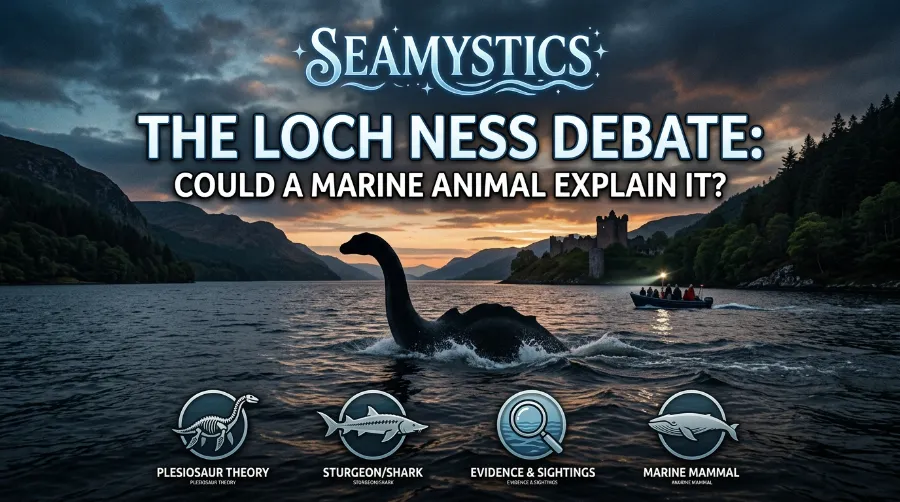

Every summer, a few dozen strangers line up along the shore of a Scottish loch. They hold their cameras ready. They wait for a shape that almost never comes. That waiting has lasted nearly a century, and it sits at the heart of the Loch Ness debate. Is there really something alive down there? Or do we just see what we want to see? As a marine biologist, I don’t think the honest answer is “neither.” Ordinary marine and freshwater animals can look extraordinary at the wrong angle, in the wrong light, for a few startled seconds. That idea is where this piece starts, and it’s why the Loch Ness debate deserves a real scientific look instead of a shrug.
Key Takeaways
| Question | Short Answer |
|---|---|
| What sparked the legend? | A 1933 newspaper report of a “monster” in Loch Ness, followed by the famous 1934 “Surgeon’s Photograph,” later admitted to be staged |
| How many sightings exist? | Over 1,150 entries on the official Loch Ness sightings register as of 2024 |
| What does the DNA say? | A 2019 University of Otago eDNA survey found no reptile, shark, catfish, or sturgeon DNA, but very large amounts of eel DNA |
| Leading scientific theory | A large eel, misidentified logs, seals, or optical effects from waves and boat wakes |
| Is it still being searched for? | Yes. The 2023 “Quest” search and a 2024 NASA-assisted search are the biggest since the 1970s |
TL;DR: No hard evidence supports a prehistoric reptile living in Loch Ness. The actual data points to something simpler: misidentified wildlife, mostly eels, otters, seals, and diving birds, plus wave interference and a century of confirmation bias. The Loch Ness debate is less about a hidden species and more about how ordinary marine biology turns into legend.
Why the Loch Ness Debate Never Actually Ended
How the Legend Started
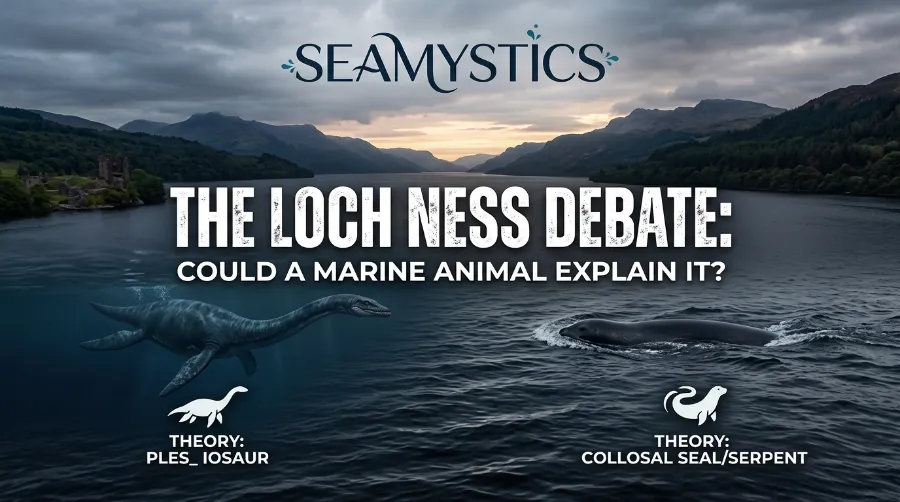
The modern legend traces back to April 1933. Hotel manager Aldie Mackay reported a “whale-like” creature in the loch. The local Inverness Courier ran the story and used the word “monster.” A year later, the famous Surgeon’s Photograph appeared in the Daily Mail. It showed a long neck rising from the water. Decades afterward, one of the men involved admitted on his deathbed that he had staged the image with a toy submarine. By then, though, the picture had already done its work. It still shapes how people imagine Nessie today.
Why Searches Keep Happening
Curiosity has never really cooled. The Loch Ness Centre says more than 1,150 sightings appear on the official register. In August 2023, hundreds of volunteers joined “The Quest.” Organizers called it the largest surface search of the loch since 1972. Drones with infrared cameras flew overhead. Hydrophones listened for unexplained calls. Livestreamed surface watches ran around the clock, and the team picked up four unexplained underwater sounds. A follow-up hunt in 2024 brought in NASA to help analyze the loch’s water and imaging data.
Sea Serpent Sightings Throughout History: What Sailors Actually Saw
So this isn’t a dead question that only shows up in tabloids. It’s an active, funded, technically serious search, even though the results so far stay ambiguous. Rabbies’ well-known travel guide to the loch lays out this back-and-forth between belief and skepticism for visitors planning a trip, and it’s worth reading for the tourism-and-folklore side of the story.
Loch Ness Monster Theories Worth Taking Seriously
Not every Loch Ness monster theory deserves equal airtime. A handful hold up better than the rest once you apply basic marine biology.
- Giant eels. European eels thrive in Loch Ness. A typical adult reaches one to one and a half meters, but size outliers happen in isolated freshwater bodies where eels can’t migrate to breed and just keep growing instead.
- Wels catfish or sturgeon strays. Both species can exceed two meters. Lakes across Europe have mistaken them for something stranger, though Scottish waters have no confirmed native populations.
- Seals and otters. Common and grey seals sometimes travel up the River Ness into the loch. A swimming seal’s humped back and raised neck match several classic Nessie sketches almost exactly.
- Standing waves and seiches. Loch Ness is long, narrow, and deep, which makes it prone to seiches. These internal waves can create moving humps on the surface with no animal involved at all.
- Misidentified logs and boat wakes. Peat-blackened tree trunks can float just below the surface for months. Combined with wave patterns from tour boats, they create shapes that photograph convincingly as a creature.
A marine biology writer at dannyechase.com walks through several of these physical explanations in more detail. It’s a useful companion read if you want the mechanics behind why waves and wakes fool even careful observers.
Cadborosaurus: Canada’s Own Deep-Sea Cryptid Explained
What the Nessie Scientific Explanation Actually Says
The 2019 eDNA Survey
The most rigorous attempt to settle the Loch Ness debate came in 2018 and 2019. Geneticist Professor Neil Gemmell of the University of Otago led an international team on an environmental DNA, or eDNA, survey of the loch. The method collects genetic material shed into water through skin, scales, waste, and mucus, then sequences it and matches it against global DNA databases. Gemmell’s team took 250 water samples from the loch’s edges, center, and greatest depths. Labs in New Zealand, Australia, Denmark, and France then analyzed the samples.
Giant Squid Legends vs Reality: How the Myth Became Science
What They Found, and Didn’t Find
The results were clear on what wasn’t there. Researchers found no reptile DNA, no shark DNA, no catfish DNA, and no sturgeon DNA anywhere in the loch. That single finding ruled out a surviving plesiosaur population and most of the other favorite Nessie scientific explanation candidates. What the samples did contain, in very large quantities and from almost every sampling point, was eel DNA.
Gemmell stayed careful about what that meant. The survey couldn’t determine the exact size of the eels contributing that DNA, so the “giant eel” idea remains genuinely open rather than proven. This isn’t even a new hypothesis. Gemmell himself pointed out that researchers floated the giant eel explanation as far back as 1933. The idea faded once the more dramatic notion of a surviving prehistoric reptile took hold in the public imagination.
Deep Sea Cryptids: Real Sightings Behind Ocean Legends
That last point matters more than it first appears. A well-supported, boring answer got quietly shelved in favor of an exciting one. That pattern shows up constantly in how marine mysteries get reported. HudsonAlpha’s piece on the Loch Ness Monster and marine life connects the dots between folklore and real biodiversity research, and it’s well worth reading in full for a broader look at how misunderstood ocean and lake creatures fuel these legends.
The Stronsay Beast Mystery: Scotland’s Sea Carcass That Fooled the Experts
A Marine Biologist’s Read on the Loch Ness Sightings History
Why Ordinary Animals Get Mistaken for Monsters
I’ve spent most of my career studying real animals that already sound made up. Anglerfish carry built-in headlamps. Some eels travel thousands of kilometers to spawn once, then die. Deep-sea squid flash light patterns like Morse code. None of them need a myth attached to feel remarkable, and that perspective changes how I read Loch Ness sightings history.
Trunko Carcass Mystery: The Bizarre Carcass That Baffled the World
Most eyewitness accounts cluster around a few recurring shapes: a long neck, one or more humps, and a wake with no visible cause. Marine biology explains every one of those shapes without much difficulty. A diving cormorant’s neck and body create a silhouette that looks reptilian from a distance. A line of otters swimming in single file produces a multi-hump pattern almost identical to classic sketches. Wind-driven waves interact with the loch’s underwater ridges and create standing humps that appear to move against the current. That’s exactly the kind of detail that convinces witnesses they saw something alive.
The Montauk Monster Identified: What Washed Up in 2008, and What It Really Was
What the Water Itself Does to Perception
None of this means every witness is wrong to trust their eyes. It means water distorts distance, size, and shape more than most people expect. That’s especially true in low light over a loch that plunges to 755 feet at its deepest point. That single fact, more than any hoax or conspiracy, explains why a century of sightings has produced thousands of stories and zero verified specimens.
Loch Ness Monster Facts That Rarely Make the Headlines
- Loch Ness holds more freshwater than every lake in England and Wales combined, roughly 1.8 cubic miles by volume.
- Peat stains the loch’s water so heavily that visibility drops to just a few feet below the surface. That’s ideal for misidentification and terrible for photography.
- The 2019 eDNA study found no evidence of any large animal outside of eels, seals, and common freshwater fish.
- Researchers couldn’t match around 25 percent of the DNA collected in that same study to any known species. That sounds dramatic, but it’s a normal outcome in environmental DNA work, since global reference databases are still incomplete.
- The loch has never fully frozen in recorded history, so a large ectothermic reptile would face real survival challenges even if one had somehow arrived there.
These Loch Ness monster facts won’t close the debate for true believers, and they aren’t meant to. They simply show that the physical environment supports plenty of drama without needing an undiscovered species to explain it.
Globster Mystery Explained: The Unidentified Blobs That Wash Ashore
Could an Undiscovered Marine Animal Really Be Behind It?
Marine biology has a long history of proving skeptics wrong about what the ocean hides. Sailors once dismissed the giant squid as myth, until specimens washed ashore in the 19th century. In 1938, a fishing net off South Africa pulled up a living coelacanth, a fish thought extinct for 65 million years. So the instinct behind the Loch Ness debate isn’t unreasonable on its face. Something big and strange might still be out there.
The Gloucester Sea Serpent: New England’s Most Famous Ocean Mystery
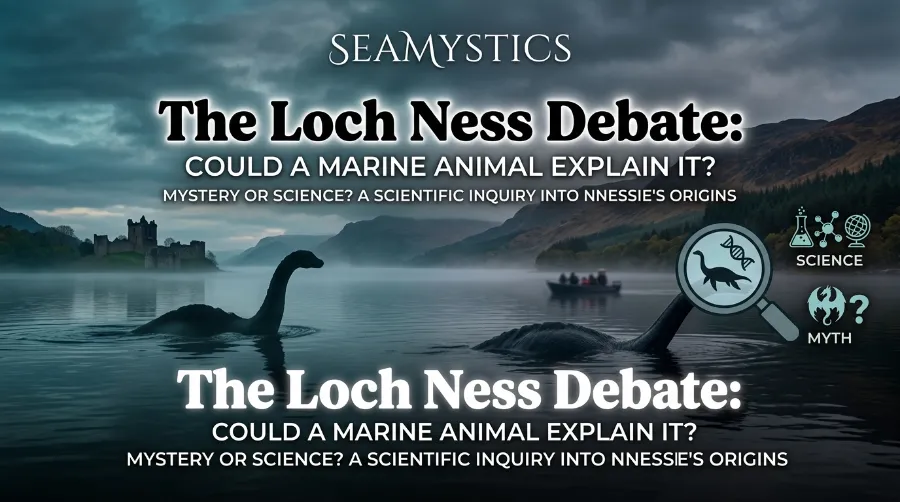
The catch is habitat. The deep ocean hides new species because it’s vast, largely unmapped, and physically inaccessible below a few hundred meters. Loch Ness is the opposite. It’s a single, well-charted freshwater basin about 23 miles long, and researchers have scanned it repeatedly with sonar since Operation Deeps can in 1987, then surveyed it at the genetic level in 2019. A breeding population large enough to sustain sightings across 90 years would need to eat, reproduce, and leave physical traces. Modern methods would almost certainly catch that evidence by now, and so far, none of it exists. Our pillar guide on deep-sea cryptids at /deep-sea-cryptids/ digs into real, verified examples of animals that stayed hidden from science for decades, if you want to see how researchers approach genuinely undiscovered deep-sea life instead of folklore.
Frequently Asked Questions
Is there any real scientific evidence for the Loch Ness Monster? No confirmed physical evidence exists. The closest thing to hard data, the 2019 eDNA survey, found abundant eel DNA and no evidence of reptiles, sharks, or catfish.
What is the most likely scientific explanation for Nessie? Most marine biologists point to a mix of misidentified eels, seals, otters, floating logs, and wave interference rather than a single hidden species.
How many Loch Ness Monster sightings have been recorded? Over 1,150 sightings appear on the official Loch Ness Centre register, dating back to the first organized surface watch in 1934.
Has anyone found Loch Ness Monster DNA? Genetic surveys haven’t found reptile, shark, catfish, or sturgeon DNA. They did find unusually high amounts of eel DNA throughout the loch.
Are searches for the Loch Ness Monster still happening? Yes. The 2023 “Quest” search was the largest in over 50 years, and a 2024 follow-up search brought in NASA and university scientists to help analyze data.
Conclusion
The Loch Ness debate has survived for almost a century, not because the evidence is strong, but because the loch itself stays genuinely mysterious: deep, dark, cold, and hard to see into. Real marine biology explains almost everything that keeps the legend alive, from oversized eels to wandering seals to simple wave physics. That doesn’t make Nessie any less fun to search for. It just means the most interesting animal in Loch Ness might already have a name, a life cycle, and a spot in a biology textbook. Keep exploring how real, verified marine mysteries get solved at seamystics.com, or check out our related guide at /related-guide.
Quiz: Test Your Loch Ness Knowledge
- What did the 2019 eDNA study find the most of in Loch Ness? a) Shark DNA b) Eel DNA c) Plesiosaur DNA Answer: b) Eel DNA
- What year did the famous “Surgeon’s Photograph” appear? a) 1933 b) 1934 c) 1972 Answer: b) 1934
- Roughly how many official Nessie sightings are on record? a) About 150 b) About 500 c) Over 1,150 Answer: c) Over 1,150
- Which organization led the 2019 environmental DNA survey? a) NASA b) University of Otago c) BBC Science Answer: b) University of Otago
- What natural phenomenon can create moving “humps” on the loch’s surface with no animal involved? a) Seiches (standing waves) b) Tides c) Tsunamis Answer: a) Seiches (standing waves)
References
- University of Otago, “First eDNA Study of Loch Ness Points to Something Fishy,” 2019
- BBC Science Focus, “Loch Ness Monster DNA Study Reveals ‘Plausible’ Explanation for Sightings”
- NPR, “Monster Hunters Are Conducting the Largest Search of Loch Ness in More Than 50 Years,” August 2023
- CBS News, “Loch Ness Centre Wants ‘New Generation of Monster Hunters’ for Biggest Search in 50 Years”
- Rabbies Travel Blog, “Loch Ness Monster: Fact or Fiction?” – https://www.rabbies.com/en-gb/blog/loch-ness-monster-fact-or-fiction
- Danny E. Chase, “The Loch Ness Monster Explained” – https://dannyechase.com/blog/lochness/
- HudsonAlpha, “How the Loch Ness Monster Could Help Save Marine Life” – https://www.hudsonalpha.org/how-the-loch-ness-monster-could-help-save-marine-life/