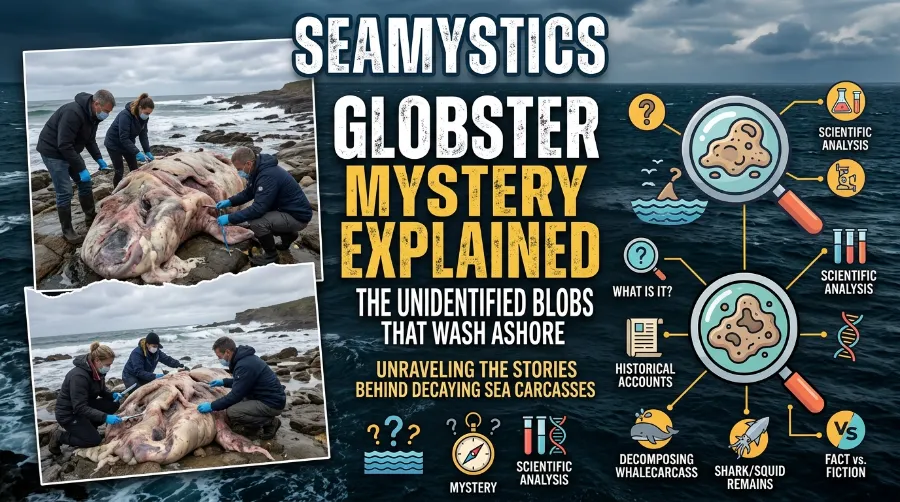

A six-foot mass of grey flesh turned up on Telok Melano beach in Malaysia on April 5, 2024, and within hours locals were calling it a monster. It had no face, no bones anyone could see, and a smell strong enough to clear the sand. Officials later said it was most likely a decomposing whale, but until lab results confirmed that, nobody could be sure. This is the globster mystery explained in its simplest form: a lump of unidentified flesh, a scared crowd, and a race to figure out what it used to be.
Globsters have washed up on coastlines for more than a century, and the pattern repeats almost every time. A shapeless mass appears, people assume the worst, and science eventually steps in with an answer that is usually less exciting than the rumor. Understanding globster identification science means understanding decay, ocean currents, and a bit of biology that most beachgoers never think about.
Key Takeaways
| Question | Quick Answer |
|---|---|
| What is a globster? | A large, unidentified organic mass that washes ashore, usually lacking bones or a recognizable shape |
| Who coined the term? | Naturalist Ivan T. Sanderson, after a carcass found in Tasmania in August 1960 |
| What are most globsters? | Decomposed whale blubber, in the vast majority of confirmed cases |
| How are they identified? | DNA testing and collagen fingerprinting, not visual inspection |
| Are they dangerous? | Not usually, but they can carry bacteria, so touching them is discouraged |
TL;DR: A globster is a mystery blob washed ashore that has lost its skin, bones, and shape through decay, which is why nobody can identify it just by looking. Almost every globster carcass explained by scientists so far has turned out to be whale, shark, or giant squid tissue. The mystery isn’t usually about the creature itself, it’s about how badly the ocean can disguise something we’d normally recognize in seconds.
What Exactly Is a Globster?
A globster is not a species. It’s a description. The word applies to any unidentified beach carcass that has decayed past the point of easy recognition, usually a pale, fibrous, gelatinous mass with no visible head, limbs, or skeleton.
The Stronsay Beast Mystery: Scotland’s Sea Carcass That Fooled the Experts
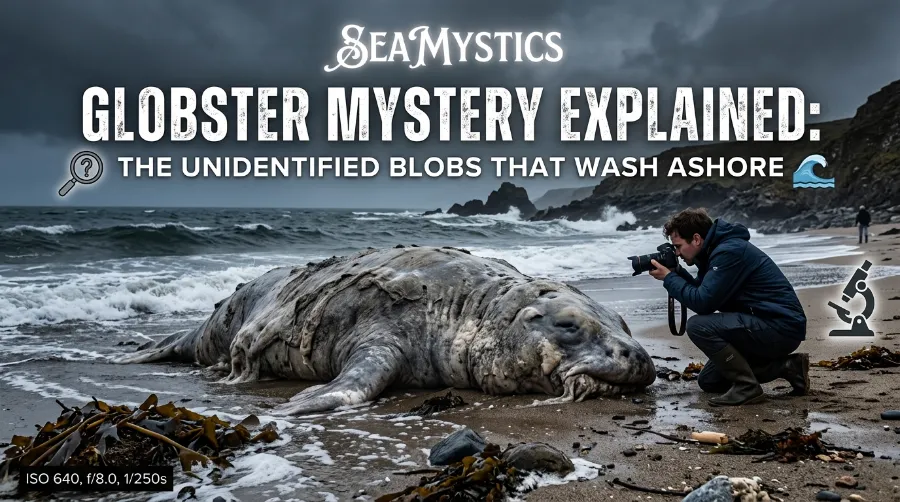
The term itself is younger than you might expect. As the Center for Inquiry has documented, Sanderson coined “globster” in 1962 by combining “glob” and “monster” after remains washed up on a Tasmanian shore two years earlier. Those remains were eventually identified as part of a whale.
Giant Squid Legends vs Reality: How the Myth Became Science
That naming pattern still holds today. Whenever a shapeless mass appears, someone gives it a nickname before anyone runs a test. Locals in Malaysia called their 2024 find a “globster” the same day it was spotted, according to coverage from Live Science and the coast guard’s own Facebook post.
Globster Identification Science: How Experts Actually Solve These Cases
Here’s the part most articles skip. Identifying a globster is not guesswork, and it stopped being guesswork decades ago.
The breakthrough case is the St. Augustine Monster, a mass that washed ashore in Florida in 1896. For nearly a century, nobody could say for certain what it was. Then, in 1995, researchers used electron microscopy and biochemical analysis and found the tissue was almost pure collagen, consistent with whale blubber rather than any giant octopus, as the Smithsonian Institution Archives explain in their account of the case.
That same approach, collagen and DNA analysis, is now the standard. A few methods marine scientists rely on:
- Collagen fingerprinting (ZooMS): breaks down protein structure to identify species even when the carcass has no distinguishing features left
- Mitochondrial DNA testing: compares degraded genetic material against known species databases
- Isotope analysis: can indicate whether the tissue came from a deep-sea or coastal animal
- Visual dissection: used alongside lab work, mainly to rule out obvious possibilities like sharks or turtles
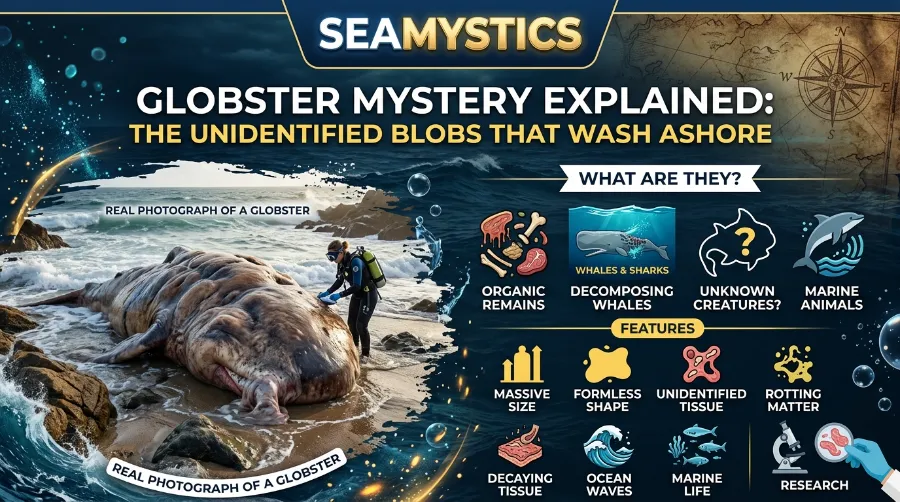
Decomposition is the real culprit behind the mystery. When a large marine animal dies, bacteria and saltwater break down skin, muscle, and cartilage far faster than fat and connective tissue. What’s left behind is often just a shapeless mound of blubber and collagen, which explains why so many globster carcasses look nothing like the animal they came from.
The Gloucester Sea Serpent: New England’s Most Famous Ocean Mystery
Real Cases: A Mystery Blob Washed Ashore Isn’t Rare
If you think this only happens once a decade, it doesn’t. Globsters turn up on coastlines almost every year somewhere in the world.
Malaysia, April 2024: A six-foot carcass appeared on Telok Melano beach and drew crowds before the APM Coastal Rescue Team confirmed it was likely a whale, pending DNA results.
Newfoundland, October 2024: Pale, gooey blobs began washing up on beaches, stumping both residents and government scientists. Guesses ranged from ambergris to sea sponge to industrial wax, and as of the reporting, experts hadn’t settled on an answer.
Philippines, 2017 and 2018: A 4,000-pound globster appeared in the Dinagat Islands in February 2017, and a 20-foot, shaggy-haired mass washed up near San Antonio beach the following year. Officials in both cases concluded the remains were whale carcasses, based on size, tissue type, and shape.
Tasmania, 1960 and New Zealand’s Muriwai case: The original globster that gave the phenomenon its name. A separate whale carcass at Muriwai went unidentified for two decades until 1995, when electron microscopy on the collagen fibers confirmed it was whale skin, according to Amusing Planet’s account of the case.
Cadborosaurus: Canada’s Own Deep-Sea Cryptid Explained
A closer look at the pattern shows something interesting. As writer Rebecca Grabill points out in her own breakdown of what a globster actually is, nearly every headline-grabbing globster story follows the same three beats: discovery, speculation, and a quieter scientific correction that rarely gets the same attention as the original scare.
Trunko Carcass Mystery: The Bizarre Carcass That Baffled the World
Why These Blobs Keep Confusing People
Three things explain why an unidentified beach carcass fools so many onlookers, even in an era of instant fact-checking.
- Scale distorts recognition. A carcass the size of a small car doesn’t look like any single animal we’re used to seeing whole.
- Water bleaches and swells tissue. Saltwater exposure changes color and texture within days, sometimes hours.
- Social media spreads the guess, not the answer. A dramatic photo travels faster than a lab result that arrives weeks later.
I’ve spent years reviewing stranding reports for coastal research groups, and the pattern is consistent: the more decomposed the animal, the wilder the public theories become, and the more mundane the eventual answer usually is. That gap between panic and paperwork is really the whole story of the globster mystery explained.
The Montauk Monster Identified: What Washed Up in 2008, and What It Really Was
Globster Carcass Explained: What It Usually Turns Out to Be
Based on documented cases going back to the 1890s, most globsters fall into a short list of categories:
| Likely Source | Approximate Share of Confirmed Cases | Identifying Clue |
|---|---|---|
| Whale blubber or skin | Majority of confirmed cases | Pure collagen structure under microscopy |
| Basking shark remains | Occasional | Distinctive gill and fin cartilage, once decomposed skin is removed |
| Giant squid tissue | Rare | Chitin remnants, distinct from vertebrate collagen |
| Unidentified or inconclusive | Small minority | Sample too degraded for reliable testing |
Numbers vary by region and by how many samples actually reach a lab, since many carcasses are buried or removed by local authorities before testing happens. That gap is one reason globster mystery explained articles sometimes disagree on exact percentages.
Frequently Asked Questions
Is a globster a new species?
Almost never. The overwhelming majority of tested globsters turn out to be known animals, usually whales, in advanced decay.
Are globsters dangerous to touch?
They can carry bacteria and parasites, so experts recommend avoiding direct contact and reporting a find to local wildlife authorities instead.
Why don’t officials identify them immediately?
DNA and collagen testing takes time, sometimes weeks, and samples need to reach a proper lab rather than being assessed on-site.
Do globsters only appear in warm climates?
No. Confirmed cases span Malaysia, the Philippines, Chile, Tasmania, New Zealand, and Newfoundland, so cold water beaches see them too.
What should I do if I find one?
Keep your distance, take photos from several angles, note the exact location, and contact a local marine stranding network or coast guard rather than approaching the carcass.
If globsters intrigue you, they sit inside a much wider world of unexplained ocean encounters. Our deep-sea cryptids guide covers the broader category these cases belong to, while the Loch Ness debate and our roundup of sea serpent sightings look at how eyewitness accounts and science collide in other corners of marine folklore. For a deeper dive specifically into definitions and history, Atlas Obscura’s piece on globsters is worth a read, including the Dinagat Islands case in more detail than covered here.
Conclusion
A globster is rarely the monster it looks like in the first photo. It’s usually a whale, stripped by the ocean of everything that would make it recognizable, left as a strange, smelly reminder of how much decay can hide. The science behind identifying these cases, collagen fingerprinting, DNA testing, and old-fashioned patience, has quietly solved most of the famous ones, even if the internet moves on before the lab results arrive. Next time a mystery blob washed ashore makes headlines near you, the real story probably won’t be a new species. It’ll be biology doing something strange and ordinary at the same time.
References
- Center for Inquiry, “Globster Mysteries,” https://centerforinquiry.org/blog/globster_mysteries/
- Smithsonian Institution Archives, “The Saint Augustine Monster,” https://siarchives.si.edu/blog/saint-augustine-monster
- Amusing Planet, “Globsters: When Sea Monsters Wash Ashore,” https://www.amusingplanet.com/2019/02/globsters-when-sea-monsters-wash-ashore.html
- Atlas Obscura, “What Is a Globster?,” https://www.atlasobscura.com/articles/what-is-a-globster
- Rebecca Grabill, “What On Earth Is a Globster?,” https://www.rebeccagrabill.com/blog/2017/9/29/the-first-night-of-halloween-what-on-earth-is-a-globster
- Live Science, “Decomposing globster washes ashore in Malaysia, drawing crowds,” April 2024
- Yahoo News, “Scientists Baffled by Gooey Blobs That Keep Washing Up on a Beach,” Newfoundland, October 2024