

Imagine a robot sinking through black water for hours. Its light flicks on at 4,000 meters, and something pale and strange drifts past the lens. The camera records it for a few seconds, and then it is gone. That is how most rare abyssal footage begins, and sometimes nobody ever sees that animal again.
Key takeaways
| Question | Short answer |
|---|---|
| What is rare abyssal footage? | Video of deep-sea animals that cameras have caught once or only a handful of times |
| Why do some animals appear only once? | The deep ocean is huge, dark, and rarely visited by cameras |
| Which animals are famous examples? | Giant squid, frilled shark, barreleye fish, Casper octopus, giant phantom jelly |
| Does “filmed once” mean “extinct” or “myth”? | No. It usually means we looked in very few places |
| Can the public watch such footage? | Yes, through live ROV streams and open video libraries |
TL;DR: A once filmed deep sea animal is usually not a ghost or a hoax. It is a real species that lives in a place almost no camera has visited. The ocean is so large and dark that one clip can be the only proof we have for years.
Why Rare Abyssal Footage Matters More Than You Think
The deep sea is the biggest living space on Earth, yet we know very little about it. NOAA says more than 80 percent of the ocean remains unmapped, unobserved, and unexplored. A 2025 study in Science Advances went further and estimated that only about 0.001 percent of the deep seafloor has ever been seen on camera. That is a tiny patch.
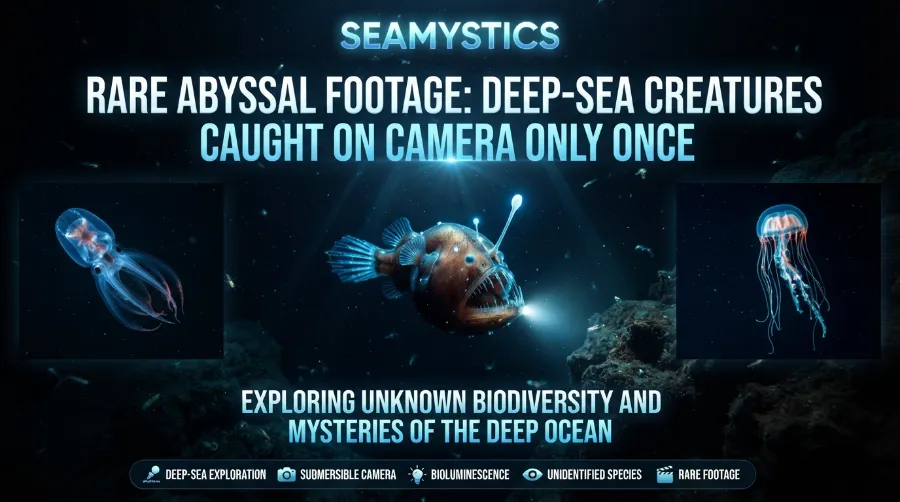
So when a camera catches a new animal, one clip can change a textbook. It shows color, movement, and behavior that a dead specimen on a ship’s deck never can. Scientists call this in situ evidence, which just means “seen in its real home.”
Rare abyssal footage also helps with protection. We cannot guard a species we have never seen alive. Even a ten second clip can tell us what depth it lives at, what it eats, and what lives nearby.
The Faceless Fish Rediscovery: Australia’s Strange Deep-Sea Find
At Sea Mystics, we keep a growing library of clips like these in our unidentified underwater footage guide. It is a good place to start if you want the bigger picture before reading the stories below.
Sonar Unidentified Shapes: Real Cases From the Ocean Floor Explained
The Rarest Ocean Footage at a Glance
Before we go deeper, here is a quick look at the best known cases. The depths are approximate, and each animal has its own story.
| Animal | Year of landmark footage | Approx. depth | What happened next |
|---|---|---|---|
| Giant squid | 2012 | About 630 m | Filmed again in 2019 in the Gulf of Mexico |
| Frilled shark | 2007 | Surface (a weak, sick animal) | Seen a few more times since, mostly by trawlers |
| Barreleye fish | 2004 | About 600 to 800 m | Seen repeatedly by research ROVs |
| Casper octopus | 2016 | About 4,290 m | Related pale octopuses found later at other sites |
| Giant phantom jelly | 2020 (modern video) | Deep midwater | Fewer than about 120 sightings in over a century |
Notice something important here. Many animals that were “seen once” were later seen again. The first clip simply told scientists where and how to look.
The Giant Squid: From Sea Monster to Moving Pictures
For hundreds of years, sailors told stories about huge squid that pulled ships under. Scientists found dead ones washed ashore, but nobody had filmed a live one. That changed in July 2012, when a Japanese team led by Tsunemi Kubodera filmed a giant squid near the Ogasawara Islands at roughly 630 meters.
The clip was calm and almost quiet. The animal moved slowly, glowed softly, and lit up the lens with its huge eye. It looked less like a monster and more like a shy deep-sea traveler.
Then came the twist. In 2019, a team working with ocean scientist Edith Widder used a low-light camera system in the Gulf of Mexico and filmed a young giant squid at around 759 meters. This shows how a one time sighting ocean story can turn into a pattern once scientists learn the right tools.
Here is what I take from it. The first clip is rarely the last, but it can take a decade of better cameras to prove it.
What the Lights Taught Us
Early footage of squid was poor because bright white lights scare deep animals. Researchers later used dim red light and a glowing lure that mimics a jellyfish. The animals came closer instead of running away.
This is a good example of practice shaping science. A camera is not a neutral window. It changes what the animal does.
Frilled Shark and Barreleye: One Time Sighting Ocean Stories
The frilled shark looks like something from a dinosaur book. It has an eel-like body, a wide mouth, and about 300 tiny three-pointed teeth. In January 2007, a weak frilled shark appeared near the surface at Awashima Marine Park in Japan, and the video went around the world.
That clip is rare for a simple reason. This shark normally lives deep, often several hundred meters down. Healthy ones almost never swim up where people can watch them.
The barreleye fish is even stranger. It has a see-through, fluid-filled head, and its green eyes sit inside it like two lamps. For decades, scientists only knew it from damaged net samples, where the clear head was lost.
Unidentified Whale Sounds That Don’t Match Any Known Species
Then researchers at MBARI used remotely operated vehicles in Monterey Bay and caught the fish on video. The footage showed that its eyes can swing forward and look up through the clear dome. You can read more about this kind of work on the MBARI website.
Why Nets Miss the Real Animal
Nets crush soft bodies. Pressure change also makes fragile animals fall apart as they rise. That is why video often beats a net when you want to know what a deep animal really looks like.
This is one of my favorite lessons from reviewing deep footage. A specimen tells you what an animal is made of. A video tells you how it lives.
Mystery Egg Cases on the Ocean Floor: What Lays Them?
Casper the Octopus and the Ghost-White Mystery
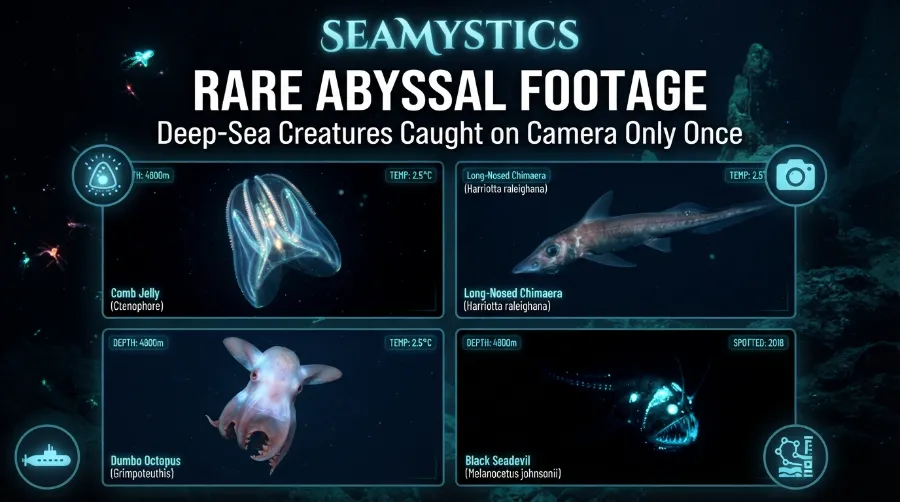
In 2016, NOAA’s Okeanos Explorer sent an ROV down near Necker Island in the Hawaiian region. At about 4,290 meters, the cameras found a small, pale octopus with no ink sac and no suckers in the usual two rows. Viewers named it “Casper,” after the cartoon ghost.
The animal sat on a dead sponge and seemed to lay its eggs there. Researchers realized that it did not match any known species. It was a clean example of rare abyssal footage that raised more questions than it answered.
Later, scientists found other ghost-like octopuses at hydrothermal and cold sites, including brooding groups off Costa Rica. So “Casper” was not alone. It was a hint that a whole group of deep octopuses had been hiding in plain sight.
For another look at how crews react when a surprise shows up on screen, see our story on the Nautilus live creature sighting. It shows how fast a calm control room can turn into a room full of excited scientists.
The Giant Eyeball Mystery: What Really Washed Up on a Florida Beach
The Giant Phantom Jelly: A Never Seen Again Creature?
The giant phantom jelly, Stygiomedusa gigantea, is a big, soft jelly with four ribbon-like arms that can stretch up to about 10 meters. Scientists first collected one in 1899. Over the following century, fewer than about 120 sightings were recorded, which makes it one of the rarest jellies on record.
In 2020, an expedition from Schmidt Ocean Institute filmed one again. The video was smooth and eerie. The jelly’s bell glided across the screen like a slow curtain.
That is why a “never seen again creature” label is often just a measure of how few cameras went looking. A species can be both rare to us and common in its own world.
The Nautilus Live Creature That Looked Alien: What It Really Was
Why Some Animals Get Filmed Only Once
If you wonder why this happens, there are a few simple reasons. They stack on top of each other.
- Darkness: Below about 1,000 meters, sunlight is gone.
- Pressure: At 4,000 meters, the water pushes on every part of a robot with huge force.
- Cost: A research ship can cost tens of thousands of dollars per day to run.
- Time: An ROV may spend hours just reaching the seafloor.
- Luck: The camera has to be in the right place at the right second.
Bioluminescence adds one more layer. A 2017 study in Scientific Reports found that about 76 percent of animals in Monterey Bay’s water column produce their own light. Many of them flash briefly and vanish, so a camera sees only a blink.
Depth and Difficulty
The numbers below show how the challenge grows with depth.
| Zone | Approx. depth range | Light | Camera difficulty |
|---|---|---|---|
| Sunlight zone | 0 to 200 m | Plenty | Low |
| Twilight zone | 200 to 1,000 m | Very faint | Medium |
| Midnight zone | 1,000 to 4,000 m | None | High |
| Abyssal zone | 4,000 to 6,000 m | None | Very high |
| Hadal zone | Below 6,000 m | None | Extreme |
Most of the famous one time clips come from the twilight and midnight zones. The abyssal and hadal zones are even less visited.
How Scientists Check Rare Footage Before Calling It Real
A strange clip is not proof of anything yet. Scientists run it through a simple routine, and I follow the same logic when I review footage for Sea Mystics.
- Check the metadata. Date, depth, location, and camera settings must match.
- Look for scale. Laser dots on the ROV give a size reference.
- Rule out debris. Plastic bags and bits of rope often fool viewers.
- Ask a specialist. A taxonomist who studies that group can often name it in minutes.
- Wait for a second source. A matching sample or another clip makes the case much stronger.
This process saves people from hoaxes and wishful thinking. It also keeps real mysteries honest.
A common mistake is to blame a “new monster” when the real answer is a known animal seen from a strange angle. I have seen blurry clips of drifting siphonophores, which are long colonies of tiny animals, taken for sea serpents. Context almost always matters more than the first impression.
Our guide on ROV mystery lights goes deeper into how glowing shapes get explained. It is useful reading if you like solving these puzzles yourself.
A Case Study in Careful Thinking
Consider a typical ROV dive that records a pale, ribbon-like shape at 3,000 meters. At first it seems like a new creature. After checking the laser scale and watching the frames one by one, the team sees that the “ribbon” is a piece of cable material drifting in the current.
That kind of result is not exciting, but it is useful. It teaches the crew what trash looks like at depth and helps them spot the real surprises later.
Mystery Seafloor Tracks: The Marks No One Can Identify
Sonar, Cameras, and the Shapes We Cannot Explain
Cameras are not the only tool. Sonar can reveal large shapes long before a robot reaches them. Some of those returns turn out to be schools of fish, a gas seep, or the seafloor itself.
Other returns remain unexplained for a while. Our report on unidentified sonar shapes explains how teams decide when a shape is worth a closer look. In short, sonar tells you where to point the camera, and the camera tells you what you found.
The Hidden Threats: Ghost Nets and Deep Fishing
Some rare animals face a quiet danger. Lost fishing gear, called ghost nets, keeps drifting and trapping animals long after the crew has left. Deep trawling can also scrape the seafloor and harm slow-growing life such as corals and sponges.
This matters for rare footage because we may lose a species before we ever learn its name. Each clip is a small record of a living place that still exists today. Protecting those places gives future cameras a chance to find more.
Where You Can Watch Rare Ocean Footage Today
You do not need a research ship to see the deep. Several groups share their dives openly, and you can explore them from your couch.
- The Nautilus Live photos and videos library shows dives from the E/V Nautilus, often with expert commentary.
- NOAA’s Ocean Exploration program posts expedition logs and video from Okeanos Explorer cruises.
- MBARI’s video work offers long records from Monterey Bay.
- Stock libraries such as Shutterstock’s abyss collection and Pond5’s deep footage search host licensed clips. They are handy for teachers and creators, but always check whether a clip is real footage, an animation, or a stylized scene.
A quick tip: when you see a viral deep-sea clip, search for the original expedition name. Real footage almost always comes with a ship name, a date, and a depth.
You can also browse the rest of our collection on the Sea Mystics homepage for related stories and new uploads.
What Makes Footage Valuable for Science
Not every clip helps scientists equally. Some features make a video far more useful.
- Clear depth and location data
- A stable view of the whole animal
- Scale lasers or a known object nearby
- Behavior such as feeding, hiding, or brooding eggs
- A sample or tissue taken at the same time
When all five come together, a one time sighting can become a formal species description. That is how Casper-type octopuses and many deep jellies move from “mystery” to “named animal.”
My Practical Advice for Readers and Creators
If you write about, teach with, or share this kind of footage, a few habits will protect your credibility.
First, name the source. Credit the ship, the institute, and the year. Second, avoid words like “monster” unless you are quoting a legend. Third, say what we do not know. Honest gaps make a story stronger, not weaker.
Fourth, keep an open mind about “only once.” Many of the animals in this article were seen again after better cameras arrived. Rare does not mean impossible.
Conclusion
Rare abyssal footage shows us how little of our own planet we have seen. Each once filmed deep sea animal is a small window into a world of darkness, pressure, and strange beauty. Some of these creatures, like the giant squid, have already been filmed again. Others, like certain ghost-white octopuses and giant jellies, are still waiting for their second close-up. The best way to support this work is to stay curious, share careful facts, and back groups that keep sending cameras down. The next great clip may already be recording, somewhere far below the waves.
Frequently Asked Questions
What does “rare abyssal footage” mean?
It means video of animals from the deep ocean that cameras have recorded once or very few times. The footage is rare because few robots reach those depths.
Is a creature filmed only once real?
Usually yes, but it needs checking. Scientists compare the clip with known species, look at scale and location, and wait for a second record when possible.
What is the rarest deep-sea animal ever filmed?
No single animal holds that title. Casper-like octopuses and the giant phantom jelly are often named because very few clips exist.
Why can’t scientists just catch these animals?
Soft deep animals often fall apart in nets or when pressure changes. Video lets researchers see them whole and alive.
Where can I watch real deep-sea footage?
Start with the Nautilus Live video library, NOAA Ocean Exploration, and MBARI. Check the expedition name before you share any clip.
Can a one time sighting ocean clip be fake?
Yes, some are hoaxes or animations. A real clip usually has a ship name, depth, date, and a research team behind it.
Quick Quiz: Test Your Deep-Sea Knowledge
1. When was a giant squid first filmed in its natural habitat?
a) 1899
b) 2012
c) 2020
2. What did early camera teams change to attract deep-sea squid?
a) Brighter white lights
b) Loud sounds
c) Dim red light and a glowing lure
3. About how deep was the Casper octopus filmed?
a) 430 meters
b) 4,290 meters
c) 10,000 meters
4. True or false: Every animal filmed only once has never been seen again.
5. True or false: Video can show deep animals more completely than net samples.
Answers: 1) b, 2) c, 3) b, 4) False. Many, like the giant squid, were filmed again later. 5) True.
References
- NOAA Ocean Exploration, “How much of the ocean have we explored?”
- NOAA Office of Ocean Exploration and Research, Okeanos Explorer expedition records (2016, Necker Island region)
- Monterey Bay Aquarium Research Institute (MBARI), Macropinna microstoma video records
- Robison, B. H., and Reisenbichler, K. R., “Macropinna microstoma and the paradox of its tubular eyes,” Copeia, 2008
- Kubodera, T., and Mori, K., “First-ever observations of a live giant squid in the wild,” Proceedings of the Royal Society B, 2005
- Martini, S., and Haddock, S. H. D., “Quantification of bioluminescence from the surface to the deep sea,” Scientific Reports, 2017
- Bell, K. L. C. and colleagues, deep-sea visual coverage study, Science Advances, 2025
- Schmidt Ocean Institute, expedition reports (2020)