
A diver drops to the seabed and spots a small black pouch with curly horns. Nothing is moving, and no animal is nearby. Yet the object feels alive, and for good reason. Mystery egg cases like this hold a growing baby, and finding one is like finding a sealed letter from the deep.
TL;DR: Most mystery egg cases on the sea floor come from skates, catsharks, chimaeras (ratfish) or sea snails. You can tell them apart by shape, size, color and texture. Look at the corners, the surface, and where you found the case, and you can usually name the parent.
| Key Takeaway | What to Know |
|---|---|
| Who lays most black cases? | Skates, catsharks and ratfish |
| Common nickname | Mermaid’s purse |
| Fastest clue | Shape of the corners and any tendrils |
| Deep sea surprise | Some skates leave eggs near warm vents |
| Incubation time | Months for shallow species, years for cold, deep ones |
| What to do | Photograph, measure, note the place, and report it |
What Are Mystery Egg Cases?
An egg case is a tough shell that protects an embryo while it grows. Many sea animals build one. The case keeps predators out and lets fresh seawater pass through tiny pores.
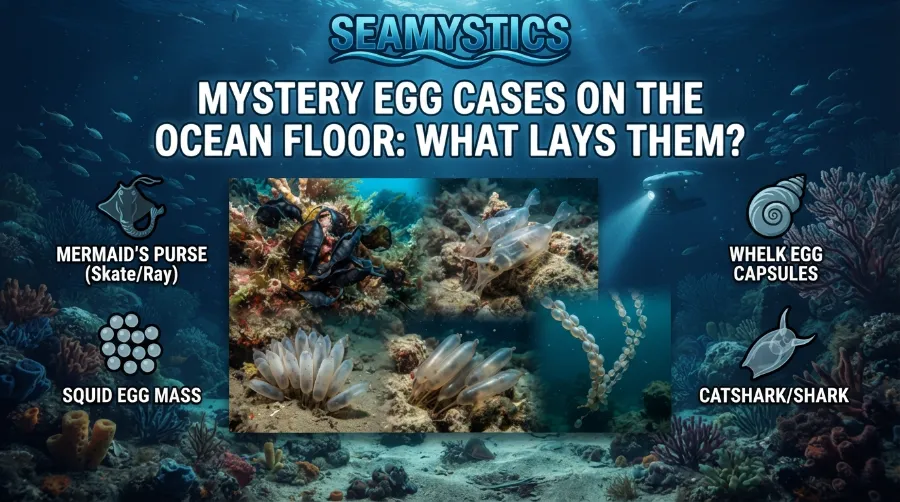
People find them on beaches, in fishing nets and on the seabed. Because the shells look odd, they often end up in the “unidentified sea creature eggs” pile. The truth is simpler. Most of them belong to a handful of well known animal groups.
Here at Sea Mystics, we get photos of these shells every month. Many people write in sure they found an alien pod. Almost none are. The real story is still wonderful, though.
The Faceless Fish Rediscovery: Australia’s Strange Deep-Sea Find
Mystery Egg Case Ocean Finds: The Usual Suspects
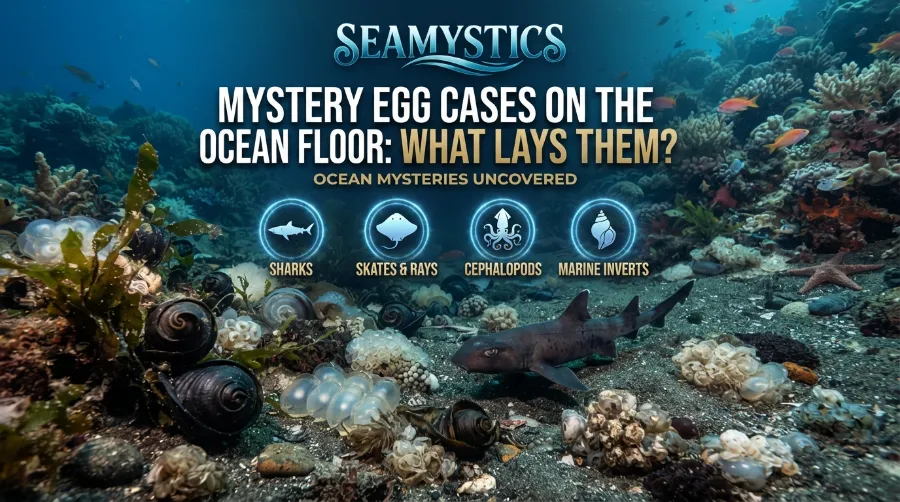
Four groups account for nearly every case you will meet. Learn these and you can name most finds in under a minute.
Skates: The Classic Mermaid’s Purse
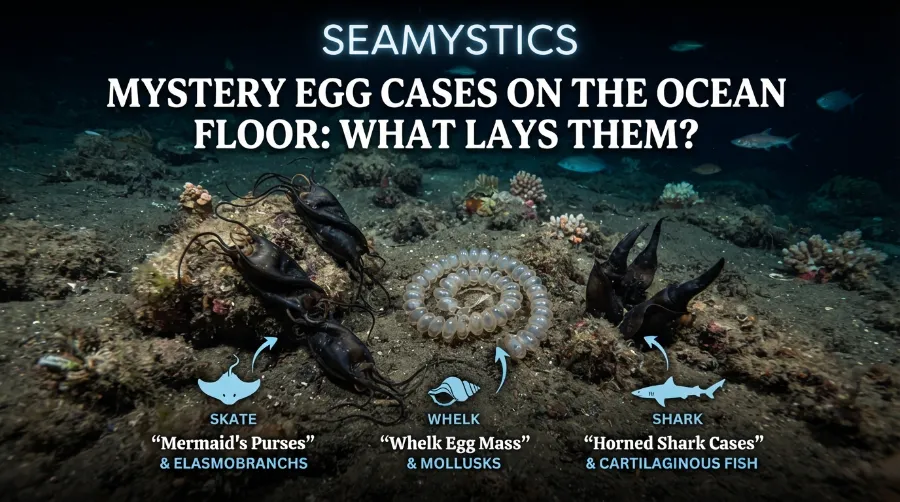
Skates are flat, wing shaped relatives of sharks. All skates lay eggs, and their cases are rectangular with a hollow horn at each corner. The shell is usually dark brown or black, and it feels leathery.
Skate cases can range from a few centimeters to about 25 cm long, depending on the species. Big deep sea skates make the largest ones. The horns help the case snag on rocks and seaweed so it will not drift away.
Catsharks: Cases With Curly Tendrils
Small spotted catsharks lay smaller cases with long, curly threads at the corners. The tendrils wrap around kelp, sponges and rope. Divers often find these on rocky reefs and wrecks.
Fresh cases look amber and almost see through. You can sometimes spot the embryo and the yolk if you hold one to the light. Old, empty cases turn dark and brittle.
Chimaeras and Ratfish: Spindle Shaped Cases
Ratfish lay long, tapered cases with a frilly edge. They look more like a leaf or a spindle than a purse. Check the Pacific coast of North America and cold northern waters for these.
The Save Our Seas Foundation write up on the first ratfish egg case of the season shows how excited researchers get over one find. It also gives a useful look at how a ratfish case differs from a skate case.
Sea Snails: The Ones People Mistake for Alien Eggs
Whelks lay stacks of small, flat pouches that join into a long string. Dried out, the chain looks like a papery wheel. Moon snails build a “sand collar,” a rubbery ring made of sand and mucus.
These cases do not look like a shark’s purse at all. Because they look so different, people often think they are a separate mystery. They are not. Each pouch holds many tiny snails, not one big embryo.
Black Egg Case Deep Sea: Why So Dark?
A black egg case on the deep sea floor often belongs to a skate. The dark color comes from a tough protein shell that darkens over time. Fresh cases start lighter, then turn brown, and finally black as they age.
Color alone is not proof, though. A dark case can mean an old, empty shell or a case that spent months in oxygen poor mud. That is why I always check shape first and color last.
A dark case also hides the contents. So here is a simple rule from my own survey work: if the case feels heavy and the sides look smooth and tight, it may still hold an embryo. If the case feels light, split or full of sand, the baby has probably left.
Unidentified Whale Sounds That Don’t Match Any Known Species
Strange Ocean Egg Discovery: Real Cases That Surprised Scientists
Science has some great stories here. They show that mystery egg cases are not just beach trash. They are clues about where animals breed.
- Galapagos skate nursery. Researchers using a deep sea submersible found a skate nursery near hydrothermal vents on the Galapagos Rift. They counted more than 150 egg cases and reported the find in 2018 in Scientific Reports. The warm vent water likely speeds up development.
- Monterey Bay deep skate nursery. The Monterey Bay Aquarium Research Institute (MBARI) described a deep sea skate nursery off California with thousands of cases. The cold water there means embryos may need several years to hatch, according to MBARI’s reporting.
- Pearl octopus garden. In 2018, researchers found a huge group of brooding octopuses near Davidson Seamount, off the California coast. That find reminds us that not every strange egg cluster belongs to a fish.
You can read more about how researchers share finds like these on the NOAA Ocean Exploration site and at MBARI.
Notice the pattern. Animals often pick the same safe spot again and again, so one case usually means more nearby. That is how a “mystery” turns into a nursery.
The Giant Eyeball Mystery: What Really Washed Up on a Florida Beach
How to Identify Unidentified Sea Creature Eggs: A Simple Step List
Use these steps in order. They work for divers, beachcombers and anyone who sorts a net catch.
- Look at the shape. Is it a rectangle, a spindle, a string of pouches or a ring?
- Check the corners. Hollow horns point to a skate. Curly threads point to a catshark.
- Measure the length. Use a ruler or coin for scale. Write the number down.
- Feel the surface. Leathery means shark relative. Papery means snail. Rubbery with sand means moon snail.
- Note the place. Record depth, habitat and the nearest coast. These details narrow the list fast.
- Photograph both sides. Add a ruler in the frame and use natural light.
- Compare with a guide. Match your notes with a trusted regional guide.
Do not shake or open a live case. If the embryo is alive, put the case back where you found it.
Quick Comparison Table
| Animal Group | Shape | Corners | Typical Size | Common Habitat |
|---|---|---|---|---|
| Skate | Rectangle | Hollow horns | About 5 to 25 cm | Sand and mud, shallow to deep |
| Catshark | Small pouch | Long curly tendrils | About 5 to 7 cm | Rocky reefs, kelp, wrecks |
| Ratfish (chimaera) | Spindle with frilled edge | None | About 10 to 20 cm | Cold, deeper shelf waters |
| Whelk | String of flat pouches | None | Chain up to 30 cm or more | Sand and rock near shore |
| Moon snail | Rubbery collar | None | Palm to dinner plate | Sandy flats |
These ranges are general. Individual species vary, so treat the table as a starting point, not a final answer.
Incubation Times: How Long Do the Babies Wait?
Temperature controls the clock. Warm shallow water speeds growth, and cold deep water slows it down.
| Setting | Rough Incubation Time |
|---|---|
| Warm, shallow skate or catshark case | A few months to about a year |
| Cold, deep skate case | Often 1 to 3 years, with some reports near 4 years |
| Hydrothermal vent nursery | Likely shorter because of warm water |
I suggest turning this table into a simple bar chart for your site. A chart makes the “cold means slow” idea clear at a glance, and it helps readers remember it.
What Lays Them? How a Skate Makes an Egg Case
The mother builds each case inside her body. A special gland coats the egg in layers of protein. Then she lays it, and the shell hardens in seawater.
Inside, the embryo feeds on a big yolk sac. It wiggles its tail to push fresh water through the case. After months or years, a fully formed baby skate cuts its way out through a seam at one end.
That baby looks like a tiny adult. It does not float as a larva. It starts hunting small prey right away, which is why a safe nursery matters so much.
Mystery Seafloor Tracks: The Marks No One Can Identify
Why Egg Case Finds Matter for Ocean Science
Each case tells us where a species breeds. That helps scientists protect the right places. If a nursery sits inside a trawling zone, the damage can be huge, because adults and eggs both stay put.
Egg cases also help track species that are hard to survey. Many skates and sharks are slow growing and slow to recover. A single recorded case can add a data point that adults alone cannot give.
Citizen science helps too. The Shark Trust runs the Great Eggcase Hunt, where beachgoers in the UK and Europe photograph and report cases they find. These reports show which species live near which coasts.
My Field Practice: Tips From Real Survey Work
I handle egg cases in the field and in the lab. A few habits have saved me from mistakes again and again.
- Always carry a scale. A photo without a ruler is almost useless for ID.
- Log the depth. A skate case at 20 meters and one at 2,000 meters can point to very different species.
- Skip the guess on color. Aged cases darken. Match on shape and size first.
- Leave live cases. If you feel the embryo move or see a tail flick, put the case back gently.
- Record the neighbors. Note corals, kelp or rock walls nearby. Egg layers love structure.
[Add your own survey numbers here, such as how many cases you logged, the dates and the sites. Real data will make this section stronger.]
When ROV Footage Shows Strange Eggs
Remote vehicles now film deep sea nurseries in clear detail. Still, a camera can fool you. Lights change colors, and size is hard to judge without lasers.
Our guide to unidentified underwater footage explains how to read odd video clips without jumping to wild ideas. If you also see floating glints in footage, our look at ROV mystery lights will help you separate real lights from camera effects.
Live feeds can show nurseries as they happen. Our article on a Nautilus live creature sighting shows how scientists describe new animals on the spot. Odd shapes picked up by sound waves can also fool people, and our piece on sonar unidentified shapes covers that side of the story.
Sometimes a round object is not an egg at all. Our post on the giant eyeball mystery shows how a simple float or a fish part can look like something far stranger. For more deep sea cases like that, browse the full Sea Mystics site.
Common Mistakes That Lead to Wrong IDs
People make the same errors over and over. Avoiding them saves time and keeps your records clean.
- Calling every black pouch a skate case. Catsharks and ratfish also lay dark cases.
- Mixing up a whelk chain with a fish egg case.
- Ignoring size. A palm sized object and a thumb sized one are rarely the same animal.
- Forgetting the habitat. A case on a rocky reef points to different animals than a case on open mud.
- Opening the case. This kills a living embryo.
What to Do If You Find One
First, take clear photos with a scale. Next, note the date, place, depth and habitat. Then check whether the case is full, split or empty.
After that, share your find. Send it to a local marine group or a citizen science project. Even a blurry beach photo can add useful data.
Finally, leave live cases in the water. A baby skate inside needs that case far more than any collector does.
Frequently Asked Questions
What are mystery egg cases?
They are tough shells that hold the embryos of sharks, skates, ratfish or sea snails. They look odd, so people often call them unidentified.
What is a mermaid’s purse?
It is the common name for an empty skate or shark egg case, often washed up on a beach.
Can I tell if an egg case is alive?
A heavy, tight, amber case may hold an embryo. A light, split or dark case is usually empty. When in doubt, leave it alone.
Are black egg cases dangerous?
No. They are harmless to touch. Wash your hands after handling anything from the sea.
How long do skate eggs take to hatch?
Warm, shallow skate eggs hatch in months. Cold, deep ones can take years.
Can sea snail eggs look like fish eggs?
Yes. Whelk strings and moon snail collars confuse many beachcombers, but their shapes differ clearly from a skate’s rectangular case.
Where do deep sea skates lay their eggs?
They often return to the same nursery sites, including some near hydrothermal vents.
Conclusion
Mystery egg cases look strange, but they follow clear rules. Shape, corners, size, texture and place will name most of them. Each find also tells a bigger story about where animals breed and how the ocean stays alive. Photograph what you see, record it carefully and share it. Your small discovery might help protect a whole nursery.
Quiz: Test Your Egg Case Skills
1. Which animal usually lays a rectangular case with hollow horns at each corner?
a) Whelk
b) Skate
c) Moon snail
2. What do the curly tendrils on a small catshark case do?
a) Help it float
b) Attract fish
c) Grip kelp, rope and rock
3. Which clue is least reliable for identification?
a) Shape
b) Color
c) Corners
4. True or False: All dark egg cases hold a living embryo.
5. True or False: Cold deep water can make egg cases take years to hatch.
Answers: 1) b. 2) c. 3) b. 4) False. 5) True.
References
- NOAA Ocean Exploration, oceanexplorer.noaa.gov
- Monterey Bay Aquarium Research Institute (MBARI), mbari.org
- Salinas de Leon et al., 2018, Scientific Reports, hydrothermal vent skate nursery at the Galapagos Rift
- Shark Trust, Great Eggcase Hunt, sharktrust.org
- Save Our Seas Foundation, “Finding the First Ratfish Egg Case of the Season”
- The Marine Detective, egg case tag, themarinedetective.com/tag/egg-case/