
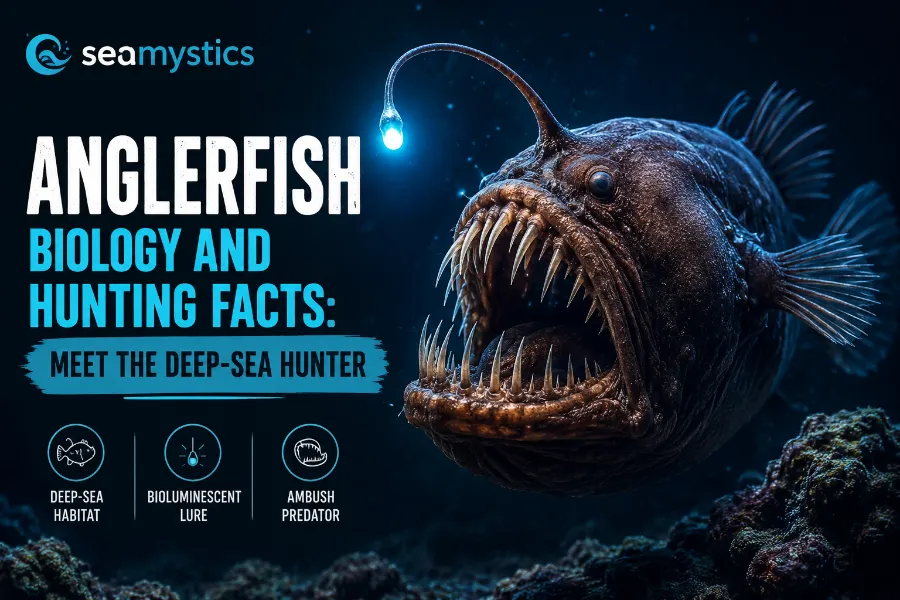

Picture total darkness, crushing pressure, and near-freezing water. Then, out of nowhere, a tiny light flickers on. That soft glow is not a rescue signal. It is a trap. This is how anglerfish biology and hunting facts come together to create one of the ocean’s strangest predators, a fish that carries its own headlamp into the abyss and waits for dinner to swim right up to its teeth.
If you want to learn more about Write what weird ocean creatures facts out our detailed guide for practical tips and expert advice.
Anglerfish live in some of the harshest parts of the sea, yet they thrive there because evolution handed them a built-in fishing rod. Their world runs on patience, camouflage, and light, and that combination makes them one of the most talked-about members of ocean life today. Before we go deeper, here is a quick snapshot of what makes this fish so unusual.If you want to learn more about Write what anglerfish facts deep sea out our detailed guide for practical tips and expert advice.
If you want to learn more about Write what giant squid facts revealedout our detailed guide for practical tips and expert advice.
Key Takeaways
| Fact | Detail |
|---|---|
| Primary hunting tool | A glowing lure called an esca, powered by bacteria |
| Typical depth | 200 to 2,000 meters (656 to 6,561 feet) |
| Size difference | Females can be 60 times longer than males |
| Diet | Fish, squid, and crustaceans, often larger than their own body |
| Reproduction method | Males fuse permanently to females in some species |
| Known species | Around 200 species across several families |
| Recent milestone | First confirmed daylight sighting recorded in February 2025 |
What Is an Anglerfish, Exactly?
An anglerfish is not one single species. It is a large group of fish, with roughly 200 recognized species living across the world’s oceans. Most of them belong to the deep sea, though a few shallow-water cousins exist near coral reefs and sandy seafloors.
The name comes from tIf you want to learn more about Write what octopus intelligence facts explained out our detailed guide for practical tips and expert advice.
heir hunting style. A modified spine on the head acts like a fishing rod, called an illicium, and it dangles a glowing lump of flesh known as an esca. Because this setup mimics a baited hook, early naturalists thought of the fish as an “angler,” and the name stuck.
If you want to learn more about out vampire squid facts explained detailed guide for practical tips and expert advice.
Most people picture the deep-sea version when they hear the word anglerfish. That image usually comes from the humpback anglerfish or a close relative, since these are the species most often filmed by deep-sea submersibles. However, shallow-water anglerfish, sometimes called frogfish, also use lures, just in brighter water and with different colors.
To get a better understanding of how jellyfish facts ocean life breaks down exactly what to expect.
Where AIf you want to learn more about out blobfish facts deep seaour detailed guide for practical tips and expert advice.nglerfish Live
Deep-sea anglerfish generally stay in the twilight zone and beyond, roughly between 200 and 2,000 meters down. According to the Woods Hole Oceanographic Institution, one commonly studied species, Oneirodes eschrichtii, grows up to 29 centimeters as a female, while males reach barely 2.8 centimeters. That is a massive gap for two fish of the same species. whoi
Because sunlight cannot reach these depths, temperatures hover near freezing and food is scarce. As a result, anglerfish had to evolve a hunting method that works in permanent darkness, and that pressure produced the glowing lure we know today.
Anglerfish Biology and Hunting Facts: How the Lure Actually Works
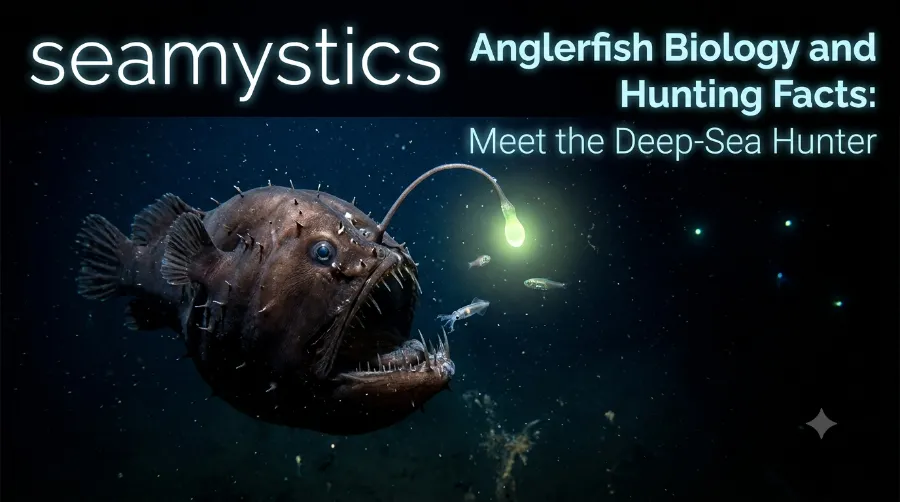
This is the part that fascinates researchers and casual readers alike. The glow does not come from the fish itself. Instead, it comes from bioluminescent bacteria living inside the esca in a partnership that benefits both sides.
To get a better understanding of how colorful sea slug species facts breaks down exactly what to expect.
The bacteria cannot switch themselves on without some kind of signal from the fish, which points to a true symbiotic relationship between the anglerfish and its microbial tenants. In simple terms, the fish controls the light, and the bacteria supply it. This arrangement lets the anglerfish flash its lure only when prey swims close enough, saving energy in a place where every calorie counts. whoi
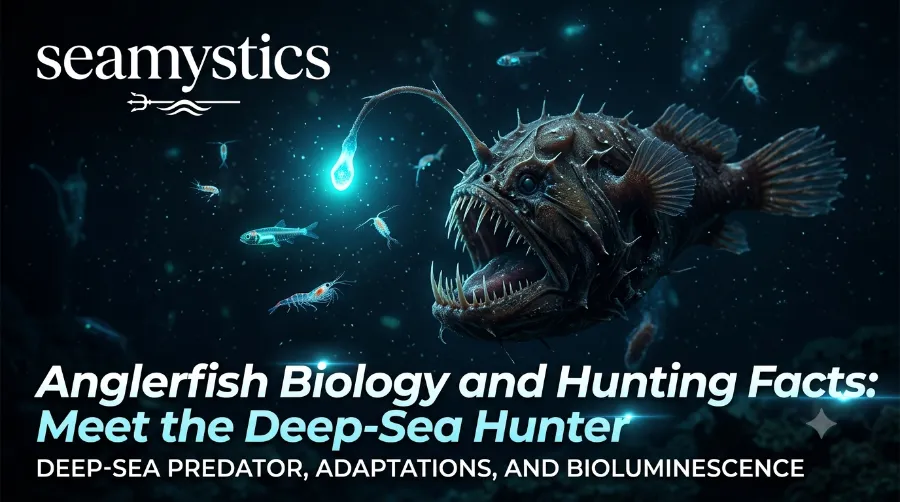
Once a smaller fish or shrimp gets curious and swims toward the light, the anglerfish strikes with astonishing speed. Its jaw and skull are hinged loosely, which allows the mouth to open wider than most fish could manage.
To get a better understanding of how seahorse facts ocean life breaks down exactly what to expect.
Why the Bite Is So Effective
Anglerfish do not just have big mouths. They have flexible bodies built for oversized meals. Here is why that matters:
- Expandable stomachs let them swallow prey up to twice their own body length, which is critical in a habitat where meals appear rarely.
- Backward-curving teeth stop struggling prey from escaping once trapped inside the mouth.
- Low metabolism means a single large meal can sustain an anglerfish for weeks or even months.
- Ambush posture keeps the fish nearly motionless, saving energy while the lure does the work.
According to the Woods Hole Oceanographic Institution, a female anglerfish’s flexible bone structure and stretchy stomach make it possible to swallow animals twice her own size, a trait that becomes essential in a food-scarce environment like the deep ocean. whoi
This hunting strategy is a textbook example of evolution favoring efficiency over speed. Rather than chasing prey across long distances, which would burn precious energy, the anglerfish waits. It lets curiosity do the work.
The Bizarre Anglerfish Mating System
If the hunting method feels strange, the mating habits are even stranger. Male anglerfish are small, weak swimmers with a single goal, finding a female before their limited energy reserves run out.
In several deep-sea species, once a male finds a mate, he bites into her body and never lets go. Over time, his tissue fuses with hers. He loses his own eyes and internal organs, becoming dependent on the female’s bloodstream for nutrients, while she can carry several fused males across her lifetime. This process, called sexual parasitism, ensures the female always has sperm available whenever she is ready to spawn, without needing to search for a partner in an empty, dark ocean. whoi
This is not romantic in the traditional sense, but it solves a real biological problem. Finding a mate in total darkness across thousands of square miles of open water is incredibly difficult. Permanent attachment removes that problem entirely.
Real-World Anglerfish Encounters and Discoveries
Textbook facts are useful, but real sightings bring this fish to life. Several recent events show just how rare and unpredictable anglerfish encounters can be.
In February 2025, researchers from the NGO Condrik Tenerife were on a shark research trip near the Canary Islands when they spotted something unusual. Photographer David Jara Boguñá filmed a humpback anglerfish, Melanocetus johnsonii, swimming near the surface in sunlit water, something scientists say had never been documented before. This species normally stays between 200 and 2,000 meters deep, and previous sightings were limited to submarine footage, dead specimens, or larvae. University of Western AustraliaOceanographic
The fish did not survive long near the surface. Researchers watched it for a few hours before it died, and the body was later transported to the Museum of Nature and Archaeology in Santa Cruz de Tenerife for further study. Scientists still are not certain why the fish rose so far from its natural habitat, but the event gave marine biologists a rare, direct look at a living specimen in daylight.
That same year brought another milestone. In March 2025, the University of Hawaiʻi at Mānoa announced a newly identified species, Gigantactis paresca. The fish was first collected in 2021 during a research cruise to the Clarion-Clipperton Zone, an abyssal region southeast of Hawaiʻi, and it was later named one of the top ten remarkable new marine species of 2024 by the World Register of Marine Species. Discoveries like this remind us how much of the deep ocean remains unmapped, since new anglerfish species are still turning up in areas being studied for potential deep-sea mining impact. University of Hawaii
Quick Timeline of Recent Anglerfish Milestones
| Date | Event | Location |
|---|---|---|
| 2021 | Gigantactis paresca first collected during research cruise | Clarion-Clipperton Zone, Pacific Ocean |
| February 2025 | First documented daylight sighting of a live humpback anglerfish | Tenerife, Canary Islands |
| March 2025 | Gigantactis paresca named a top-ten new marine species of 2024 | University of Hawaiʻi announcement |
These events matter because they show anglerfish are not just museum curiosities or animated movie villains. They are living, evolving animals that scientists are still learning about, even in 2025 and 2026.
Common Myths About Anglerfish
A lot of misinformation circulates about this fish, partly because pop culture leans on exaggeration. Clearing up a few myths helps readers understand the real biology of ocean life at extreme depths.
- Myth: All anglerfish are giant monsters. Most deep-sea anglerfish are actually quite small, often under 30 centimeters.
- Myth: The lure glows all the time. The light is triggered by the fish and its bacteria together, not left on constantly, since that would waste energy and attract predators too.
- Myth: Every anglerfish species practices sexual parasitism. Only some deep-sea families show this fused-mating behavior. Many shallow-water anglerfish species mate normally.
- Myth: Anglerfish are aggressive hunters that chase prey. In reality, they rely on stillness and patience rather than speed or aggression.
Why Anglerfish Matter to Ocean Science
Beyond their strange appearance, anglerfish tell researchers a lot about how life adapts to extreme environments. Studying their bioluminescent bacteria has already influenced research into microbial partnerships and low-light biology. Their hunting strategy also offers clues about energy efficiency in animals living where food is unpredictable.
Marine researchers continue to track anglerfish because the twilight zone, the layer of ocean where most of these fish live, plays a major role in the planet’s carbon cycle. Understanding the creatures that live there, including anglerfish, helps scientists understand how the ocean stores carbon and supports global food webs. If you want to explore more strange creatures from this same region of the ocean, our weird ocean creatures hub covers several other twilight zone residents worth knowing.
Anglerfish and Climate Research
Deep-sea ecosystems are sensitive to changes in ocean temperature and chemistry. Because anglerfish depend on a delicate food web that starts near the surface, shifts in plankton and small fish populations eventually ripple down to predators like them. Tracking anglerfish populations, therefore, gives scientists an indirect way to monitor deep-sea health over time.
Frequently Asked Questions
Are anglerfish dangerous to humans?
No. Anglerfish live far too deep for casual human contact, and their hunting method only works on small prey like fish, squid, and crustaceans.
How big can anglerfish grow?
Sizes vary widely by species. Many deep-sea females stay under 30 centimeters, though some species, like certain black seadevils, can grow larger, reaching lengths documented at over a meter in rare specimens.
Do anglerfish actually glow?
Yes. The glow comes from bioluminescent bacteria living in the esca, not from the fish’s own tissue.
Why are male anglerfish so much smaller than females?
Males evolved to be small and efficient swimmers so they can search for a mate without burning through limited energy reserves, since females provide the reproductive investment.
Has anyone seen a live anglerfish outside the deep sea?
Yes. In February 2025, researchers near Tenerife filmed a live humpback anglerfish swimming near the surface in daylight, a first for the species.
Conclusion
Anglerfish prove that survival in the ocean’s darkest, harshest zones does not always require size or speed. Instead, it can come down to patience, a clever light trick, and a body built for rare but massive meals. From the glowing esca to the strange permanent mating bonds some species form, every part of anglerfish biology and hunting facts points to an animal shaped entirely by its environment. Recent events, like the 2025 daylight sighting near Tenerife and the newly named Gigantactis paresca, show that scientists are still uncovering new details about this fish. As deep-sea exploration technology improves, it is likely more anglerfish secrets will surface in the years ahead. For more strange and wonderful ocean life, visit Sea Mystics and keep exploring the deep with us.
References
- Woods Hole Oceanographic Institution. “Creature Feature: Anglerfish.” Ocean Twilight Zone. https://twilightzone.whoi.edu/explore-the-otz/creature-features/anglerfish/
- Live Science. “Deep-sea anglerfish facts.” https://www.livescience.com/deep-sea-anglerfish.html
- University of Hawaiʻi System News. “UH-discovered deep-sea anglerfish named to top 10 remarkable species list.” March 27, 2025.
- Oceanographic Magazine. “Rare deep-sea anglerfish seen for first time in broad daylight.” February 10, 2025.
- The Conversation, republished by University of Western Australia. “How a dying anglerfish became a social media sensation.” March 7, 2025.
- CBS News. “Video shows Black seadevil fish, usually only found in lightless depths of the sea, making rare swim near ocean surface.” February 11, 2025.