
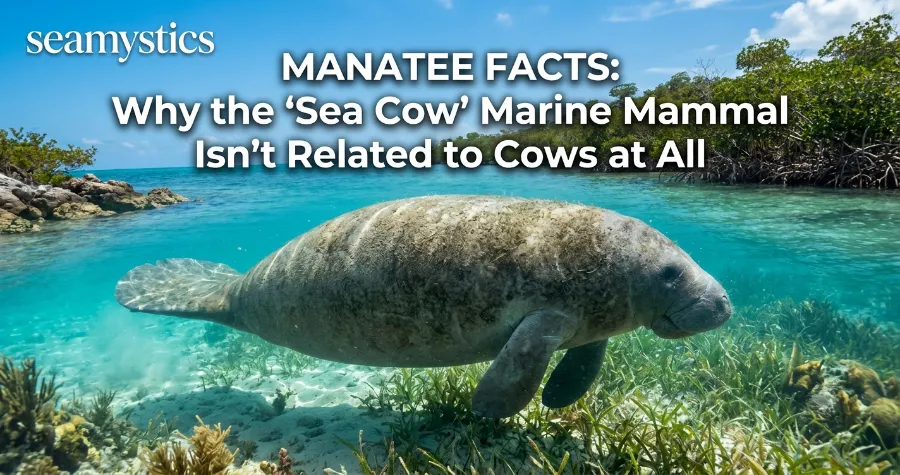

A manatee glides through warm Florida water, munches on seagrass for hours, and somehow earned the nickname sea cow. Yet this gentle giant shares nothing with the animal grazing in your local farm field. In fact, some of the strangest manatee facts marine mammal fans love to share involve an unexpected cousin roaming the African savanna. So why did sailors centuries ago link a marine mammal to cattle, and what does science actually say about its real family tree? This guide answers both questions with clear facts, current numbers, and a few surprises along the way.
If you want to learn more about living fossils found alive tips and expert advice.
If you want to learn more about mysterious lights deep ocean tips and expert advice.
Before diving deeper, here is a quick snapshot of what you are about to learn.
Key Takeaways
| Fact | Detail |
|---|---|
| True relatives | Elephants and hyraxes, not cows |
| Scientific order | Sirenia |
| Average weight | 800 to 1,200 pounds |
| Average length | 9 to 10 feet |
| Lifespan | 50 to 60 years in the wild |
| Diet | Seagrass, algae, and freshwater plants |
| Florida population estimate | 8,350 to 11,730 manatees |
| Conservation status | Threatened under the US Endangered Species Act |
| Recorded deaths in 2024 | 565 manatees |
Now let us look at where this nickname came from and why it never matched the biology.
What Is a Manatee? Meet the Real Sea Cow
A manatee is a large, slow moving aquatic mammal that spends nearly its whole life in water. It never leaves the water to breed, rest, or feed, unlike seals or sea lions that haul out onto rocks. Because of this, biologists classify manatees as fully aquatic marine mammals rather than semi aquatic ones.
If you want to learn more about lost shipwrecks ocean floor tips and expert advice.
Three living species exist today. The West Indian manatee lives along the coasts of Florida, the Caribbean, and parts of South America. The West African manatee stays in rivers and coastal waters of West Africa. The Amazonian manatee, meanwhile, is the only species that lives its entire life in freshwater rivers of the Amazon basin.
The Sirenia Order Explained
Scientists group manatees, along with the dugong, inside an order called Sirenia. This name comes from the mythical sirens of ancient sailor stories, since early explorers reportedly mistook these animals for mermaids from a distance. That myth, oddly enough, has aged better than the cow comparison.
Sirenians share a few unusual traits that set them apart from most marine mammals.
- They are the only fully herbivorous marine mammals alive today.
- Their bones are dense and heavy, which helps them stay near the seafloor while grazing.
- Their flippers still contain finger like bones, a leftover trait from land dwelling ancestors.
Why Sailors Called Them Sea Cows
The sea cow nickname likely stuck for a simple reason. Manatees graze slowly on underwater grass meadows for hours each day, much like cattle graze on land. Additionally, their round bodies and slow, deliberate movements reminded early European sailors of livestock back home.
However, the resemblance stops at behavior. A cow belongs to the order Artiodactyla, a group that includes pigs, deer, and hippos. A manatee belongs to Sirenia, a completely separate branch of the mammal family tree. Their last shared ancestor lived tens of millions of years before either group looked anything like it does today.
Manatee Facts Marine Mammal Enthusiasts Should Know
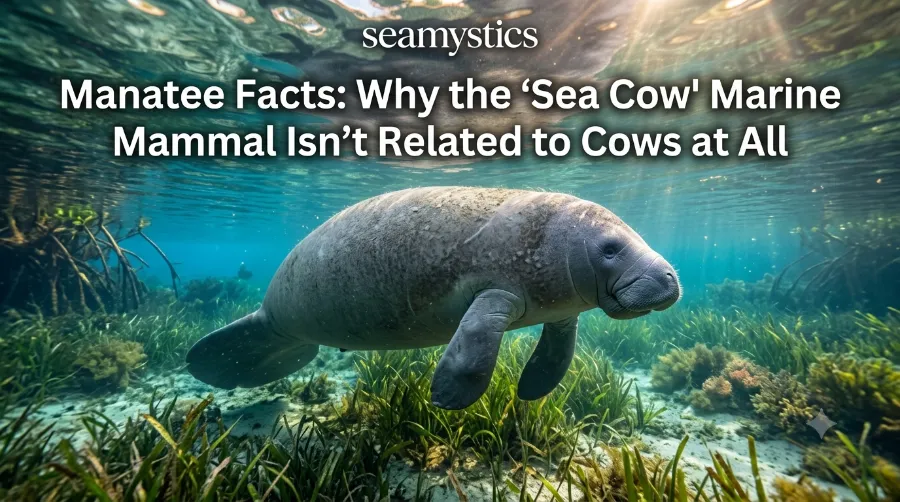
Once people learn the sea cow name is misleading, curiosity usually grows. Below are some of the most requested manatee facts marine mammal researchers get asked about, backed by current data from wildlife agencies.
Size, Weight, and Lifespan
Adult manatees typically measure between 9 and 10 feet long, though some individuals reach 13 feet. They generally weigh between 800 and 1,200 pounds, with a few large males exceeding 3,500 pounds in rare cases. According to the U.S. Fish and Wildlife Service, manatees can live 50 to 60 years in the wild when they avoid boat strikes and cold stress.
Their skin is thick, wrinkled, and sparsely covered in short hairs called vibrissae. These hairs are highly sensitive and help manatees detect changes in water current, similar to how a cat uses whiskers.
What Manatees Eat Every Day
Manatees are strict herbivores. As a result, they spend six to eight hours a day eating seagrass, algae, and other aquatic plants. A single adult manatee can eat up to 10 percent of its body weight in vegetation daily, which for a 1,000 pound manatee equals roughly 100 pounds of plants.
This constant grazing plays a bigger ecological role than most people realize. Seagrass meadows trimmed regularly by manatees tend to grow back healthier and denser, similar to how mowing a lawn encourages fuller grass growth.
Manatee vs Whale vs Cow at a Glance
The table below places manatees next to two animals people often confuse them with, a whale and a cow, so the differences become obvious quickly.
| Trait | Manatee | Whale | Cow |
|---|---|---|---|
| Habitat | Coastal and freshwater | Open ocean | Land |
| Diet | Plants only | Fish, krill, or plankton | Grass |
| Closest relative | Elephant | Hippopotamus | Pig, deer |
| Average lifespan | 50 to 60 years | 50 to 90 years, species dependent | 15 to 20 years |
| Breathing | Surfaces every 3 to 5 minutes | Surfaces every 10 to 90 minutes | Breathes air on land |
| Order | Sirenia | Cetacea | Artiodactyla |
This comparison table also connects nicely to a broader topic worth exploring further in our complete guide to whale facts marine mammals, since both groups evolved from land animals that returned to the sea.
How Manatees Compare to Whale Facts Marine Mammals
Manatees and whales both belong to a small club of mammals that gave up land life entirely. Still, their evolutionary paths could not be more different.
Shared Traits With Whales and Dolphins
Both manatees and whales breathe air through lungs, give birth to live young, and nurse their calves with milk. Both groups also evolved streamlined bodies and paddle like limbs to move efficiently through water. If you want to see how far this adaptation goes in a hunting predator, our piece on orca whale hunting behavior shows just how specialized cetaceans became compared to the plant eating manatee.
Key Differences Between Manatees and Whales
Despite these similarities, the two groups split apart on the evolutionary tree more than 50 million years ago. Whales descended from hoofed land mammals related to hippos, while manatees descended from elephant like ancestors.
- Whales are carnivores that hunt fish, squid, or krill, while manatees eat only plants.
- Whales can dive to extreme depths, as detailed in our guide on the sperm whale deep dive, while manatees rarely go below 10 feet.
- Whales travel thousands of miles during seasonal journeys, similar to what we cover in our humpback whale migration facts article, whereas manatees mostly stay within a single coastal region.
- The largest whale species, covered in our guide to blue whale facts and size, dwarfs a manatee by well over one hundred times in body mass.
Meanwhile, other marine mammals take entirely different survival paths. Readers curious about vocal communication among ocean giants may also enjoy our breakdown of whale song communication, since manatees, by contrast, communicate mostly through short chirps and squeaks rather than long songs.
The Elephant Connection: Manatees’ True Family
Here is the fact that surprises almost everyone. Manatees share a more recent common ancestor with elephants than with any marine animal. Both belong to a larger group called Afrotheria, which also includes hyraxes and aardvarks.
Fossil Evidence and Evolution
Fossil records show that early sirenians walked on four legs roughly 50 million years ago before gradually adapting to full aquatic life. Their front limbs evolved into flippers, while their back limbs disappeared almost entirely, leaving only small internal bone remnants that scientists still find during dissections today.
A few physical clues still hint at this elephant connection.
- Manatees, like elephants, continually replace their molars throughout life through a process called horizontal tooth replacement.
- Both animals have thick, wrinkled skin and similar toenails on their flippers.
- Both species share a comparable structure in their inner ear bones, a detail geneticists use to confirm the family link.
According to the World Wildlife Fund and multiple peer reviewed studies, DNA evidence strongly supports this elephant to manatee lineage, making it one of the more unexpected relationships in the animal kingdom.
Manatee Senses, Sounds, and Daily Behavior
Manatees rely on more than eyesight to move through murky coastal water. Their eyes work reasonably well underwater, yet vision alone would not keep them safe in low visibility rivers and lagoons. Consequently, they lean heavily on touch and hearing instead.
Those short whiskers covering a manatee’s face, called vibrissae, are far more sensitive than they look. Each hair connects to its own nerve bundle, so a manatee can detect subtle water movement, texture, and even food location purely through touch. Similarly, their hearing picks up low frequency sounds extremely well, which helps them detect an approaching boat engine long before it becomes visible, though the sound often does not travel fast enough for the animal to react in time.
Manatees are not silent animals either. They communicate through short chirps, squeaks, and squeals, especially between mothers and calves. These calls typically last less than half a second, unlike the long, complex songs used by some whale species. A mother and calf pair often exchange these sounds constantly while swimming together, which helps them stay in contact in cloudy water where sight becomes nearly useless.
Manatee Reproduction and Calf Care
Female manatees, called cows, reach sexual maturity around age five, while males mature slightly earlier. Once pregnant, a female carries her calf for roughly 12 to 14 months, one of the longer gestation periods among marine mammals. Typically, she gives birth to a single calf, and twins remain rare.
A newborn calf weighs between 60 and 70 pounds and can swim to the surface for its first breath within minutes of birth. Nursing happens underwater near the mother’s flipper, and calves stay close to their mothers for one to two years while learning feeding grounds and travel routes. This long dependency period explains why population recovery moves slowly even when adult survival rates improve.
Where Manatees Live Around the World
People often assume all manatees live in Florida, yet the species range spreads across several continents. Understanding this global picture helps explain why conservation status differs so much between regions.
| Species | Primary Region | Estimated Population | Habitat Type |
|---|---|---|---|
| Florida manatee | Southeastern United States | 8,350 to 11,730 | Coastal, estuarine, freshwater springs |
| Antillean manatee | Caribbean, Central America, northern South America | Under 7,000 | Coastal and river systems |
| West African manatee | Coastal West Africa | Roughly 10,000 | Rivers and coastal lagoons |
| Amazonian manatee | Amazon River basin | 8,000 to 30,000 | Freshwater rivers only |
The Florida manatee and Antillean manatee are both subspecies of the West Indian manatee, while the Amazonian and West African manatees stand as separate species entirely. Interestingly, the Amazonian manatee is the only one that never enters saltwater at all, since it lacks the salt gland adaptations its coastal relatives rely on.
European readers sometimes encounter manatees through accredited aquariums and marine research partnerships rather than in the wild, since no manatee species is native to European coastal waters. Several European institutions, however, actively fund Caribbean and West African manatee research through international conservation grants, which shows how global this recovery effort has become.
The Mermaid Myth: Manatees in History and Culture
Manatees hold a curious spot in maritime history. In January 1493, Christopher Columbus recorded seeing three mermaids near the coast of what is now the Dominican Republic, though he noted they were not as beautiful as commonly depicted in stories. Most historians now agree he had actually spotted manatees, likely distorted by distance, fatigue, and centuries of sailor folklore about half fish, half human creatures.
This mermaid connection still shapes how manatees appear in modern pop culture, tourism branding, and coastal town names throughout Florida and the Caribbean. Even the scientific order name, Sirenia, directly references these mythical sirens, tying ancient folklore permanently to modern taxonomy.
Threats Facing Manatees Today
Manatee numbers have improved significantly since the 1990s, yet real dangers remain. Understanding these threats helps explain why conservation groups still monitor the species closely every year.
Manatee Mortality Numbers 2024 to 2025
Florida’s manatee population was estimated between 8,350 and 11,730 individuals during the most recent statewide survey period. This marks a major recovery from just 1,267 manatees counted when aerial surveys began in 1991, according to the U.S. Fish and Wildlife Service.
Still, mortality data tells a more complicated story. In 2024, the Florida Fish and Wildlife Conservation Commission recorded 565 manatee deaths statewide. By mid 2025, preliminary reports showed 477 deaths already logged, a noticeable jump compared to the same period in 2024, driven largely by a cold winter and a red tide bloom in southwest Florida.
A major Unusual Mortality Event tied to seagrass loss in the Indian River Lagoon ran from December 2020 through April 2022 and claimed 1,255 manatee lives before wildlife officials closed the case in March 2025. During that crisis, volunteers and biologists distributed more than 600,000 pounds of leafy greens to starving manatees as an emergency feeding measure.
The main threats manatees face today include the following.
- Watercraft collisions, which remain one of the leading causes of manatee death in Florida each year.
- Loss of seagrass habitat due to poor water quality and agricultural runoff.
- Cold stress during unusually harsh winters, since manatees cannot tolerate water below 68 degrees Fahrenheit for long periods.
- Red tide algal blooms, which release toxins that manatees ingest while feeding.
- Entanglement in fishing gear and marine debris.
Why These Numbers Matter for Everyday Readers
Numbers on a page can feel distant, yet each figure represents a real animal navigating a busier, warmer, and more polluted coastline than it faced fifty years ago. A boater slowing down in a manatee zone, a homeowner cutting back on lawn fertilizer, or a tourist keeping a respectful distance while snorkeling all contribute directly to the trends shown below. Understanding the data, in other words, is the first step toward acting on it responsibly.
Chart: Florida Manatee Deaths by Year
| Year | Recorded Manatee Deaths |
|---|---|
| 2021 (UME peak) | 1,101 |
| 2022 | 800 |
| 2023 | 555 |
| 2024 | 565 |
| 2025 (through July, preliminary) | 477 |
The chart above shows a promising decline after the 2021 crisis, followed by a slight uptick in 2025 linked to cold weather and red tide rather than starvation, which is a meaningful distinction wildlife biologists track closely.
Manatee Facts Marine Mammal Conservation Efforts
Conservation groups, government agencies, and everyday boaters all play a part in protecting manatees. Their combined effort explains why the species moved from endangered to threatened status back in May 2017, a milestone worth celebrating even though more work remains.
Here are practical steps that support ongoing manatee recovery.
- Slow down in posted manatee zones, since boat strikes remain a top cause of injury and death.
- Report injured or distressed manatees immediately to the FWC Wildlife Alert hotline rather than approaching them directly.
- Avoid feeding or watering manatees, since this behavior can teach them to associate boats with food, increasing collision risk.
- Support seagrass restoration programs, which directly address the root cause behind the 2020 to 2022 mortality crisis.
- Reduce fertilizer and chemical runoff at home, since nutrient pollution feeds the algal blooms that destroy seagrass meadows.
How Scientists Track and Study Manatees
Good conservation decisions depend on good data, and manatee research has come a long way since the first aerial surveys began in 1991. Today, biologists combine several methods to build an accurate picture of population health rather than relying on a single count.
- Aerial surveys, flown by small planes over coastal Florida during winter months, count visible manatees gathered near warm water sites.
- Photo identification catalogs individual manatees using unique scars, usually caused by boat propellers, which allows researchers to track specific animals over decades.
- Satellite linked radio tags attach to a manatee’s tail, recording movement patterns and revealing migration routes that would otherwise stay hidden.
- Necropsy examinations on recovered carcasses help scientists confirm the exact cause of death, whether that is cold stress, red tide toxins, or a boat strike.
Together, these methods feed into what researchers call an integrated population model, a statistical approach that blends survey counts with survival and birth rate data. As a result, wildlife agencies can now estimate population trends even during years when a full aerial survey was not possible, giving policymakers more reliable numbers to work from.
Organizations such as the World Animal Protection group and the Marine Sanctuary Foundation publish regular updates on these efforts, and both are worth following for readers who want deeper background beyond this guide. The National Wildlife Federation also covers manatee recovery stories, including a good overview in their piece on manatees as the mermaids of the sea, which pairs nicely with the mermaid myth mentioned earlier in this article.
If manatees intrigue you, other marine mammals offer equally fascinating comparisons. Readers often move next to learn about dolphin intelligence facts, the unusual tusk biology covered in our narwhal tusk and Arctic life guide, or the simple visual differences explained in seal versus sea lion. Teachers and homeschool parents building an ocean science unit around these topics may also find these free learning apps for students useful for turning marine biology lessons into interactive homework.
Manatee Ecotourism: What US and European Travelers Should Know
Crystal River, Florida remains the only place in the United States where swimming with wild manatees is legally permitted, and it draws thousands of visitors from across the country and overseas each winter. Because manatees gather there in large numbers between November and March, seeking warm spring fed water, the season creates a rare, close range wildlife encounter that few other destinations can match.
Responsible tour operators follow strict federal guidelines, since harassing a manatee remains illegal under the Marine Mammal Protection Act. Visitors are expected to practice passive observation, meaning no chasing, grabbing, or separating a mother from her calf. First time visitors from Europe often find these rules stricter than expected, yet marine biologists argue this caution is exactly why Crystal River’s manatee population has stayed healthy for decades.
For travelers who cannot make the trip to Florida, several accredited European aquariums and marine parks house manatees under research partnerships with US and Caribbean conservation programs. These facilities typically focus on rehabilitation, breeding support for at risk populations, and public education rather than entertainment alone, which reflects a broader shift in how zoological institutions on both sides of the Atlantic approach marine mammal care today.
Frequently Asked Questions About Manatees
Is a manatee really related to an elephant?
Yes. Genetic studies place manatees and elephants in the same larger mammal group called Afrotheria, and both share traits such as continuous molar replacement and similar toenail structure.
Why is a manatee called a sea cow if it is not a cow?
The nickname comes from its slow grazing habits on underwater grass, not from any biological connection to cattle.
How long can a manatee hold its breath?
A resting manatee can hold its breath for up to 20 minutes, though it typically surfaces every 3 to 5 minutes while active.
Are manatees still endangered?
Florida manatees were reclassified from endangered to threatened in May 2017 under the US Endangered Species Act, though they remain federally protected and still face serious threats.
What is the biggest threat to manatees right now?
Watercraft collisions and habitat loss from seagrass decline remain the two leading concerns among wildlife biologists today.
Do manatees have any natural predators?
Adult manatees have almost no natural predators due to their size, though young calves are occasionally vulnerable to sharks or alligators in rare cases.
How fast can a manatee swim?
A manatee typically cruises at 3 to 5 miles per hour, though it can briefly reach speeds close to 15 miles per hour when startled or fleeing danger.
Can manatees survive in cold water?
No, manatees cannot tolerate water temperatures below 68 degrees Fahrenheit for extended periods, which is why they gather near warm water springs and power plant outflows during winter months.
Is a dugong the same thing as a manatee?
Not quite. A dugong is a close relative within the same order, Sirenia, but it belongs to a different family and has a fluked tail similar to a whale rather than the paddle shaped tail of a manatee.
Conclusion
Manatees prove that appearances and nicknames can be deeply misleading once real science gets involved. A slow grazing habit earned them a name tied to cattle, yet their true family tree links back to elephants roaming an entirely different continent. As Florida’s population data shows, conservation work over the past three decades genuinely changed the outlook for this species, even though new challenges like red tide and cold snaps continue testing that progress. Therefore, the next time someone calls a manatee a sea cow, you will know the real story behind that gentle giant floating through the seagrass.
References
U.S. Fish and Wildlife Service, Manatee species profile, fws.gov
Florida Fish and Wildlife Conservation Commission, Manatee mortality statistics and abundance surveys, myfwc.com
Marine Mammal Commission, Florida Manatee priority topic report, mmc.gov
World Animal Protection, 10 facts about manatees
Marine Sanctuary Foundation, Sea Wonder Manatees
National Wildlife Federation, Manatees the Mermaids of the Sea