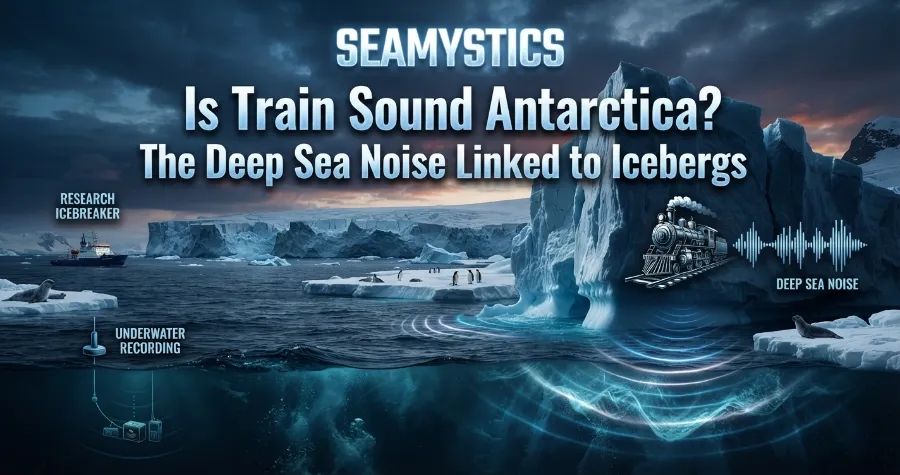

Imagine a freight train rolling through the dark, but there are no tracks, no town, and no air. The “train” is a mountain of ice, and it is dragging its belly across the seafloor at the bottom of the world.
That is the story behind the train sound Antarctica produced in 1997, one of the most famous recordings in ocean science. I have spent years reading underwater recordings, and few of them stay with people the way this one does. It is odd, it is steady, and it is real.
TL;DR: The Train is a low, steady hum recorded by NOAA hydrophones in 1997. Scientists traced it to a huge iceberg that was grounded in the Ross Sea and scraping the seabed as it moved. It is not a monster or a machine. It is the sound of ice meeting rock.
Key Takeaways at a Glance
| Question | Short answer |
|---|---|
| What is the Train? | A long, steady underwater hum recorded in March 1997 |
| Who recorded it? | NOAA’s Pacific Marine Environmental Laboratory (PMEL) |
| Where did it come from? | Most likely a grounded iceberg near Cape Adare, Ross Sea |
| What pitch is it? | About 32 to 35 Hz, below most human hearing |
| Is it dangerous? | No. It is a natural ice sound |
| Why does it matter? | It shows how noisy and active Antarctic ice really is |
What Is the Train Sound Antarctica Scientists Recorded?
The Train is a sound with a nickname. NOAA’s own page says it was recorded on March 4, 1997, and stayed fairly steady at around 32 to 35 Hz. The recording came from hydrophones in the equatorial Pacific, not from anywhere near the ice. noaa
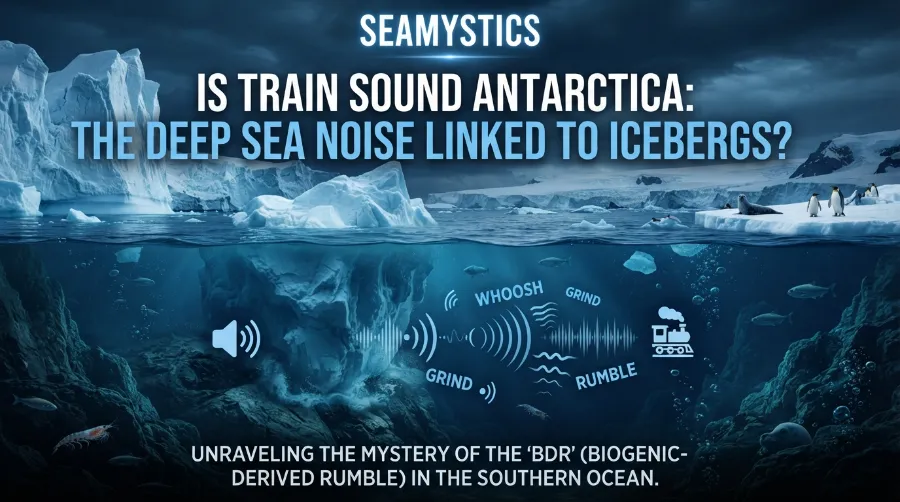
That detail surprises many readers. The microphones sat in warm tropical water, yet they heard a sound born in the Antarctic. Based on the direction the sound arrived from, NOAA says the source was most likely a very large iceberg grounded in the Ross Sea, near Cape Adare. noaa
Listeners also notice the pitch. At 32 to 35 Hz, the tone sits at the very bottom of what people can hear. NOAA notes that the clip online has been sped up 16 times, so your ears can pick it up. Without that boost, you would feel it more than hear it. noaa
Ocean Nuclear Testing: How Cold War Blasts Changed the Ocean Floor
The name fits. Live Science compared it to the rub of train wheels against tracks, and that picture helps. If you want the broader story of other named sounds, our guide to ocean floor mapping shows how seafloor science and sound research often overlap. livescience
Train Sound NOAA Recorded: How the Hydrophones Worked
Sound travels far in water. Cold, deep layers of the ocean can act like a pipe that guides low tones across whole basins. That is why a hydrophone in the Pacific can hear ice in the Southern Ocean.
NOAA’s array was built for other jobs. It tracks undersea earthquakes, ice noise, and the calls of whales. The Train was a bonus find. Scientists were listening for one thing and heard another.
How Scientists Find the Source
Finding the source is a bit like finding a lost phone by its ringtone. One microphone tells you the direction. Several microphones let you cross the lines on a map and find the spot. That cross-check is called triangulation.
In my own practice reading spectrograms, I check three things first. I look at the pitch, I look at how long the sound lasts, and I look for harmonics, which are echo-like stripes above the main tone. The Train has a steady pitch and stripes that last, and that pattern points to something slow and heavy. An earthquake would look sharper. A whale call would bend and slide.
Unmapped Ocean Zones: Why Some Deep-Sea Areas Have Never Been Charted
Iceberg Noise Ocean Listeners Hear: Why Ice Makes Sound
Ice is not silent. It cracks, groans, scrapes, and fizzes. In fact, a lot of the Southern Ocean’s natural noise comes from frozen water.
Dr. Robert Dziak, an Oregon State University seismologist who worked with NOAA, once explained how most ocean sounds break down. He said nearly all sounds fit into a few groups: geophysical, weather, human-made, ice, and animals. The Train belongs in the ice group. fandom
Here are the main ways icebergs make noise:
- Grounding: A big iceberg drifts into shallow water and its keel hits the seabed.
- Scraping: The berg keeps moving and drags along the bottom, which makes a long, steady tone.
- Cracking: Stress splits the ice and sends out sharp pulses.
- Collisions: Two bergs rub or bump each other.
- Melting: Trapped air bubbles pop and hiss as ice thaws.
The Stick-Slip Idea, in Plain Words
Think of a chair leg dragged across a floor. It does not slide smoothly. It sticks, then jumps, then sticks again. Do that fast enough and you hear a hum.
A research team studied this near the Antarctic Peninsula and found that iceberg tremor can come from grounding on the shelf or from contact with another iceberg, through stick-slip motion and vibration. That is the best working picture of what the Train is. A giant block of ice sticks, slips, and sticks again, thousands of times a minute. nih
Slow Down Sound: NOAA’s Strangest Underwater Audio Recording
Antarctic Ocean Sound: A Surprisingly Loud Place
Many people picture the Antarctic as quiet and still. The data say the opposite.
A study published in PLOS ONE placed hydrophones in the Bransfield Strait and the Scotia Sea from 2005 to 2009. The authors found that iceberg grounding and rapid breakup release large amounts of sound energy, similar to big geophysical events. They also found that overall sound levels can run about 10 to 20 dB higher in the deep, open Scotia Sea than in the shallower Bransfield Strait. nihnih
That gap matters. A 10 dB rise is roughly a tenfold jump in sound energy. So the open Southern Ocean can be much louder than a sheltered strait nearby.
The same paper makes a point I find important. Human-made noise has grown by as much as 12 dB since the 1960s in some places, but ice breakup in the Southern Ocean may be an underrated natural source. In other words, the south is not quiet before humans arrive, and it may be getting louder as ice breaks up. nih
The Devil’s Sea: Japan’s Own Version of the Bermuda Triangle
| Source of sound | Type | Typical sound |
|---|---|---|
| Iceberg grounding | Natural, ice | Long, steady hum or tremor |
| Iceberg breakup | Natural, ice | Loud, broadband bursts |
| Whale calls | Natural, animal | Moans, pulses, and sweeps |
| Wind and waves | Natural, weather | Broad background hiss |
| Ships and seismic surveys | Human-made | Engines and air gun blasts |
Train, Julia, Slow Down, and Bloop: How They Compare
The Train has relatives. NOAA named several odd sounds, and most of them trace back to ice.
Julia, recorded in 1999, was linked to a large iceberg that had run aground off Antarctica. You can read our full breakdown in the Julia sound mystery article. Slow Down is another case. NOAA located its source off the Antarctic Peninsula and linked it to a drifting iceberg hitting the seafloor and grinding to a stop. Our Slow Down sound guide covers the details. Wikipedialivescience
Not every mystery sound comes from ice, though. Upsweep, for example, has a different story, which we explain in the Upsweep sound mystery post.
| Sound | Year | Likely source | Region |
|---|---|---|---|
| Train | 1997 | Grounded iceberg dragging its keel | Ross Sea, near Cape Adare |
| Bloop | 1997 | Large icequake | Antarctic region |
| Julia | 1999 | Iceberg grounding | Off Antarctica |
| Slow Down | Recorded by NOAA | Drifting iceberg hitting seafloor | Antarctic Peninsula |
| Upsweep | Long-running signal | Likely volcanic activity | Pacific |
One real-world case helps here. Scientists tracked iceberg A53a as it broke apart near South Georgia Island in early 2008. That tracking work suggested the sound sources were likely between the Bransfield Strait and the Ross Sea, or possibly at Cape Adare. Cape Adare keeps coming up, so it looks like a hot spot for this kind of noise. Wikipedia
Ice Sound Recording: How You Can Learn From It
You do not need a research ship to explore this field. Many ice sound recording files are free online, and the process of studying them is simple.
Here is a basic way to start:
- Open NOAA’s Train recording page and play the sped-up clip.
- Look at the spectrogram, which is a picture of sound over time.
- Find the steady band near the bottom and note how long it lasts.
- Compare it with the Julia and Slow Down clips.
- Ask yourself what could produce a sound that long and that steady.
If you want a human feel for the polar soundscape, the Symphony of Silence journey to Antarctica story from The Well shows how travelers and artists experience it. Anyone curious about how people actually reach these waters can also read about Antarctica expeditions and what the trips involve.
A Practical Tip From the Field of Analysis
Always ask what a sound is not before you ask what it is. The Train is not a whale, because whales bend their pitch. It is not a ship, because ships have propeller patterns. It is not an earthquake, because quakes start sharply. After you remove those, the iceberg answer looks much stronger. That habit of ruling things out is how most “mysteries” in ocean acoustics get solved.
The Rogue Wave Phenomenon: Freak Ocean Waves Science Once Doubte
Why the Train Sound Antarctica Story Matters for Climate
This is not only a spooky tale. Sound is a cheap, remote way to watch ice that no ship can see in winter.
Floating ice also tells a bigger story. If you want background on how sea ice grows and shrinks, the Antarctic sea ice guide from Antarctic Glaciers explains the basics clearly.
The link to sound is simple. More breakup and more grounding mean more noise. A hydrophone can count those events around the clock, even in storms and polar night. For researchers, a quiet microphone can be as useful as a satellite photo.
Sunken City Ruins: Real Underwater Cities Found Beneath the Sea
My own view, based on years of reading this kind of data, is that acoustic monitoring is underused. Satellites show the surface. Hydrophones show what the ice does under the waterline, where keels meet rock. Combining both would give a much fuller picture.
Common Myths About the Train Sound
Myth 1: It was a sea monster. No. NOAA scientists linked it to ice, and the sound pattern matches grounding events.
Myth 2: It was a submarine or machine. The direction, pitch, and steady behavior do not match known vessels.
Myth 3: It is unsolved. Strictly, NOAA says the iceberg is the “most likely” source. That is careful science language, and it is not the same as “we have no idea.” Good scientists keep room for new data.
Frequently Asked Questions
What is the train sound in Antarctica?
It is a steady, low underwater hum recorded in 1997 and traced to a grounded iceberg in the Ross Sea.
Who recorded the train sound?
NOAA’s Pacific Marine Environmental Laboratory recorded it using hydrophones in the equatorial Pacific.
Can people hear the train sound without speeding it up?
Barely. It sits around 32 to 35 Hz, so the online clip is sped up 16 times.
Do icebergs make noise in the ocean?
Yes. They crack, scrape, collide, and hiss as they melt, and some of those sounds travel thousands of kilometers.
Is the train sound still being recorded?
Ice noise continues to be recorded across the Southern Ocean by research hydrophones, although the original 1997 clip is the famous one.
Conclusion
The train sound Antarctica gave us is a reminder that the ocean is never silent. A giant iceberg, a rocky seabed, and a hydrophone thousands of kilometers away came together to make one steady hum.
Scientists read that hum as grounding ice, and the wider research shows the Southern Ocean is full of this kind of natural noise. If you keep exploring, start with our ocean floor mapping pillar guide, then visit Sea Mystics for more deep ocean sound stories.
Quick Quiz: Test What You Learned
1. When was the Train sound recorded?
A) 1977 B) 1997 C) 2007
2. Where did NOAA say the Train most likely came from?
A) The Mariana Trench B) The Arctic C) The Ross Sea near Cape Adare
3. What is the best explanation for the Train sound?
A) A grounded iceberg dragging its keel B) A submarine C) A whale chorus
4. Why is the online Train clip sped up?
A) To make it scarier B) So human ears can hear it C) To hide background noise
5. Which group does Dr. Dziak place iceberg groundings in?
A) Animal sounds B) Human-made sounds C) Ice sounds
Answers: 1) B, 2) C, 3) A, 4) B, 5) C
References
- NOAA PMEL Acoustics Program, Iceberg Grounding (Train): https://www.pmel.noaa.gov/acoustics/sounds/train.html
- Sources and Levels of Ambient Ocean Sound near the Antarctic Peninsula, PLOS ONE, 2015: https://www.ncbi.nlm.nih.gov/pmc/articles/PMC4397061/
- Live Science, Spooky Science: Unexplained Sounds from the Deep: https://www.livescience.com/24303-spooky-science-unexplained-ocean-sounds.html
- NOAA PMEL, Iceberg Grounding (Julia): https://www.pmel.noaa.gov/acoustics/sounds/julia.html