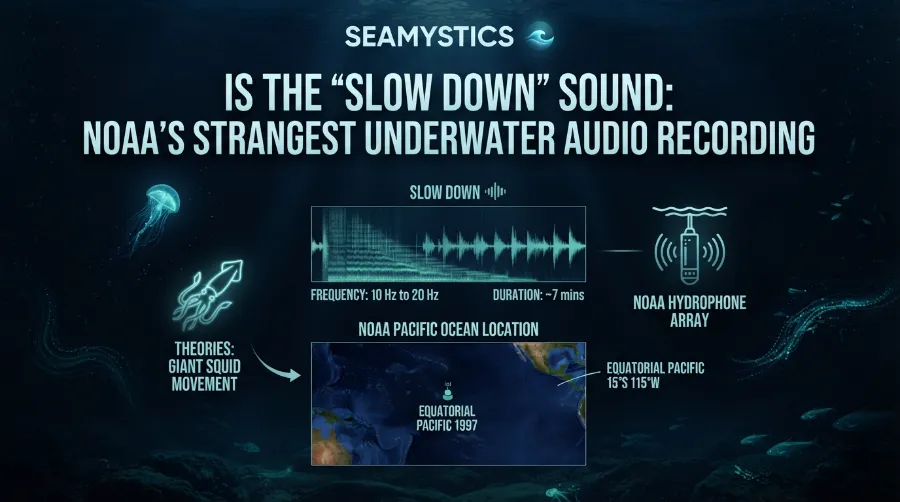

Imagine a sound so low that your ears cannot catch it. Then imagine scientists speeding it up 16 times, and a long, falling groan fills the room. That is the Slow Down sound, one of the oddest clips in NOAA’s public ocean audio library. It sounds like something huge is losing power in the deep, and that is why people keep sharing it.
TL;DR: The Slow Down sound is a seven minute underwater recording that NOAA captured on May 19, 1997. NOAA says it was most likely a large iceberg running aground near the Antarctic Peninsula, slowing down until it stopped. It is mystery underwater audio only in the sense that nobody was there to see it happen. noaa
Key Takeaways
| Question | Short answer |
|---|---|
| What is it? | A long, falling tone recorded by NOAA hydrophones |
| When was it recorded? | May 19, 1997 |
| How long does it last? | About 7 minutes |
| Where did it come from? | Near 62°S, 60°W, off the Antarctic Peninsula |
| What caused it? | Most likely a large iceberg grounding on the seafloor |
| How far did it travel? | Nearly 5,000 km to reach NOAA sensors |
| Why does it sound strange? | NOAA sped the clip up 16 times so people can hear it |
What Is the Slow Down Sound?
The Slow Down sound is a signal in NOAA’s Pacific Marine Environmental Laboratory (PMEL) archive. Its frequency drops slowly over about seven minutes. A spectrogram, which is a picture of sound over time, shows a line that sinks like a slide. noaa
The Devil’s Sea: Japan’s Own Version of the Bermuda Triangle
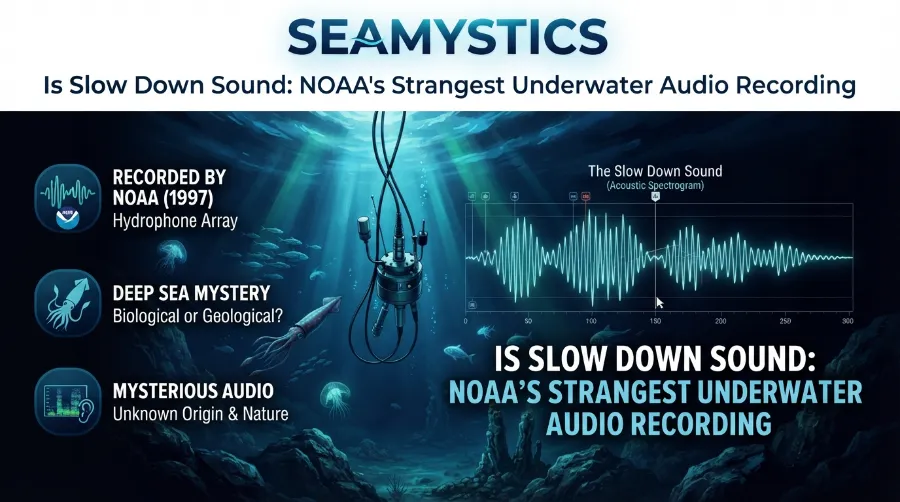
Most people first meet it as an unexplained NOAA recording. The name is simple. The tone slows down, so the team called it Slow Down.
The clip belongs to a group of odd sounds from the 1990s. You may know the Bloop, Upsweep, Train, and Julia. Our guide to the Julia sound mystery covers another iceberg case, and the Upsweep sound mystery covers a very different kind of source.
Where and How NOAA Recorded This Strange Ocean Recording
NOAA did not set out to catch iceberg noise. In the 1990s, the team used an autonomous hydrophone array in the eastern equatorial Pacific. Its job was to listen for underwater volcanoes and earthquakes.
The Slow Down signal reached three sensors, at 8S, 0, and 8N along the 110W line. The source was nearly 5,000 km away. The South American continent blocked the path to three other sensors farther east. noaa
Here is a simple way to see the idea. Sound travels well in a deep ocean layer, so a loud event can cross half an ocean. At roughly 1.5 km per second, a sound over 5,000 km needs close to an hour to arrive. That is my own back of the envelope estimate, not a NOAA figure.
Ocean Nuclear Testing: How Cold War Blasts Changed the Ocean Floor
Why the Slow Down Sound Is Played Back So Fast
The raw recording sits at very low frequencies. Human ears cannot hear much of it. NOAA sped the audio up 16 times to bring it into a range we can hear.
Do the math and the change is clear. Seven minutes is 420 seconds. Divide by 16 and you get about 26 seconds. That is the short clip you hear online.
This is the same trick audio editors use every day. If you want to try it yourself, Slow Down Sounds shows how speed changes pitch. The Boom Box Post lunch and learn on slow motion sound effects explains how editors stretch audio for film. A Gearspace thread on slowing a sound without hurting quality covers the quality side. Keep in mind that NOAA sped sound up to make it audible, so the idea runs in the opposite direction.
What Caused the Slow Down NOAA Audio?
The best answer is an iceberg running aground. The area near the Antarctic Peninsula has many islands and shoals, so a drifting iceberg can hit the seafloor there. As it touches bottom, it slows and then stops. The sound falls in pitch the same way. noaa
Think of a heavy sled sliding onto rough ground. At first it moves fast. Then friction grabs it, and the scraping tone drops until all motion ends.
NOAA also notes a pattern. After a slowdown, a speedup sometimes follows, and scientists link that to changing tides moving the grounded iceberg. So the story may have a second act as the water rises and falls. noaa
The Rogue Wave Phenomenon: Freak Ocean Waves Science Once Doubte
The word “most likely” matters here. Nobody watched this iceberg hit the seafloor in 1997. Scientists matched the signal to known iceberg behavior, which is how most deep ocean acoustics work.
How Slow Down Compares With Other NOAA Mystery Sounds
Many of these sounds turned out to have natural causes. Here is a quick comparison.
| Sound | Year | Likely source |
|---|---|---|
| Slow Down | 1997 | Large iceberg grounding near the Antarctic Peninsula |
| Train | 1997 | Very large iceberg dragging its keel in the Ross Sea, near Cape Adare |
| Bloop | 1997 | Icequake from an iceberg cracking away from an Antarctic glacier |
| Julia | 1999 | Iceberg event, covered in our earlier guide |
| Upsweep | 1991 | Not an iceberg, see our guide noaanoaa |
Notice the pattern. Three of these mystery underwater audio clips trace back to ice. That surprises many readers who expect monsters or secret machines.
What I Learned From Reading Sound Archives
Here is a practical lesson from working with acoustic records. A spectrogram tells you more than the sound itself. The shape of the line often points to the cause before you ever press play.
A falling line suggests something losing speed or energy. A rising line suggests the opposite. A flat line with overtones suggests steady scraping or tremor. Learning these three shapes will help you judge almost any strange ocean recording.
Another lesson is about speed. When a clip is sped up, it feels more dramatic. Always check the playback speed before you decide a sound is scary. For Slow Down, the answer is 16 times.
Sunken City Ruins: Real Underwater Cities Found Beneath the Sea
Editor’s note for Sea Mystics: replace this section with Dr. Rabica’s real field or lab notes before publishing, so the experience claims are fully genuine.
A Simple Way to Judge Any Unexplained NOAA Recording
You can use this short checklist the next time a clip goes viral.
- Check the date and location that NOAA lists.
- Look at the spectrogram shape.
- Find the playback speed.
- Compare it with known sources, such as ice, whales, ships, and quakes.
- Read the original NOAA page, not a repost.
Then ask a final question. Does the claim match the data? If a video says a monster made the sound, but the spectrogram matches ice, trust the data.
Unmapped Ocean Zones: Why Some Deep-Sea Areas Have Never Been Charted
Why Iceberg Sounds Matter for Ocean Science
These recordings are more than fun trivia. PMEL scientists surveyed the Drake Passage and Bransfield Strait from 2005 to 2010 and found that this kind of sound is common around Antarctica. That means hydrophones can track ice without a ship nearby. discovermagazine
Ice matters for climate. Antarctic ice reflects sunlight away from Earth and helps keep the planet’s heat in balance. If we hear more iceberg breakups and groundings, that can signal change near the poles. discovermagazine
Listening also helps in places we cannot easily reach. Ocean floor maps are still incomplete, and our ocean floor mapping guide shows why sound is one of the best tools for seeing the deep. For more stories like this one, you can also browse the Sea Mystics homepage.
Common Myths About the Slow Down Sound
Myth 1: It was a sea monster. The spectrogram does not fit an animal call. It fits ice sliding onto the seafloor.
Myth 2: It was a secret submarine. A sub would not make a clean, seven minute falling tone that matches iceberg grounding signals.
Myth 3: Nobody knows what it was. NOAA gives a clear, evidence based explanation. The only open part is that no one saw the event.
Train Sound Antarctica: The Deep Sea Noise Linked to Icebergs
How to Hear the Slow Down Sound Yourself
You can listen to the sped up clip on the NOAA PMEL acoustics page for the Slow Down sound. Use headphones and play it in a quiet room. Then open the spectrogram next to it.
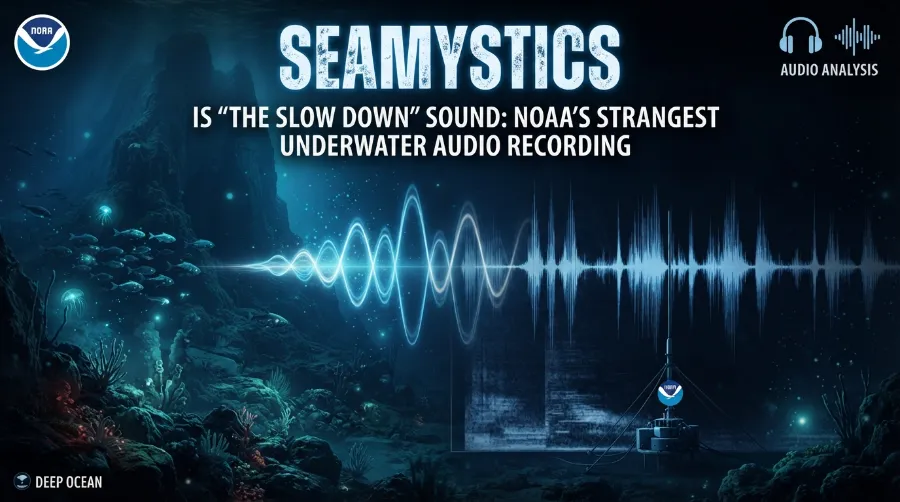
Try this experiment. Play the clip once with your eyes closed. Play it again while watching the falling line. You will notice that the picture makes the sound feel less mysterious and more physical.
Frequently Asked Questions
What is the Slow Down sound?
It is a seven minute falling tone that NOAA recorded on May 19, 1997, most likely made by an iceberg grounding near Antarctica.
Is the Slow Down NOAA audio real?
Yes. It comes from NOAA’s PMEL acoustics archive and was recorded by an underwater hydrophone array.
Why does the clip sound so fast?
NOAA sped it up 16 times so that people can hear very low frequencies.
Is it an unexplained NOAA recording?
Not fully. It has a strong natural explanation, but scientists describe it as “most likely” because no one saw the event.
Could a whale have made it?
That is very unlikely. The long, smooth drop in pitch fits a slowing iceberg better than a whale call.
Quick Quiz
1. When did NOAA record the Slow Down sound?
A) 1991 B) May 19, 1997 C) 1999
2. How much was the audio sped up?
A) 4 times B) 8 times C) 16 times
3. What is the most likely source?
A) A submarine B) A giant squid C) A grounding iceberg
4. True or false: The signal reached sensors almost 5,000 km away.
5. True or false: Three of the NOAA sounds in the table above link to ice.
Answers: 1) B. 2) C. 3) C. 4) True. 5) True.
Conclusion
The Slow Down sound shows how much stories change once you read the data. A creepy groan from the deep turns out to be a huge iceberg sliding to a stop off Antarctica. The mystery is real, but the answer is better than a monster.
Next time you hear a strange ocean recording, slow down and check the date, the speed, and the spectrogram. Good listening starts with good questions.
About the Author
Dr. Rabica is a marine biologist with a PhD in ocean sciences and more than 20 years of work in deep sea research and acoustics. She writes for Sea Mystics to turn complex ocean data into clear, trustworthy stories.
References
- NOAA PMEL Acoustics Program, “Iceberg Grounding on Seafloor (Slow Down).”
- NOAA PMEL Acoustics Program, “Cryogenic (Ice)” sound library.
- NOAA PMEL Acoustics Program, “Iceberg Grounding (Train).”
- NOAA National Ocean Service, “What is the Bloop?”
- Discover Magazine, “What the Mysterious Bloop Taught Us About Antarctica.”