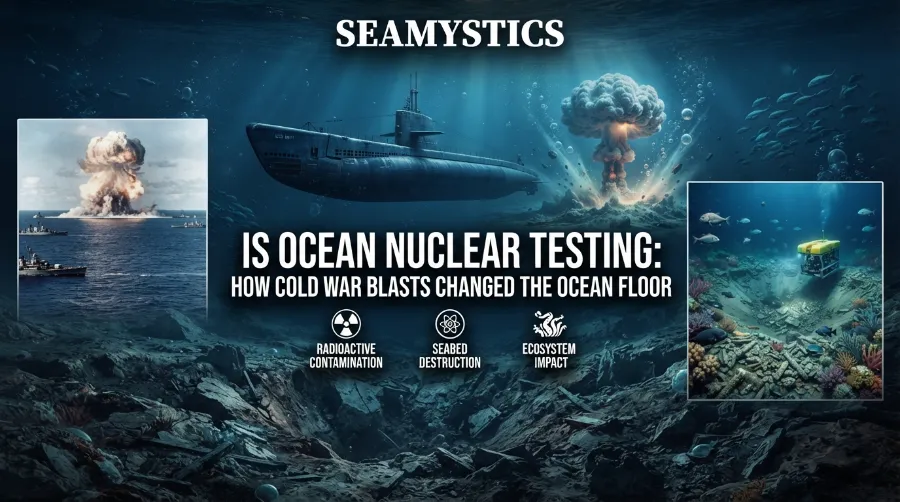

Picture a calm turquoise lagoon in the Pacific. Now picture a flash that turns the water into a rising white column taller than a mountain. That is what happened on July 25, 1946, at Bikini Atoll, and it was only the start of ocean nuclear testing. Over the next five decades, the world’s major powers set off hundreds of blasts in, on, and above the sea. The seabed still holds the evidence today.
TL;DR: Ocean nuclear testing between 1946 and 1996 pushed radioactive metals like plutonium and cesium into seawater and sediment. Most open ocean water is now safe, but the radioactive ocean floor near test sites will stay contaminated for thousands of years. Scientists now use that leftover signal to study how the ocean moves and mixes.
Key Takeaways
| Question | Short Answer |
|---|---|
| When did ocean nuclear testing start? | July 1946, at Bikini Atoll in the Marshall Islands |
| How many tests happened worldwide? | More than 2,000 since 1945, with over 500 in the atmosphere |
| What is the biggest US test at sea? | Castle Bravo, March 1, 1954, about 15 megatons |
| What stays on the seabed? | Plutonium, americium, and cesium bound to sediment |
| Which treaty stopped testing in water? | The Partial Test Ban Treaty of 1963 |
| Is the ocean still dangerous? | Open water is low risk, but test site sediments stay contaminated |
Ocean Nuclear Testing Explained: What Happened Between 1946 and 1996
Let me start with the plain definition. Ocean nuclear testing means setting off a nuclear device on an island, on a barge, under the surface, or in the air above the sea. Militaries wanted to see how a bomb affects ships, harbors, and coastal cities. The ocean also gave them empty space far from big crowds.
The numbers are large. According to the Global Zero overview of the nuclear age and the world’s oceans, the sea carries a long legacy from these tests and from waste dumping. The legacy did not end when the flashes stopped. It moved into water, sand, coral, and mud.
Where the Tests Took Place
Several countries picked ocean sites. The list of nuclear test sites on Learn About Nukes shows how widely these spots spread across the globe. Here is a quick summary of the major ocean programs:
| Country | Main Ocean Test Areas | Approximate Period |
|---|---|---|
| United States | Bikini and Enewetak Atolls, Marshall Islands; Johnston Atoll | 1946 to 1962 |
| Soviet Union | Novaya Zemlya in the Arctic, including Chernaya Bay | 1955 to 1990 |
| United Kingdom | Christmas Island and Malden Island in the Pacific | 1957 to 1958 |
| France | Moruroa and Fangataufa Atolls, French Polynesia | 1966 to 1996 |
The United States ran 67 tests in the Marshall Islands alone between 1946 and 1958. Their combined power came to about 108 megatons. France later ran 193 tests at Moruroa and Fangataufa, with 46 in the air and 147 underground beneath the coral.
Why Militaries Chose the Sea
There were three simple reasons. First, atolls sit far from big cities. Second, a lagoon gives you a ready made test field for ships. Third, nobody asked the island residents for a vote.
Unmapped Ocean Zones: Why Some Deep-Sea Areas Have Never Been Charted
That last point matters. In 1946, the US Navy moved 167 Bikini residents to another atoll before Operation Crossroads. Many never returned home. As a marine scientist, I think this is the part of the story that textbooks skip, and it shapes how we read the science. The ocean was not empty. People lived there, fished there, and still do.
Bikini Atoll Ocean: The Test Site That Still Teaches Us
Bikini Atoll is the best known case for a reason. It had the first big shot at sea, and the Navy documented much of it. The atoll became a UNESCO World Heritage site in 2010, mainly because it shows the start of the nuclear age so clearly.
Operation Crossroads in 1946
Operation Crossroads had two blasts. Test Able was an air burst on July 1. Test Baker was an underwater blast on July 25, with a yield near 21 kilotons. About 90 ships sat in the lagoon as targets.
Baker was the one that scared the planners. The device sat about 90 feet below the surface. It threw up a hollow column of water and then a huge wave of spray. Radioactive mist coated the ships, and crews struggled to wash them clean. The Navy learned that radioactive water sticks to hulls and cannot simply be hosed away.
Many of the target ships sank or ended up on the lagoon floor. The aircraft carrier USS Saratoga went down in about seven hours and now rests near 180 feet deep. Today it is one of the most famous wreck dives on Earth, and divers swim over a site that sits in a radioactive ocean floor zone.
Castle Bravo in 1954
On March 1, 1954, the US tested Castle Bravo at Bikini. Planners expected about 6 megatons. The blast came in at roughly 15 megatons, more than double the estimate. A surprise in the fuel chemistry caused the extra power.
The blast dug a crater about 6,500 feet wide in the reef. Fallout drifted east and landed on Rongelap and Utirik Atolls. It also reached the Japanese fishing boat Daigo Fukuryu Maru, known as Lucky Dragon No. 5. Radio operator Aikichi Kuboyama died that September.
This one event turned ocean nuclear testing from a military secret into a public health story. It also gave scientists their first real data on how fallout moves through seawater, fish, and food chains.
Train Sound Antarctica: The Deep Sea Noise Linked to Icebergs
What Bikini Looks Like Under the Water Now
Here is where my own field work habits come in. When I look at reef survey data from old test sites, I check three things first: coral cover, fish size, and the species that are missing. At Bikini, coral cover has bounced back in many areas, and large fish swim the lagoon. Some coral species, however, have not returned, and the reef still looks different from nearby untested atolls.
The Smithsonian Ocean report on nuclear bombs and coral reefs explains how reefs responded after the blasts. Coral is tough, but it cannot fully hide the scar of a crater. The Smithsonian story is a useful read if you want a simple view of reef recovery.
One more practice insight from reading these studies: reef fish in the lagoon often show lower radiation than land food. Coconuts and coconut crabs on the island take up cesium from the soil much more than fish do from the water. That is why Bikini remains unsafe for permanent living even though the sea looks healthy.
The Rogue Wave Phenomenon: Freak Ocean Waves Science Once Doubte
Radioactive Ocean Floor: What Stayed Behind
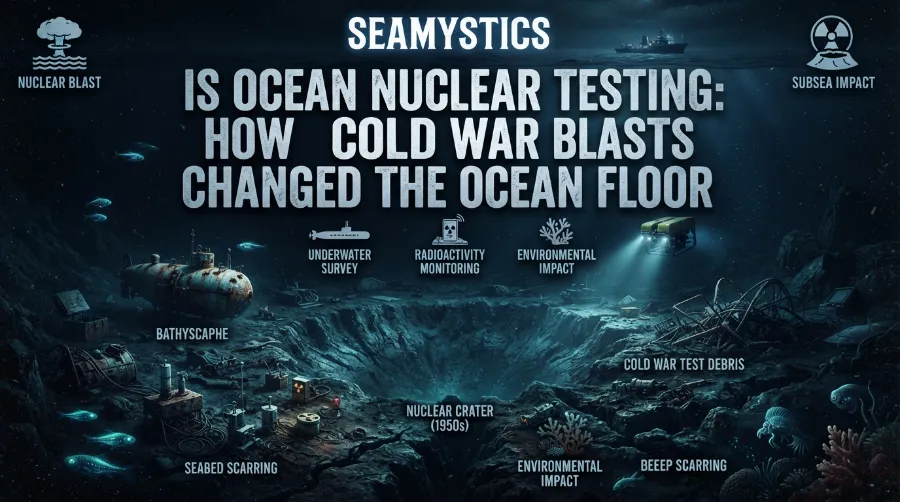
Now let me answer the question many people type into search: what exactly sits on the seabed after a test? The short answer is a mix of heavy metals and fission products. They do not spread evenly. They gather where sediment gathers.
The Isotopes That Matter
Different isotopes act in different ways. Some fade within a human lifetime. Others outlast every civilization we know. This table shows the main ones:
| Isotope | Half-Life | Behavior in the Ocean |
|---|---|---|
| Cesium 137 | About 30 years | Dissolves in water, spreads far, fades fairly fast |
| Strontium 90 | About 29 years | Acts like calcium, can enter bones and shells |
| Americium 241 | About 432 years | Sticks to particles, settles in sediment |
| Plutonium 239 | About 24,100 years | Binds tightly to sediment, stays for millennia |
Here is the same data in a chart. Notice how plutonium dwarfs the rest, which is why the radioactive ocean floor matters more than the water column over the long term.
How Sediment Locks In Plutonium
Plutonium does not like seawater. It clings to tiny particles, sinks, and settles into the mud. Over time, worms, clams, and other burrowing animals stir that mud, a process called bioturbation. This slowly mixes buried material back toward the surface.
In my experience reading core data, this is the most misunderstood part of the story. People assume that buried means gone. In reality, a layer of sediment from 1954 can still show a clear radioactive spike decades later, and animals that dig can lift small amounts of it. The risk is low per animal, but it shows why nobody should call a test site clean just because the water tests well.
Other Sources of a Radioactive Ocean Floor
Weapons tests were not the only source. Governments also dumped waste at sea for decades. The US placed tens of thousands of barrels of radioactive waste near the Farallon Islands off California. The Soviet Union dumped reactors and waste in the Kara Sea. These sites add to the mix scientists track on the seabed.
Underwater tests added more. In May 1955, Operation Wigwam set off a 30 kiloton device about 2,000 feet deep, roughly 500 miles southwest of San Diego. In 1958, tests named Wahoo and Umbrella at Enewetak used shallow water bursts. Each one placed radioactive material directly into the water column and onto the bottom.
The Runit Dome and the Pacific Legacy
On Runit Island in Enewetak Atoll, the US built a concrete cap in the late 1970s over a bomb crater. It holds about 73,000 cubic meters of contaminated soil and debris. The crater has no waterproof liner at the bottom. That means seawater already moves through the soil below the dome.
Researchers from Columbia University measured parts of the Marshall Islands and found some soil readings higher than those near Chernobyl and Fukushima. The dome also faces rising seas, which adds a worry that the old crater could leak more over time. This is one clear case where ocean nuclear testing meets modern climate change.
The Devil’s Sea: Japan’s Own Version of the Bermuda Triangle
Moruroa and Fangataufa
France used a different method in its last years. Teams drilled shafts into the volcanic rock under the atolls and set off bombs underground. Some blasts caused cracks in the rock, and scientists have studied whether radioactive material can escape into the lagoon. The total harm is still debated, and the data on long term leakage remains limited. I treat that gap as a warning sign rather than a green light.
Cold War Ocean Radiation: How Scientists Track It Today
Here is a twist that surprises many readers. The same fallout that harmed the ocean now helps us study it. Atmospheric tests created a sharp jump in carbon 14 and other markers across the world. Researchers call this the bomb pulse.
Because the spike happened at a known time, it works like a date stamp. Marine biologists use it to check the age of fish ear bones, corals, and shells. Oceanographers also follow cesium to learn how water moves from the surface to the deep. If you like stories about how the sea hides and reveals things, check out our pillar guide on ocean floor mapping, which shows how sound and sonar read the same seabed.
How a Team Studies a Contaminated Seabed
Here is the basic process most research teams follow:
- Choose sample sites near the test crater and at control sites far away.
- Pull sediment cores with a tube that keeps the layers in order.
- Slice each core into thin layers, often one centimeter thick.
- Measure plutonium, cesium, and americium in each layer.
- Compare the results with the known test dates to build a timeline.
- Check nearby animals for uptake, such as clams, fish, and crabs.
This method gives a clear picture that no single water sample can match. Water changes daily. Sediment keeps a record.
Sound, Sonar, and the Deep Mysteries
The deep ocean also holds many sounds that people once feared were weapons or tests. The Julia sound mystery and the Upsweep sound mystery both started in the Cold War era, when underwater microphones listened for submarines and blasts. The Slow Down sound and the train sound in Antarctica show how much natural noise the sea makes, from ice to volcanoes. The network that now spots hidden nuclear tests grew from that same listening effort, and groups like the CTBTO still run it today.
Slow Down Sound: NOAA’s Strangest Underwater Audio Recording
Safety Today: What the Data Says
Here is a plain answer for anyone worried about seafood. Open ocean radiation from old tests is very low. The 1963 Partial Test Ban Treaty ended tests in the air, in space, and underwater, so no new fallout from those methods has entered the ocean from major powers since then. Agencies such as the IAEA keep monitoring marine radioactivity worldwide.
Sunken City Ruins: Real Underwater Cities Found Beneath the Sea
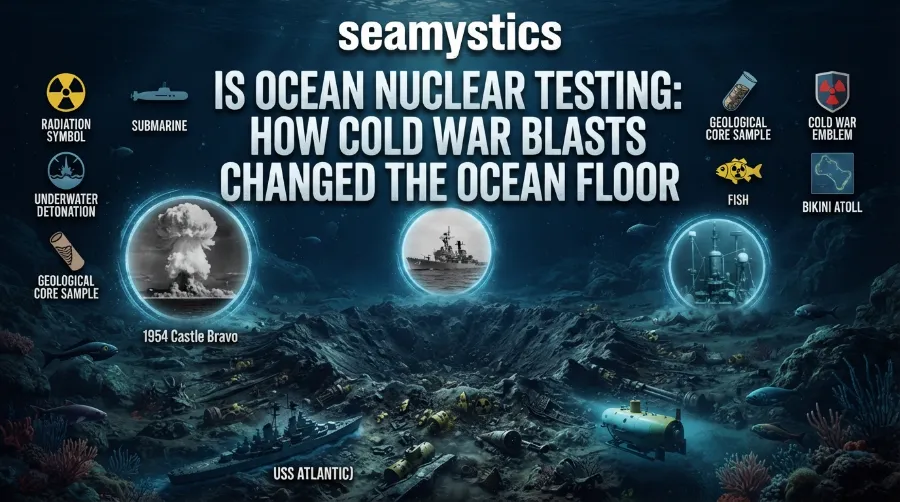
The main risk sits close to old test sites. Sediment near craters, certain island soils, and some local foods still carry higher levels. For travelers and seafood buyers in the US and Europe, the risk from tested waters is tiny because the fish you buy comes from broad, mixed ocean areas.
Quick Answers Many Readers Search For
What is the radioactive ocean floor? It means seabed sediment that holds radioactive metals from nuclear tests or waste dumping, mostly plutonium, americium, and cesium.
Did nuclear testing ocean damage still show up today? Yes. Craters, sediment layers, and a few coral changes remain visible, and plutonium will stay for thousands of years.
Why does Bikini Atoll matter? It hosted 23 of the 67 US tests in the Marshall Islands, including Castle Bravo, and it gives scientists a long record of how the sea heals.
Frequently Asked Questions
Is Bikini Atoll safe to visit?
Short visits for diving are allowed under controlled conditions. Living there full time is not safe because local food takes up cesium from the soil.
Can fish near old test sites be eaten?
Reef fish usually show lower levels than land food, but local health advice should come first. Always follow the rules set by the Marshall Islands government.
Does ocean nuclear testing still happen?
No major power tests in the ocean now. A few countries have tested underground since the 1990s, and North Korea ran tests in the 2000s and 2010s, but those did not happen at sea.
How long will plutonium stay in the ocean floor?
Plutonium 239 has a half-life of about 24,100 years. That means it takes tens of thousands of years to drop to a tiny fraction.
Did the tests change the shape of the seabed?
Yes. Castle Bravo left a crater about 6,500 feet wide, and other blasts reshaped reefs and lagoon floors.
How do scientists tell testing fallout from other radiation?
They look at isotope ratios. Plutonium 239 and 240 appear in a pattern unique to weapons, which acts like a fingerprint.
Conclusion
Ocean nuclear testing changed the sea in ways we still measure today. It dug craters in reefs, sank whole fleets, and pushed radioactive metals into the sediment, where plutonium will linger for millennia. At the same time, the open ocean has diluted most of the damage, and scientists have turned the leftover signal into a tool for studying the deep.
If you remember one thing, make it this: a clear lagoon does not mean a clean seabed. Reliable data, long term monitoring, and honest reporting matter most. To keep exploring the hidden side of the sea, start with our ocean floor mapping guide and follow the sound mysteries linked above.
Quick Quiz: Test What You Learned
1. When did Operation Crossroads happen at Bikini Atoll?
A) 1936
B) 1946
C) 1956
D) 1966
2. Which test produced about 15 megatons and surprised its planners?
A) Able
B) Baker
C) Castle Bravo
D) Wigwam
3. Which isotope has the longest half-life in this article?
A) Cesium 137
B) Strontium 90
C) Americium 241
D) Plutonium 239
4. Which treaty ended nuclear tests underwater, in the air, and in space?
A) The Partial Test Ban Treaty
B) The Kyoto Protocol
C) The Geneva Convention
D) The Antarctic Treaty
5. What is the bomb pulse used for today?
A) Powering ships
B) Dating fish, corals, and ocean water movement
C) Making sonar
D) Cleaning sediment
Answers: 1 B, 2 C, 3 D, 4 A, 5 B
References
- Global Zero, “The World’s Oceans Bear the Legacy of the Nuclear Age”: https://www.globalzero.org/updates/the-worlds-oceans-bear-the-legacy-of-the-nuclear-age/index.html
- Learn About Nukes, “Nuclear Test Sites”: https://learnaboutnukes.com/consequences/nuclear-tests/nuclear-test-sites/
- Smithsonian Ocean, “Nuclear Bombs and Coral Reef”: https://ocean.si.edu/holding-tank/technology/nuclear-bombs-coral-reef
- CTBTO Preparatory Commission: https://www.ctbto.org/
- International Atomic Energy Agency: https://www.iaea.org/