
A whale dies. It sinks for hours, sometimes days, before it touches the seafloor. Then something strange happens. Out of the darkness, thousands of tiny pink worms creep onto the bones and begin to dissolve them from the outside in. This creature has no mouth. It has no stomach. Logically, it should not be able to eat anything at all, yet it is one of the most efficient bone recyclers in the ocean. These are zombie worms, and the zombie worm facts behind their biology are stranger than most fiction.
Key Takeaways
| Fact | Detail |
|---|---|
| Scientific name | Osedax, Latin for “bone devourer” |
| First discovered | 2002, on a gray whale carcass off California |
| Formally described | 2004, by researchers at the Monterey Bay Aquarium Research Institute |
| Depth range | Roughly 1,000 to 3,000 meters, and in shallower waters too |
| Feeding method | Root-like tissue secretes acid to dissolve bone, symbiotic bacteria digest the fat |
| Known species | At least 27 described taxa worldwide |
| Reproduction | Microscopic males live inside the bodies of much larger females |
| Current concern | A 2025 decade-long study off British Columbia found no zombie worms colonizing whale bones, raising questions about low oxygen and climate change |
TL;DR: Zombie worms, or Osedax, eat whale bones without a mouth or gut, using acid and bacteria instead of digestion. They were first found in 2002 and have reshaped how scientists understand whale falls. Recent research suggests warming oceans may already be pushing them out of some habitats.
What Is a Zombie Worm, Really
The name sounds like something from a horror movie, but Osedax worms are a genuine scientific curiosity. They belong to the same broad worm family as tube worms found near hydrothermal vents, yet their lifestyle looks completely different. Instead of chemicals rising from the seafloor, they rely on something rarer: a dead whale.
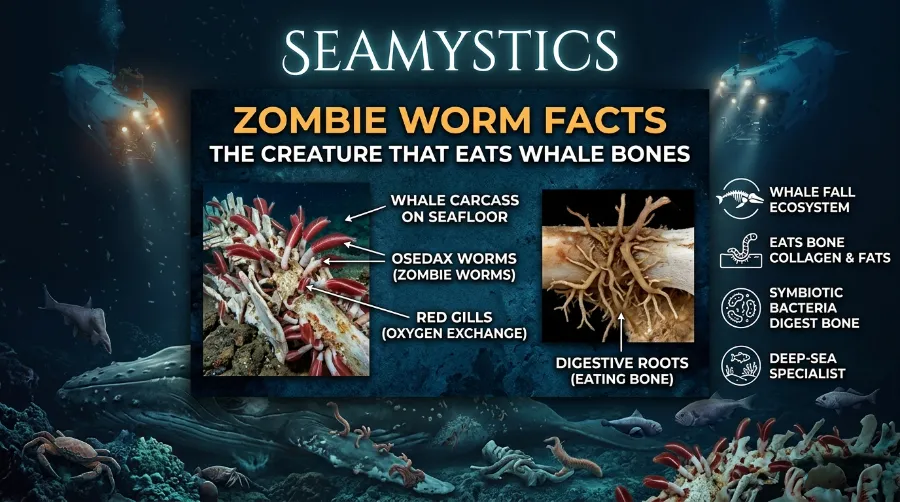
Researchers first noticed these bone eating worm colonies in 2002 while studying a gray whale carcass off California. The worm’s remains were discovered on a decaying gray whale at a depth of over 3,000 meters. Two years later, scientists at the Monterey Bay Aquarium Research Institute formally described the worms and gave them the genus name Osedax, meaning “bone devourer” in Latin. Since then, taxonomists have identified real diversity within the group. At least 27 higher taxonomic units of Osedax have been described across the world’s oceans, which tells you this is not a rare oddity confined to one patch of seafloor. It is a global phenomenon.
Giant Isopod Facts: The Deep-Sea Relative of the Pill Bug
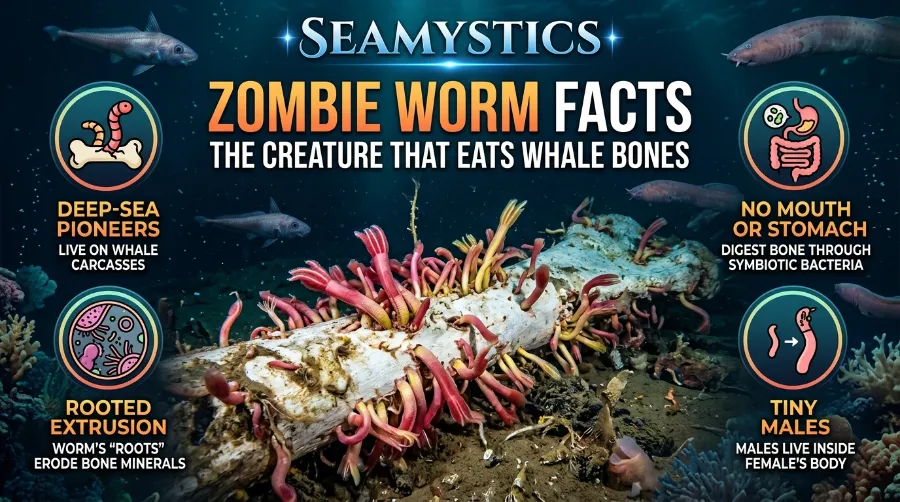
Physically, the worms are small, usually one to three inches long, and look more like feathery pink flowers than a typical worm. Bright red plumes extend from their tubes to work as gills. Pale, root-like structures burrow down into the bone itself. Eyes, legs, and a mouth are all absent, and so is any kind of digestive tract.
Sea Pig Facts: The Deep-Sea Cucumber That Looks Like a Toy
How Osedax Worm Facts Break the Rules of Digestion
Most animals eat by taking food into a mouth and processing it through a gut. Osedax skips both steps entirely. Its root system secretes acid directly onto the bone, slowly dissolving the mineral shell to expose the fat and collagen stored inside. The green roots that grow from the worm’s base release this acid straight into the bone. From there, the worm does not digest anything itself.
Fangtooth Fish Facts: The Small Fish With the Biggest Teeth
Instead, symbiotic bacteria living inside its root tissue take over. These bacteria break down the fats and proteins released from the bone, and the worm absorbs the nutrients through its tissue. Scientists are still not entirely sure how the nutrients pass from bacteria to worm. It might involve direct digestion of the bacteria, or some transfer method nobody has observed yet. Either way, it works well enough that a single skeleton can feed generations of these creatures for years.
This feeding strategy, borrowing an entire digestive process from bacteria, is not something most biology courses ever cover. It is one of the clearest examples in the ocean of evolution finding a shortcut nobody predicted.
Whale Fall: The Stage Where Zombie Worm Whale Fall Colonies Appear
None of this happens without a whale fall, the scientific term for a dead whale settling on the ocean floor. Whale falls unfold in fairly predictable stages, and Osedax only shows up once earlier scavengers have done their part.
- Mobile scavengers such as sharks, hagfish, and crustaceans strip away the soft tissue within the first months.
- Smaller invertebrates and bristle worms clean up whatever flesh remains attached to the skeleton.
- Sulfur-loving bacteria begin breaking down fats trapped in the bone, changing the local seafloor chemistry.
- Osedax worms move onto the exposed bones and slowly dissolve them from the outside.
A single whale carcass can sustain this kind of community for decades. Cold, high-pressure conditions in the deep sea slow decomposition far more than they would near the surface. Marine biologists sometimes describe whale falls as islands, since they appear unpredictably and support a miniature ecosystem before eventually disappearing. If this kind of deep sea strangeness interests you, it sits alongside other unlikely survivors covered in our bizarre sea creatures guide, worth a look if Osedax is your first stop into deep sea curiosity.
Real Numbers From a Real Whale Fall
One well-documented case comes from off the coast of Rio de Janeiro. Researchers used the submersible HOV Shinkai 6500 to study a whale skeleton resting more than four kilometers below the surface. Marine biologist Joan Alfaro-Lucas and a team from the University of São Paulo noticed something unexpected while comparing nine whale vertebrae from the site. Four of the bones were riddled with holes from Osedax, while the other five showed bacterial decomposition instead, and the two groups never appeared together on the same bone. That natural split gave scientists a rare, almost controlled comparison of how differently a whale fall community develops depending on which decomposer arrives first.
Zombie Worm Whale Fall Reproduction Is Its Own Kind of Bizarre
Bone-eating biology alone would make Osedax memorable, but its reproduction pushes things further. Only the females grow to a visible size and burrow into bone. Males never develop past a microscopic, larval stage. Rather than living independently, each one takes up permanent residence inside a female’s body.
A single female can carry dozens, sometimes hundreds, of these tiny males inside her tube at once. This setup guarantees she always has access to sperm, which matters in an environment where finding a mate across miles of dark seafloor would otherwise be close to impossible. Adult worms cannot travel, so it falls to the larvae to disperse. Ocean currents can carry them hundreds of kilometers to reach a new whale fall, a journey that depends entirely on luck and timing, since most larvae never land anywhere near a suitable carcass.
Whale Bone Eating Creature Roots Run Deeper Than Whales Alone
Despite the name, Osedax is not limited strictly to whales. Under experimental conditions, researchers have shown it will colonize cow bones just as readily. In natural settings, it has also turned up on skeletons of fish, sharks, and pinnipeds, wherever enough fat remains in the bone. This flexibility suggests the worm’s ancestors were feeding on marine reptile carcasses long before whales existed.
A History Stretching Back to the Dinosaurs
Genetic evidence points to Osedax appearing around 100 million years ago, well within the age of dinosaurs. It likely survived on plesiosaurs and mosasaurs before those animals went extinct roughly 65 million years ago. That timeline has a strange side effect for paleontology. Because the worms bore into bone so efficiently, they may have destroyed part of the marine reptile fossil record before it ever formed, a pattern researchers now call the Osedax effect.
Fossil evidence backs up that long history. A team led by marine biologist Nicolas Higgs at the Natural History Museum and the University of Leeds studied borings preserved in a three-million-year-old whale bone fossil recovered from the Mediterranean in Italy. Using a micro CT scanner, they compared the tunnel shapes to those made by living Osedax worms and confirmed a match. That single fossil proved the worms have carried out this exact behavior for millions of years.
Why Losing These Bone Eating Worm Colonies Would Matter
It would be easy to file Osedax under obscure trivia and move on, but its ecological role is bigger than its size suggests. Biologists call it an ecosystem engineer, meaning its activity physically reshapes the environment for other species. Tunneling through bone increases the surface area and structural complexity of a skeleton, which opens up microhabitats for other invertebrates and microbes. Without that process, whale falls support noticeably less biodiversity overall.
A Troubling Discovery From 2025
This is exactly why a 2025 finding has quietly worried researchers who track deep sea health. Fabio De Leo of Ocean Networks Canada led a decade-long experiment that placed humpback whale bones on the seafloor in Barkley Canyon, off British Columbia. High-resolution underwater cameras monitored the site continuously. Over ten full years, not a single Osedax worm appeared on the bones. In science, a negative result this consistent is unusual enough to be genuinely alarming, and researchers link the absence to expanding low-oxygen zones tied to ocean warming.
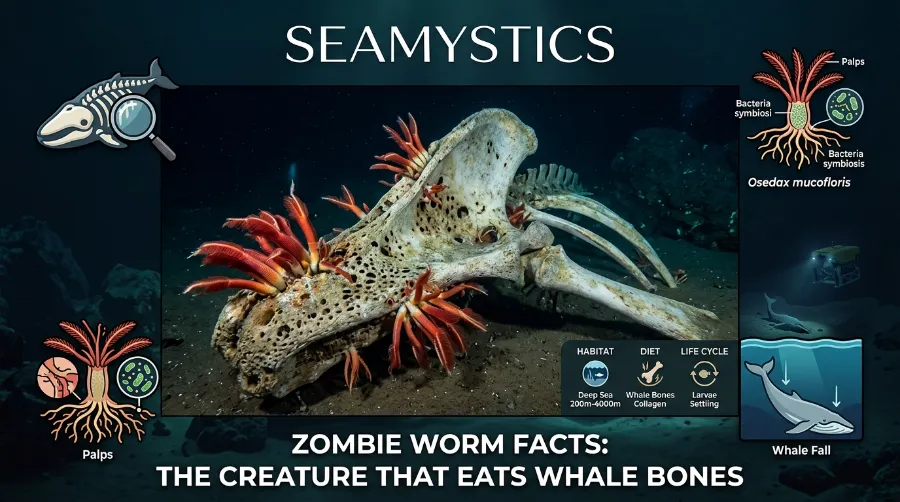
De Leo described the wider risk plainly. Whale falls behave like stepping-stone islands, and if larvae cannot survive long enough to reach them, entire regional populations of Osedax could quietly disappear. That kind of disconnect between habitats does not just affect one species. It threatens the whole successional chain of life that depends on whale falls existing on a predictable cycle. The Smithsonian documents these worms in the wild through its zombie worms crave bone collection, and the original habitat-engineering research appears in Hakai Magazine’s coverage of Osedax as beavers of the deep. More recent reporting on the decline is covered in depth by SciTechDaily’s piece on missing zombie worms.
Zombie Worm Facts Compared to Other Deep Sea Oddities
Osedax is far from the only creature that makes the deep ocean feel like a different planet. A handful of other residents are worth exploring for similar reasons.
- The frilled shark looks almost prehistoric and has barely changed in millions of years.
- The dumbo octopus flaps ear-like fins to glide through total darkness.
- The pink see-through fantasia is a sea cucumber with an almost transparent, glowing body.
- The barreleye fish has a transparent head and eyes that rotate upward.
- The fangtooth fish carries the largest teeth relative to body size of any fish in the ocean.
- The pink deep-sea cucumber drifts across the seafloor using leg-like projections instead of swimming.
Each species solved a different survival problem, the same way Osedax did, by adapting to conditions that would be lethal near the surface.
Frequently Asked Questions About Zombie Worm Facts
What do zombie worms actually eat?
They feed on the fat and collagen stored inside whale bones, using acid secretions and symbiotic bacteria instead of a traditional digestive system.
Do zombie worms have a mouth?
No. Osedax has no mouth, no stomach, and no anus, which makes its feeding process one of the most unusual in the animal kingdom.
When were zombie worms discovered?
They were first observed in 2002 on a gray whale carcass off California and formally described in 2004 by researchers at MBARI.
How deep in the ocean do zombie worms live?
Most populations live between roughly 1,000 and 3,000 meters, though some species turn up in shallower coastal waters too.
Are zombie worms dangerous to humans?
Not at all. They pose no threat to people and are too small and specialized to interact with anything outside a whale fall.
Why are scientists worried about zombie worms now?
A long-term study off British Columbia found no zombie worm colonization on test whale bones over ten years, a pattern researchers connect to expanding low-oxygen zones from ocean warming.
Conclusion
Zombie worms prove that the ocean floor still holds biology nobody expected. A creature with no mouth, no stomach, and a reproductive system built around microscopic mates found a way to eat bone using acid and borrowed bacteria instead of digestion. For millions of years, that strategy quietly shaped how marine skeletons disappear and how new life rebuilds around them. The fact that some populations now seem to be vanishing from parts of the Pacific is worth paying attention to, not because Osedax is glamorous, but because its disappearance would ripple through a deep sea food web that depends on it more than most people realize.
References
- Smithsonian Ocean Portal, Zombie Worms Crave Bone
- Hakai Magazine, Tiny Zombie Worms Are the Beavers of the Deep
- SciTechDaily, Zombie Worms Are Missing and It’s Worrying Scientists
- ScienceDaily, Zombie Worms Have Gone Missing, University of Victoria research release, 2025
- Oceanbites, The Backbone of an Ecosystem: Bone-Eating Zombie Worms Control Biodiversity at Deep-Sea Whale Falls